
Best Electric Scooter for Commuting: Top Picks for 2026
Flex Electric
The UK's #1 Electric Moped and Electric Motorbike dealer.

If you’re looking for the best electric scooter for commuting, you’re probably thinking about more than just a small, kick-style e-scooter. For a proper daily commute in the UK, the real game-changers are road-legal electric mopeds and motorcycles. They hit that sweet spot of low running costs, decent speed, and a practical range for city travel.
Your Guide To The Best Electric Scooter For Commuting
This guide is designed to help you find the right electric commuter for your specific needs. Let’s be clear from the start: we’re not talking about the small, privately-owned e-scooters, which remain illegal to use on UK public roads. We're focused on fully road-legal electric mopeds and motorcycles—the kind that are genuinely transforming how people get around. These are serious transport solutions built to cut your fuel bills, produce zero emissions, and slice through city traffic.
Here at Flex Electric, this is what we do day in, day out. From our Edinburgh showroom, we’ve helped hundreds of riders make the switch to a smarter commute. Our range includes electric motorcycles, mopeds, off-road electric motorcycles, and kids' motocross bikes. This guide is built on all that hands-on experience, breaking down the key things you need to weigh up before you buy.
Key Factors This Guide Will Cover
We'll cut through the marketing noise and get straight to what actually matters for your daily A-to-B. We've structured this guide to help you make a solid decision, whether you’re navigating the city, working as a delivery rider, or buying your very first bike.
Here’s a quick look at what we’ll cover:
- Real-World Range vs. Advertised Range: We’ll show you how to figure out the battery capacity you’ll actually need, not just the number on the box.
- Licence Categories and Speed: We'll demystify the difference between 50cc and 125cc equivalents so you can match a bike to your existing licence.
- Total Cost of Ownership: Look past the initial price tag. We’ll explore the real savings on charging, tax, and maintenance.
- Practical Use Cases: Find recommendations specifically for city commuting, food delivery, and riders just starting out.
Finding the right electric moped isn't just about getting the highest top speed. It’s about matching the battery, power, and legal requirements to your daily route for a ride that’s seamless and stress-free, every single time.
Comparing Commuter Types At A Glance
To kick things off, it helps to see how the main categories stack up. The best electric vehicle for your commute really comes down to what your journey looks like.

Right, let's get down to what really matters. Before you even start looking at shiny new electric mopeds, the most important thing is to figure out what you actually need. It's easy to get sidetracked by top speeds and fancy features, but if the bike doesn't fit your daily grind, it's the wrong bike.
Think of it as building a profile of your perfect ride. By asking a few straightforward questions about your journey, you can avoid two common pitfalls: either paying for performance you'll never use or, far worse, ending up with a moped that can't even get you to work and back reliably. Let's break down the essentials.
Real-World Range and Your Daily Route
The first question we always get is, "How far will it actually go on a full charge?" While every manufacturer gives a maximum range, you have to take that number with a pinch of salt. It’s usually based on a lightweight rider on a perfectly flat road with no wind on a warm day. In other words, not your typical British commute.
Here’s how to work out the range you genuinely need:
- Map Your Round Trip: Use something like Google Maps to get the exact mileage for your daily journey, both there and back.
- Add a Realistic Buffer: Always add a 20-30% buffer to that number. This isn't just for detours or a quick trip to the shops; it also accounts for the fact that all batteries lose a bit of capacity over the years.
- Think About Hills: Is your route hilly? Climbing eats up battery power much faster than riding on the flat. If you're facing steep inclines, you need to factor that into your range calculation.
- Consider Your Load: Your weight, and the weight of anything you're carrying, affects the range. A delivery rider with a full thermal bag will get fewer miles out of a charge than a solo commuter.
A common mistake is seeing a 12-mile range advertised and thinking it's perfect for your 10-mile round trip. In reality, you should be looking for a model with at least a 15-mile real-world range to ride confidently without constantly worrying about your battery level.
Speed and Licence Categories
The speed you need is directly tied to the licence you have. In the UK, electric mopeds and motorcycles fit into the same categories as petrol bikes, and knowing the difference is key to staying on the right side of the law.
- 50cc Equivalent (AM Licence): Topping out at 28 mph, these are built for the city. They’re brilliant for slicing through traffic and are all you need for most urban journeys. You can ride one on a car licence if it was issued before 1st February 2001, or by getting your Compulsory Basic Training (CBT).
- 125cc Equivalent (A1 Licence/CBT): If your commute includes dual carriageways or roads where traffic moves faster than 30 mph, this is where you should be looking. With speeds hitting 45-75 mph, they have the power to keep up. A CBT is the minimum you’ll need to ride one.
Getting this right isn't just about compliance; it's about making sure your bike is capable and safe for the roads you'll be using every day.
Portability, Storage, and Charging
Another huge consideration is a practical one: where are you going to park and charge it? This simple question can immediately narrow your search.
If you live in a flat or a terraced house with no off-street parking, a model with a removable battery is a lifesaver. You can just carry the battery indoors and plug it into a standard socket, just like your phone. For city living, this kind of flexibility is a massive advantage.
On the other hand, if you have a garage, a drive, or a secure spot with a power outlet, a bike with a fixed (integrated) battery works perfectly well. These often pack a larger capacity and can be plugged in directly, much like an electric car.
Durability for UK Weather
Let's face it, your commuter bike is going to see some rain. It needs to be built to withstand the notoriously unpredictable British weather. A key spec to look for here is the IP (Ingress Protection) rating. A rating of IP65 or higher shows the bike has been properly sealed against dust and water jets, giving you the peace of mind to ride all year round.
This shift towards practical, weather-proof electric vehicles is happening all over. In London's e-scooter rental trial, for instance, trips jumped by a massive 54% in just one year. It’s clear proof that people are embracing electric two-wheelers for daily travel. The success of the trial, overseen by Transport for London (TfL), shows that when the vehicles are right for the job, electric commuting is both simple and incredibly effective. You can see how these trends are taking shape by reviewing the complete data on London's successful trial.
Comparing Top Electric Moped and Motorcycle Categories
So, you’re ready to switch to an electric moped or motorcycle. Good choice. But with all the different types out there, figuring out which one is right for your commute can feel a bit overwhelming. Getting this first step right is crucial; it’s the difference between buying a machine that fits your life perfectly and one that just doesn’t quite cut it.
The whole game is about matching the bike’s performance—its real-world range, top speed, and the licence you need to ride it—with the journey you actually make every day.
This chart quickly lays out the main things you need to think about.
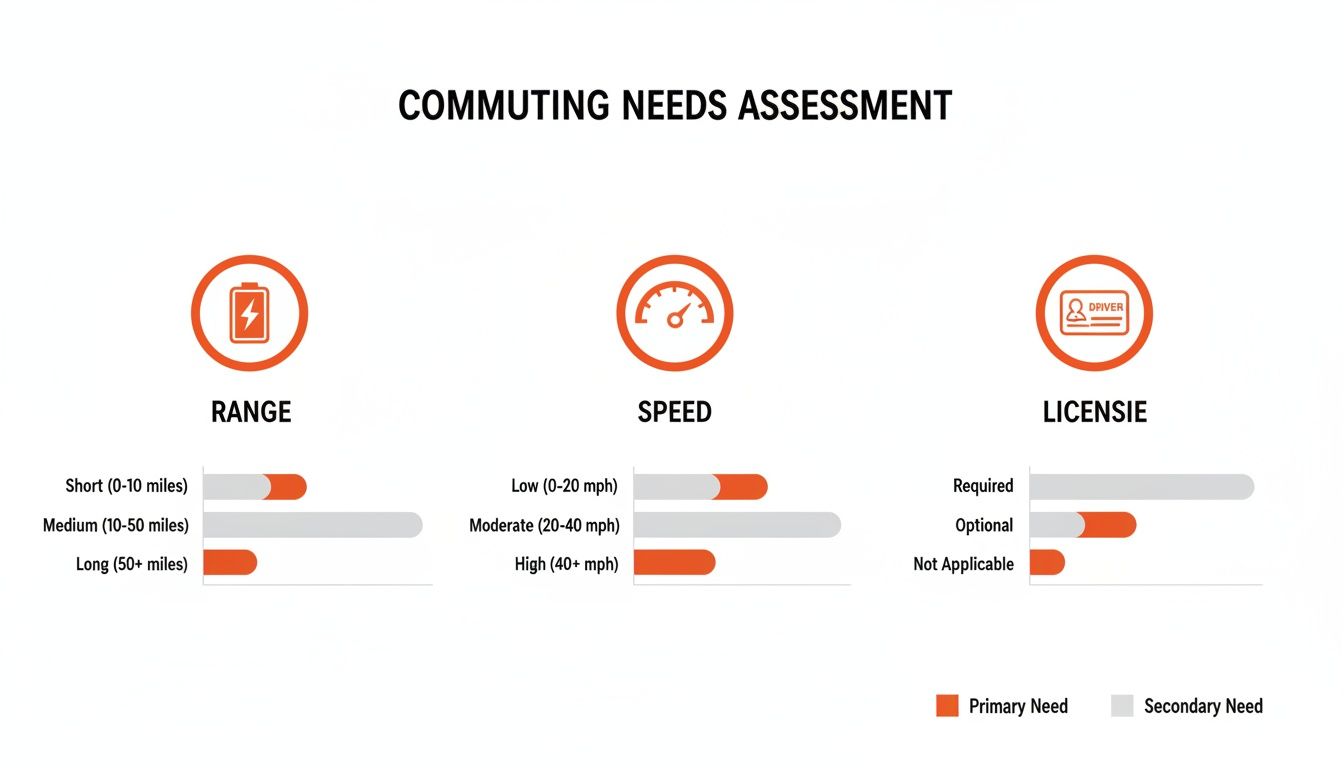
As you can see, it’s all a balancing act. If you’ve got a long slog on your hands, you’ll want more range and speed, which naturally points you towards a specific licence category. Let's break down what that means in practice.
50cc Equivalent Mopeds: The City Specialists
If your commute is purely urban, a 50cc equivalent electric moped is almost always the smartest tool for the job. These bikes are born and bred for slicing through traffic jams, offering fantastic agility for shorter, stop-start journeys.
Their speed is limited to 28 mph, which is plenty for city streets and means you can ride one with a CBT, an AM licence, or even a full car licence if you got it before 1st February 2001.
A brilliant example is the NIU UQiGT. It’s light, a doddle to handle, and its battery pops out. This is a game-changer if you live in a flat or don't have an outdoor plug; just carry the battery inside and charge it like your phone. This category is all about cheap, no-fuss city travel.
For a five-mile commute through central Manchester or Glasgow, a 50cc equivalent is ideal. You get the benefit of filtering through traffic legally, zero road tax, and running costs that amount to just pennies per mile, without paying for performance you don't need.
125cc Equivalent Scooters: The All-Round Commuters
Does your daily route include faster A-roads or a stretch of dual carriageway? Or maybe it's just a bit longer than a quick hop across town? If so, the 125cc equivalent electric scooter category is where you should be looking. This is the sweet spot for many UK commuters.
These models are a big step up in performance, delivering speeds from 45 mph to over 60 mph. That extra poke means you can confidently keep up with traffic flow outside of town, making them fantastic all-rounders. You’ll need to have completed your Compulsory Basic Training (CBT) to ride one.
The Horwin SK3 is a great representative of this class. It gives you that zippy acceleration off the lights, a sturdier frame for better stability at speed, and a real-world range that handles suburban commutes without breaking a sweat. These are the true workhorses of the electric commuting world.
High-Performance Electric Motorcycles: The Ultimate Experience
For the seasoned rider after maximum power, range, and the latest tech, high-performance electric motorcycles are the top of the food chain. Let’s be clear: these aren’t just for commuting. They're built for the sheer thrill of the ride, with motorway-ready speeds and acceleration that often leaves petrol bikes for dust.
A machine like the Vmoto Stash shows what's possible. With a top speed touching 75 mph and looks that get you noticed, it’s aimed squarely at riders with a full motorcycle licence (A1, A2, or A) who don’t want to compromise. They pack advanced engineering, large integrated batteries for serious range, and refined rider tech. They're a bigger investment, for sure, but they deliver an incredible riding experience and a taste of motorcycling's future.
Electric Commuter Bike Comparison 50cc vs 125cc vs High-Performance
To make the choice crystal clear, we've put together a simple table comparing a representative model from each category. This focuses on the specs that really matter to a UK commuter day-in, day-out.
As you can see, the right choice really hinges on your personal needs. For city-only travel, the 50cc is tough to beat for cost and convenience. For mixed routes, the 125cc offers the perfect blend of power and practicality, while the high-performance models are for those who need to cover serious distance or simply want the best performance available.
Matching the Right Electric Vehicle to Your Use Case

A spec sheet only tells you half the story. When you’re choosing an electric vehicle, the single most important question is: what will you actually be doing with it every day?
The perfect ride for a student zipping to lectures is completely wrong for a professional delivery rider trying to maximise their income. Likewise, what a business needs for a fleet of delivery vehicles is worlds away from what a first-time rider needs to build their confidence.
Let's break down the most common scenarios we see. By pinpointing your primary use case, you can cut through the noise and find a vehicle that genuinely solves your transport headaches, rather than creating new ones.
For The Urban City Commuter
If you’re wrestling with a daily commute through a city like London, Manchester, or Edinburgh, your priorities are simple: agility, low running costs, and sheer convenience. You need something that can slice through traffic jams, park almost anywhere, and be easy to charge—especially if you live in a flat.
This is where the lightweight 50cc and 125cc equivalent models really come into their own. They are nimble enough for constant stop-start riding, and crucially, many have removable batteries. This is a game-changer for city dwellers. You just carry the battery indoors and plug it into any standard socket. No garage or driveway needed.
- What to look for: A light frame for easy handling, a removable battery for hassle-free charging, and a top speed that’s practical for city limits (28 mph is usually more than enough).
- Model Profile: A 50cc equivalent like the NIU UQiGT is brilliant for short hops across town. For longer commutes that might involve some faster roads, a 125cc model like the Horwin SK3 gives you that extra bit of power.
For the typical city commuter, it all comes down to efficiency. A removable battery takes all the stress out of finding on-street charging. It makes your daily travel simple and predictable, with running costs that amount to just pennies per mile.
For The Food Delivery Rider
For anyone working with platforms like Uber Eats or Deliveroo, an electric moped isn’t just a vehicle; it’s a tool for making a living. Here, the focus shifts entirely to durability, maximum possible range, and the absolute lowest running costs to protect your profit margin. Every minute your bike is off the road, you’re losing money.
Reliability is non-negotiable. These mopeds have to endure long hours and high mileage in all weathers, day in and day out. Models that offer dual batteries are particularly sought after because they double the range, letting riders work a full shift without having to stop and recharge.
The other huge win is low maintenance. With no oil to change, no spark plugs to replace, and no complex engines to service, electric mopeds keep downtime and running costs to an absolute minimum compared to their petrol counterparts.
- What to look for: A rock-solid build quality, the option for dual batteries for all-day range, and a reputation for ultra-low maintenance.
- Model Profile: You need a workhorse. Certain models have proven themselves in the delivery industry and are built specifically to withstand the rigours of constant, heavy use.
For Business and Fleet Owners
Switching a commercial fleet to electric—whether for last-mile logistics, property services, or council work—is one of the smartest decisions a business can make. It’s a clear statement about sustainability, but more importantly, it delivers significant savings on fuel and maintenance.
For a fleet, the core considerations are reliability, a low total cost of ownership, and simplicity. The vehicles have to be tough enough to uphold your brand's reputation and straightforward enough for any member of staff to use safely.
We work with businesses to identify models that provide a fast return on investment. This means focusing on bikes with durable parts, long service intervals, and even options for integrated tracking or telematics for better fleet management. You’d be surprised how smooth and cost-effective the switch can be.
For The First-Time Rider
Getting on the road for the first time is exciting, but it can also feel a bit intimidating. The ideal first bike should be manageable, cheap to run, and have enough power to be useful without feeling overwhelming. This is exactly why CBT-compliant electric mopeds and motorcycles are such a brilliant starting point.
Both 50cc and 125cc equivalent models are perfect. The automatic "twist-and-go" throttle means there are no gears or a clutch to master. This allows new riders to put all their focus on reading the road, understanding traffic, and building up their confidence.
The smooth, predictable power from an electric motor is far less jerky and much more forgiving than a petrol engine, which makes for a gentler learning curve. Starting with an electric moped or motorcycle is an incredibly accessible and affordable way to get your licence and gain real-world road skills.
How to Pay for Your Electric Moped without the Headache
So you've found the perfect electric moped, but now you're thinking about the cost. We get it. That’s why we’ve made the financial side of things as straightforward and accessible as the bikes themselves. Our focus is on getting you on the road, not giving you a financial headache.
The key for many of our riders is our Hire Purchase and PCP Finance options. It’s a simple, transparent way to own your ideal electric moped or motorcycle without a massive upfront payment. There is no minimum deposit, and you can spread the remaining cost over manageable monthly payments. It’s how a top-spec model suddenly feels surprisingly affordable.
A Warranty That Has Your Back
We stand behind every bike that leaves our showroom, from the zippy 50cc equivalents to our high-performance electric motorcycles. That’s why each one comes with a serious warranty package as standard.
You’re covered by a 2-year parts warranty and an impressive 3-year battery warranty. This isn't just a piece of paper; it's our promise that your commuter will be a reliable, cost-effective partner for years to come.
A vehicle’s battery is its heart. Offering a 3-year warranty is our commitment to your bike's long-term performance. It protects you from unexpected costs and gives you real confidence in your investment.
UK-Wide Delivery and All the Gear You Need
Don't let our Edinburgh location put you off. We deliver our bikes right across the UK, so whether you’re in London, Manchester, or a village in between, we’ll bring your new ride directly to your door.
We also know you want to be ready to ride from day one. That’s why we stock all the essential accessories, so you can get everything you need in one go.
- Helmets: The most important piece of safety gear you'll own.
- High-Security Locks: Crucial for protecting your vehicle from theft, especially in cities.
- Top Boxes: Add secure, practical storage for your work bag, shopping, or deliveries.
- Phone Mounts: A must-have for safe, hands-free navigation.
You can bundle your bike, finance, and all your gear into one simple package. We’ll sort out the details so you can just get on with enjoying the ride.
Your Questions About Electric Commuting Answered
Thinking about making the switch to electric? It's a big decision, and naturally, a few key questions always pop up. We get asked these all the time, so we’ve put together some straight answers to help you choose with confidence.
What Licence Do I Need to Ride an Electric Moped in the UK?
This is probably the most common question we hear, and the answer all comes down to the bike's power.
- For 50cc equivalents (up to 28 mph): If you got your full car licence before 1 February 2001, you're good to go. If not, you'll just need to complete your Compulsory Basic Training (CBT), which is valid for two years.
- For 125cc equivalents (over 28 mph): A CBT is the minimum here. It gets you on the road with L-plates, but you won't be able to carry passengers or use motorways just yet.
How Much Does It Really Cost to Run an Electric Commuter?
This is where electric really shines. A full charge from your home socket will set you back about 50p and deliver a solid 30-50 miles of range. When you compare that to the ever-climbing price of petrol, the savings start to add up very quickly.
It gets even better. Electric vehicles pay £0 road tax, and maintenance is minimal—no oil changes, spark plugs, or filters to worry about. The total cost of ownership is a fraction of a petrol bike's.
Can I Ride an Electric Motorcycle in the Rain?
Absolutely. We wouldn't be selling them in the UK if you couldn't! Our bikes are built to handle British weather.
The key is their IP (Ingress Protection) rating, which tells you how well-sealed they are against water. Most of our models are rated IP65 or higher, meaning they’re properly protected from the rain, so you can rely on your bike all year round.
How Long Does an Electric Scooter Battery Last?
A modern lithium-ion battery is a seriously robust piece of kit, designed for thousands of charge cycles and many years of service. While any battery will lose a tiny bit of capacity over its lifetime, you can expect it to perform reliably for years to come.
To make sure you're completely covered, every new bike we sell includes our industry-leading 3-year battery warranty. It's our way of protecting your investment for the long haul.
Ready to find the perfect electric commuter for your journey? Explore the full range of electric motorcycles and mopeds at Flex Electric and see how our 0% APR finance can get you on the road today. Visit us at https://www.flexelectric.co.uk to learn more.
Find us
You will find us at 74 Dalry Road, Edinburgh, EH11 2AY
Showroom Opening Times:
Monday: By Appointment
Tuesday to Friday: 11am - 5:00pm
Saturday: 10am - 5pm
Sunday: By Appointment
