
Your Ultimate Charger for Electric Motorcycles Guide

Flex Electric
The UK's #1 Electric Moped and Electric Motorbike dealer.

Finding the right charger for your e-scooter—or in our world, electric motorcycle—is about so much more than just finding a plug that fits. It's the key to protecting your investment, keeping your bike performing at its peak, and making sure it's always ready to go when you are. In fact, using the correct charger is the single most important thing you can do for your battery’s health and your own safety.
Choosing the Right Charger for Your Electric Motorcycle
Think of a charger not as an accessory, but as a vital part of your electric motorcycle, moped, or kids' motocross bike's power system. Getting this wrong can lead to painfully slow charging, a much shorter battery lifespan, or worse, catastrophic damage and a serious fire risk. We've written this guide to cut through the technical jargon and give you practical, straightforward advice you can actually use.
Whether you're a daily commuter on a Super Soco, a weekend trail rider on an off-road beast, or a business owner managing an electric delivery fleet, understanding your charger is crucial. Our goal is to give you the real-world insights we've gained over the years to keep your vehicle running at its best.
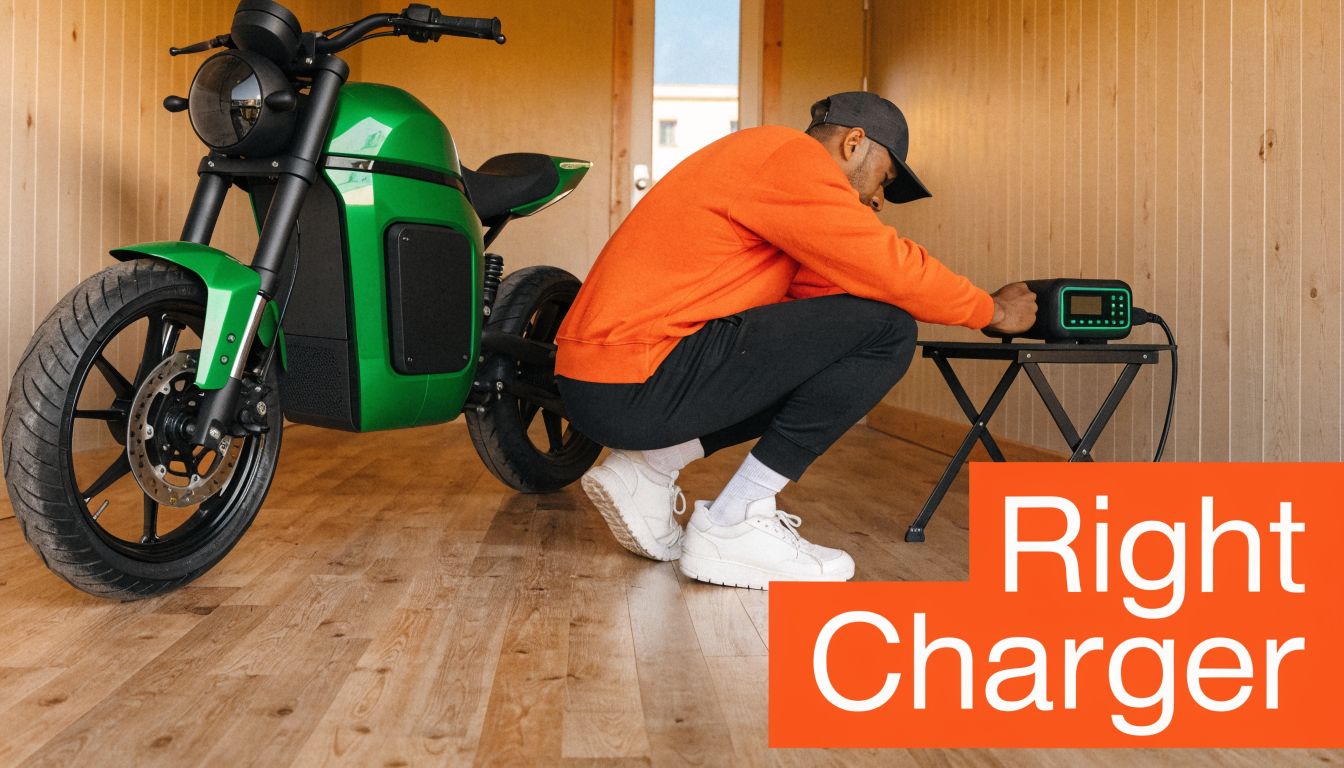
Why the Right Charger Matters
Using a charger that isn’t specifically designed for your bike’s battery is simply not an option. An incompatible charger can push the wrong voltage or current into your battery, which can trigger "thermal runaway"—a terrifying chain reaction where the battery uncontrollably overheats.
We'll walk you through the most important things to get right:
- Matching Specifications: How to pair charger voltage (V) and amperage (A) with your battery's specific needs.
- Connector Types: A simple guide to identifying the correct plug for a safe and solid connection.
- Charging Habits: Best practices for charging that will genuinely extend your battery life and keep you safe.
The temptation to buy a cheap, third-party charger is real, but the consequences can be severe. It might feel like you're saving a few quid, but you're gambling with a battery that can cost hundreds, if not thousands, of pounds to replace.
Navigating Your Options
This guide is focused purely on chargers for electric motorcycles, mopeds, and off-road bikes—it’s our area of expertise, after all. We won't be covering electric bicycles here. Our advice is grounded in our hands-on experience with leading brands like Horwin, Vmoto, and Segway, giving you knowledge you can put into action immediately.
There are other great resources out there for different types of personal transport. For instance, if you need to find the right Segway charger for a smaller personal transporter, other expert guides can help. Our focus remains firmly on keeping your electric motorbike in prime condition.
Matching Charger Specs to Your Battery
Before you even look at buying a new charger for your electric motorcycle or moped, you need to get intimately familiar with your battery. I've seen it happen too many times: a rider grabs the wrong charger, and what seems like a simple mistake ends up being a costly, and frankly, dangerous one.
Your first step is to play detective. Get your hands on the battery pack and look for the information label. This sticker is the single source of truth, and it tells you everything you need to know. You're looking for two key figures: the Voltage, marked as V, and the Amp-hours, shown as Ah. Think of voltage as the 'pressure' of the electricity and amp-hours as the 'size' of your fuel tank.
Getting the Voltage Right Is Non-Negotiable
Every charger has an output voltage (V) and an amperage (A). Here’s the golden rule, and it’s not flexible: the charger's voltage must be an exact match for your battery's voltage. No ifs, ands, or buts.
For instance, the popular Horwin EK1 runs on a 72V battery, so it absolutely requires a 72V charger.
Let me paint a picture of what can go wrong. Say you try to use that 72V charger on an older 60V battery from a Super Soco. The charger's higher voltage will force way too much power into the battery cells. They’ll heat up incredibly fast, leading to permanent damage, a drastically shorter lifespan, or worse—thermal runaway. That’s a nasty chemical chain reaction that can, and does, cause fires.
Why the Charger’s Amperage Matters
Next up is amperage (A), which dictates how quickly your battery charges. A higher amperage means a faster charge, but this isn't a case of 'more is always better'. You can't just grab the charger with the highest 'A' rating and hope for the best. Your bike's Battery Management System (BMS) is designed to handle a specific range of charging current.
Sticking with the correct, manufacturer-approved charger isn't just about following rules. It’s a smart financial move that protects the most expensive component on your bike: the battery.
As a rule of thumb, a safe charging rate (known as the 'C-rate') is somewhere between 0.1C and 0.2C. To figure this out, you just do a bit of simple maths with your battery's Amp-hour (Ah) rating. If you have a 30Ah battery, a 0.1C rate is 3A (30 * 0.1), and a 0.2C rate is 6A (30 * 0.2). This tells you that a charger with an output anywhere between 3A and 6A is the sweet spot.
This isn't just workshop talk, either. A recent study in 2026 by the UK Energy Saving Trust found that simply using the correct charger can extend an electric motorcycle battery's lifespan by a massive 25-30%. For the average rider, that translates to saving an estimated £150-£200 a year on what would have been a premature battery replacement. You can dig into the specifics by reading the official government publication on battery safety.
Alright, you’ve nailed down the voltage and amperage your e-moped needs. But hold on a second before you add that new charger to your basket—we’re not quite done. The physical plug on the end of the cable is just as critical as the power it’s carrying.
Getting the connector wrong is a classic mistake. At best, it simply won’t fit. At worst, you get a wobbly, loose connection. That’s where things get dangerous. A poor fit can cause electrical arcing, creating intense heat that can easily melt the plastic housing on both the plug and your bike’s expensive charging port.
Think of it this way: you wouldn't try to force a European plug into a UK socket. It’s a recipe for disaster. The same logic applies here. The right fit is non-negotiable for a safe, efficient charge.

Just as this graphic shows the danger of mismatched voltage, a mismatched plug carries its own serious risks to your vehicle and your safety.
Getting to Grips With Common Connector Types
Thankfully, you don't need to be an electrical engineer to figure this out. In the world of electric mopeds and motorcycles, you'll generally come across a handful of standard plugs. A quick visual check is all it takes to identify what you’re working with.
Most of the popular models you see on UK roads from brands like Super Soco or Vmoto will use one of a few common types. Knowing what to look for will save you the headache of receiving a charger that’s completely useless to you.
To help you tell them apart, here’s a quick rundown of the most common connectors you're likely to find on your electric moped or motorcycle.
| Connector Type | Appearance Description | Commonly Used On | Key Feature |
|---|---|---|---|
| XLR Connector | A circular metal plug with 3 pins inside a grooved housing. | Higher-performance electric motorcycles and premium mopeds. | Often includes a secure locking mechanism to prevent it from being pulled out accidentally. |
| Anderson Plug | A rectangular, blocky plug, usually grey or red plastic. | Off-road bikes, utility models, and some custom builds. | Genderless design means any two Anderson plugs of the same size and colour can connect. |
| Coaxial Plug | A small, cylindrical "barrel" plug, like a laptop charger. | Smaller electric mopeds and some kids' electric motocross bikes. | Comes in many different diameters, so matching the exact size is absolutely crucial. |
Each of these plugs is designed for a specific purpose, so making sure you have the right one is key to a solid and secure connection every time you charge.
How to Guarantee a Perfect Fit
The single best way to avoid a mistake is to simply take a picture. Before you even start shopping, pull out your phone and get a clear, well-lit photo of your bike’s charging port. Make sure you can see the shape of the socket and the number and layout of the pins inside.
Our Top Tip: With that photo in hand, you can visually compare it to the product images of any charger you're considering. If there’s even the slightest doubt, don’t risk it. Give an expert a call—our team at Flex Electric can identify it for you in minutes. It's a simple check that saves a lot of time, money, and potential frustration.
Safe and Efficient Charging Habits
So, you’ve picked out the perfect charger. That’s a great start, but getting the hardware right is only half the battle. How, where, and when you charge your electric moped is just as critical for safety and keeping your battery in top condition. This isn't just about efficiency; it's your first line of defence against the very real risk of battery fires.
Every time you plug in, take a moment to look at your surroundings. The golden rule we live by is to always charge on a hard, non-flammable surface. Think concrete garage floor or tiled utility room. Never, ever charge your motorcycle or moped on a carpet, sofa, or bed. These surfaces not only trap heat but also provide the perfect fuel for a fire if the worst should happen.
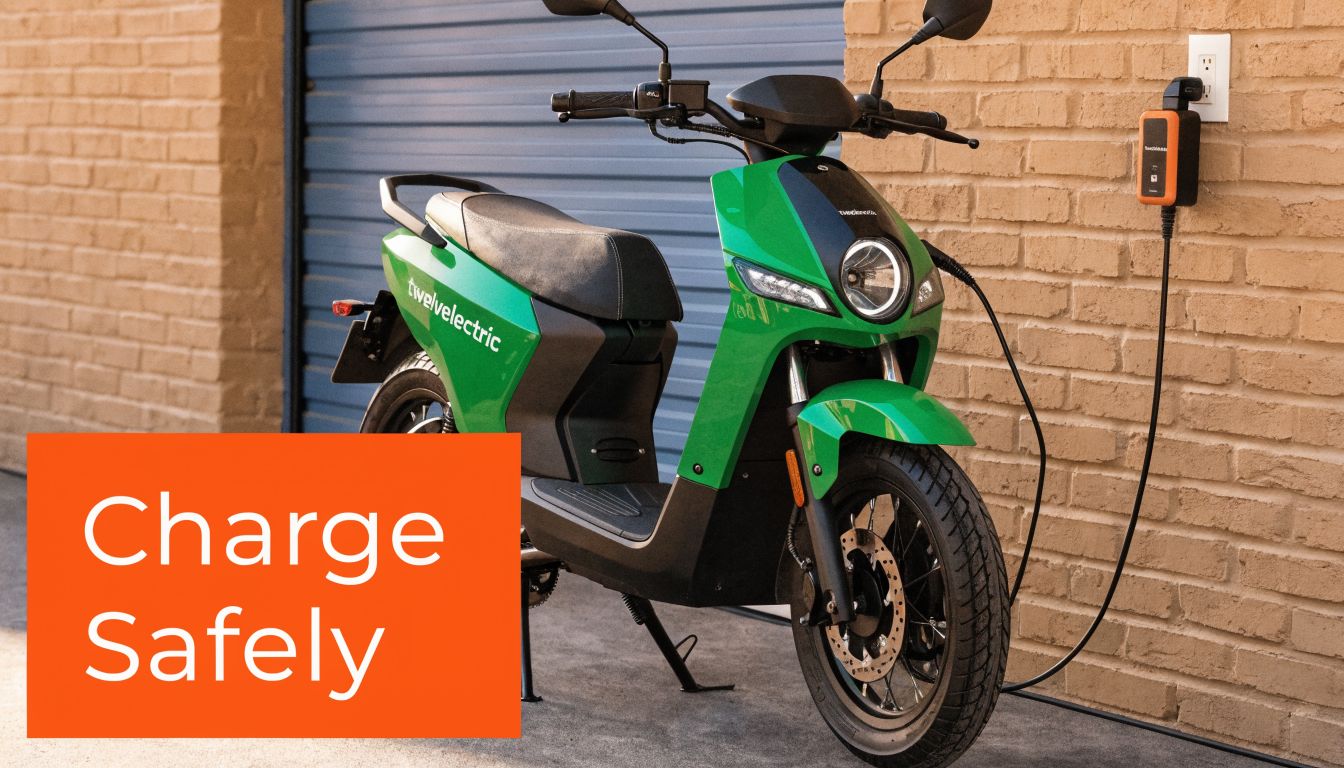
It’s also crucial to give your charger some breathing room. Don’t shove it into a cramped cupboard or hide it behind furniture where air can’t circulate. Chargers naturally get warm, and that heat needs to go somewhere. Good ventilation is key to preventing overheating.
Creating a Safe Charging Routine
Building a solid, safe charging routine is one of the most important things you can do as an owner. It’s the small, consistent habits that prevent accidents and ultimately extend the life of your expensive battery.
One of the biggest risks is leaving your motorcycle to charge unattended, especially while you're asleep. You can't react to the early warning signs of a problem—like a strange smell, a hissing sound, or the charger feeling unusually hot.
If there’s one piece of safety advice we could shout from the rooftops, it’s this: Never leave your electric moped charging unattended indoors overnight. We know it’s convenient, but that convenience simply isn’t worth the risk. Always charge when you are awake, nearby, and able to respond if something goes wrong.
This isn't us being overly cautious; it's a direct response to a serious and growing problem. The London Fire Brigade, for example, reported a frightening 40% increase in fires related to electric motorcycles and mopeds in 2025. A major cause they found was people using incorrect chargers, which then failed catastrophically during unattended charging sessions. You can read more about it in the official UK government battery safety findings.
Powering Up Safely and Efficiently
Beyond your charging space, the way you physically connect everything also makes a huge difference to both safety and battery health. A common and dangerous mistake we see is people reaching for an extension cord.
- Avoid Extension Cords: They might seem handy, but they can add electrical resistance, which causes heat to build up. This can lead to a melted plug or a complete failure. Always plug your charger for your e-motorcycle directly into a proper wall socket.
- Let It Cool Down: After a ride, your battery is going to be warm. Plugging it in straight away puts extra thermal stress on the cells. Just give it 30-60 minutes to cool down to room temperature before you even think about charging.
- Mind the Temperature: Just as you wouldn't charge a hot battery, don't charge it in extreme cold (below 0°C) or intense heat (above 40°C). Charging in extreme temperatures can cause permanent damage to the battery cells, slashing their capacity and lifespan.
Following these simple but critical steps dramatically reduces the risk of an accident. It also ensures your electric motorcycle's battery will stay healthy and reliable for thousands of miles to come.
Troubleshooting Common Charging Problems
It’s a frustrating moment for any rider. You plug in your motorcycle after a long day, expecting to see that reassuring red charging light, but… nothing. Your charger is dead, or the battery just isn't taking any charge.
Before you start thinking about expensive repairs, take a breath. More often than not, the fix is surprisingly simple. We've seen it all, and a few quick checks are usually all it takes to get you back on the road.
First, let's cover the basics—and don't be tempted to skip these! You'd be surprised how often a loose connection is the real villain. Make sure the charger is pushed firmly into both the wall socket and your bike’s charging port. Then, try plugging a lamp or your phone into the same wall socket to make sure it's actually working.
Here in the UK, another common culprit is the fuse inside the charger's plug. They're designed to blow during a power surge to protect the charger, and swapping it out is a quick and cheap fix.
Diagnosing the Problem
If you've checked all the connections and the power outlet is fine, it's time to play detective. The way your charger is behaving (or not behaving) gives us valuable clues.
Is the charger completely dark, with no lights on at all? Or are you getting some signs of life, just not the ones you expect?
For instance, one thing we see all the time is a problem that looks like a faulty charger for e scooter but is actually caused by the battery's own protective system. If a battery is left to go completely flat, its Battery Management System (BMS) can enter a deep 'sleep' mode to prevent damage. In this state, it won't respond to the charger and will refuse to "wake up" and accept a charge.
A completely lifeless charger is one of the most common issues riders face. Before assuming the unit has failed, thoroughly check the power source, the plug's fuse, and all connections. Often, the solution is much simpler and cheaper than buying a new charger.
Pay close attention to these specific signs:
- No Indicator Lights: If the charger shows no lights whatsoever when plugged into a working wall socket, the problem is almost certainly power-related. It's either the plug fuse, a break in the cable, or an internal fault within the charger itself.
- Charger Stays Green: The light should be red when charging and turn green when full. If it goes green the instant you plug it into your bike, but the battery level isn't changing, the charger isn't detecting the battery. This often points to an issue with the scooter's charging port or its BMS.
- Cooling Fan Isn't Spinning: Most chargers get warm and use a small fan to keep things cool. Hearing that fan whir to life is a good sign the charger is getting power and doing its job. A silent fan could mean the fan has failed or the charger's internal power supply is faulty.
When to Seek Professional Help
Being able to diagnose the simple stuff yourself is a great skill, but it's vital to recognise when to stop. If you've run through all these checks and your electric motorcycle or moped still won't charge, it's time to call in a professional.
Never, ever continue to use a charger that’s acting erratically. If it's getting dangerously hot to the touch, making strange buzzing or popping sounds, or giving off any kind of burning smell, unplug it from the wall immediately.
These are clear signs of a serious internal fault that poses a significant fire risk. Don't take a chance. At this point, your only move should be to put it safely aside and get in touch with a specialist like us here at Flex Electric.
Getting Expert Support for Your Charger Needs
When your charger gives up the ghost, it’s more than a minor headache—it grounds you completely. Trying to figure out a replacement on your own can be a real minefield, but you don't have to navigate it solo. As specialists in electric motorbikes and mopeds, we know these machines inside and out and can match you with the correct charger for your electric motorcycle, ensuring it’s both safe and effective.
To get you back on two wheels as quickly as possible, a little information goes a long way. Before you call or email, try to have your bike's make, model, and year handy. For instance, just telling us, "I need a charger for a 2022 Horwin SK3," lets us pull up the exact product you need in seconds. A quick photo of your bike's charging port is also a massive help.
Why Expert Guidance Matters
Going with a manufacturer-approved charger from a specialist like us isn't just about convenience; it's about protecting your bike. You get a guarantee of perfect compatibility, which means no more worrying about whether you've got the right voltage or amperage.
It also protects your investment. Every new bike we sell includes a comprehensive 3-year battery warranty, but that cover often depends on using the right charging gear. Using a cheap, unapproved charger could easily void that warranty, leaving you with a very expensive problem. We can also walk you through official upgrades, like the fast chargers available for brands such as Horwin, which can safely cut down your charging time.
For most riders, a standard three-pin socket at home is all you'll ever need. In fact, 85% of UK electric motorcycle and moped users charge this way, with a typical 50cc-equivalent model taking just 5-6 hours to fully juice up. You can dig into the specifics by reading the findings on UK government battery safety.
Our job doesn't end when you ride away on your new bike. We’re here to make sure it serves you well for years, and getting the charging right is a huge part of that commitment.
If you're thinking about a more permanent setup, like a dedicated charging point in your garage, it's always best to bring in a qualified electrician. For complex jobs, resources that connect you with professionals, like those offering home EV charger installation in Utah, can be a great starting point for ensuring all electrical work is handled safely.
Your E-Motorcycle Charger Questions, Answered
When it comes to electric motorcycle and moped chargers, we get a lot of questions from riders. It's completely understandable—getting this right is crucial for your vehicle's health and your own safety. Here are the answers to some of the most common queries we handle.
Can I Use a Faster Charger on My Electric Moped?
This is a big one, and the short answer is: only if your moped was specifically built for it. Your battery has a sophisticated brain called a Battery Management System (BMS), and it's designed to accept a specific flow of power.
Trying to force more power with an unauthorised fast charger is a recipe for disaster. It can lead to irreversible cell damage, dangerous overheating, and even poses a serious fire risk. Before you even think about a faster option, it's vital to consult a specialist like us. We can tell you if a fast-charge option is genuinely safe and compatible with your model.
Is It Normal for My Charger to Get Hot?
It's perfectly normal for your charger to get warm while it's working—but it should never become too hot to comfortably touch.
If you notice it's getting excessively hot, hear any strange buzzing sounds, or smell burning plastic, unplug it from both the wall and your vehicle straight away. Don't hesitate.
A simple but critical safety habit is to always place your charger for your electric motorcycle or moped on a hard, non-flammable surface with plenty of air circulating around it. Never leave it on a carpet, bed, or sofa.
How Do I Know When My Motorcycle Battery Needs Replacing?
The most obvious sign that your battery is getting old is a noticeable drop in its maximum range. A full charge just doesn't get you as far as it used to.
Other clues include the battery struggling to reach a 100% charge or, on the flip side, charging up suspiciously quickly. An unusually fast charge can indicate that some battery cells are failing and no longer holding a charge at all. If you suspect your battery's health is declining, the best move is to get it professionally diagnosed.
For expert, friendly advice on choosing the right charger for your electric motorcycle or moped, the team at Flex Electric is here to help. You can find the perfect, safe solution for your ride by visiting us online at https://www.flexelectric.co.uk and get back on the road with confidence.
Find us
You will find us at 74 Dalry Road, Edinburgh, EH11 2AY
Showroom Opening Times:
Monday: By Appointment
Tuesday to Friday: 11am - 5:00pm
Saturday: 10am - 5pm
Sunday: By Appointment
