
Your Guide to Dirt Bikes That Are Street Legal in the UK

Flex Electric
The UK's #1 Electric Moped and Electric Motorbike dealer.

It’s a common question we get: can you actually ride a proper dirt bike on UK roads? The short answer is yes, but there's a crucial catch—it must be fully 'street legal'.
A standard motocross or enduro bike is built for one thing: performance in the dirt. They're stripped-down, lightweight machines without the lights, indicators, or other gear needed for public highway use. You simply can’t ride one straight from the trail onto the tarmac without making it compliant with UK law.

Can You Ride a Dirt Bike on UK Roads
The idea of using a nimble off-roader for your daily commute is appealing, but bringing that vision to life means getting to grips with the legal framework. While you can technically convert a petrol-powered dirt bike, the reality is that it's an expensive, complicated, and often frustrating process.
Getting a converted bike approved involves more than just adding a few parts. The entire machine has to pass a stringent inspection to satisfy the DVLA that it’s safe and roadworthy. This is where many riders find the project stalls.
Thankfully, there’s a much more straightforward way. The easiest and most reliable route to owning a road-ready off-roader is to buy a purpose-built electric motorcycle that’s already street legal from the factory. These bikes deliver authentic off-road thrills but are designed from day one to be fully compliant for road use.
The Smart Alternative to Conversion
Rather than getting tangled up in a complex and costly DIY conversion, riders now have a far better option. Electric off-road motorcycles that are sold as road-legal have been engineered specifically to meet all UK regulations right out of the box.
This approach sidesteps all the common headaches of a traditional conversion project:
- No Legal Guesswork: These bikes come factory-fitted with everything you need—lights, indicators, a horn, and road-legal tyres. This means they are ready for an MOT and DVLA registration without any hassle.
- Budget-Friendly: You avoid the hidden and spiralling costs of sourcing compatible parts and paying for labour. The price you see is what it costs to get on the road.
- Guaranteed Compliance: Manufacturers handle the tricky business of meeting noise and emissions standards. Being electric, these bikes are whisper-quiet and have zero tailpipe emissions, making them a perfect fit for urban riding and a non-issue for regulators.
In essence, opting for a factory-approved electric off-road bike takes all the uncertainty out of the equation. You get the raw excitement of a dirt bike combined with the convenience and legality needed for the road, saving you time, money, and a whole lot of stress.
The UK's Legal Roadmap for Street Legal Motorcycles
Thinking of making your dirt bike road legal in the UK? It’s not as simple as just slapping on a number plate and heading out. There’s a formal process, governed by strict rules, to ensure every vehicle on public roads is safe for the rider and everyone else.
Your journey will involve two main government agencies: the Driver and Vehicle Licensing Agency (DVLA), which handles vehicle registration and tax, and the Driver and Vehicle Standards Agency (DVSA), which sets the safety and environmental standards your bike has to meet.
For any bike that's been converted or custom-built, the biggest challenge is the Motorcycle Single Vehicle Approval (MSVA) test. This is a rigorous, one-off inspection to prove your machine is genuinely roadworthy. Frankly, it's a test that many traditional petrol motocross bikes fail without some serious—and often expensive—modifications.
Why the MSVA Test Is So Tough
The MSVA isn't there to make life difficult; it’s all about public safety. The inspection is incredibly detailed, checking that your bike meets the same core standards as one straight from the factory. It’s about making sure your bike behaves predictably and safely in traffic.
Right away, this puts a standard off-road bike at a massive disadvantage. They are built for one thing: performance on the dirt. Their lightweight, stripped-back design is the total opposite of what's needed for the road.
Think of it this way: an F1 car is an engineering marvel, but you wouldn't pop to the shops in it. It's simply not designed for that environment. A motocross bike is the same—it’s a specialised tool for competition, not for navigating a roundabout during rush hour.
The MSVA test looks at dozens of components, but a few key areas consistently cause headaches for petrol dirt bike conversions.
The Major Hurdles for Petrol Conversions
If you're set on converting a traditional petrol-powered dirt bike, you need to be prepared for some significant engineering challenges. The standards are incredibly specific, with no wiggle room.
- Emissions and Noise: This is the big one. A competition two-stroke or four-stroke engine is incredibly loud and chucks out emissions far beyond what’s allowed on the road. Getting it compliant often means fitting a whole new exhaust system and re-tuning the engine, which is both costly and complicated.
- Lighting and Signalling: Your dirt bike has no lights. You'll need to add a headlight (with high and low beams), a tail light, a brake light, and indicators that flash at a regulated rate of between 60 and 120 times per minute. Every one of these components must be E-marked to show it meets official standards.
- Braking Systems: Off-road brakes are strong, but they may not meet the specific performance standards for road use. Newer machines often require linked braking systems or even ABS, which is a major retrofitting job.
- Speedometer and Tyres: You must fit a calibrated speedometer that accurately displays your speed in miles per hour. On top of that, your knobbly off-road tyres have to go, replaced with Department for Transport (DOT) approved road-legal ones.
Getting your head around all these rules can be a real task. A great place to start is with The Highway Code, which lays out the fundamental rules and responsibilities for every road user in the UK.
The reality is, when you add up the cost, time, and sheer hassle of these modifications, it can often cost more than the bike itself is worth. This is exactly why factory-built, road-legal electric motorcycles are such a compelling alternative. They are designed from day one to meet all these regulations, giving you a fully compliant bike that's ready to go, without any of the legal headaches.
Your Essential Street Legal Conversion Checklist
So, you want to get your dirt bike on the road? It’s a common dream, but turning a pure-bred off-road machine into a road-legal ride is a serious undertaking. This isn't just about adding a few lights; it's a full-blown technical overhaul to meet the UK’s strict Motorcycle Single Vehicle Approval (MSVA) standards.
Every new part needs to be the right type, fitted correctly, and officially approved for road use. It’s a world away from buying a factory-built electric motorcycle that’s ready to ride straight out of the showroom. With those, all the legal bits are part of the original design, saving you from the complex and often expensive process we’re about to dive into.
Lighting and Visibility Components
First things first, let's talk about lights. Your typical motocross bike has none, so you’re essentially building a complete electrical lighting system from the ground up.
- Headlight: You’ll need a proper headlight with both high and low beam settings. Crucially, it must be E-marked, which is the stamp of approval showing it meets UK and European safety standards.
- Tail and Brake Lights: A red tail light that’s always on with your headlight is mandatory. You also need a brighter red brake light that comes on when you pull the front brake or press the rear.
- Indicators: Front and rear indicators are a must. They have to be positioned correctly and flash at a steady, regulated pace of between 60 and 120 times per minute.
- Number Plate Light: A white light must illuminate your rear number plate so it can be seen clearly at night.
This chart gives you a sense of the key areas the official inspection focuses on.
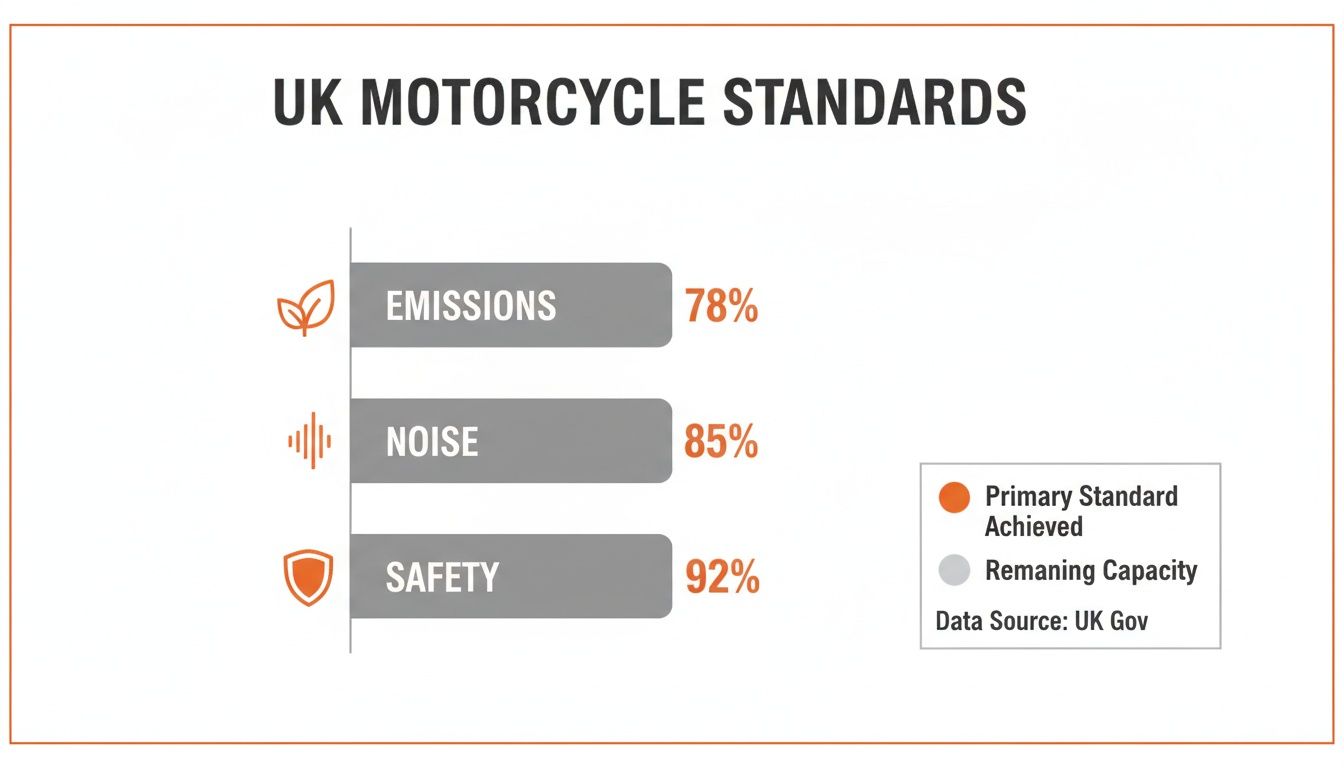
As you can see, the MSVA test is rigorous on safety, noise, and emissions—three areas where purpose-built electric bikes already have a massive head start without any modifications.
Road-Ready Running Gear
Next up is getting the bike ready for tarmac. The specialist components built for mud and dirt just aren't safe or legal for the street.
- Road-Legal Tyres: Those knobbly off-road tyres have to go. You must fit a set of road-legal tyres that are approved for road use (often marked as DOT or E-marked). They provide the grip and stability you need on paved surfaces.
- Speedometer: A working, calibrated speedometer is required to show your speed in miles per hour (MPH). It must also have an odometer to record the total distance covered.
- Mirrors: You need at least one mirror, but fitting a pair is just common sense for seeing what’s happening behind you in traffic.
- Horn: A continuous-tone horn that’s loud enough to warn other drivers is another non-negotiable safety feature.
Think of it like this: trying to make a dirt bike road-legal is like trying to get a world-class sprinter to run a marathon. The raw athletic ability is there, but the gear, the technique, and the rules of the race are completely different. That’s the core challenge.
Estimated Costs for Street Legal Conversion
This is where many people get a shock. The cost of parts adds up quickly, and that's before you factor in the skilled labour needed to wire everything up and fit it correctly.
The table below gives a rough idea of the costs you can expect. Remember, these are just estimates—prices for parts can vary wildly, and labour costs will depend on who does the work.
Component/RequirementEstimated Part Cost (£)Estimated Labour Time (Hours)Lighting Kit (Headlight, Tail/Brake, Indicators)£150 - £3503 - 5Horn£15 - £300.5 - 1Mirrors (Pair)£20 - £500.5Road-Legal Tyres (Pair)£100 - £2501 - 2Speedometer/Odometer£50 - £1501 - 2MSVA Test Fee£96N/ATotal (Excluding Labour)£431 - £8766 - 10.5
When you add it all up, the financial reality of converting a petrol bike becomes clear. You aren't just buying parts; you're paying for specialist knowledge to force them onto a bike that was never designed for them in the first place.
This is where the value of a factory road-legal electric motorcycle really shines. Every single one of these components is standard, integrated, and approved from day one. It's an off-the-shelf solution that guarantees compliance without the hidden costs and headaches of a DIY project.
Electric Off-Road Motorcycles: The Smart Street-Legal Alternative
Trying to make a petrol dirt bike road-legal is often a minefield of technical challenges, baffling paperwork, and escalating costs. But there's a much cleaner, simpler way to get the best of both worlds: purpose-built electric off-road motorbikes.
This new generation of electric bikes isn't a watered-down compromise. They’ve been designed from scratch to be phenomenal on the trails while being fully compliant for UK roads right out of the box. You get all the off-road fun without any of the legal headaches or mechanical guesswork that comes with a DIY conversion.

The All-In-One Solution
When you buy a road-legal electric off-road motorcycle, you're getting a complete package. Forget the long shopping list of parts needed for a petrol bike conversion; these machines arrive with everything already fitted and fully integrated.
That means you automatically get:
- A full lighting system, including E-marked headlights, tail lights, and indicators.
- A horn, mirrors, and a road-legal number plate mount.
- A calibrated speedometer and compliant, road-legal tyres.
Every component is designed to work flawlessly together and is guaranteed to fly through the strict MSVA inspection. This is a real turning point for anyone looking for dirt bikes that are street legal, as more and more riders are realising the sheer convenience of a factory-built solution.
Zero Emissions and Silent Operation
One of the biggest wins for electric off-road bikes is their impact—or lack thereof—on the environment and the community around you. They produce zero tailpipe emissions, which is a massive advantage for anyone riding in the UK’s growing number of Clean Air Zones (CAZ) and Ultra Low Emission Zones (ULEZ).
For urban commuters or delivery riders, that means no daily charges and unrestricted access to city centres, which adds up to real financial savings. On top of that, the near-silent electric motor is a genuine game-changer. It allows you to slip through residential streets or quiet green lanes without causing a racket, showing respect to both your neighbours and local wildlife.
Imagine setting off for an early morning ride without waking the whole street, or exploring a peaceful trail without scattering every animal in sight. That quiet power opens up a world of possibilities for where and when you can ride, making your bike a far more versatile machine.
This appeal is clear in the market data. Even as the wider motorcycle market saw a downturn, the 'competition' category—which includes these road-legal enduro and trail bikes—saw registrations dip by only 9.2 percent. It shows a solid, sustained demand for bikes that can do it all. You can dive deeper into these trends in the Europe Dirt Bikes Market Report.
A Prime Example: The Sur-Ron Ultra Bee
If you want to see this new wave in action, look no further than the Sur-Ron Ultra Bee. This bike is the perfect fusion of aggressive off-road performance and full street legality. It has incredible torque and a lightweight, nimble frame for tackling tough trails, but it also comes with every single item needed to ride it legally on the road, straight from the factory.
With the Ultra Bee, there's no project. You just handle the DVLA registration, fit your number plate, and you're good to go. You can genuinely use the same bike for your Monday commute and your Saturday trail-shredding session.
When you factor in the 'ready-to-ride' convenience and the dramatically lower running costs—no petrol, no oil changes, and far fewer moving parts to worry about—the argument for electric becomes incredibly strong. For anyone searching for dirt bikes that are street legal, going electric isn't just an alternative; it's the forward-thinking choice. It's simpler, cheaper to run, and better for everyone.
Getting Your Bike Legal: Licences, Insurance, and Costs
So, you’ve found an electric dirt bike you want to make street legal. That's the exciting part. Now comes the paperwork and figuring out the real-world costs. Just like any car or motorbike, you can't just jump on and ride – you'll need the right licence, proper insurance, and a clear idea of what it will cost to keep on the road.
Thankfully, if you’re buying a factory road-legal electric model, this whole process is much, much simpler than trying to convert an old petrol bike. Because these electric bikes are designed and sold as road-worthy from the get-go, both insurers and the DVLA know exactly what they’re dealing with. This makes the admin side of things surprisingly smooth.
Do I Need a Special Licence for an Electric Motorcycle?
The UK’s motorcycle licensing is tiered based on your age and the bike's power. With electric motorcycles, we talk about power in kilowatts (kW) instead of the cubic capacity (cc) you see on petrol engines. It’s crucial to know which category your bike falls into.
Here’s a quick breakdown of how electric power lines up with the traditional licence tiers:
- AM Licence (Electric Mopeds): If you're 16 or over, this is your starting point. It covers bikes with up to 4kW of power and a top speed of 28 mph, making them the electric equivalent of a 50cc petrol moped.
- A1 Licence (Light Motorcycles): At 17, you can aim for an A1 licence. This lets you ride anything up to 11kW of continuous power. Think of this as the 125cc category, which is where many of the best urban electric motorbikes sit.
- A2 Licence (Standard Motorcycles): Once you’re 19, the A2 licence opens up a lot more options, covering bikes with up to 35kW of power. This is where some seriously fun and high-performance electric bikes, like the Sur-Ron Ultra Bee, come into play.
For most people starting out, the first step is the Compulsory Basic Training (CBT). It’s a one-day course that, with a provisional licence, allows you to ride a moped (AM) or a 125cc-equivalent (A1) electric bike with L-plates.
Insuring Your Electric Dirt Bike
Getting insurance is a legal non-negotiable. The good news? Insuring a purpose-built electric motorcycle from a well-known brand is usually a piece of cake. Insurers can easily look up the bike’s specs and safety features, which means they can give you an accurate quote without much fuss.
It's a completely different story if you've converted a petrol dirt bike yourself. Many insurers get very nervous around heavily modified vehicles, especially when there's no official manufacturing history or standard safety gear. You'll likely face sky-high premiums or could even be refused cover altogether.
A key part of the insurance and registration process is the bike's unique identifier. To get a full picture of what’s involved, our guide on the VIN Number Explained is a must-read. This number is how the DVLA and insurers track and identify your specific machine.
The Running Costs: Where Electric Really Shines
This is the area where electric bikes pull miles ahead. While the initial ticket price can sometimes be higher, the day-to-day cost of running an electric motorcycle is a fraction of a petrol equivalent, especially when compared to a thirsty, high-maintenance converted dirt bike.
The numbers really speak for themselves.
Cost FactorConverted Petrol Dirt BikeFactory Road-Legal Electric MotorcycleFuelHigh (and constantly changing)Very Low (Charge at home for pennies)Tax (VED)Standard motorcycle rates£0 (Zero-emission vehicles are exempt)MaintenanceFrequent oil, filters, spark plugs; engine workMinimal (No oil, no exhaust, very few moving parts)RepairsFinding parts for a one-off build can be a nightmareStandard parts are easy to get from a dealer
The savings start from day one. You can forget about trips to the petrol station entirely. A full charge from a standard home socket often costs less than £1. When you add in zero road tax and almost non-existent maintenance, the financial argument for going electric becomes incredibly strong, whether you're a daily commuter, a delivery rider, or a business managing a fleet.
So, What's the Next Move?
We’ve walked through the maze of costs, technical jobs, and legal red tape involved in trying to make a traditional petrol dirt bike road legal. Let's be honest: it’s a path often paved with hassle and unexpected bills. It’s more of a passion project for a dedicated mechanic than a practical choice for most riders.
The alternative couldn't be more different. Grabbing an electric motorcycle that's already built to be street legal is simple, smart, and ready for the future. These bikes aren't clumsy conversions; they're designed from day one to tear up the trails and handle UK roads, fully compliant right out of the showroom. The real question isn't if you can get a bike on the road, but what's the sanest way to do it.
Think of it this way: wrestling with a conversion is like building a kit car in your garage. It can be rewarding, but it's a long, uncertain hobby. Choosing a factory-built electric model is like driving a brand-new car off the forecourt. One is a project; the other gets you where you need to go, today.
Finding the Right Bike for Your Ride
What you do next really comes down to what you need your bike for. We’ve lined up some clear paths, whether you're dodging traffic on your commute, running deliveries, or looking to upgrade an entire business fleet.
For the Urban Commuter
Tired of being packed into buses or trains? If you're looking for a cheap, nimble, and fun way to get around town, the right electric motorcycle is here. Models like the Super Soco TC Wanderer have that classic scrambler look but are packed with modern electric tech, making them perfect for slicing through the city during the week and exploring back roads on the weekend.
- Your Next Step: The best way to know is to try. Book a test ride on a Super Soco TC Wanderer and feel how it handles the urban jungle.
For the Delivery Rider
When your income depends on it, every penny counts. The cost of petrol, tax, and constant maintenance on a standard bike can really eat into what you take home. Our electric moped range was built specifically to slash those running costs. We've seen riders save hundreds of pounds a month.
- Your Next Step: See what the numbers look like for you. Calculate your potential savings with our purpose-built electric moped range and find out how much more you could be earning.
For Business and Fleet Owners
Switching your fleet to electric is one of the smartest decisions a business can make right now. It cuts your daily running costs right down and dramatically shrinks your carbon footprint. Our bikes are workhorses, offering a reliable, low-maintenance transport option for everything from local food delivery runs to managing large sites.
- Your Next Step: Let's talk specifics. Enquire about our fleet electrification programme for practical advice on moving your business vehicles to a cleaner, more affordable electric future.
Getting your hands on one of the best dirt bikes that are street legal is easier than you think. Whether you're a commuter, a professional rider, or a business owner, the most efficient way forward is an electric one.
Your next adventure is ready when you are. Browse our complete range of electric motorcycles online, swing by our Edinburgh showroom to see them up close, or give our expert team a call for some straightforward, honest advice. Let's get you on the road.
Frequently Asked Questions About Street Legal Dirt Bikes
Let's tackle some of the most common questions we hear from riders. Getting these answers straight can save you a world of time, money, and hassle as you figure out the best way to get on the road.
Are Kids Motocross Bikes Street Legal in the UK?
In short, no. A standard kids' motocross bike is built purely for off-road fun on private land. They are simply not designed or equipped for public roads.
These bikes are missing all the essential safety gear required to pass an inspection, such as lights, indicators, a horn, and road-legal tyres. They are strictly for the track and trail.
Can I Make Any Dirt Bike Street Legal?
In theory, yes, but in practice, it's a massive and often frustrating undertaking. You're looking at a mountain of modifications, a very strict MSVA inspection, and a bill that can quickly spiral.
The easiest and most reliable path to owning one of the best dirt bikes that are street legal is to choose a model that was built and approved for the road right from the factory, such as an electric enduro bike.
The core issue is that a standard motocross bike is titled for off-highway use only. Overcoming this legal classification is often the biggest hurdle, even before you start adding parts.
What Is the Easiest Type of Dirt Bike to Make Street Legal?
Without a doubt, the easiest option is a bike you don't have to convert at all—a purpose-built electric off-road motorcycle. These machines are engineered from day one with full road legality baked in.
They arrive with all the required lights, mirrors, and certifications already sorted. There's no technical guesswork or expensive conversion project. You just register it, get your number plate, and you're ready to ride anywhere you please.
At Flex Electric, our entire focus is on making the switch to electric both simple and exciting. Our range of road-legal electric motorcycles, mopeds, and off-road bikes gives you that perfect mix of performance and practicality, all backed by our expert advice and nationwide support.
Ready to find the right ride for you? Explore our full collection at https://www.flexelectric.co.uk.
Find us
You will find us at 74 Dalry Road, Edinburgh, EH11 2AY
Showroom Opening Times:
Monday: By Appointment
Tuesday to Friday: 11am - 5:00pm
Saturday: 10am - 5pm
Sunday: By Appointment
