
Electric Cargo Bikes UK: Choose Your Ideal Model
Flex Electric
The UK's #1 Electric Moped and Electric Motorbike dealer.

Are you looking for an electric cargo bike, or are you trying to solve a business transport problem?
Many searches for electric cargo bikes uk start with box size, battery range, or frame style. For commercial use, the first decision sits earlier than that. Do you need a pedal-assist cycle, or do you need a road-legal electric vehicle built to carry goods through a full working day?
Pedal-assist cargo bikes have a place. They suit light local runs, campus work, and short trips where payloads stay modest and routes stay simple. Business use changes the calculation. Once the job involves repeated stops, heavier loads, tight delivery windows, poor weather, and mixed urban traffic, a cargo bicycle and an electric cargo moped are no longer close substitutes.
That distinction is important because many buyers still group them under the same label and expect the same result. In practice, they solve different problems. A pedal-assist e-cargo bike can work well in the right setting, but many UK operators need higher average speeds, better weather protection for goods, stronger load stability, and a machine that keeps pace with traffic rather than working around it.
From our side of the market at Flex Electric, that is the point many businesses miss. They do not need a lifestyle bike with a cargo box attached. They need payload confidence, road presence, and day-in, day-out usability. For serious delivery work, service calls, and trade use, that usually points away from consumer-grade e-bikes and towards commercial electric mopeds or motorcycles designed for the job.
The Urban Logistics Revolution
What moves goods efficiently through a UK city. A pedal-assist cargo bike, or a road-legal electric vehicle that can carry weight, keep pace with traffic, and stay out all day?
Congestion, parking pressure, fuel costs, and clean air rules have changed urban transport for trades, couriers, and local service businesses. The old van-first approach works less well once the job involves short hops, repeated stops, and city-centre access restrictions. Operators need vehicles that waste less time at the kerb and recover less time from delays.

Electric cargo transport has grown well beyond a niche idea. The market is expanding, as noted earlier, because last-mile delivery, emissions policy, and rising operating costs have pushed businesses to look for smaller electric vehicles that can still do proper commercial work.
The problem is not demand. It is category confusion.
Buyers often search for “electric cargo bike” and end up comparing machines that share a broad purpose but behave very differently on the road.
A long-john cargo cycle with a front box suits light local work in the right conditions. A road-legal electric moped or motorcycle with a secure rear box suits a different class of job entirely. It handles longer routes, mixed traffic, tighter schedules, and heavier day-to-day use with less compromise from the rider.
Practical rule: If the vehicle is earning money every day, traffic speed, load security, and durability usually matter more than cycle-style simplicity.
I see this mistake regularly. A business starts by looking at cargo bikes because the term sounds right, the entry price looks attractive, and the marketing often shows neat urban use. Then the working day gets in the way. Payloads vary, weather turns, riders swap shifts, and the route includes roads where a cycle-based platform starts costing time rather than saving it.
Why the search term can send buyers in the wrong direction
A search for electric cargo bikes uk often surfaces family carriers, leisure-focused reviews, and light-duty delivery setups. That helps if the task is replacing short car journeys. It helps far less if the aim is takeaway delivery across a wider patch, mobile trade work, pharmacy runs, or a small commercial fleet that has to perform through winter.
Commercial operators usually care about three practical outcomes:
- Keeping pace with urban traffic: Higher road speeds and better vehicle presence reduce the stop-start penalty on busy routes.
- Protecting goods properly: Lockable, weather-resistant cargo boxes suit tools, food orders, parts, and medical items better than open cycle loads in many cases.
- Reducing rider fatigue across a shift: Less dependence on pedalling produces more consistent performance from first drop to last.
That point matters because many businesses do not need a better bicycle. They need a better working vehicle.
Beyond the Bicycle Choosing Your Electric Cargo Vehicle
The phrase “electric cargo bike” covers two very different categories in the UK. If you don’t separate them early, you can end up buying a machine that fits the internet trend rather than the work itself.
What a standard e-cargo bike is
A standard pedal-assist cargo bike sits within the EPAC style framework. In practical terms, that means a cycle platform with electric assistance, not a motor vehicle in the moped or motorcycle sense. The key limit is that these machines are governed by rules that cap them at a 250W motor and 15.5mph assisted speed, while road-going electric mopeds and motorcycles are built for city traffic at 28mph and above, as described in Urban eBikes’ cargo platform specification notes.
That distinction changes everything on the road.
At lower urban speeds in filtered streets, protected lanes, or local neighbourhood routes, a pedal-assist cargo bike can be effective. In mixed traffic, on longer delivery loops, or on roads where surrounding vehicles are moving more briskly, the limitations become obvious. The bike doesn’t suddenly stop working, but the rider has to work around the vehicle more often.
What a commercial rider usually needs instead
For serious commercial use, the more relevant categories are road-legal electric mopeds and 125cc-equivalent electric motorcycles. These are the machines designed to live on the road as powered vehicles first, cargo carriers second.
They bring several practical advantages:
Vehicle typeBest forMain limitationPedal-assist cargo bikeDense urban runs, short distance carrying, low-speed routesLimited traffic pace and rider fatigue under heavier daily workElectric mopedFood delivery, local service calls, town and city business useLess suited to riders who only want cycle-style accessElectric motorcycleFaster urban movement, wider territory, heavier-duty road useMore than some local errands require
The important point isn’t that one category is universally better. It’s that commercial work usually exposes the weaknesses of bicycle-based cargo platforms faster than private leisure use does.
Where pedal-assist works, and where it doesn’t
Pedal-assist cargo bikes work well when the route is short, the load is moderate, and the rider has either cycle infrastructure or low-stress local roads. They also suit businesses with a very defined operating patch, especially where parking and access matter more than pace.
They work less well when:
- The rider needs to stay with traffic
- The route includes hills, poor surfaces, or repeated heavy starts
- The load needs to be enclosed and secured
- The working day depends on predictable turnaround times
A commercial rider can tolerate compromise for a day. They can’t build a business around it.
A lot of delivery problems aren’t caused by range. They’re caused by the wrong vehicle class for the route.
Why speed and road presence matter
On paper, a few miles per hour may not look dramatic. In practice, the difference between a pedal-assist cutoff and a proper road-speed electric moped affects route choice, junction confidence, and how tiring the day feels. A vehicle that can flow with city traffic asks less of the rider and usually broadens the kind of jobs that are realistic.
Many buyers searching electric cargo bikes uk should pause and reflect on their primary use. If the task is family transport, local errands, or novelty value, bicycle-based cargo can be a great fit. If the task is earning, carrying, and repeating, a moped or motorcycle platform is usually the more sensible machine.
A better way to choose
Start with the mission, not the label.
Ask yourself:
- Will this vehicle work for money or just convenience?
- Will it spend most of its life in mixed traffic?
- Do I need secure cargo storage rather than exposed carrying space?
- Can I afford lost time from underpowered transport?
If most of those answers point toward paid work, longer shifts, or wider-area delivery, the smarter move is often to skip the bicycle category entirely and look at electric mopeds or electric motorcycles built for UK road use.
Calculating Your Total Cost of Ownership
What does the vehicle cost once it starts earning its keep?
The purchase price is the easiest number to compare. It is also the one that causes the most bad buying decisions. Commercial operators live with the full cost of the machine, not the sticker.
The UK market is still developing. Only 4,000 electric cargo bikes were sold in the UK in 2022, compared with 90,000 in Germany, according to Fact.MR’s UK electric cargo bikes market report. For a business buyer, that matters because support networks, parts availability, resale confidence, and product maturity can vary a lot across vehicle types. That is one reason I treat bicycle-style cargo platforms cautiously for serious paid work, and why road-legal electric mopeds and motorcycles often come out better once the numbers are laid out properly.
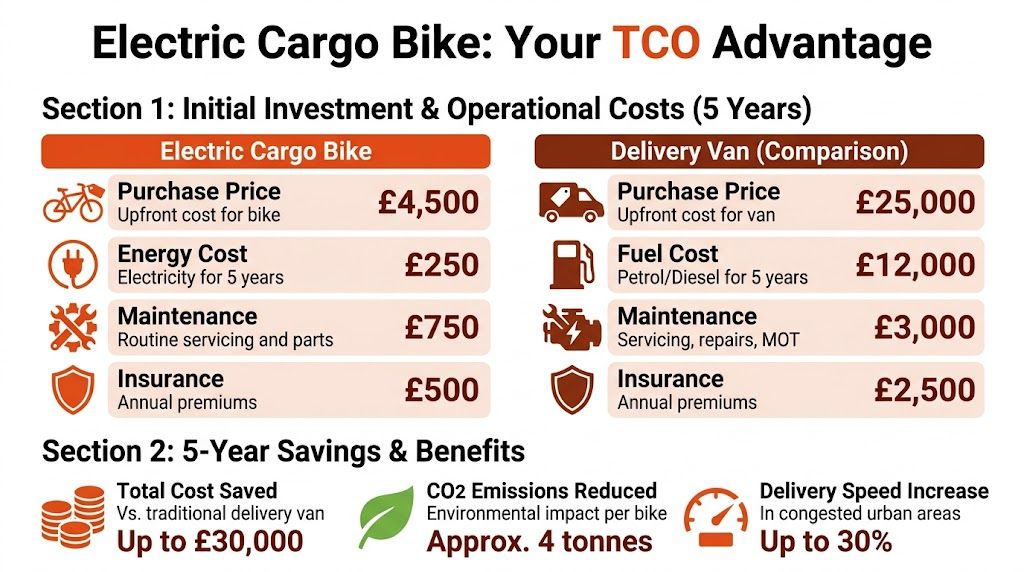
The infographic above is useful as a broad prompt. For an actual buying decision, I would go line by line through the costs a working vehicle creates in a normal week.
The costs that matter
For commercial use, I break ownership into six buckets:
- Acquisition cost: Purchase price, deposit, finance terms, and how much working cash stays in the business.
- Energy or fuel: Electricity is usually easier to budget than petrol, especially on repeat urban routes.
- Maintenance: Tyres, brakes, chains, servicing intervals, and whether the platform is built for daily commercial mileage.
- Insurance and compliance: This changes by vehicle class, storage arrangements, and rider profile.
- Downtime risk: A cheaper machine becomes expensive fast if it misses shifts waiting for parts or repair.
- Cargo suitability: If the base vehicle needs improvised racks, exposed loads, or repeated adjustments, the overall cost goes up.
A practical comparison table
There is no single approved UK-wide dataset that gives every ownership cost line for every cargo format. In practice, the useful comparison is operational rather than theoretical.
Cost FactorElectric Cargo MopedPetrol MopedSmall Van (Used)Upfront spendOften higher than a basic petrol scooter, depending on battery size and business setupFamiliar entry price for many operatorsHighest initial outlay, even at the lower end of the used marketEnergy or fuelLower and usually easier to predictOngoing fuel price swingsHighest routine fuel spendMaintenance profileFewer engine-related service items, but battery and charger support matterMore regular engine and exhaust servicingBroader servicing exposure across drivetrain, brakes, tyres, and bodyworkParking and urban accessStrong fit for dense town and city workSimilar access benefitsMore restrictions, more time lost to parking and loadingCargo flexibilityWorks well with a proper rear box, rack, or trade-specific setupSimilar carrying format, but with petrol running costs and noiseBest for enclosed bulk, weakest for agilityDowntime impactUsually manageable if charging routine and dealer support are in placeEasy to understand mechanically, but workshop visits are more frequentHighest disruption when the vehicle is off the road
Why electric often wins after purchase
The strongest electric case usually appears after month two, not on day one.
A petrol moped can look simpler because the routine is familiar. A van can look safer because it covers more edge cases. But if the work is local delivery, site visits, mobile services, or repeated urban drops, the machine that wastes less time usually produces the better margin. That tends to favour a road-legal electric moped or motorcycle over both a pedal-assist cargo bike and a van.
Operator view: The cheapest vehicle to buy is rarely the cheapest vehicle to run.
Vehicle class matters. A pedal-assist cargo bike may post a low headline running cost, but that number can hide limits that matter in paid work. Lower average speeds, rider fatigue, exposed cargo, and lighter-duty components all have a cost if the vehicle is out all day. A proper electric cargo moped or motorcycle usually carries the load more securely, copes better with mixed traffic, and asks less of the rider over a full shift.
Three ownership mistakes I see often
Buying for the test ride, not the job
A short ride can make a light consumer machine feel appealing. A week of deliveries exposes the weak points. Payload margins shrink, brakes work harder, storage feels improvised, and the rider starts adapting to the vehicle instead of the vehicle supporting the work.
Comparing against the wrong alternative
If the choice is between an electric cargo moped, a petrol scooter, and a small van, compare those three. Too many buyers start with bicycle pricing, then discover they needed road speed, lockable storage, and all-day usability from the beginning.
Ignoring downtime as a line item
Downtime is not abstract. It means missed jobs, delayed drops, rearranged shifts, and spare vehicle costs. That is why dealer support, parts access, charging routine, and build quality deserve the same attention as monthly payments.
Where the decision becomes clear
Choose an electric cargo moped or motorcycle when the route involves paid work, repeated stops, urban roads, and cargo that needs to arrive secure and dry. Choose a van when the load is bulky enough that enclosed volume matters more than speed, parking, and access. Choose a pedal-assist cargo cycle for short-range, low-speed use where cycle access matters more than carrying security or road performance.
That approach usually prevents two expensive mistakes. Buying more vehicle than the job needs, or buying a bicycle-based platform for work that really needs a road-going machine.
Matching the Machine to the Mission
Which machine still works properly after a full week of deliveries, site visits, or stock runs in British weather? That is the question that matters more than headline range or a clever product page.
For commercial use, the answer often points away from pedal-assist cargo bikes and towards road-legal electric mopeds or light motorcycles. A bicycle-based platform still has a place, but that place is narrower than many buyers expect. Once the job includes repeated road use, heavier loads, secure storage, or pressure to keep to time slots, a proper road vehicle usually fits the mission better.
The food delivery rider
Takeaway work punishes weak setups quickly. The vehicle needs to pull away cleanly dozens of times per shift, stay stable with a loaded box, cope with wet roads, and keep food protected from rain and spills.
A pedal-assist cargo bike can suit a dense city centre with short distances and strong cycle access. Outside that pattern, the compromises start to stack up. Riders get pushed onto faster roads, routes stretch, gradients matter, and the vehicle needs to carry a proper insulated box without feeling unsettled. In that job, an electric moped is usually the better tool because it is designed to work on the road network riders use.
A practical setup usually includes:
- A compact electric moped with a fixed, insulated rear box
- Predictable charging between shifts or overnight
- Weather protection for both cargo and rider contact points
- Brakes and tyres specified for daily stop-start use
Poor fits include open racks for hot food, lightly built cycle platforms covering wide delivery zones, and any machine that becomes tiring to control at the end of a long shift.
The small business fleet
Small firms rarely need maximum payload on every trip. They need a vehicle that starts every morning, carries the day’s working load securely, parks close to the job, and does not create hassle for whoever is riding it that week.
That is why electric mopeds and light motorcycles often suit florists, bakeries, pharmacies, mobile technicians, venue teams, and local retailers better than pedal cargo bikes. Many of these businesses move goods that are not especially bulky but do need to arrive dry, tidy, and intact. Repair parts, boxed products, tools, documents, flowers, and prepared orders all fit that pattern well.
A good fleet machine also needs to be easy to standardise. Staff changes happen. Different riders will use the same vehicle. A road-going platform with lockable storage, familiar controls, and predictable handling tends to be easier to assign across a team than a pedal-assist cargo bike that depends more on rider fitness, confidence, and willingness to work around the machine’s limits.
A business vehicle should cut effort from the working day, not add effort through awkward loading, poor weather protection, or route restrictions.
The commuter who carries more than a backpack
Some buyers searching for electric cargo bikes uk are not running deliveries at all. They want a practical daily vehicle that carries more than a standard scooter setup without stepping up to a car.
For that use, a cargo-style electric moped often makes more sense than a pedal-assist bike. The rider can carry shopping, work kit, waterproofs, tools, or personal gear in a lockable box and still travel at a pace that suits normal urban roads. It stays compact, simple to park, and useful every day. That matters more than bicycle styling cues.
A good visual of cargo-focused use in action helps here:
Rural and edge-of-town work
Rural and edge-of-town operators often get left out of cargo vehicle discussions, even though in such settings, the difference between a pedal-assist machine and a road-legal electric cargo moped becomes much clearer.
The Local Government Association’s shared micromobility publication notes untapped potential for e-cargo vehicles in rural areas, including parcel and food delivery, because of their range and ability to handle varied terrain: https://www.local.gov.uk/publications/shared-micromobility-within-uk
That point needs some practical interpretation. Rural routes usually mean longer loops, mixed road speeds, fewer convenient charging opportunities during the day, and longer periods where the vehicle is left unattended. Those conditions favour a road-legal moped or motorcycle platform. Riders get better pace on open stretches, stronger carrying stability, and more secure storage for tools, stock, or customer orders.
For village takeaways, service engineers, hospitality sites, farm shops, and businesses serving outskirts estates, electric mopeds and light motorcycles often hit the right middle ground. They keep running costs low without asking a bicycle-based platform to do work it was never really built for.
Navigating UK Rules and Real-World Practicalities
What changes once you move from a pedal-assist cargo bike to a road-legal electric cargo moped or motorcycle in the UK? Quite a lot, and that is usually a good thing for commercial users. The vehicle sits inside a clearer legal framework, it copes better with higher daily loads, and it asks the rider to treat it like working transport rather than a bicycle pushed beyond its comfort zone.
That distinction matters. UK Research and Innovation has highlighted the need for stronger attention to safety standards, rider training, and supporting infrastructure as e-cargo use grows, particularly for newer riders and family use, in UK Research and Innovation’s coverage of e-cargo bike adoption. For commercial operators carrying stock, tools, food, or equipment on UK roads, those points apply even more strongly to electric mopeds and motorcycles.
Licensing and paperwork
The first practical difference is compliance. A road-legal electric cargo moped or motorcycle comes with obligations, but it also gives you a machine that is better suited to serious road use.
In day-to-day terms, that usually means:
- The right licence route: Many new riders begin with CBT, then choose the correct path for the vehicle class.
- Registration: The vehicle needs to be properly registered for road use.
- Insurance: Required, and worth arranging with the cargo use declared clearly.
- Road-legal equipment: Tyres, lights, mirrors, number plate fitting, indicators, and the rest need to meet UK requirements.
Get the category right before buying. I have seen businesses lose time and money by starting with a machine that looked capable on paper but did not match the legal use case they had in mind.
Charging that works in real operating conditions
Charging only feels simple if the routine matches the job. For a private rider doing short, flexible trips, a pedal-assist cargo bike can be forgiving. For a business with fixed delivery slots or service calls, missed charging quickly turns into missed work.
A workable setup usually includes:
- Overnight charging at home or base: Best for single operators and small fleets with allocated parking.
- Planned workplace charging: Useful where vehicles return between runs.
- Sensible battery handling: If packs are removable, store and charge them somewhere dry, secure, and temperature-stable.
- Basic battery discipline: Avoid leaving batteries fully flat for long periods.
Bigger battery figures are not the whole story. A smaller-capacity machine that gets charged properly every night is often the better tool than a larger one with no settled routine behind it.
Maintenance habits that keep the vehicle earning
Electric drivetrains cut out some of the usual engine servicing, but cargo work still wears tyres, brakes, suspension, racks, mounts, and fasteners. That is one reason commercial riders often outgrow bicycle-based cargo platforms. Once payloads rise and stop-start work becomes constant, stronger chassis components and road-spec braking systems start to matter.
Keep the inspection routine simple.
Before riding
Check tyre condition and pressure, brake feel, lights, mirrors, and the security of any box, rack, or mounted equipment. Loose cargo fittings are common on working vehicles and easy to catch early.
Weekly
Inspect wear points, look for damaged wiring, check mounting bolts, and clean the vehicle well enough to spot cracks, rubbing, or fluid contamination around suspension and brake components.
If the vehicle feels different
Treat that as a fault until proven otherwise. A change in braking, steering, tracking, or noise usually gets worse, not better, under a full day of commercial use.
Security and storage
Cargo vehicles attract attention because they carry useful equipment and often have visible add-ons. The practical question is not whether you need security. It is whether your storage plan matches the value of the vehicle and the kit attached to it.
Good practice is straightforward:
- Use serious physical locks
- Park where the vehicle is visible and hard to load into a van
- Remove loose items and delivery kit
- Plan overnight storage before purchase
For business users, secure off-street storage can be the difference between a vehicle that is easy to live with and one that becomes a constant worry.
Rider kit and safety habits
Short urban routes still produce crashes. Rain, painted road markings, potholes, van doors, and rushed turns catch riders out every day.
Use proper protective gear. That means a decent helmet, gloves, weatherproof clothing that will not flap or snag, and high-visibility kit when conditions call for it. If a phone mount is fitted, it should support clear navigation, not tempt the rider into looking down every few seconds.
Training matters as well. A loaded vehicle turns, stops, and balances differently from an unloaded one. Learn it with the cargo setup fitted and weighted as it will be used in real work. That lesson is one of the clearest dividing lines between light consumer e-bikes and proper electric cargo mopeds or motorcycles. The more serious the job, the more that extra stability, braking confidence, and road presence count.
Essential Accessories for a Professional Workhorse
A cargo-capable electric moped or motorcycle is only partly defined by the vehicle itself. The accessories decide whether it feels improvised or properly set up for work.

Cargo systems that earn their keep
Start with carrying equipment, because that’s where most commercial value sits. A good top box, rack system, or enclosed luggage setup protects the load, keeps the bike balanced, and speeds up every stop. For food work, that means cleaner handovers and better temperature control. For business use, it means tools, stock, or products arrive in better condition.
Don’t buy cargo storage on appearance alone. Check how it mounts, how it opens, whether it locks properly, and whether it interferes with daily use. A box that rattles, flexes, or shifts under load becomes annoying very quickly.
Security kit that matches the vehicle
Many riders under-spend here. That’s backwards. If the vehicle is your income source or your main transport, security accessories aren’t optional extras. They’re operating essentials.
Good setups usually combine:
- A heavy-duty chain for fixed-object locking
- A disc lock for quick deterrence
- A tracker or alarm if the vehicle’s value justifies it
The goal isn’t to make theft impossible. It’s to make your machine a bad target compared with the one next to it.
Workshop habit: Buy security before you think you need it. Riders rarely regret being over-prepared after the first close call.
Rider comfort that improves output
Comfort sounds secondary until you ride in bad weather for several hours. Then it becomes a performance issue.
A few accessories make a real difference:
- Waterproof outer layers that are easy to put on between jobs
- Decent gloves that still allow confident control use
- A secure phone mount for navigation
- A helmet suited to the actual riding pattern, not just style preference
Cheap accessories often fail at the exact moment they’re needed. A weak mount drops a phone. Poor waterproofs soak through. A flimsy box hinge gives up under repeated use. Spend where failure would stop the day.
Your Next Steps to Electrification with Flex Electric
What should you do next if you have been searching for electric cargo bikes uk but the job in front of you looks more like moped or motorcycle work?
Start by being honest about the workload. A lot of buyers begin with the idea of a cargo bike, then realise their actual requirement is longer road mileage, better weather protection, more secure carrying capacity, and a machine that can keep up with traffic without rider fatigue becoming part of the cost.
The buying process is straightforward when you strip it back to operational basics.
A practical shortlist before you buy
Check these points before you compare brands or monthly payments:
- Define the job clearly
Delivery work, site visits, mobile services, commuting with equipment, and mixed-use riding all place different demands on the vehicle. If the machine will earn money, daily reliability and legal road use come before novelty. - Look at the cargo itself
Weight matters, but shape matters just as much. Hot food, tools, medical items, flowers, paperwork, and parcels all need different storage, access, and security. - Assess the actual route
Urban stop-start riding, faster A-road stretches, steep hills, and exposed winter routes quickly separate a bicycle-based setup from a proper electric moped or motorcycle. - Sort charging before purchase
Home charging works for some riders. Others need workplace charging or a removable battery because the vehicle cannot be brought close to a socket. - Plan storage and theft prevention early
Secure parking, locking points, and overnight storage need sorting before the vehicle arrives. - Price the full setup
The vehicle is only part of the spend. Add insurance, security, luggage, weather kit, and any licence or training costs needed to get it on the road properly.
What a serious buyer should look for
For light personal errands, a pedal-assist cargo bike can make sense. For regular paid work, heavier loads, and full use of the road network, electric mopeds and motorcycles are usually the better tool.
That is the distinction many buyers miss.
A supplier should be able to explain, in plain terms, whether a 50cc-equivalent machine is enough or whether the job really calls for a 125cc-equivalent model. They should also be honest about range under load, charging times in real ownership, accessory fit, service support, and rider licensing. Spec sheets alone do not answer those questions.
The strongest suppliers for commercial use usually understand:
- 50cc-equivalent electric mopeds for shorter urban delivery runs
- 125cc-equivalent electric motorcycles for faster roads and wider operating areas
- Proper box, rack, and security fitment for working vehicles
- Support after handover, not just a sale
A smaller, better-selected range is often more useful than a huge catalogue full of machines that are wrong for the task.
Why support after delivery matters
The weak point in many online purchases is not the vehicle itself. It is everything that follows.
Riders still need to set up charging routines, confirm licence requirements, choose security that suits the machine, and fit luggage that works day after day without becoming a nuisance. Business buyers also need consistency. If one machine works well, the next one should be specified the same way.
Flex Electric focuses on electric mopeds, scooters, motorbikes, off-road machines, and kids MX bikes rather than pedal-assist bicycles. That suits buyers who have already worked out that a bicycle platform will be limiting for serious delivery, commuting, or utility use. The company is family-run, operates from an Edinburgh showroom, delivers nationwide, and offers selected brands including LiveWire, Vmoto, Super Soco, Segway, Horwin, and Naxeon. Buyers also get a 2-year parts warranty, 3-year battery warranty, and 0% APR finance with a minimum £500 deposit, along with accessories and support aimed at delivery riders and fleet operators.
The simplest way to decide
Drop the word bike for a moment and focus on the work. If the vehicle needs to carry securely, operate daily, cope with British weather, and move efficiently on public roads, an electric cargo moped or motorcycle will often be the more practical choice.
That decision saves a lot of trial and error.
If you want straight-talking advice on choosing a road-legal electric cargo-capable moped or motorcycle, talk to Flex Electric. They’ll help you compare real-world options, sort the right accessories, and choose a machine that suits delivery work, commuting, or business use without pushing you towards the wrong vehicle class.
Find us
You will find us at 74 Dalry Road, Edinburgh, EH11 2AY
Showroom Opening Times:
Monday: By Appointment
Tuesday to Friday: 11am - 5:00pm
Saturday: 10am - 5pm
Sunday: By Appointment
