
Electric Moped CBT: Your 2026 UK Licence Requirements
Flex Electric
The UK's #1 Electric Moped and Electric Motorbike dealer.

You're probably in one of two places right now. You're either fed up with sitting in traffic and paying for fuel, or you've spotted an electric moped and thought, “That would suit my commute,” then immediately hit the wall of licence rules, age limits, CBT talk, and dealer jargon.
That confusion is normal. New riders often don't struggle with the riding part first. They struggle with working out what they're allowed to ride, at what age, and what counts as legal once the bike is electric rather than petrol.
Your First Step to Riding an Electric Moped
For most new riders in the UK, the starting point is simple. If you want to ride an electric moped on public roads, you need the right licence status before you even think about batteries, speed, or range.
Under UK law for electric mopeds in 2026, a rider must hold a provisional driving licence and a valid Compulsory Basic Training (CBT) certificate to legally operate an electric moped on public roads, because these vehicles are classed as motor vehicles. Without both, riding is a criminal offence.
That single rule clears up a lot of beginner confusion. An electric moped is not treated like an e-bike. If it belongs in the moped or motorcycle category, the law expects you to meet the same road-use basics as any other motor vehicle rider.
What the CBT actually is
A CBT isn't a full motorcycle test. It's practical training that checks whether you can ride safely enough to use learner-legal machines on the road.
Think of it as your entry point, not your final destination. It gives you a legal route onto the road while you build experience.
What most new riders get wrong
People often assume one of these things:
- “It's electric, so the rules must be lighter.” They aren't, if the bike is road-classified as a moped or motorcycle.
- “I can buy the bike first and sort the paperwork later.” You can buy first, but you can't legally ride first.
- “CBT is only for petrol scooters.” It applies to electric mopeds too.
Practical rule: Sort your provisional licence first, then book your CBT, then choose the exact bike category you're legal to ride.
If you keep that order, the rest becomes much easier.
Electric Moped Categories and UK Licence Rules
You can save yourself a lot of stress here by sorting one question first. Are you looking at a moped-class electric bike, or a 125cc-equivalent electric bike?
That distinction decides your minimum age, the kind of machine you can ride on a CBT, and whether the bike is learner-legal at all.
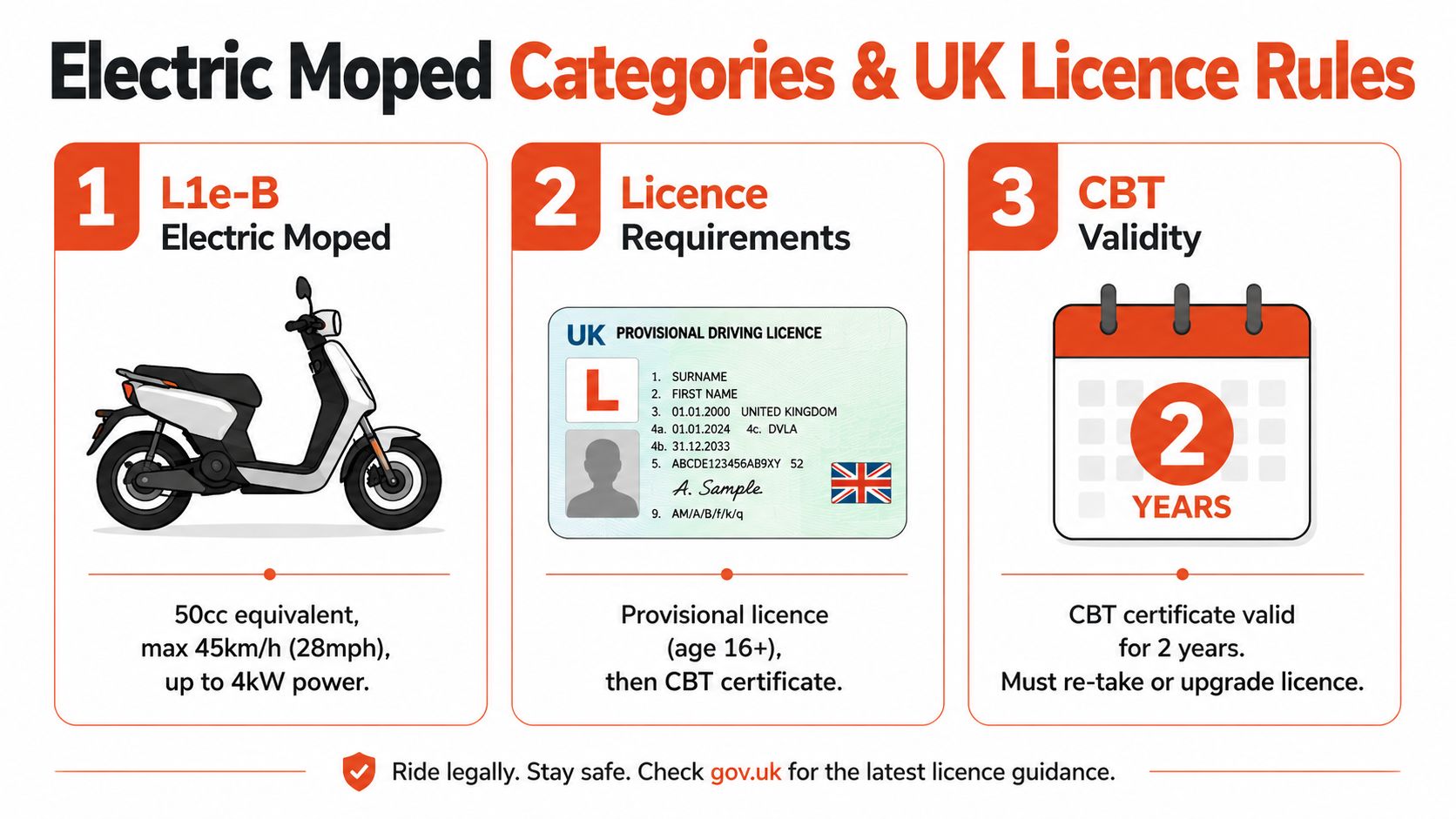
L1e-B electric mopeds
L1e-B is the category most riders mean when they say "electric moped". It is the electric version of a 50cc petrol moped.
For learner riders, this class is aimed at younger riders and lower-speed urban use. The key limits are a top speed of around 28 mph and a power ceiling of up to 4kW. If you are 16 and have completed your CBT, this is usually the category that matters.
L3e-A1 light electric motorcycles
L3e-A1 is the next step up. This is the electric equivalent of a 125cc learner-legal petrol bike.
If you are 17 or over, you can ride an A1-category electric motorcycle on a CBT if the bike fits the learner rules. The headline figure here is up to 11kW continuous rated power. That word, continuous, is where many new riders get tripped up.
The power figure that actually matters
Electric bikes often have two different power numbers on the spec sheet. One is the peak power, which is the short burst the motor can produce for acceleration. The other is the continuous rated power, which is the legal figure used for licence category purposes.
A simple way to read it is this. Peak power tells you how hard the bike can shove for a short moment. Continuous rated power tells you which legal box the bike sits in.
So if a bike has a higher peak output, that does not automatically mean it is too powerful for CBT use. What matters for learner legality in the 125cc-equivalent class is whether its continuous rated power stays within the A1 limit.
A simple comparison
CategoryRough petrol equivalentMinimum ageKey legal limitL1e-B50cc moped16Around 28 mph, up to 4kWL3e-A1125cc light motorcycle17Up to 11kW continuous rated power
That last column matters more than many buyers realise.
Where buyers often get caught out
A sales page might highlight acceleration, top speed, or a big peak power figure because those are the exciting numbers. The legal category usually depends on the approved vehicle class and, for A1 machines, the continuous rated power.
That is why you need to read an electric bike spec sheet a bit like a driving licence checker, not just like a shopper.
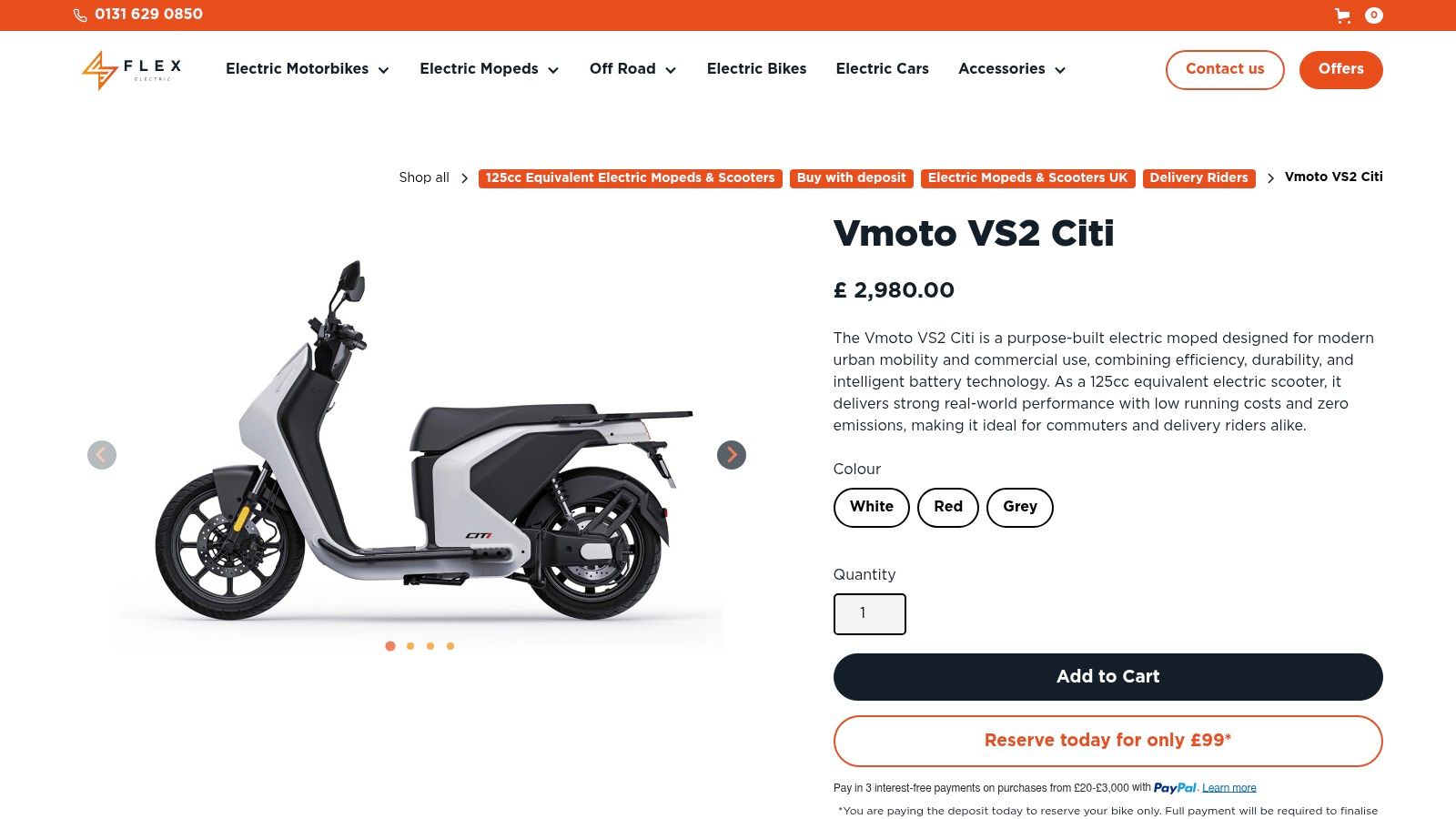
For example, the Vmoto VS2 Citi is a 125cc-equivalent electric scooter. It is built for urban riding and commercial use, and its performance places it in a different category from a low-speed L1e-B moped. If you are considering a machine like that, check the approved classification and the continuous rated power, not just the top speed headline.
One point riders often misunderstand about the CBT itself
A CBT is not tied to petrol or electric in the way many beginners assume.
If you complete your CBT on an electric machine, the certificate still covers you to ride learner-legal petrol bikes in the same licence category. The training is about safe road use and machine control, not locking you into one fuel type. So an electric CBT does not trap you in electric-only riding.
Restrictions that still apply on a CBT
Even with the right bike and a valid CBT, learner rules still apply:
- No motorway use
- No pillion passengers
- Your age, CBT status, and the bike's approved category must all match
Read the category first, then the power figure, then the marketing claims. That order keeps you much closer to the right side of the law.
How to Prepare for Your CBT Appointment
Preparation makes your CBT day calmer, cheaper, and much less frustrating. Riders who turn up organised usually learn faster because they're focused on the training, not on missing documents or unsuitable clothing.
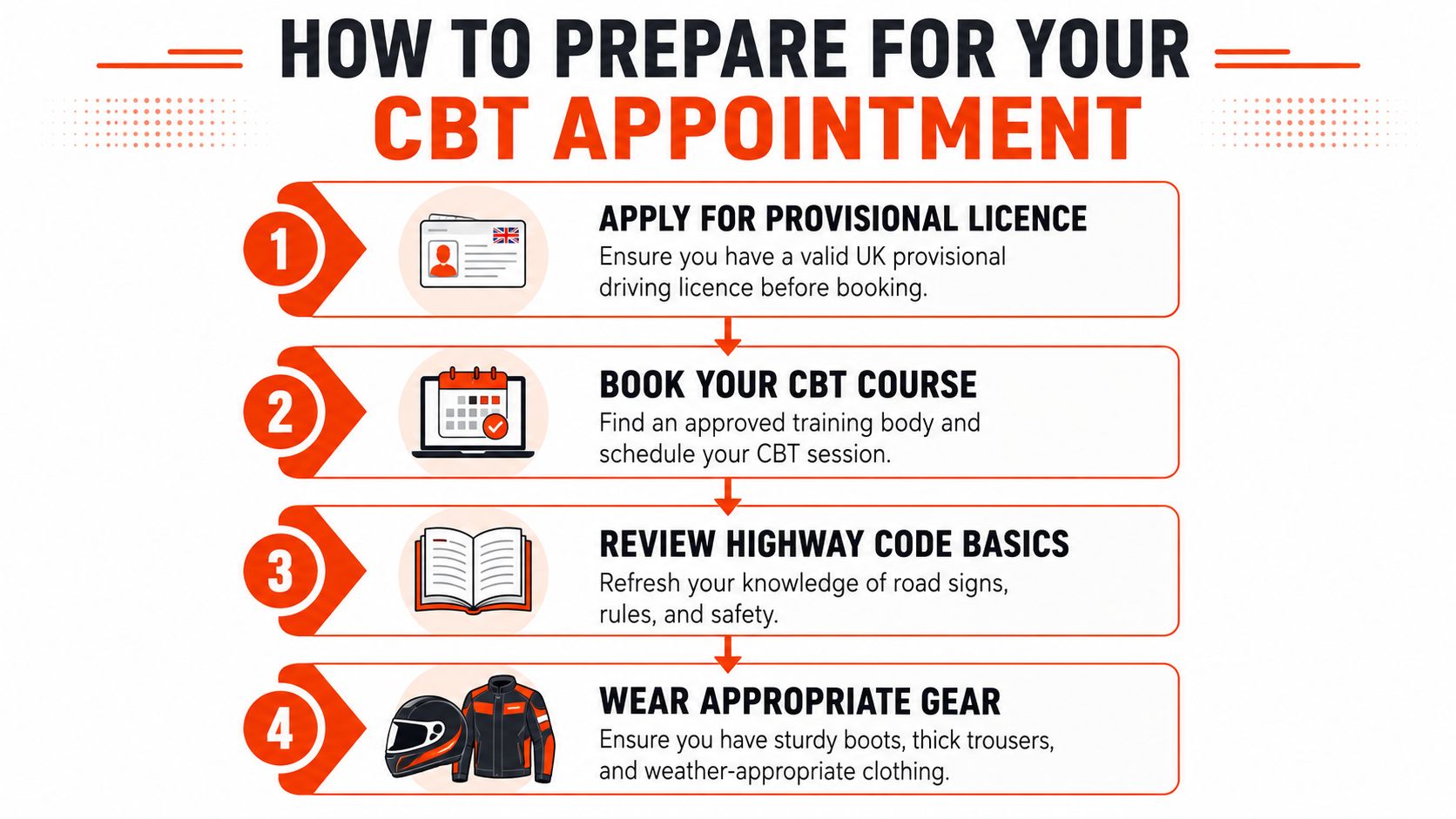
Start with your provisional licence
You need a valid UK provisional driving licence before booking a CBT. Training schools will want to see that you're legally entitled to start rider training.
If you haven't sorted that yet, stop there first. Everything else depends on it.
Book the right training body
Choose an approved training school and ask practical questions before you pay. If you know you want to ride electric, it's sensible to ask whether they train on electric machines or whether they mainly use petrol scooters.
Either is fine for the certificate itself. What matters is whether the school explains the controls clearly and gives you training that matches the kind of riding you plan to do.
Bring the right things
Don't overcomplicate this. You mainly need your paperwork, suitable clothing, and a willingness to listen.
A sensible pre-CBT checklist looks like this:
- Licence documents: Bring whatever the training school tells you to bring and check it the night before.
- Sturdy clothing: Wear thick trousers, proper footwear, and weather-appropriate layers.
- Eyewear if needed: If you normally wear glasses or contact lenses, bring them.
- An open mind: Most riders start the day nervous. That's fine. Instructors expect that.
What the training school usually provides
Many beginners worry they need to buy a full riding kit before doing the CBT. Usually, they don't.
According to Bennetts' explanation of electric bike CBT training, CBT courses typically cost between £120 and £200, and that price almost always includes the hire of the motorcycle or moped plus essential protective gear like a helmet, jacket, and gloves for the day.
That's useful because it lowers the upfront barrier. You can get trained before committing to buying your own kit or your own bike.
A few smart questions to ask when booking
Not every school runs the day the same way. Ask direct questions.
- “Is the bike hire included?” Usually yes, but confirm.
- “Do you provide helmet, jacket, and gloves?” Most do, but don't guess.
- “What should I wear on my lower half and feet?” Schools often have clear safety rules.
- “Do you train complete beginners?” If that's you, make sure they know.
Turn up rested, fed, and early. Riders who arrive flustered usually make simple mistakes they wouldn't make otherwise.
What to Expect on Your Electric Moped CBT Day
The CBT day feels much less intimidating once you know its rhythm. It isn't a surprise exam. It's structured training, and your instructor is watching how you learn, how you listen, and whether you can ride safely.
The day starts off-bike
You'll usually begin with introductions, a basic briefing, and checks such as eyesight and licence paperwork. Your instructor will also talk through safety, road awareness, and the plan for the day.
That first part matters more than people think. It settles nerves and makes sure everyone starts from the same point.
Getting used to the electric moped
Once you move to the training area, the early focus is simple machine control. On an electric moped, that often feels friendlier to beginners because there's no clutch and no gear changing to think about.
But electric brings its own learning point. The power arrives quickly and smoothly, so a new rider needs gentle throttle control rather than a heavy hand.
The biggest difference from petrol training
With petrol scooters, beginners often hear the engine build. On an electric machine, that noise cue is reduced or absent, so riders need to pay closer attention to feel, road position, and speed awareness.
That doesn't make electric harder. It just changes what you notice.
Smooth hands matter on an electric moped. If you snap the throttle open, the bike responds straight away.
Low-speed practice
This is the part many riders worry about, but it's usually the part where confidence starts to grow. You'll practise moving off, stopping, slow control, turns, and observation.
A typical beginner experience goes like this:
- You start stiff and overthink every control.
- After a few repetitions, the moped begins to feel predictable.
- Your instructor helps you link the controls with what the bike is doing.
- The day gets easier once your body relaxes.
Low-speed control is where electric scooters can feel very manageable. The automatic transmission removes one layer of complexity, so you can focus on balance, braking, and looking where you want to go.
Road theory before the road ride
Before the on-road section, your instructor will make sure you understand the essentials of safe road riding. That includes observations, positioning, signs, junction behaviour, and reacting to other road users.
You don't need to be perfect. You do need to show that you can take instruction and apply it safely.
The supervised road ride
During the final stage, you put the pieces together on public roads under supervision. Here, riders realise the CBT is practical, not abstract. You'll deal with real traffic, real junctions, and real decision-making.
On an electric moped, two things usually stand out.
First, the immediate response when you move away from lights can feel brisk. Second, the quiet running can make you more aware of everything around you, from tyre noise to nearby vehicles.
That's why instructors keep stressing observation, planning, and smooth braking. Electric torque is useful in town, but it works best when the rider stays measured rather than reactive.
Choosing a CBT-Legal Electric Moped
You finish your CBT, start shopping, and spot an electric scooter described as “125cc equivalent.” It looks right, the price seems fair, and the performance sounds strong. Then one small spec decides whether you can ride it on a CBT licence. That spec is continuous rated power.
Many new riders get caught by this because electric bike listings often give the biggest, most exciting number first. For CBT legality, that is often the wrong number to focus on.
Peak power and continuous rated power are not the same
Peak power is the short burst a bike can produce for acceleration. Continuous rated power is the output it is legally rated to sustain. A simple way to picture it is this. Peak power is like a sprint. Continuous rated power is like the pace you can hold.
For learner legality, the number that matters is continuous rated power.
That point gets missed all the time with electric mopeds and scooters, because ads tend to lead with speed, range, and punch off the line. Those details matter for day-to-day riding, but they do not tell you on their own whether the bike fits CBT rules.
Why riders get this wrong
“125cc equivalent” is a market description, not a legal shortcut. Sellers may use it to describe overall performance, road presence, or the kind of petrol bike it roughly compares with.
That still leaves one question you must answer before buying.
What is the continuous rated power?
If the seller cannot show you that clearly in the spec sheet or vehicle documents, pause the purchase. You are not being awkward. You are checking the figure that decides whether the bike matches your licence position.
A better way to shop
Check the legal fit first, then the nice-to-have stuff.
What to checkWhy it mattersVehicle categoryTells you whether the bike sits in the moped class or light motorcycle classYour ageAffects which learner category you can rideCBT statusYou need a valid CBT to ride as a learner on the roadContinuous rated powerDecides whether a 17+ learner can legally ride a 125cc-equivalent electric machine
This saves a lot of confusion. A bike can feel quick and still be learner-legal. Another can be sold as learner-friendly and turn out to fall outside the category you expected.
One practical example
If you are 17 or over and looking for an electric scooter for commuting or delivery work, the Vmoto VS2 Citi is one example of a purpose-built urban model. The useful habit is not just checking the top speed or range. It is confirming that the model's legal classification and continuous rated power match what your CBT allows you to ride.
One more point often gets missed here. Doing your CBT on an electric scooter does not lock you into electric bikes only. A CBT is about showing basic riding competence in the right learner category. It does not create an “electric-only” restriction. So while choosing a CBT-legal electric moped, you are choosing a machine that fits your current needs, not closing off petrol options later.
That is the difference between shopping by headline claims and shopping by the spec of real importance.
Your Next Steps After Passing the CBT
Passing your CBT feels like the moment everything opens up, and in many ways it does. You can start riding a learner-legal machine on the road, gain experience, and decide later whether you want to stay at that level or move on to a full motorcycle licence.
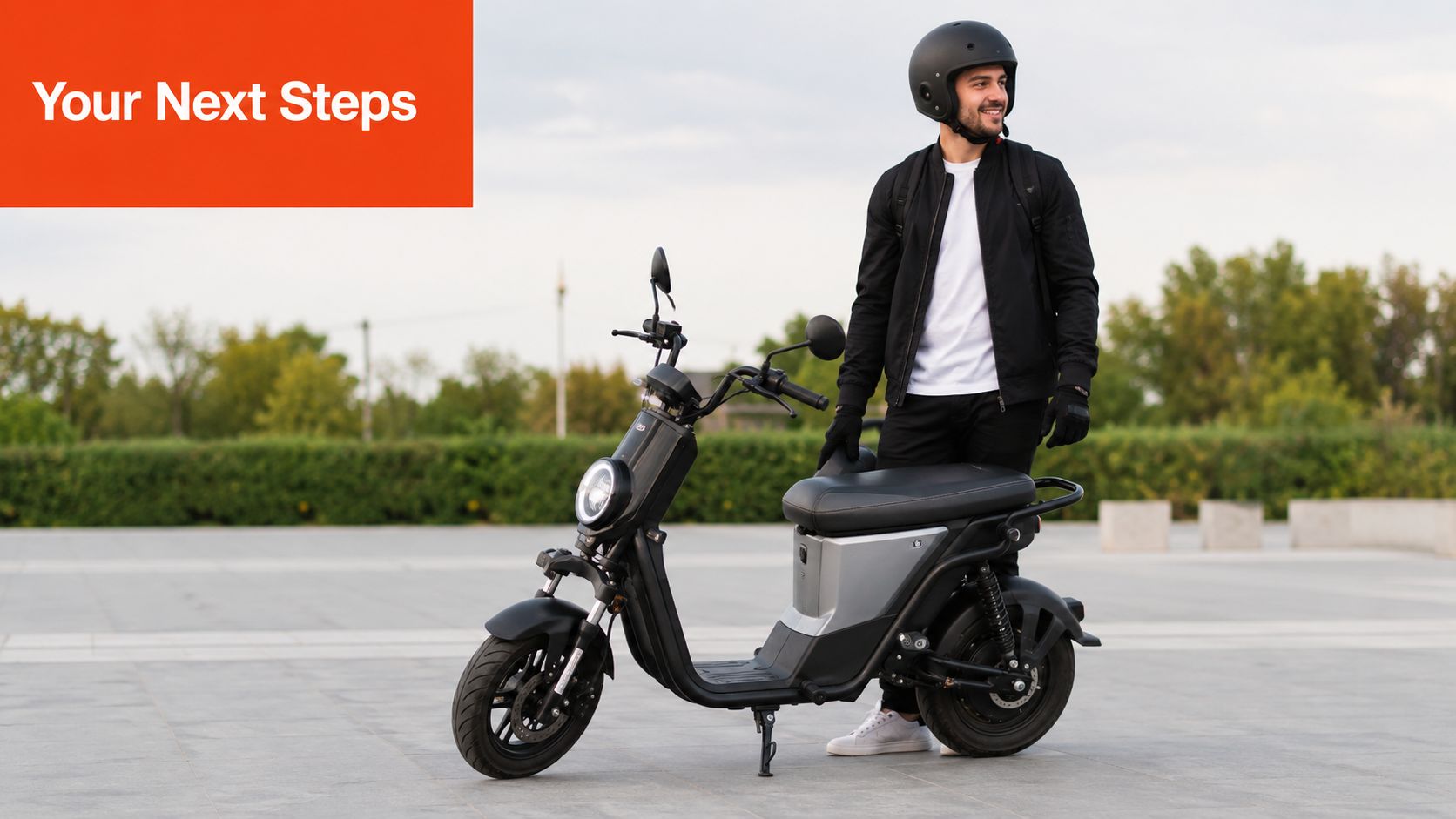
One myth needs clearing up straight away. Some riders worry that if they do their CBT on an electric scooter, they'll be limited to electric bikes afterwards. That isn't how it works.
According to Move Electric's explanation of CBT on electric motorbikes, a CBT certificate is a competency certificate, not a vehicle-specific one, and completing training on an automatic electric scooter gives you the same legal right to ride a geared, petrol motorbike of the equivalent power category as someone who trained on petrol.
What that means in real life
If you complete your CBT on an electric machine, you haven't boxed yourself in. You can still move to a petrol bike later, provided it fits the same learner category rules.
That's useful for riders who want to start with an easier-to-manage automatic scooter, then decide later whether they prefer a geared petrol bike, a stronger electric machine, or a full licence route.
The practical jobs after the certificate
Once you've passed, your next tasks are straightforward:
- Arrange insurance: You'll need valid insurance before road use.
- Fit L-plates: Learner riders need to display them.
- Choose the right bike carefully: Match the machine to your age and licence status.
- Watch your renewal date: The CBT certificate shown in the infographic earlier is valid for 2 years, so you'll need to retake it or move on to a full licence before it runs out.
If you want a feel for electric learner riding in action, this short video helps:
The bigger point is reassuring. An electric moped CBT gives you a route into riding. It doesn't shut off other routes later.
Frequently Asked Questions About Electric Moped CBT
Do I need a motorcycle theory test before taking a CBT
No. You can take the CBT without first passing a separate motorcycle theory test.
Can I carry a passenger after I pass my CBT
No. Learner riders on a CBT can't carry a pillion passenger.
Can I ride on the motorway with a CBT
No. Motorway use isn't allowed for CBT riders.
If I do my CBT on an electric scooter, can I ride a petrol bike later
Yes. Your CBT isn't tied to electric only. It proves riding competence for the equivalent learner category.
How long does the CBT last
The infographic earlier notes that the CBT certificate is valid for 2 years. Before that period ends, you'll need to retake the CBT or upgrade your licence.
Does Flex Electric run CBT training directly
This article focuses on helping riders understand the rules and choose suitable electric mopeds. If you're comparing models and trying to work out what fits your licence position, getting model-specific advice before buying is a sensible next step.
If you're trying to work out which electric moped fits your age, CBT status, and commuting needs, Flex Electric is a useful place to compare road-legal electric mopeds, scooters, and motorbikes with clear model information.
Find us
You will find us at 74 Dalry Road, Edinburgh, EH11 2AY
Showroom Opening Times:
Monday: By Appointment
Tuesday to Friday: 11am - 5:00pm
Saturday: 10am - 5pm
Sunday: By Appointment
