
Electric moped charger: electric moped charger tips for safe, fast charging

Flex Electric
The UK's #1 Electric Moped and Electric Motorbike dealer.

Picking the right electric moped charger is just as important as choosing the motorcycle itself. It's the unsung hero of your daily commute, the device that directly affects your battery's health, your moped’s performance, and your overall convenience. This guide is your complete roadmap to powering up your ride safely and efficiently.
Powering Your Ride the Right Way
Getting to grips with how to charge your electric motorcycle is the first real step in unlocking its full potential. Whether you're on a Super Soco, Segway, or a high-performance LiveWire, the charger is the critical link between the national grid and your battery. Nailing this part from the start means you’ll save money with every charge and help your battery last for years to come.
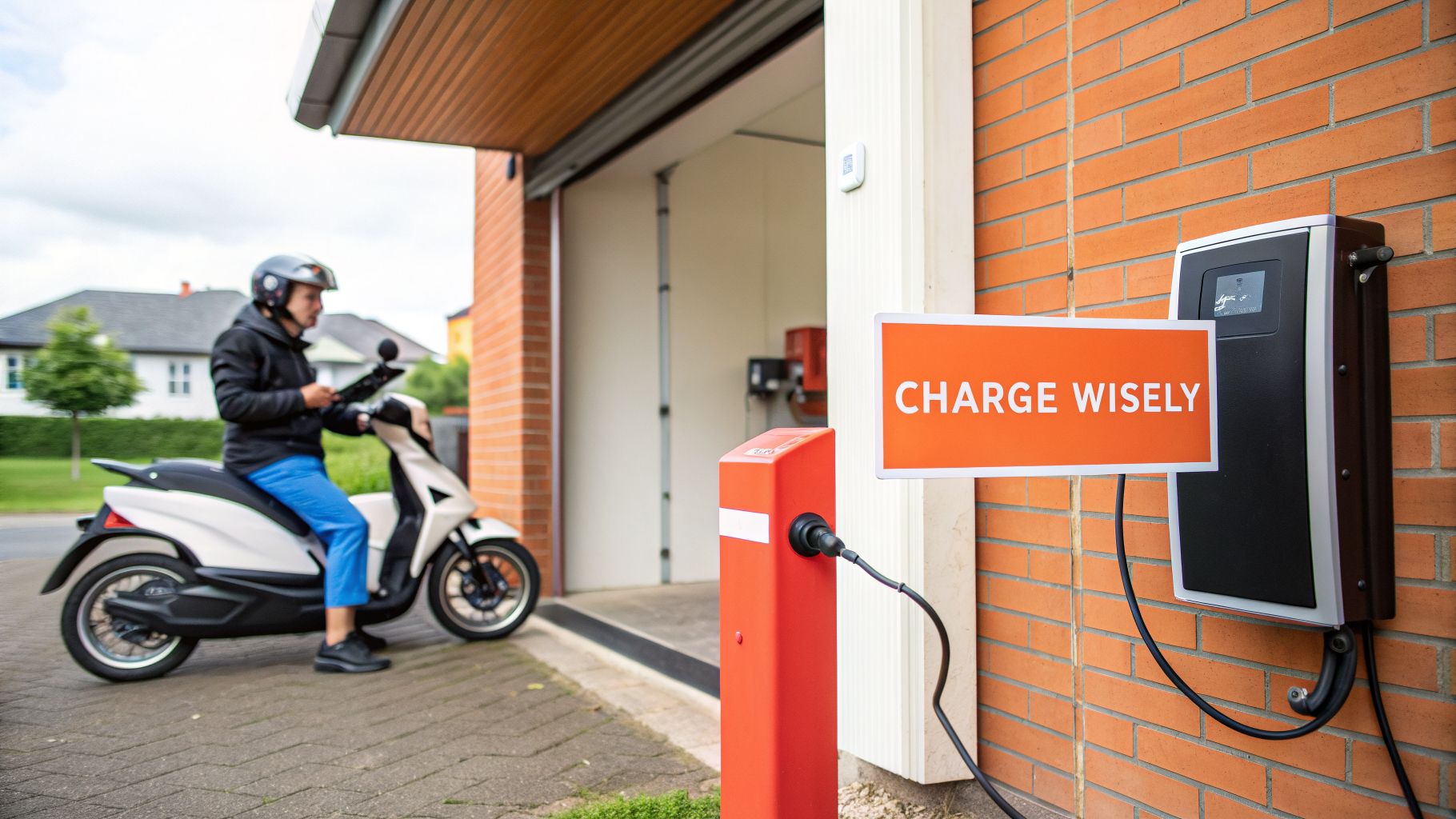
It helps to think of your electric moped charger as more than just a plug. It's actually a smart piece of kit that takes the AC power from your standard UK wall socket and converts it into the DC power your moped’s battery can store. This whole process is carefully managed to prevent overcharging and protect the delicate chemistry inside the battery.
In this guide, we’ll demystify the tech behind the plug, giving you the confidence to charge like a pro. We'll cover everything from the different types of chargers and connectors to charging costs and the must-know safety checks. It's all about making sure your electric motorcycle is ready to go when you are.
Key Aspects We Will Cover
To give you the full picture, we’re going to walk through all the essentials. You’ll learn about the different chargers out there, how to make sense of their technical specs, and what really matters when choosing one. We'll explore:
- Different Charger Types: From portable chargers you can pop in a backpack to the on-board units that are built right into the motorcycle.
- Essential Specifications: We’ll decode voltage, amps, and connector types to make sure you always have a perfect match.
- Charging Times and Costs: Learn how to quickly estimate how long a full charge will take and, more importantly, what it’ll cost you.
- Home and Public Charging: The best strategies for powering up, whether you're at home, at work, or out on the road.
- Safety and Maintenance: A few simple habits to keep your charger and battery in top condition for the long haul.
By the end, you’ll be able to sidestep the common mistakes and ensure your electric ride—whether it's a daily commuter, an off-road beast, or even a kid's motocross bike—is always primed for action.
Good charging habits do more than just top up your battery; they protect your investment. Simple things, like always using the correct electric moped charger and sticking to best practices, can dramatically extend your battery's lifespan and save you hundreds of pounds over time.
Ultimately, understanding your charger is the key to enjoying all the benefits of going electric. Let's start by breaking down the main types of chargers you’re likely to come across. Getting this foundation right will make everything that follows much clearer.
Getting to Grips with Electric Moped Chargers
When you get an electric moped, the charger that comes with it is more than just a cable – it’s your connection to the grid and the key to keeping you on the road. It’s a sophisticated bit of kit, and knowing how the different types work will help you choose a bike that genuinely fits your daily routine.
Chargers mainly come in two flavours: portable and on-board. Each has its own pros and cons, and the right one for you really depends on how and where you ride.
The Freedom of Portable Chargers
Think of a portable charger like the power brick for your laptop. It’s a separate box that connects your moped’s battery to any standard UK 3-pin wall socket. This is the setup you'll find on most 50cc and 125cc equivalent electric mopeds, from brands like Super Soco and NIU to smaller kids' off-road bikes.
The real beauty of a portable charger is its flexibility. You can take the battery out of your moped and carry it with you. This means you can charge it up in your flat, at your desk at work, or even in a café while you’re grabbing lunch. For city dwellers, especially anyone living in a terraced house or an apartment block without a garage, this is a total game-changer. No more worrying about finding a parking spot right next to a plug socket.
There are a few solid reasons why so many riders love this setup:
- Charge Anywhere: You’re not tied down. It's perfect for commuters who need a top-up during the day or delivery riders who can't afford any downtime.
- Better for Your Battery: Bringing the battery indoors protects it from the worst of the British weather. Extreme cold and summer heatwaves aren't great for battery health, so charging inside can help it last longer.
- Added Security: An electric moped without its battery is a much less attractive target for thieves. It’s a simple but effective security boost.
At its heart, every charger does the same job: it takes the AC (Alternating Current) power from your wall socket and converts it into DC (Direct Current) power that your battery can store. This isn't just a simple conversion; clever electronics manage the whole process to keep it safe and efficient.
If you're curious to learn a bit more about the technical side of things, it’s worth understanding how AC is converted to DC voltage, as this is what’s happening inside your charger every time you plug it in.
The Convenience of On-Board Chargers
An on-board charger, as the name suggests, is built right into the motorcycle itself. With this system, the battery stays put. You just plug a cable directly from a wall socket into a port on the bike, exactly like you would with an electric car.
You'll typically find on-board chargers on bigger, more powerful electric motorcycles like the LiveWire S2 or Vmoto Stash. Their batteries are often much larger, heavier, and built into the bike’s frame, so removing them isn't practical. The main advantage here is pure convenience—no need to lug a heavy battery around.
Pros of On-Board Chargers:
- Simple to Use: Just park up and plug in. It couldn't be easier.
- Weatherproof: The charging system is sealed and integrated into the bike, offering better protection from rain and damp.
- Faster Charging Potential: Because they're built-in, these systems can sometimes handle more power, allowing for quicker charging times if you have access to a higher-output socket.
The good news is that almost all electric mopeds and motorcycles, no matter the charger type, are designed to work with a standard UK 3-pin AC power supply. As the UK's public charging network expands, it's becoming even easier to own an electric two-wheeler. As of early 2024, standard chargers (3-8kW), which are perfect for an overnight top-up on models like a Horwin or Naxeon, already make up 50% of the 116,052 total public charging points.
With 24,557 new chargers added in 2024 alone and cities like Greater London leading the charge, finding a spot to plug in is getting simpler all the time. This rapid growth makes both portable and on-board charging more practical than ever before.
Decoding Connectors, Voltage and Amps
Getting your head around your charger's specs might seem a bit technical, but it’s the single most important part of keeping your electric moped running safely and efficiently. Those numbers on the side of the charger aren't just jargon; they're a precise language that dictates how your moped gets its power.
Think of it like this: charging your battery is like filling a bucket with a hose. Voltage (V) is the water pressure, and amperage (A) is the width of that hose. To fill the bucket just right, you need the perfect combination. Too much pressure (voltage) and you’ll crack the bucket; too wide a hose (amperage) and you risk it overflowing.
It’s exactly the same with your moped. Your electric moped charger must deliver the exact voltage and amperage your battery was built for. There’s no room for guesswork here. Using the wrong charger is a costly mistake that can lead to overheating, permanent battery damage, or a bike that simply won't charge at all.
Matching Voltage and Amps Perfectly
When you buy a moped from a trusted dealer, it will always come with a charger specifically approved by the manufacturer. Whether it’s a Vmoto, a Segway, or a high-performance LiveWire, that charger has been precisely calibrated to work with your bike's battery.
The golden rule of charging is simple: always use the charger that came with your motorcycle or an identical, manufacturer-approved replacement. A mismatch in voltage or amps is one of the fastest ways to ruin a battery, and it will almost certainly void your warranty.
So, what do those numbers actually mean for you day-to-day?
- Voltage (V): This number must match your battery’s voltage. If you have a 72V battery, you need a 72V charger. No exceptions. A lower voltage charger won’t do the job, while a higher voltage will cause severe, irreversible damage.
- Amperage (A): This tells you how quickly the charger delivers power. A higher amp rating means a faster charge, but only if your battery’s management system is designed to handle that speed. Using a charger with amps that are too high can stress the battery cells and shorten their lifespan over time.
If you ever lose or damage your original charger, you have to replace it with one that has the exact same voltage and amperage. You can always find these details printed on the charger's label.
The two main types of chargers you’ll come across are designed for different kinds of bikes and use cases, as shown below.
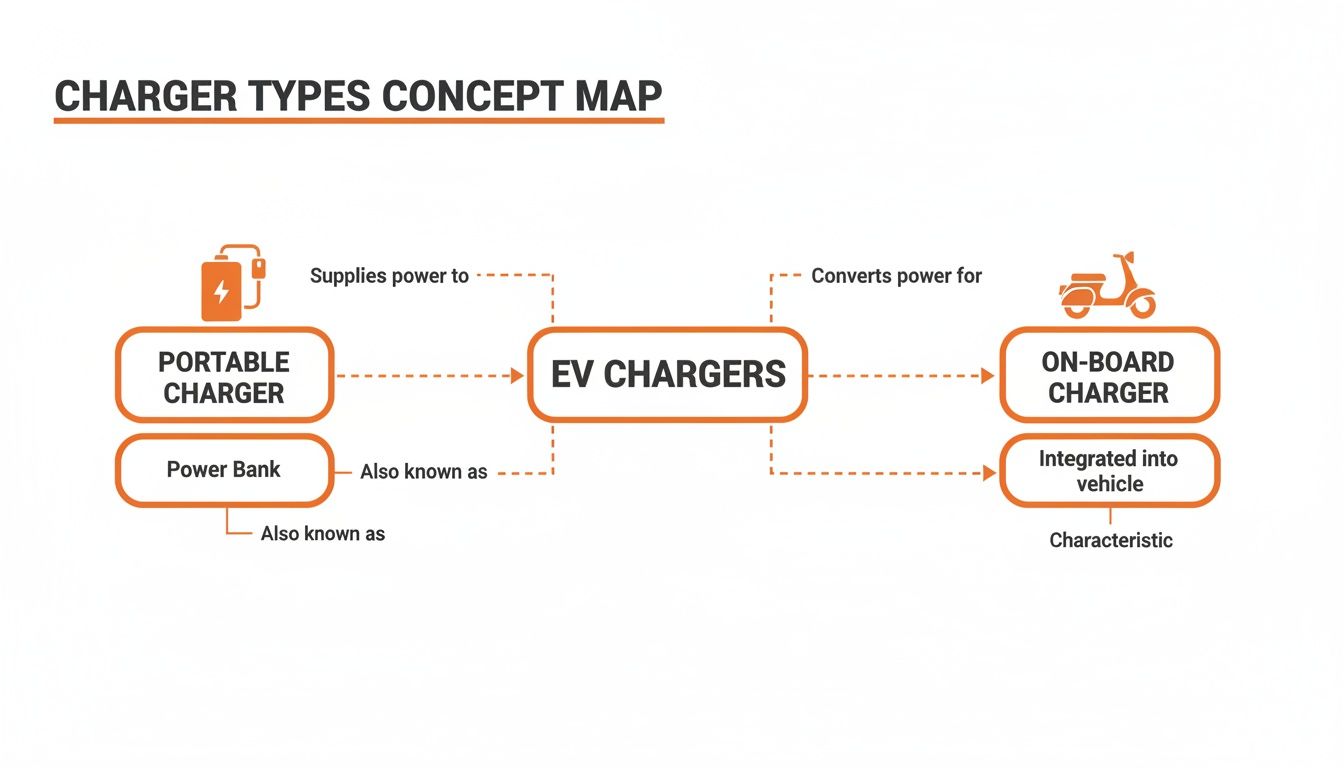
This just breaks down the difference between portable chargers for removable batteries and on-board chargers that are built directly into the bike for plug-and-go convenience.
Understanding Connectors in the UK
Just as important as the charger itself is the plug that connects it to the wall. For most electric moped and motorcycle riders here in the UK, your charging lifeline is the standard Type G plug—that familiar 3-pin plug you find in every home and office.
This is a huge advantage for owners of electric two-wheelers. It means you don't need any special equipment and can top up your battery almost anywhere you can find a socket.
Common Connector Types
- Standard 3-Pin Plug (Type G): This is the workhorse. It’s used for charging the vast majority of electric mopeds and motorcycles in the UK, from city commuters to kids’ off-road bikes. It’s a safe, reliable, and universally available connection.
- Type 2 Connectors: You'll spot these at public charging stations built for electric cars. Some high-end electric motorcycles with on-board chargers, like the LiveWire S2, are now being built with a Type 2 socket. This allows them to tap into the much faster charging speeds available at public points.
- Adapters: If your motorcycle does have a Type 2 socket, you'll likely get an adapter cable. This lets you plug into a normal 3-pin domestic socket at home, giving you the best of both worlds—fast charging when you're out and about, and convenient top-ups overnight.
At the end of the day, a safe and effective charge comes down to making sure every link in the chain is compatible. From the wall socket to the charger, and from the cable to your battery, a perfect connection is non-negotiable.
Calculating Charging Times and Costs
Let's get straight to the two questions we hear all the time: "How long does it take to charge?" and "How much is it actually going to cost me?". The great news is that the answers are surprisingly simple, and they highlight one of the biggest perks of switching to electric. You don't need to be a maths whizz; a little back-of-the-envelope arithmetic is all it takes.
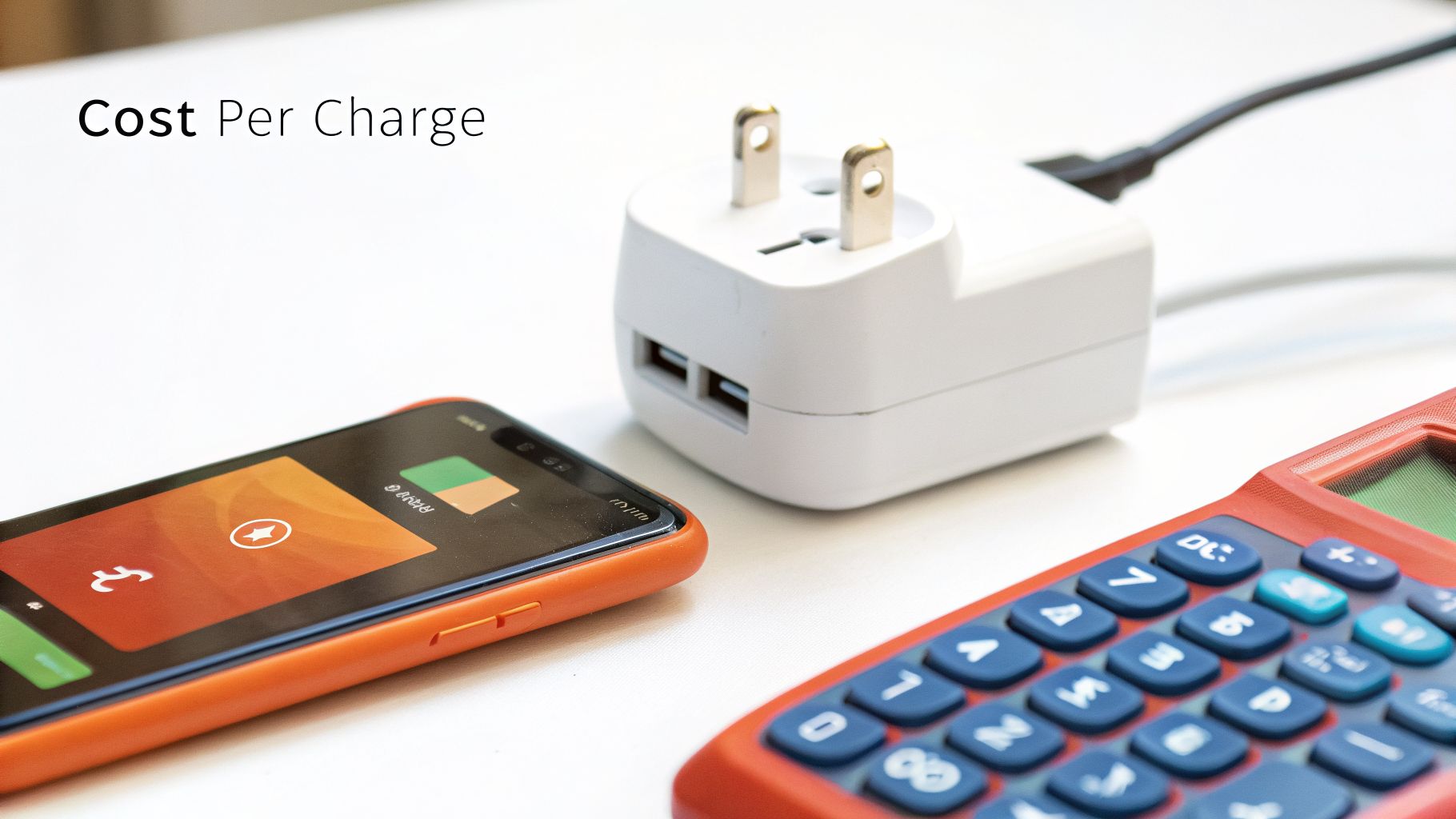
Figuring out your charging time isn't as complicated as you might think. It all boils down to two key numbers: your moped’s battery capacity (in kilowatt-hours, or kWh) and the power output of your charger (in kilowatts, or kW).
The Charging Time Formula:
Battery Capacity (kWh) ÷ Charger Power (kW) = Charging Time (Hours)
This simple equation is your key to planning every charge, whether it's an overnight top-up or a quick boost during the day.
Let’s put it into practice. A standard portable electric moped charger that plugs into any UK 3-pin wall socket typically delivers about 0.6 kW of power. If you’re riding a Super Soco with a 1.8 kWh battery, the calculation is just 1.8 kWh ÷ 0.6 kW = 3 hours. That’s a full charge from empty in the time it takes to make dinner and watch a film.
How to Calculate Your Charging Cost
Now for the really exciting part. Working out the cost of a full charge is just as easy, and this is where you’ll see the incredible savings compared to a trip to the petrol station. All you need is your battery capacity and your electricity rate, which you can find on your latest energy bill.
The average UK electricity rate is currently around £0.25 per kWh. To find your cost for a full charge, you simply multiply your battery’s capacity by that rate.
Using our Super Soco example again:
- Battery Capacity: 1.8 kWh
- Electricity Rate: £0.25 per kWh
- Calculation: 1.8 kWh × £0.25/kWh = £0.45 per full charge
That's right—less than 50 pence to get you back to 100% range. For daily commuters and delivery riders, these savings are a complete game-changer. You could be spending just a few pounds a week on "fuel" instead of £20 or more on petrol.
Estimated Charging Times and Costs for Electric Mopeds
To give you a clearer picture of what to expect in the real world, we’ve put together a quick comparison table. This shows typical charging times and costs for common battery sizes, all based on using a standard home socket.
.tbl-scroll{contain:inline-size;overflow-x:auto;-webkit-overflow-scrolling:touch}.tbl-scroll table{min-width:600px;width:100%;border-collapse:collapse;margin-bottom:20px}.tbl-scroll th{border:1px solid #ddd;padding:8px;text-align:left;background-color:#f2f2f2;white-space:nowrap}.tbl-scroll td{border:1px solid #ddd;padding:8px;text-align:left}Battery Capacity (kWh)Approx. Range (miles)Est. Charging Time (from empty)Est. Cost per Full Charge (at £0.25/kWh)1.8 kWh (e.g., a standard Super Soco)30-40 milesApprox. 3 hours£0.453.0 kWh (e.g., a larger moped battery)50-60 milesApprox. 5 hours£0.754.3 kWh (e.g., a Vmoto Stash)70-90 milesApprox. 7-8 hours£1.0810.3 kWh (e.g., a LiveWire S2)100+ milesVaries (fast charge capable)£2.58
As you can see, even for a high-performance electric motorcycle with a hefty battery, the cost to "fill up" is a tiny fraction of what you’d pay for petrol. This is precisely why so many riders—from city commuters to small business fleets—are making the switch. The savings add up fast, putting more money back in your pocket with every mile you ride.
Your Home and Public Charging Options
Forget what you think you know about vehicle charging. With an electric moped, topping up your battery is easier and more convenient than you might imagine, whether you're relaxing at home or out on the road. Let’s walk through your options, starting with the one you'll use most often.
The beauty of most electric mopeds and motorbikes is their sheer simplicity. The vast majority of them, from nippy city commuters to kids' dirt bikes, are designed to work with a standard 3-pin wall socket. This means your garage, shed, or even a corner of your kitchen effectively becomes your own personal fuel station.
Charging Safely at Home
For nearly every rider, home is where the charge is. Most of the time, this just means bringing your moped's removable battery inside, plugging in the portable electric moped charger, and letting it do its thing. If you've got a larger bike with an on-board charger, you can plug the entire motorcycle directly into a socket in your garage.
It’s a simple process, but it pays to be smart about it, especially if you need to use an extension lead.
- Always Fully Unwind the Lead: Never, ever leave an extension cable coiled up while it's charging. As power flows through the cable, it gets warm. A coiled lead traps that heat, which can quickly become a serious fire hazard.
- Use a Heavy-Duty Cable: Don't just grab any old extension lead from the back of a cupboard. You need a quality, heavy-duty cable rated for at least 13A to handle the continuous power draw safely.
- Keep Connections Dry: This one’s a no-brainer. Make sure the plug, the socket, and the charger connection are always kept in a dry, sheltered spot, far away from any rain or puddles.
If you’re thinking about a more permanent or weatherproof outdoor charging point, it’s worth looking into professional EV Charger Installations to see what’s involved.
Tapping into the Public Charging Network
When you’re on a longer trip or just need a quick boost, the UK’s public charging network is your friend. You’ll often see electric car owners waiting around for expensive rapid chargers, but as a moped rider, you have a brilliant little secret on your side.
The UK's public charging infrastructure is growing at an incredible pace. By early 2026, it had expanded to 118,321 chargers across 45,561 locations—that’s a 13% jump from the end of 2024. For riders of Vmoto or Super Soco models, this is fantastic news. Most electric mopeds charge using a standard plug at under 8kW, and these slower charging points make up a whopping 50% of all UK EV chargers.
The secret isn’t finding a charger; it’s realising the most common ones are exactly what you need. While car drivers hunt for high-power units, thousands of standard sockets are sitting empty, waiting for you.
To track them down, an app like Zapmap is essential. In a few seconds, you can filter for standard 3-pin or Type 2 sockets, check their availability, and see if they're free to use. You'll find these points are especially plentiful in cities. London, for example, has a massive 338.1 chargers per 100,000 people, so you’re never far from a top-up.
Charger Maintenance and Safety Practices
Your charger is the unsung hero of your electric moped. It might not be the most exciting part of your bike, but treating it with a bit of respect is the single best thing you can do for safety, reliability, and the long-term health of your battery. It's not about complicated procedures, just a few simple habits that make a world of difference.
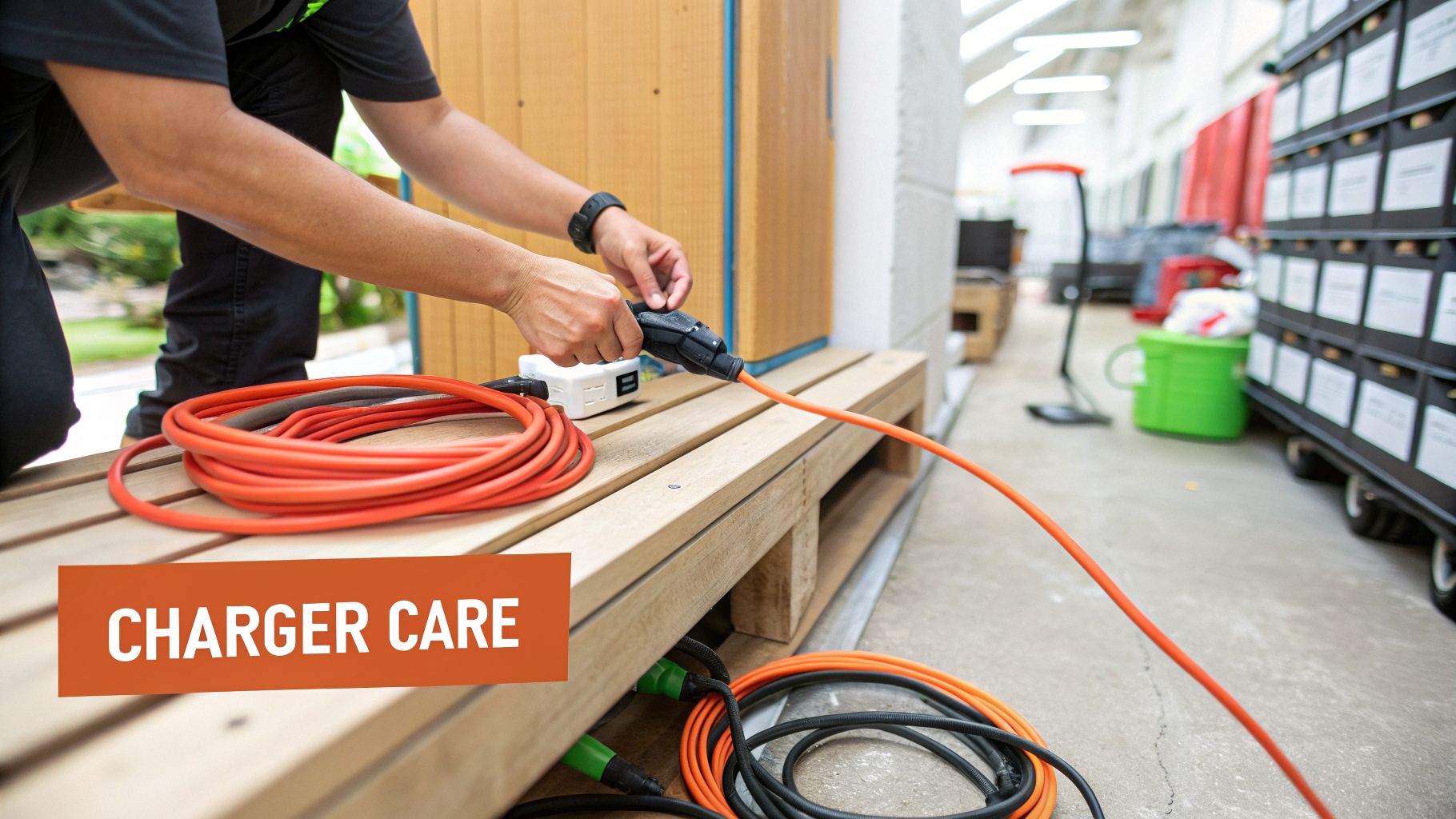
It helps to think of your charger like any other important piece of electronics. It’s built to be tough, certainly more so than your laptop’s power adapter, but it’s not invincible. This means not dropping it, avoiding sharp bends or kinks in the cables, and storing it somewhere cool and dry – never in direct sunlight or a damp shed.
Essential Daily Safety Checks
Before you even think about plugging in, get into the habit of a quick, 10-second visual check. It’s a tiny investment of time that can save you from major headaches and keep every charge a safe one.
Here’s what to look for:
- Inspect the Cables: Run your eyes along the power cord and the connector cable. Any signs of fraying, cracking, or exposed wires are a major red flag. A damaged cable is a serious safety risk and needs to be replaced immediately.
- Check the Plugs and Ports: Take a quick peek at the pins on the charger's connector and the charging port on your moped. They should be clean, dry, and free of any gunk or corrosion. A dirty connection can cause heat build-up and stop your battery from charging properly.
- Give It Room to Breathe: Your charger gets warm when it's working – that’s normal. It relies on airflow to dissipate that heat. Never cover the charger with a jacket, a bag, or anything else while it’s charging. This can trap heat, leading to overheating and potential damage.
A well-maintained electric moped charger isn't just about performance; it’s about peace of mind. Following these basic safety practices is non-negotiable and reinforces your bike’s warranty, including the comprehensive 3-year battery warranty we provide at Flex Electric.
Maximising Your Battery's Lifespan
Good charger care goes hand-in-hand with smart battery management. How you charge directly affects how long your battery performs at its best. For the lithium-ion batteries found in nearly all modern electric motorbikes, from commuter mopeds to kids' motocross bikes, a few key habits can make a huge impact.
The most powerful strategy is what we call the ‘20-80% rule’. For your daily rides and commutes, try to keep your battery’s charge somewhere in this sweet spot. This means plugging it in before it dips below 20% and often unplugging it once it hits 80%. You don't need a full 100% charge every single night. This simple routine reduces stress on the battery cells and can dramatically extend their overall life.
Of course, if you’ve got a long journey planned and need every bit of range, charging to 100% is perfectly fine. The trick is to not make a full charge the default for short, everyday trips. By making these small adjustments to your maintenance and charging habits, you’ll ensure your electric moped is always ready when you are.
Frequently Asked Questions
We get a lot of questions about charging, so we've put together some straightforward answers to the most common ones. Our goal is to make sure you can charge your electric moped with complete confidence.
Can I Use Any Electric Moped Charger for My Motorcycle?
No, and this one is really important. You should only ever use the charger that was specifically made for your moped's battery. Think of an electric moped charger as being keyed to its battery – the voltage (V) and amperage (A) have to be a perfect match.
Using the wrong charger isn't like using a different phone charger; it's a serious safety risk that can cause permanent damage to your battery. It will also instantly void your warranty. That’s why every electric moped we supply comes with the correct, manufacturer-approved charger to keep things safe and efficient.
Seeing a green light on your charger usually means the battery is full. But if your moped isn't charged and the light is green, don't panic. First, double-check that every connection is snug: the plug in the wall, the cable into the charger, and the plug into your moped's port. Sometimes a bit of dirt or moisture in the port can also block the connection, so give it a quick check to make sure it's clean and dry.
Is It Safe to Charge My Electric Moped in the Rain?
You should never charge your electric moped or its battery outside in the rain. Water and high-voltage electricity are a dangerous mix. Always make sure your charging spot is dry and sheltered, like in a garage or under a proper waterproof cover.
The easiest and safest bet, especially for models with a removable battery, is to simply bring the battery inside to charge. This keeps both the battery and the charger well away from damp and cold weather.
Do I Need a Special Wallbox for My Electric Moped?
Good news – no, you don't. Unlike many electric cars, almost all electric mopeds and motorcycles, including the popular models from Super Soco, NIU, and Horwin, are designed to charge from a standard UK 3-pin wall socket.
This is a massive plus. It makes charging incredibly simple and means you don’t have to worry about the extra cost and hassle of installing a dedicated wallbox. Just plug in and you're good to go.
How Can I Extend My Moped Battery's Lifespan?
A few good habits can make a huge difference to your battery's long-term health. For day-to-day use, try to follow the ‘20-80% rule’. This just means keeping the battery's charge level between 20% and 80% most of the time, as it reduces stress on the cells. Try to avoid running it completely flat or leaving it on charge for hours after it’s already hit 100%.
Temperature is also a big factor. If you can, avoid charging in extreme heat or freezing cold, as this can degrade the battery over time. Sticking to these simple tips will go a long way in prolonging your battery's life and performance.
Ready to see just how easy and affordable electric riding can be? At Flex Electric, we’ve hand-picked a range of top-brand electric mopeds and motorcycles for every kind of rider. Explore our collection and find your perfect ride today at https://www.flexelectric.co.uk.
Find us
You will find us at 74 Dalry Road, Edinburgh, EH11 2AY
Showroom Opening Times:
Monday: By Appointment
Tuesday to Friday: 11am - 5:00pm
Saturday: 10am - 5pm
Sunday: By Appointment
