
Electric Moped Insurance UK Costs & Legal Essentials
Flex Electric
The UK's #1 Electric Moped and Electric Motorbike dealer.

You've found the bike you want. The running costs look sensible, the charging routine fits your week, and you can already see yourself skipping fuel stations and city traffic. Then the insurance quote lands in your inbox and suddenly the simple part of buying an electric moped doesn't feel simple at all.
That's the point where most riders start asking the same questions. Is electric moped insurance different from petrol bike insurance? Why are some quotes reasonable and others painful? Do you need special cover for the battery, delivery work, or a higher-value model?
The short answer is this. Electric moped insurance in the UK follows the same legal framework as petrol mopeds, but the details matter more than many riders expect. Your age, licence, postcode, storage, business use, and the exact bike you choose all change the picture. A cheap quote that leaves the wrong risks uncovered can cost you more than the expensive quote you were trying to avoid.
Your New Electric Moped and The Insurance Question
A common shop-floor conversation goes like this. A rider has done the hard part already. They've compared 50cc equivalent and 125cc equivalent bikes, worked out whether they need a commuter or something suitable for longer urban runs, and maybe even chosen a model. Then they ask the question that usually decides whether they ride next week or spend another month thinking about it.
How much is insurance going to be?
That's a fair question because the range can be wide. Some riders come in expecting electric mopeds to be insured like bicycles, which they aren't. Others assume electric means insurers will automatically load the premium, which also isn't always true. What matters is how the bike is classified, who's riding it, where it's kept, and what it's used for.
If your moped is road legal, insurance isn't optional. It sits alongside your CBT or licence position, registration, and road use requirements. For a commuter, that means getting legal before the first weekday ride. For a new rider, it means understanding that the cheapest bike to buy isn't always the cheapest bike to insure. For a delivery rider, it means checking the policy class properly before doing a single paid drop.
Straight answer: If you're comparing bikes and haven't checked insurance yet, you don't have the full ownership cost.
Electric models add a few practical considerations that petrol riders don't always think about first. Battery cover, charging cable cover, and whether the insurer understands electric motorcycles and mopeds all matter. That doesn't mean the process has to be difficult. It just means you need to ask better questions before you buy.
UK Legal Requirements for Electric Moped Insurance
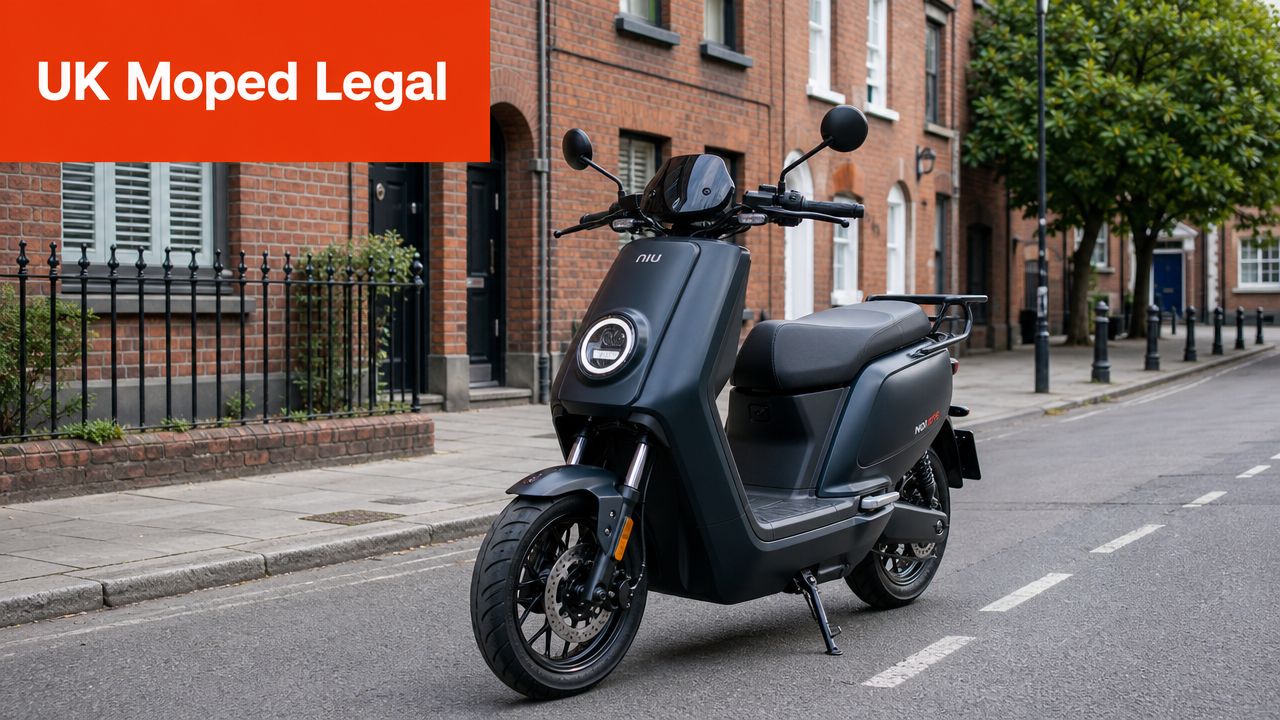
Electric mopeds are treated the same way as petrol bikes for UK insurance purposes. If you want to ride one on public roads, you need at least third-party insurance. That requirement applies regardless of whether you're riding for commuting, personal travel, or any other road use that falls within your declared policy terms.
What the minimum legal cover actually means
Third-party cover is the legal baseline. In practical terms, it covers damage or injury you cause to other people, their vehicles, or their property. It does not cover damage to your own moped if you come off, hit a post, or someone leaves you with a repair bill after an incident that your policy doesn't protect against.
That point catches riders out. They hear “insured” and assume the bike itself is protected. Sometimes it isn't.
Electric mopeds restricted to 28mph (45kmh) are classified as L1e-B and treated as 50cc petrol mopeds in UK law, while models above that threshold are classified as L3e-A1 and require the relevant rider age and licence position for that category, as set out in RiiRoo's explanation of UK electric moped classes. That classification feeds directly into how insurers view the bike.
Why uninsured riding is a serious mistake
The penalties are severe. If an electric motorbike rider in the UK is found without valid insurance, they face fines, licence points, potential unlimited fines, court disqualification, and police authority to destroy the vehicle, according to Carole Nash's summary of uninsured riding penalties.
That's why getting the policy right matters just as much as having one at all. An invalid policy can leave you in almost the same position as no policy.
Two checks riders often miss
- Licence match: Your insurer needs the right licence or CBT status for the bike you're insuring.
- Usage match: If you say commuting but start doing paid deliveries, the policy may no longer match the risk you've declared.
Riding with the wrong class of use is not a technicality. It can become the central problem after a claim.
Decoding The Three Main Types of Insurance Cover
Choose the cover level by asking one practical question first. If the bike was stolen tonight or written off on the way to work tomorrow, could you afford to replace or repair it yourself?
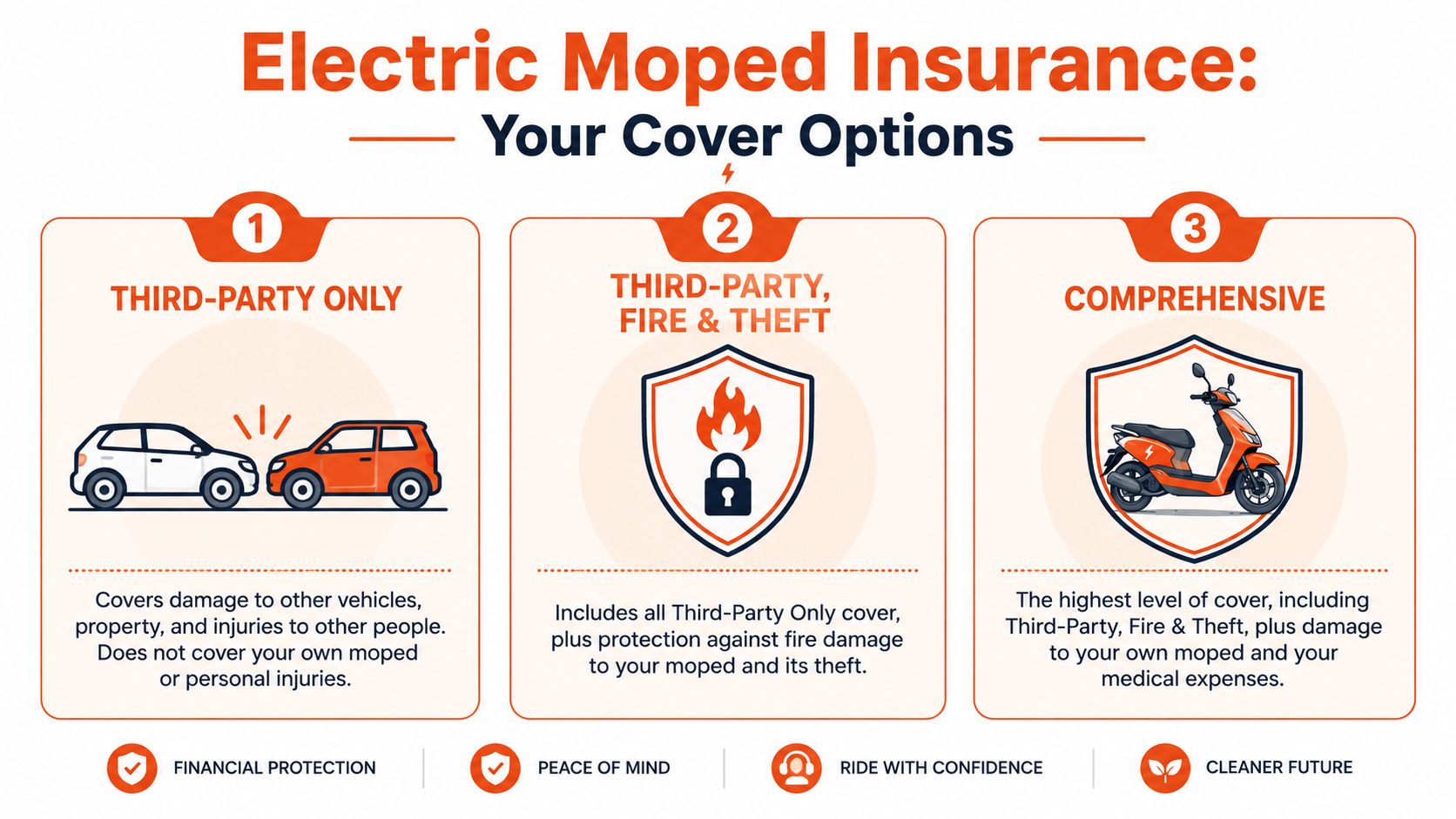
Electric Moped Insurance Types Compared
FeatureThird-Party OnlyThird-Party, Fire & TheftCover including accidental damage to your own mopedLegal to ride on public roadsYesYesYesCovers injury or damage caused to othersYesYesYesCovers theft of your mopedNoYesYesCovers fire damage to your mopedNoYesYesCovers damage to your own moped after an accidentNoNoYesUsually best forLowest-cost legal coverRiders worried about theft riskNewer or higher-value bikes, financed bikes, daily-use riders
What each level suits in practice
Third-party only keeps you legal, but it protects other people and their property, not your own bike. I only suggest it for riders on older, lower-value mopeds where the premium saving is clear and the owner has already accepted the risk of paying for repairs or replacement themselves.
Third-party, fire and theft is often the middle ground for town and city riders. It suits commuters who park outside stations, flats, or workplaces, and riders who know theft is a more realistic risk than a crash they cannot afford to repair.
Cover including accidental damage to your own moped makes more sense once the bike is worth protecting properly. That usually means a newer model, a financed bike, or anything you rely on five or six days a week. For a delivery rider, downtime costs money as well as repair bills. For a commuter, losing the bike can mean train fares, taxis, and missed shifts.
Electric-specific points riders often miss
Some electric motorbike policies can include battery theft or damage, charging cable cover, breakdown help, and protection for riding gear, as outlined in MoneySuperMarket's overview of electric motorbike cover.
Read the battery wording carefully.
Battery degradation is usually excluded. Insurers generally deal with sudden damage, theft, or fire. They do not step in because the battery has aged, lost range over time, or no longer performs like it did when the bike was new. That catches out new electric riders more often than it should.
Matching cover to the bike and rider
A Super Soco TC Max is a good example of where the cheapest policy is not always the smartest one. It is a 125cc-equivalent electric motorcycle, not a throwaway runabout. On a bike like that, theft risk, parts cost, and repair time all matter.
The right choice also depends on who is riding it. A new rider using a lower-value moped for short local trips may decide basic third-party is a calculated risk. A commuter with a newer machine parked near a station usually wants theft included at minimum. A rider using a higher-spec bike every day, or paying finance on it, usually has a stronger case for cover that also pays out for damage to their own moped after an accident.
Good cover is not about buying every add-on. It is about being honest about which losses you could absorb, and which ones would cause a real financial problem.
Understanding the Costs of Electric Moped Insurance
A rider buys an electric moped for a cheap city commute, then gets the insurance quote and realises the yearly premium can change the maths of the whole purchase. I see that happen with new riders more than it should, especially when they price the bike first and the policy second.
The range of quotes is wide
In the UK, full coverage for new electric mopeds can reach £1,500 to £2,000 annually for riders under 30, while third-party only policies can be as low as £145 per year. The same source notes that 51% of UK customers aged 16 to 17 were quoted less than £1,214.33 annually in June 2025, based on discussion and quote examples shared in this MotoUK thread.
That spread is why headline averages only get you so far. A London commuter locking up near a station, a first-time 17-year-old rider, and a takeaway rider doing evening shifts can all look like “electric moped owners” on paper while facing very different premiums.
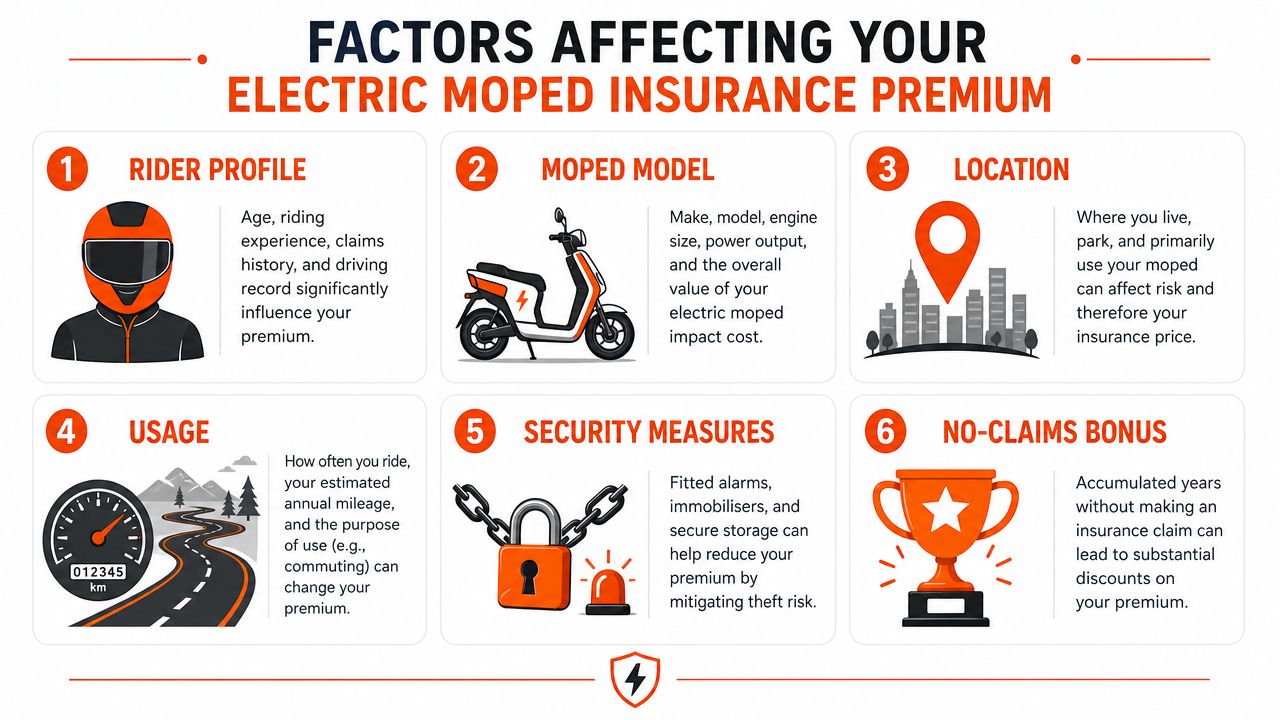
What moves the premium
Rider profile
Age, licence type, riding history, claims record, and no-claims bonus all affect the price. New riders usually pay more. Riders with a clean record and a few years behind them usually have more room to shop around.
The cost jump can be sharp for younger riders on CBTs, particularly if the bike is their first vehicle and the insurer has little history to price from.
The bike itself
Insurers price the bike you have, not the generic idea of an electric scooter. They look at replacement value, performance, parts cost, theft appeal, and how easy it is to repair after a spill.
The Vmoto VS2 Citi is a useful example because it sits in a category many riders misunderstand. It is a purpose-built electric moped for urban work, a 125cc equivalent electric scooter with a 50mph top speed and 66 mile range. For a commuter, that can make it a sensible all-rounder. For a delivery rider or business, those same specs can place it in a different risk conversation because mileage, parking patterns, and business use all change the insurer's view.
A lower-value runabout used for short local trips may attract a very different quote from a newer, higher-spec model, even if both are electric.
Location and overnight storage
Postcode still matters a lot. So does where the moped sleeps.
On-street parking usually costs more than a locked garage. Shared underground parking can be viewed differently from a private outbuilding. Approved locks, trackers, and secure storage do not guarantee a cheap quote, but they often help, especially on bikes that are common targets for theft in bigger towns and cities.
Benchmarks that help set expectations
For younger riders, the market is often expensive. Young riders aged 16 to 17 face average moped insurance costs of around £1,215 annually for extensive coverage, while 50cc moped insurance can be under £481 and 125cc scooter insurance under £803, according to Compare the Market's moped and scooter insurance data.
For older riders with a clean record, secure storage, and some no-claims history, quotes can come down a lot. Electric bikes are not automatically cheaper to insure just because they are electric. In practice, insurers still care about repair cost, theft risk, and rider profile far more than the fuel type.
What usually saves money, and what wastes it
- Usually helps: getting quotes before you buy, especially if you are choosing between a 50cc-equivalent and a 125cc-equivalent model
- Usually helps: declaring the right use from the start, including commuting or business use where relevant
- Usually helps: improving overnight security and being precise about where the bike is kept
- Usually backfires: choosing the cheapest policy without checking excess, theft cover, and storage conditions
- Usually backfires: assuming a delivery setup will price like a personal commuter bike
The practical lesson is simple. Insurance cost is part of the bike's running cost, not a side note. If the premium stretches the budget, it is better to change the bike, the storage setup, or the cover level before purchase than to force a setup that never made financial sense.
Insurance for Delivery Riders and Business Fleets
If you use your electric moped for paid deliveries, standard social, domestic and pleasure cover isn't enough. Commuting cover on its own usually isn't enough either. Once money changes hands for transport work, you need the correct class of policy for that use.
For riders doing food delivery, that typically means hire and reward or another business-use arrangement that specifically matches the work. Without it, you can end up paying for a policy that looks valid until the moment you need to claim.
Why this catches so many riders out
A lot of delivery riders start with a bike they also use personally. That's normal. The problem starts when they assume the same insurance follows them into paid work. It often doesn't.
If you have an accident while working and your insurer sees undeclared business use, the consequences can be serious. At best, you're in an argument at the worst possible time. At worst, the policy doesn't respond the way you thought it would, and you're left exposed for damage, third-party costs, or both.
If you're carrying food for payment, insure the bike for that exact job. Don't rely on guesswork.
What businesses should think about
For restaurants, takeaways, florists, venues, and other operators electrifying local transport, insurance needs to be treated as part of fleet planning, not an afterthought. The right policy setup depends on who rides the bikes, how many riders use them, where the bikes are stored, and whether they're used only for business.
A business also needs consistency. If one bike is insured correctly and another isn't, the weak point is still there. Good fleet planning means matching bike choice, rider eligibility, and insurance class before bikes are deployed.
Practical checks before any work starts
- Confirm class of use: Ask specifically whether the quote covers delivery or hire and reward.
- List all riders properly: Fleets fall over when rider details are incomplete or outdated.
- Check accessories and equipment: Delivery boxes, business equipment, and daily-carry items may need to be declared.
- Review downtime risk: If a working bike is off the road after theft or damage, the business impact is immediate.
How to Get Your Electric Moped Insured
You buy the bike, sort the helmet, and book the first ride. Then the insurance form asks whether it is social use, commuting, or business, where it sleeps at night, and who will ride it. That is the point where a straightforward quote can turn messy.
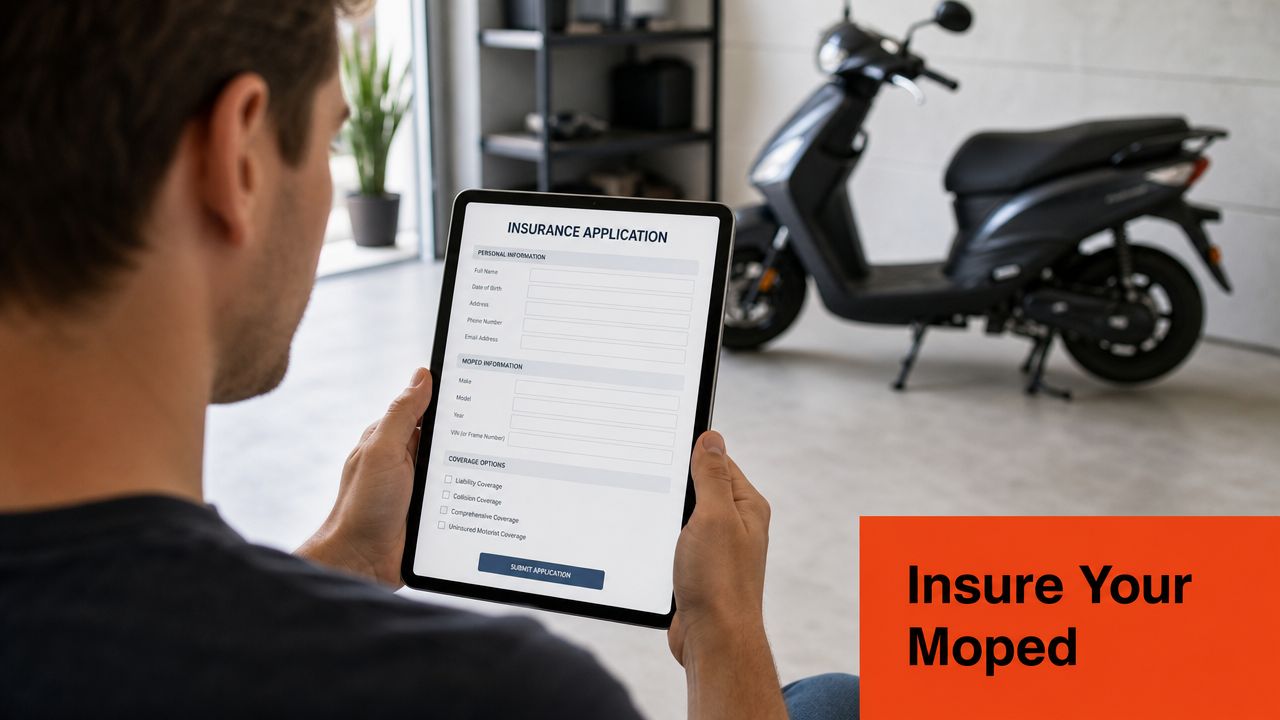
For UK riders, the process is usually simple if the details are accurate from the start. Insurers will ask about your licence, your no-claims history, how many miles you expect to do, where the moped is kept, and whether it is only for private riding or tied to work. Lexham's electric motorcycle and moped insurance page gives a good outline of the information they typically need.
Get your details ready first
Before you request quotes, get the basics straight:
- Your licence position: CBT, AM, A1, A2, or A.
- Bike details: Registration if you have it, or the exact model if you're quoting before purchase.
- Usage pattern: Personal use, commuting, business use, or delivery.
- Storage: Where the moped stays overnight.
- No-claims proof: If you've built one up, make sure you can show it.
Accuracy matters more than speed here. A commuter riding a NIU, Super Soco, or similar 50cc-equivalent into town each day should say that plainly. A new rider using the same bike only at weekends will often need a different setup. A delivery rider on a higher-mileage schedule is a different risk again, and the quote needs to reflect that from day one.
Comparison sites versus specialists
Comparison sites are useful for a first price check. They help you see whether your quote is broadly in the right range.
Specialists are often better once the details get less standard. That includes riders insuring a more expensive model, riders with limited history, or anyone who wants to check exactly how the policy treats batteries, charging kit, or declared accessories. In the shop, I usually tell customers to do both. Use a comparison site to set a baseline, then speak to a specialist if the bike, rider profile, or use case is not completely ordinary.
Here's a useful walkthrough on how riders approach the process in practice:
Don't confuse warranty with insurance
This catches out new riders all the time. A warranty deals with faults and defects covered by its terms. Insurance deals with crashes, theft, fire, vandalism, and liability to other people.
If you're buying through Flex Electric, you may see included warranty cover for parts and the battery as part of the ownership package, as noted earlier. That still does not replace road insurance. The two protect you against different costs, and riders who mix them up usually realise the difference at the worst possible moment.
One application rule that saves trouble later
Declare the bike as it will be used.
If you fit a top box, add security devices, change where it is stored, or start using it for work, tell the insurer. The same goes for named riders. A policy is only as good as the information behind it, and claim problems usually start with a detail that seemed too minor to mention when the quote was taken out.
Frequently Asked Questions About Electric Moped Insurance
Is electric moped insurance more expensive than petrol bike insurance
Price usually comes down to risk profile, not fuel type. For a UK commuter on a 50cc equivalent electric moped kept in a locked garage, the premium can sit in the same general bracket as a petrol scooter. For a new rider in a city, a financed bike, or a delivery setup, the cost can climb quickly.
The bike still matters. A Sur-Ron used off road is a different insurance conversation from a NIU or Super Soco used for weekday commuting. The insurer will look at value, theft risk, where it sleeps at night, and whether the bike is being used for social riding, commuting, or paid work.
Can I insure an off-road electric motorbike
Yes, but the cover needs to match how the bike is used. If the bike never goes on public roads and stays on private land, you are usually looking at theft and accidental damage cover rather than normal road insurance.
This catches out riders who buy a road-legal electric bike and then use it mainly on farms, tracks, or private estates. Tell the insurer exactly where it is ridden and stored. If the bike goes on the road even occasionally, say so from the start.
How can I bring the premium down
Start with what insurers care about most. Secure storage, approved locks, realistic mileage, and the right use class all make a difference.
I also tell riders to insure the bike they need, not the one that looks best on paper. A new commuter choosing a sensible 50cc equivalent for station runs will often get a cleaner result than someone stretching to a faster bike they do not need. Adding security can save money. Underinsuring its actual use can cost far more later if a claim is challenged.
Do I need special cover for the battery
Sometimes. Battery theft and battery damage are not always treated the same way, and battery degradation is usually a separate issue again.
Check the wording for theft, fire, water damage, accidental damage, and whether the battery is treated as part of the bike or as a listed component. This matters more on higher-value electric mopeds, where the battery is a large share of the bike's replacement cost.
Is the cheapest policy usually the best option
Cheap can work for an older runabout you could afford to replace yourself. It is a much riskier choice for a new electric moped, a bike on finance, or a machine you rely on for work.
Look past the headline price. Check excess levels, theft conditions, whether accessories are covered, and whether commuting or hire-and-reward use is included. For delivery riders, the wrong cheap policy is often useless the moment you need to claim.
If you're weighing up bike choice, insurance reality, and daily running costs together, Flex Electric is a practical place to start. The team works with electric mopeds, scooters, motorbikes, off-road models and business-use riders every day, so the advice stays grounded in real UK ownership rather than generic bike-shop talk.
Insurance for your electric motorcycle or moped
Finding insurance for an electric motorcycle or moped can sometimes be more challenging than insuring a conventional petrol-powered bike, as not every insurer offers cover for electric two-wheelers.
If you're looking for insurance, it's worth shopping around and comparing quotes from a number of providers. The following companies may be able to help:
Specialist Motorcycle Insurance
- Lexham Insurance – Specialist insurance for electric motorcycles and mopeds.
- Bikesure – Specialist motorcycle broker offering cover for electric motorcycles and scooters.
- Bennetts – Motorcycle insurance for a wide range of riders and bikes.
- Carole Nash – Motorcycle and scooter insurance.
Compare Insurance Quotes
- The Bike Insurer – Compare motorcycle insurance quotes from multiple providers.
- Biker Insure – Comparison service specifically covering electric motorcycles, scooters and mopeds.
Tip: Insurance premiums can vary considerably depending on your age, postcode, licence, riding experience, annual mileage, the value of your bike and how it is used. It's therefore worth getting quotes from more than one provider.
Flex Electric is not an insurance broker and does not recommend or endorse any particular insurance provider. Availability of cover and premiums will depend on your individual circumstances and the vehicle being insured.
Find us
You will find us at 74 Dalry Road, Edinburgh, EH11 2AY
Showroom Opening Times:
Monday: By Appointment
Tuesday to Friday: 11am - 5:00pm
Saturday: 10am - 5pm
Sunday: By Appointment
