
Electric Moped Range: Real World UK Insights

Flex Electric
The UK's #1 Electric Moped and Electric Motorbike dealer.

The most common advice on electric moped range is also the least useful: just look at the claimed number and leave a bit of buffer. That's not how real UK riding works.
Range isn't a fixed figure. It moves with speed, weather, route, payload, battery condition, and how the rider uses the bike. For a commuter, that decides whether the journey home feels routine or stressful. For a delivery rider, it decides whether the shift stays profitable.
The practical question isn't “what range does this model advertise?” It's “what distance will this moped cover on my roads, in my weather, with my riding style, and how does that affect charging time, running cost, and battery wear?” That's the number that matters.
Why Your Moped's Advertised Range Is Not the Full Story
Walk into any showroom or browse product pages and you'll see the same pattern. A moped is presented with a headline range figure that looks tidy, reassuring, and easy to compare. The problem is that riders don't travel in test conditions.
Electric moped range is better understood as a moving target. A moped can feel frugal on one day and thirsty on the next, even when the route looks similar on paper. A cold morning, a heavier load, more stop-start traffic, or a faster stretch of road can all shift the result.
What the headline figure really means
Advertised range usually reflects controlled conditions. That makes it useful as a benchmark between models, but poor as a promise for daily riding. If you treat it as guaranteed distance, you'll almost always plan too aggressively.
That matters more in the UK because a lot of riding is urban. Riders deal with junctions, traffic lights, hills, wet roads, wind, and seasonal temperature swings. Those conditions don't just trim range slightly. They can change whether a battery comfortably covers the day or runs out too early.
Practical rule: Buy an electric moped for the range you'll actually use, not the number that looks best on a spec sheet.
What riders should focus on instead
A better approach is to ask four simple questions:
- How far is the actual daily duty cycle? Include detours, errands, and the trip home.
- How fast will the bike usually be ridden? Higher speed costs range.
- What load will it carry? Rider weight, luggage, and delivery gear all count.
- Where will it charge? Home charging solves a lot. Limited charging access changes the whole calculation.
When riders answer those properly, range stops being a marketing number and becomes an operating number. That's the difference between choosing the right machine and choosing one that only looks right.
Manufacturer Claims Versus Real-World Performance
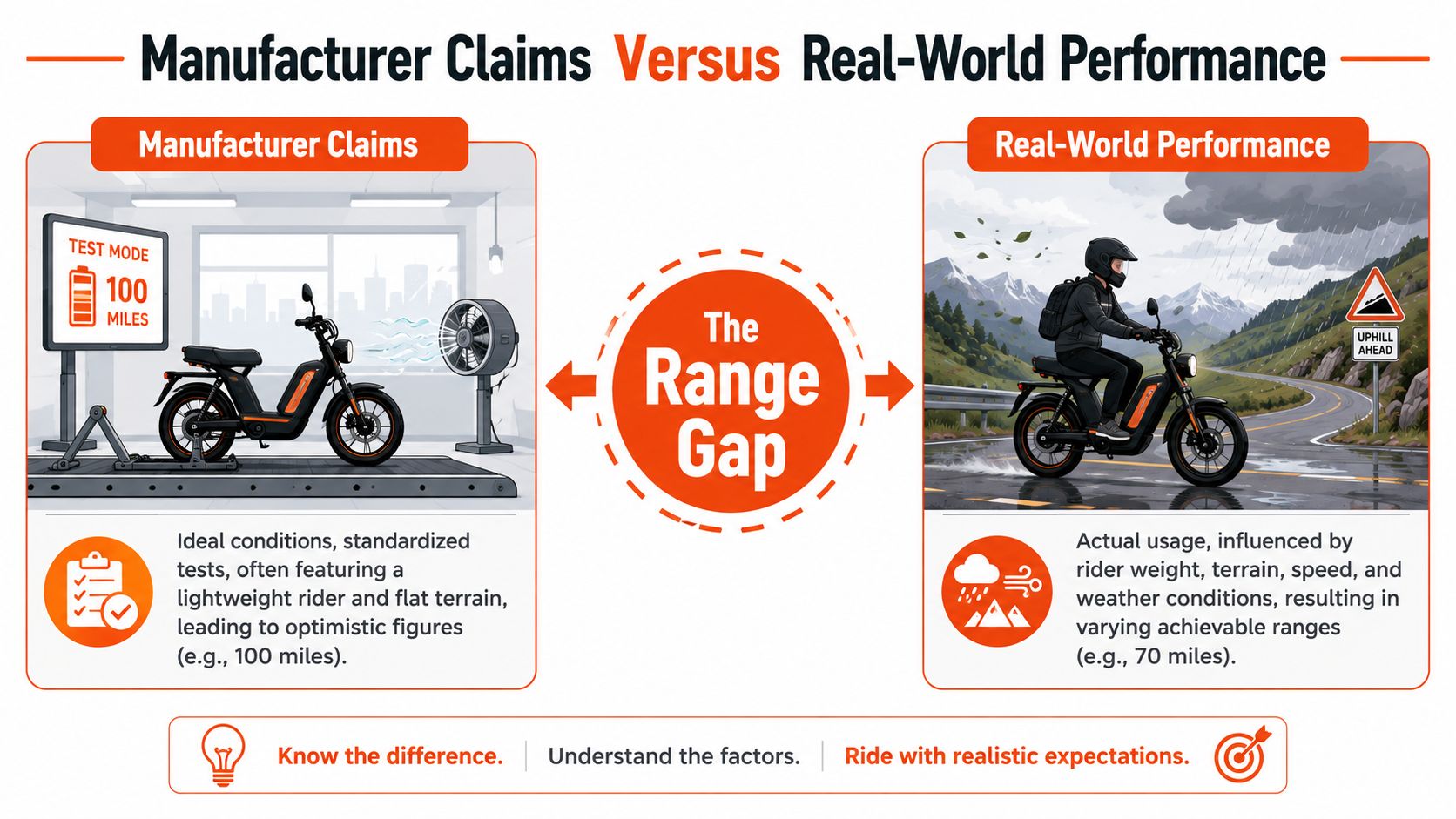
The brochure figure is usually the best-case number, and that matters because riders buy shifts and journeys, not laboratory results. Independent testing found that electric scooters and mopeds delivered about 71% of claimed range in real use, with some dropping to 53%, according to Rider Guide's claimed-versus-tested range analysis.
Why the gap happens
Test conditions are usually kind to the battery. Steady speed, mild weather, lighter loads, and fewer interruptions all help a moped post a strong number.
UK use is rarely that tidy. Riders deal with traffic lights, cold starts, wet roads, hills, headwinds, and the extra drag of a delivery box or loaded backpack. Each one chips away at usable miles. Put several together on the same shift and the gap becomes expensive, not academic.
A practical buying rule is simple. Treat the claimed figure as a comparison tool, then cut it down for planning. For private riders, that stops you overbuying a bike that looks good on paper but does not reliably cover the weekly routine. For delivery operators, it affects route design, spare battery needs, charger placement, and whether a rider loses earning time waiting on charge.
Cold weather is one of the biggest UK variables, especially for winter fleet work. Teams that want better consistency should look at how to extend battery performance, because winter range loss changes both daily capacity and battery stress over time.
What that means on the road
At Flex Electric, we frame range in three layers. There is the advertised number, the actual daily number, and the safe operating number you plan around. The last one is what keeps a commuter from arriving home with 3% left and what keeps a delivery rider from missing the final run.
- For commuters: Keep reserve for detours, traffic build-up, and colder months.
- For delivery riders: Cost per drop matters more than headline range. If a bike needs mid-shift charging or an extra spare battery to finish a round, the operating cost changes quickly.
- For fleet managers: Warranty support and battery replacement terms matter as much as outright mileage. A cheaper bike with weak aftersales cover can cost more over a year if downtime rises.
A model such as the Vmoto CPX 74V is often shortlisted for commuting and delivery because it is a 125cc-equivalent electric scooter with up to 87 mile range and a 56mph top speed. Even then, the useful number for planning is the one the bike can repeat in your actual duty cycle, with your rider weight, your roads, your speed, and your charging setup.
Range complaints are often planning mistakes. The real cost shows up in missed jobs, extra charging time, and batteries pushed harder than the warranty assumptions.
The 9 Key Factors That Drain Your Battery
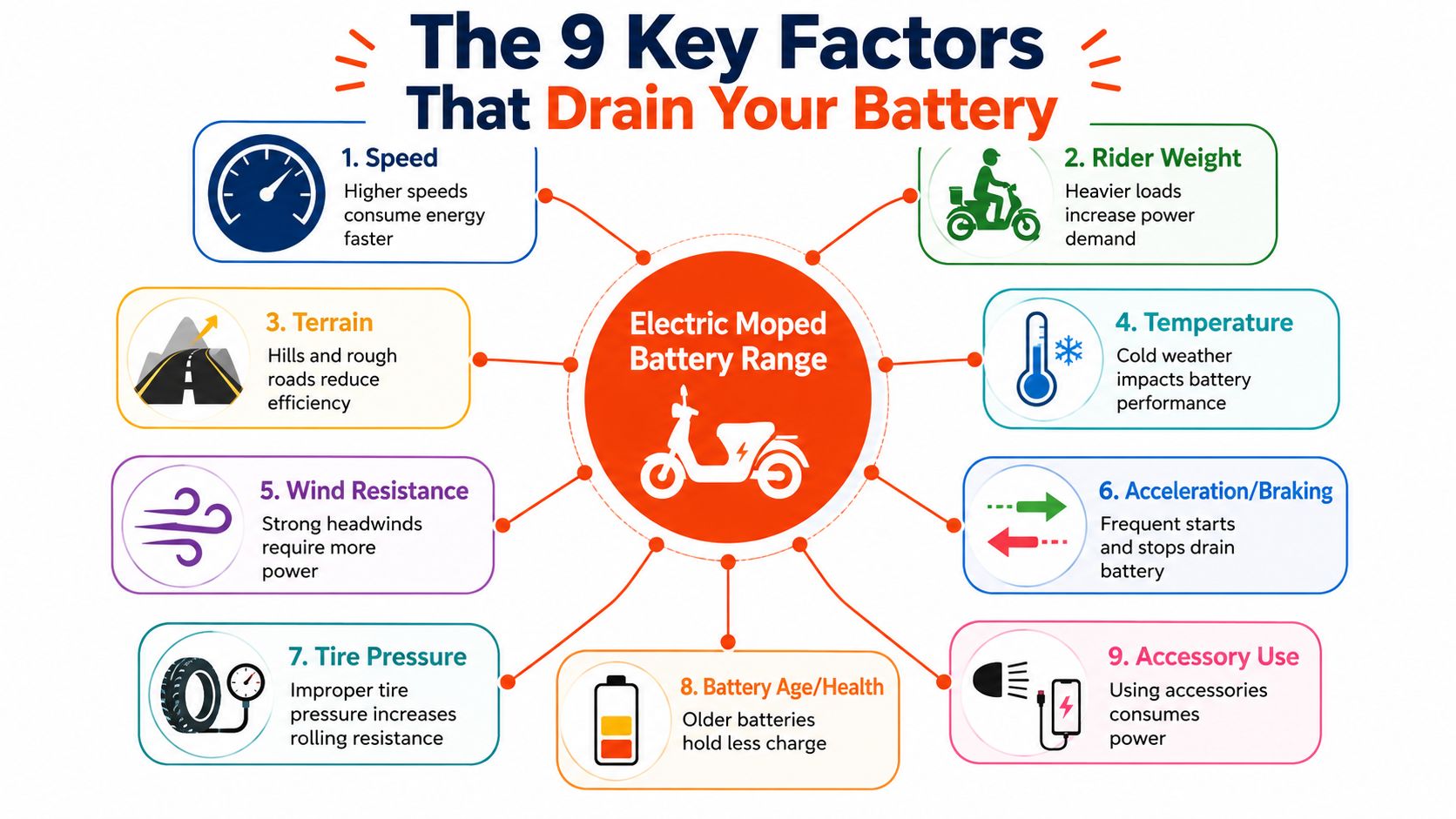
Headline range figures hide the part that matters in daily use. Battery drain comes from a stack of small penalties, and on UK roads they add up fast. For a commuter, that usually means less buffer at the end of the ride. For a delivery rider or fleet manager, it means more charging stops, more spare batteries, and higher cost per mile.
A battery works more like a daily operating budget than a fuel gauge. Spend energy gently and the bike covers more ground. Spend it in short bursts, carry extra load, fight hills, wind, and cold, and the same route starts costing more than expected.
Rider and usage factors
Three drains come from how the bike is ridden.
- Speed: Higher speed is the biggest range killer for many riders. Once you push on, the motor keeps spending harder to overcome air resistance, so the battery depletes much faster than many new owners expect.
- Rider weight and payload: Extra body weight, a passenger, a delivery box, or a full bag all increase the energy needed to pull away and climb.
- Acceleration and braking: Hard launches and repeated stop-start riding waste range because the bike keeps paying to rebuild momentum.
Then there is auxiliary load. Headlights, heated kit, phone charging, and rider accessories draw less power than the motor, but they still come from the same battery. On a short commute that may be minor. On an all-day delivery shift, it becomes part of the operating maths.
Road and weather factors
The road itself often decides whether a claimed range feels realistic.
- Hills: Climbing raises motor load straight away.
- Road surface and junction density: Rough streets, speed bumps, and repeated starts all reduce efficiency.
- Wind: A steady headwind can drain a battery in the same way higher cruising speed does.
- Cold weather: Low temperatures reduce usable battery performance and can make charging less convenient if the pack is left outside.
Cold weather matters in the UK because it changes both range and routine. Riders who leave a removable battery in a freezing shed overnight often see poorer morning performance, and fleets feel that loss across multiple bikes. If winter use is part of the plan, charging access indoors and battery care should be part of the purchase decision, not an afterthought. For a practical guide on how to extend battery performance, that Mobile Systems article is a useful reference.
Cold-weather habit: Bring a removable battery indoors before charging if the bike has been outside in freezing conditions.
Moped condition factors
The final group is mechanical, and in this group, avoidable range loss often hides.
- Tyre pressure: Underinflated tyres increase rolling resistance and make the bike work harder all the time.
- Battery age and health: Older packs usually hold less charge and deliver less consistent performance under load.
- General maintenance: Dragging brakes, dry bearings, poor wheel alignment, or neglected servicing all waste energy.
These factors rarely appear one at a time. A cold day, soft tyres, a loaded rear box, and a rider holding a faster pace can turn a routine round into a mid-shift charging problem. That has a direct cost. More downtime, more battery cycles, and more pressure on warranty support. For delivery use, that is the difference between a bike that is cheap to buy and one that is cheap to run.
Typical Electric Moped Ranges by Class
Range only makes sense when it is tied to the job the bike has to do. For a UK rider, that usually means one of two things. Either the moped comfortably covers the day with reserve left, or it creates charging stops, downtime, and avoidable battery wear.
In practical terms, class is the first filter. An L1e 50cc-equivalent machine is built for slower urban work. A 125cc-equivalent model has the pace for faster roads and wider route planning, but that extra performance usually comes with a higher purchase price and more battery to charge.
As noted in Bennetts' electric scooter range examples, bigger battery electric scooters can stretch much further in favourable conditions than smaller urban mopeds. On the road, UK riders should treat those top-end figures as best-case potential, not a daily guarantee.
Real-world range examples
| Moped Class (Equivalent) | Typical Battery Capacity (kWh) | Estimated Real-World Range | Example Model |
|---|---|---|---|
| 50cc equivalent | Around 2 | Short urban days, often suited to local errands and compact delivery zones | Urban L1e moped |
| Mid-capacity commuter | Roughly 2.7 to 5.4 | Moderate cross-town use, but speed and stop-start riding can cut range quickly | Higher-output commuter scooter |
| 125cc equivalent | Around 5.6 | Longer mixed-road use with more flexibility for commuting and wider delivery runs | Larger-capacity road bike |
That table is less about headline mileage and more about operating cost. A small L1e machine can be the cheapest option to buy and charge, but it becomes expensive if the route is too ambitious and the rider needs top-ups mid-shift. For owner-riders, that means inconvenience. For fleets, it means idle time, extra batteries, extra chargers, and more pressure on scheduling.
Where a 125cc-equivalent fits
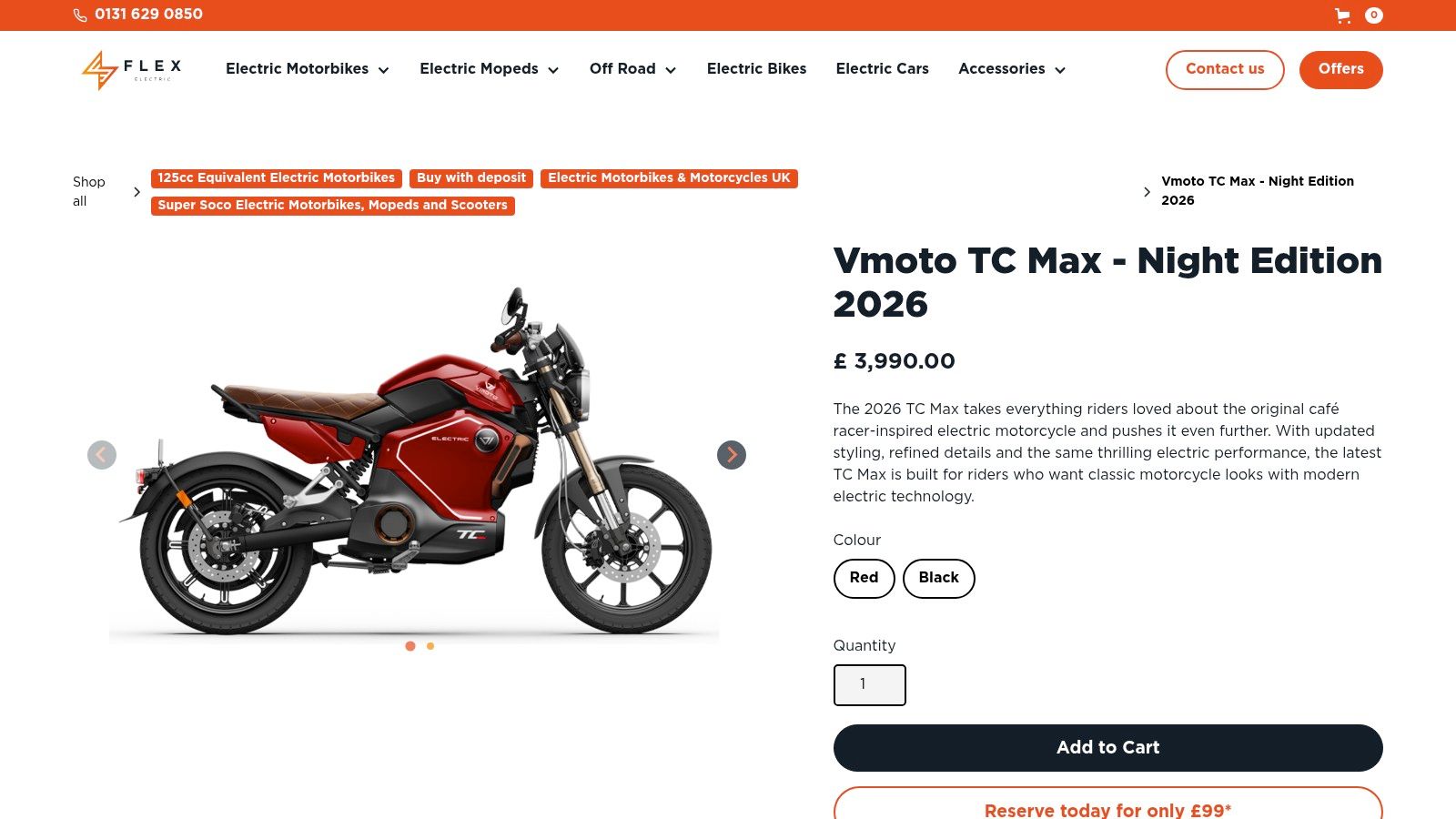
The Super Soco TC Max sits in the 125cc-equivalent category. Its product snapshot lists a 5kW peak power motor, removable ATL lithium-ion battery, 60 mph top speed, 60 mile range, keyless ignition, app connectivity, and three power modes.
That class suits riders who need proper road pace and a bike that still works outside short city hops. It also changes the financial picture. A larger-capacity machine can cost more upfront, but if it removes a charging stop, covers a full delivery shift more reliably, or stays within warranty terms because it is not being pushed to empty every day, the total cost can look better over time.
For delivery fleets, that is usually the right way to judge range by class. Buy enough battery for the route, keep a reserve, and avoid building the whole operation around the bike's best day.
How to Estimate Your Personal Range
The most reliable estimate starts with energy, not marketing. Battery capacity is stored energy. Consumption is how quickly you spend it. Once you know both, range becomes easier to judge.
Use this simple formula:
Battery capacity in Wh / your expected Wh per km = estimated range in km
For context, the tested benchmark earlier showed 47 Wh/km for a typical 1.2 kWh battery moped ridden at 20 mph. Your own figure can be lower in gentler use or higher if you ride harder, carry more, or face tougher roads.
A simple way to do it
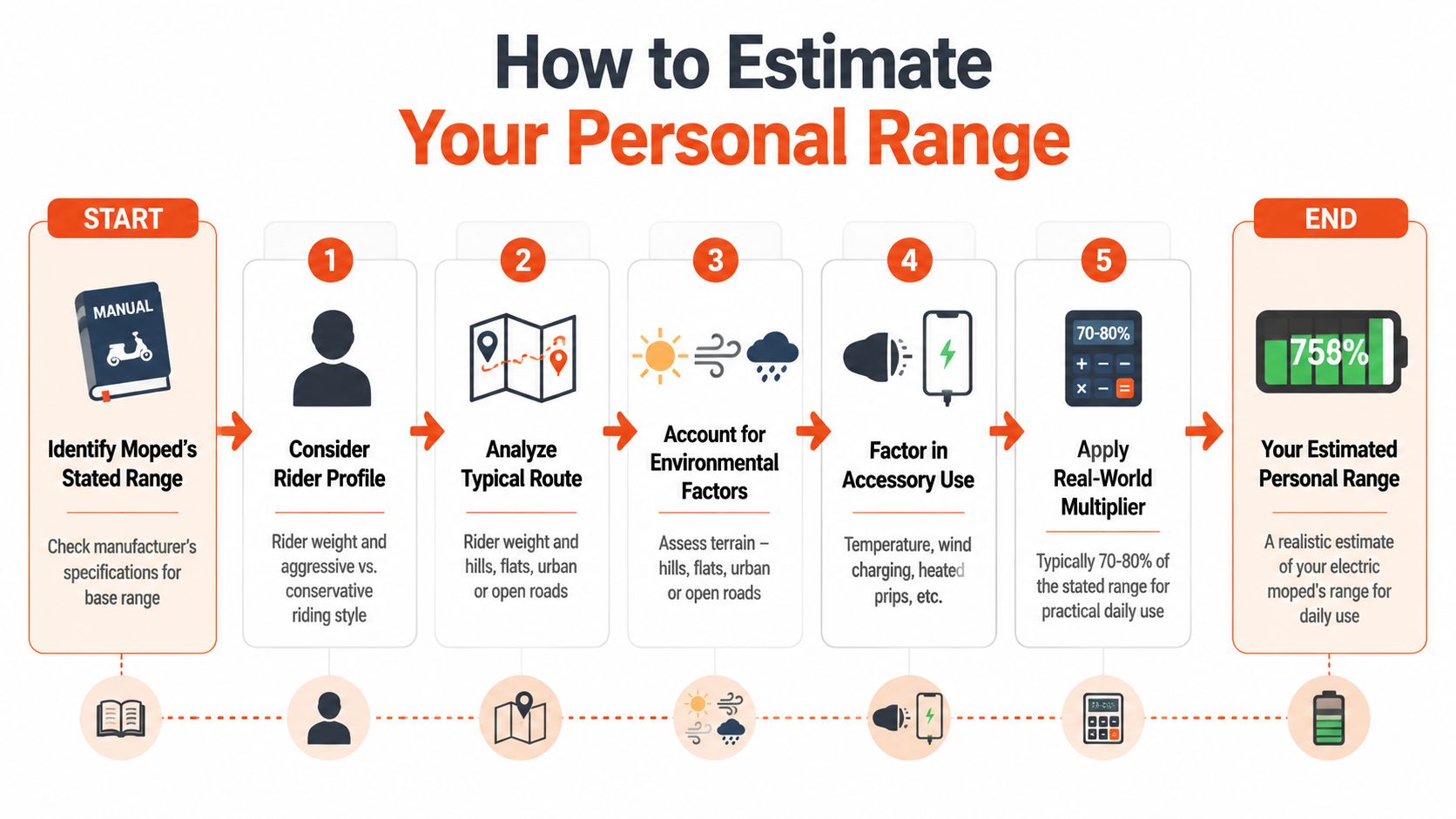
Follow this order:
- Check battery size in Wh. If the spec is in kWh, convert it.
- Pick an honest consumption figure. Start from your likely usage, not your best day.
- Consider route type. Flat city miles and hilly city miles aren't the same.
- Adjust for weather and load. Cold, wind, and cargo all push consumption up.
- Keep a reserve. Don't plan to empty the battery on every ride.
This walkthrough helps visually if you prefer a quick explainer:
Worked examples
Take the tested example above. A 1.2 kWh battery equals 1200 Wh. Divide that by 47 Wh/km and you get about 25.5 km, which aligns with the cited real-world figure of roughly 51 km only when measured under the specific benchmark conditions in the earlier source context, so riders need to be careful and use the actual observed figure rather than forcing the formula without the full bike setup behind it. In practice, the formula is best used with your own observed consumption after a few rides.
For a commuter, the method is straightforward. Track a normal week, note battery used for a familiar return journey, and use that pattern as the baseline. If the route is predictable, your estimate gets accurate quite quickly.
For a delivery rider, the calculation needs more caution. The route changes, the load changes, and repeated stops increase consumption. A practical estimate for delivery work should always be conservative because the cost of being wrong is lost time, lost orders, and an unplanned charging stop.
Simple Habits to Maximise Your Moped's Range
Riders often chase big technical answers when the biggest gains usually come from ordinary habits. The bike already has the battery it has. What changes day to day is how efficiently that energy gets used and how well the pack is looked after over time.
In UK urban commuting, real-world range typically lands at 70 to 80% of the manufacturer's claimed figure, partly because conditions differ from the 20°C test standard, and colder weather reduces the usable energy available from lithium-ion cells according to NIU's explanation of battery performance and temperature.
Riding habits that actually help
The first habit is smoothness. Open the throttle progressively, avoid pointless bursts to the next red light, and keep momentum where traffic allows. That doesn't mean riding slowly all the time. It means avoiding waste.
The second habit is route choice. The shortest route isn't always the most efficient. A slightly longer road with fewer stops can be easier on the battery than a shorter route packed with junctions and repeated acceleration.
- Check tyres regularly: Correct pressure reduces drag and helps the bike roll properly.
- Carry what you need: Unnecessary weight forces the bike to spend more energy all day.
- Use riding modes sensibly: If your moped has multiple modes, match them to the road rather than leaving it in the most demanding setting.
Battery care that protects long-term range
Battery care matters because today's charging habit affects next year's useful range.
If the battery is removable, store and charge it sensibly in colder weather rather than leaving it to sit at outdoor temperature all the time. Avoid treating every ride like a race to empty. Deep discharges and poor temperature habits don't help battery life.
This is also where warranty matters practically. A battery is one of the most valuable parts of the bike, so proper care isn't just about today's miles. It supports long-term performance and keeps you aligned with the manufacturer's maintenance expectations. At Flex Electric, that matters because bikes are supplied with a 3-year battery warranty and 2-year parts warranty as part of the ownership package.
Good battery care doesn't feel dramatic. It feels boring, consistent, and cheaper over time.
Range Planning for Delivery and Fleet Riders
For delivery and fleet use, range isn't just a convenience issue. It's an operating constraint. If the bike can't complete the work window reliably, the lower running cost doesn't help much.
The strongest financial case for electric mopeds comes from home charging. In the UK, home charging costs around 1p per mile, which is an 85% saving compared to petrol, but charging takes 4 to 8 hours and public charging suitable for mopeds is limited, according to Lexham's breakdown of electric moped travel and charging reality.
What works for commercial use
A delivery rider should plan around the full shift pattern, not the average trip. That means looking at peak demand periods, the distance between likely jobs, and whether there's a dependable place to charge between sessions.
For many riders, overnight charging is the simplest answer. It's cheap, predictable, and easy to schedule. The weak point is riders who rent, share accommodation, or don't have practical access to charging where they live. In those cases, battery strategy becomes part of the buying decision, not an afterthought.
Choosing for uptime, not just range
Fleet buyers and self-employed riders should think in terms of uptime.
- Battery capacity: Enough real-world coverage for the working block.
- Charging access: Home, depot, or workplace charging changes what's viable.
- Vehicle role: Short-hop takeaway work and all-day multi-zone delivery aren't the same job.
- Warranty support: Battery cover has real commercial value because downtime costs money.
A machine such as the Vmoto VS2 Citi is relevant here because it's a purpose-built 125cc-equivalent electric moped aimed at urban and commercial use, with a 50mph top speed and 66 mile range in its product snapshot. For delivery use, that kind of spec needs to be judged against the rider's actual shift pattern, not the headline number alone.
For businesses, total cost of ownership often matters more than top speed or styling. Electricity cost per mile is low. Routine maintenance is typically simpler than petrol. But none of that rescues a poor range plan. The right setup is the one that finishes the shift, charges where the rider lives or works, and has battery cover strong enough to protect the asset.
If you're weighing up real-world electric moped range for commuting, delivery work, or a business fleet, Flex Electric is a practical place to compare models against the journeys you make. Focus on battery size, speed class, charging setup, and the warranty behind the pack. That's how riders avoid range surprises and choose a bike that works on UK roads, not just on a spec sheet.
Find us
You will find us at 74 Dalry Road, Edinburgh, EH11 2AY
Showroom Opening Times:
Monday: By Appointment
Tuesday to Friday: 11am - 5:00pm
Saturday: 10am - 5pm
Sunday: By Appointment
