
Electric Moped Scooter Parts: A UK Rider's Guide 2026

Flex Electric
The UK's #1 Electric Moped and Electric Motorbike dealer.

A lot of riders start paying attention to electric moped scooter parts only when something goes wrong. The bike suddenly feels flat pulling away from lights, the dash throws a warning, the front brake starts rubbing, or the range you relied on last week disappears on a wet morning run across town. That’s usually the moment you realise an electric moped or motorcycle doesn’t need less understanding. It needs different understanding.
If you ride in the UK, that matters even more. Parts choice isn’t just about cost or convenience. It affects road legality, MOT outcomes, insurance, uptime, and whether your machine still suits the kind of riding you do. That could mean daily commuting, food delivery, or managing a small fleet that can’t afford repeated workshop visits.
The good news is that most faults and most wear patterns follow a small set of predictable component issues. Learn those parts properly and you’ll make better decisions, spend money in the right places, and avoid the usual mistakes new riders make.
Your Guide to Electric Motorcycle and Moped Parts
The first thing to know is simple. Not every part on an electric moped wears out at the same rate, and not every cheap replacement is a bargain. Riders often focus on the battery and motor because those sound expensive and important. In practice, plenty of breakdowns begin with smaller items such as connectors, brake components, charging ports, switchgear, or poor-quality replacement controllers.
That’s why electric moped scooter parts are worth understanding even if you never plan to pick up a spanner. You don’t need to become a technician. You do need to know which parts affect safety, which affect performance, and which affect compliance in the UK.
A useful way to think about it is in layers:
- Core power parts keep the bike moving. Battery, motor, controller, throttle, wiring loom.
- Wear parts keep it safe and rideable. Brake pads, tyres, suspension parts, bulbs or LED units, chain or belt parts where fitted.
- Support parts stop nuisance faults becoming major downtime. Connectors, seals, fasteners, charge sockets, body fixings, and sensors.
Practical rule: If a part affects braking, steering, charging, or the delivery of power, don’t treat it as a cosmetic issue.
New riders also make the mistake of judging parts only by headline specs. A higher-rated motor, a generic battery, or a random imported controller can look like an upgrade on paper. On the road, that same part may fit badly, trigger faults, create waterproofing problems, or cause trouble at MOT time.
The sensible approach is to understand what each part does, what failure feels like from the saddle, and where replacing with the wrong thing creates more cost than it saves.
The Core Components of Your Electric Motorcycle
A rider heads out for an evening delivery shift in Manchester, the bike shows a healthy charge, then power drops away on the first steep hill and the throttle response turns erratic in the rain. Cases like that rarely come down to one dramatic failure. They usually come from a weak link in the core system, often a tired battery, a poor connector, water ingress, or a controller that is not matched properly to the bike.
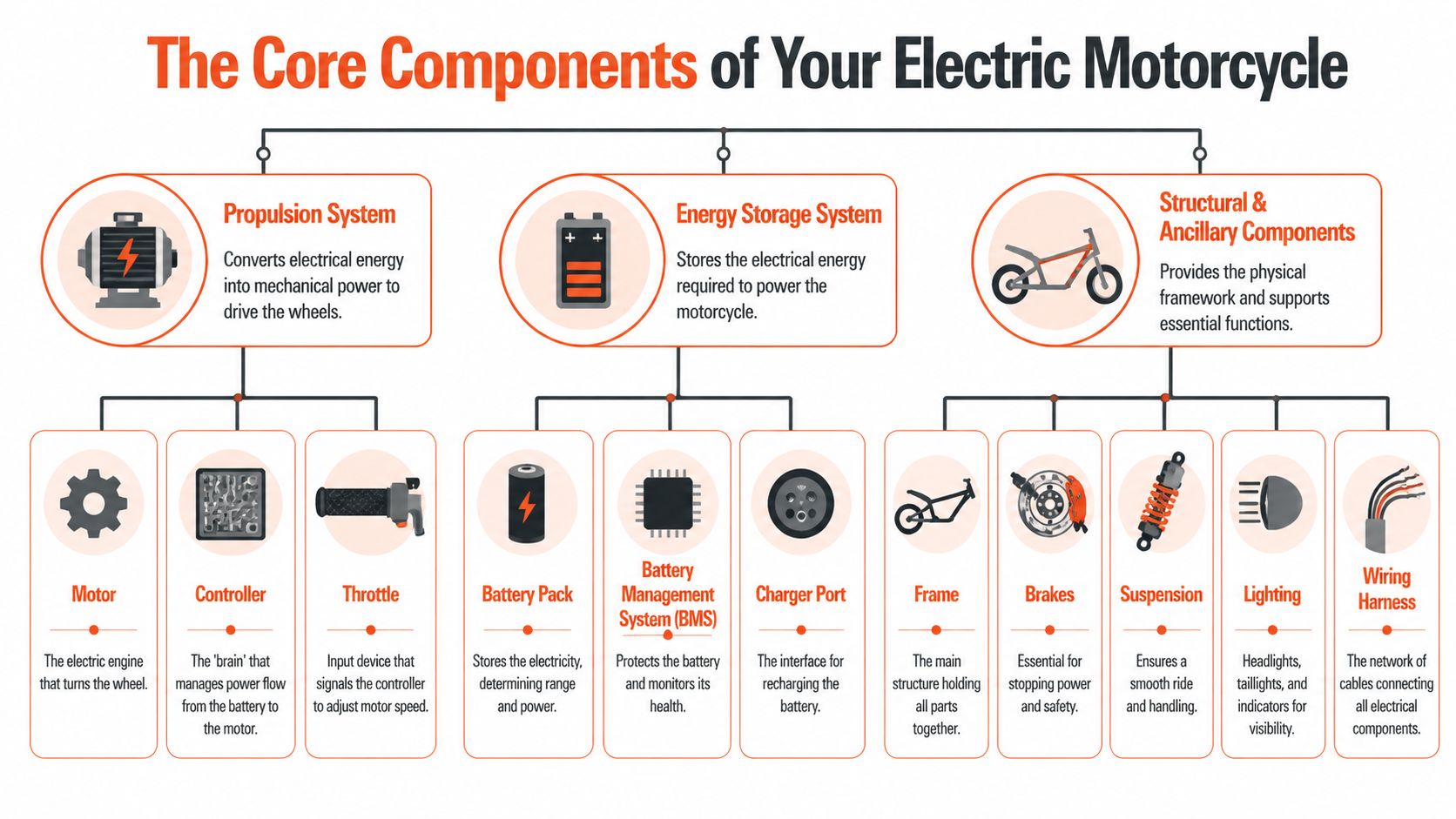
Motor and drive layout
The motor, battery, controller, and wiring loom work as one system. If one part is underspecified, damaged, or replaced with the wrong unit, the whole bike feels off. You see it in weak pull-away, rough throttle pickup, fault codes, poor charging, or range that falls short of what the rider expects.
The motor converts electrical energy into drive. On many learner-legal and urban electric mopeds in the UK, that means a hub motor built into the wheel. On larger bikes, or models designed to feel more like a conventional motorcycle, you may find a mid-drive motor using a chain or belt.
Hub motors suit a lot of UK use. They are quiet, compact, and have fewer exposed drivetrain parts to deal with road salt, grit, and constant stop-start riding. Mid-drive setups can give better weight distribution and easier motor access for some repairs, but they add mechanical parts that wear and need adjustment.
For UK riders, the right motor is not only a performance question. It also has to match the bike’s approval category, speed classification, and road-going setup. If a replacement motor or controller changes how the vehicle performs, that can create problems with legality, insurance, and MOT expectations on road-registered machines. That is one reason we advise checking the full system spec before fitting any "upgrade" part.
Hub motor versus mid-drive in practice
| Drive type | What works well | What usually catches riders out |
|---|---|---|
| Hub motor | Quiet town riding, fewer external drivetrain parts, tidy packaging | More weight in the wheel, cable damage after tyre work, impact damage from potholes or kerbs |
| Mid-drive | More familiar motorcycle feel, easier wheel changes on some models, better central mass | Chain or belt wear, alignment issues, more servicing points |
A bike that feels calm in traffic is usually running a motor and controller that suit each other. Bigger numbers on a listing do not guarantee a better road bike.
Battery pack and BMS
The battery pack decides far more than range. It affects voltage stability under load, how hard the bike can accelerate, how it behaves on hills, and how consistent it feels near the end of a shift. High-mileage delivery riders notice battery condition earlier than weekend riders because repeated fast charging, heavy loads, and all-weather use expose weakness quickly.
Inside the battery sits the Battery Management System, or BMS. It monitors cell voltage, temperature, and charging behaviour, then cuts or limits output if it detects a condition that could damage the pack. When a bike powers on but refuses to drive, or cuts out under load with charge still showing on the dash, the BMS is one of the first places to check.
The terms worth knowing are simple:
- Voltage affects how the system delivers power
- Amp hours describe capacity
- Watt hours show total stored energy in a way that is more useful for comparing packs
- Cell quality and pack construction often matter more than optimistic label claims
Battery faults often imitate other problems. A worn pack can feel like a weak motor, a lazy throttle, or a controller fault because voltage sag changes how the whole bike responds.
Controller and throttle
The controller manages power delivery between battery and motor. It reads throttle input, checks sensor data, and decides how current is released. On a good setup, take-off is smooth, regen is predictable where fitted, and the bike stays consistent in traffic. On a bad setup, low-speed control becomes awkward, especially in wet city riding.
A mismatched or poor-quality controller causes a lot of workshop headaches. Some give jerky launch from a standstill. Some cut power after a bump because of poor internal soldering or weak connector fit. Some overheat during repeated delivery runs and reduce performance once the bike is fully warmed through.
Common warning signs include:
- Jerky launch from a standstill
- Power cutting after bumps or in wet weather
- Intermittent throttle response
- Loss of performance after repeated stop-start use
- Fault codes that appear only under load
The throttle itself is usually straightforward, but it takes abuse. Drops, bar-end impacts, water ingress, and damaged switchgear can all cause inconsistent input. If the dash lights up but response is patchy, test the throttle circuit before blaming the motor.
Wiring loom, connectors and charge hardware
Many avoidable breakdowns frequently originate from components situated in a vulnerable area. Wiring looms, connectors, fuse holders, charge sockets, and sensor plugs live in the worst part of the bike. They deal with vibration, spray, winter salt, repeated seat or panel removal, and accessory wiring that was never fitted properly in the first place.
In UK workshop conditions, I see connector and loom issues more often than outright motor failures on commuter mopeds. That is especially true on bikes used for food delivery, where charging cycles are frequent and body panels come off more often for quick fixes. One loose or corroded connector can produce symptoms that look much more expensive than they are.
The small parts that deserve proper attention:
- Charge port assemblies wear out from repeated use, dirt, impact, or forcing the plug
- Main connectors loosen, corrode, or overheat if earlier repairs were poor
- Hall sensor wiring near the motor can chafe or get trapped during wheel work
- Accessory splices for phone mounts, extra lights, alarms, or heated kit can create hard-to-trace faults if fitted badly
Clean connections, correct sealing, proper cable routing, and strain relief keep a road bike dependable. They also reduce the kind of intermittent fault that wastes hours and leaves riders replacing good parts by guesswork.
A healthy electric bike is a matched system. Safe, affordable running comes from parts that fit properly, suit the bike’s UK road use, and hold up to the miles.
Essential Wear and Tear Parts Explained
Electric bikes don’t need oil changes, but they absolutely do wear through consumables. In workshop terms, these are the parts that most often decide whether a bike feels sharp and safe or tired and expensive. Ignore them and you’ll blame the wrong component.
Brakes
Brakes are your first inspection item because electric torque hides problems. A bike can still pull strongly while the pads are nearly gone or the disc is already scored.
Watch for these signs:
- Pads wearing thin and producing squeal, grinding, or weak bite
- Disc issues such as scoring, pulsing through the lever, or visible blueing from heat
- Fluid problems shown by a spongy lever feel or inconsistent bite point
For commuters, brake checks should become routine. Delivery riders in stop-start traffic need to be even more vigilant because repeated low-speed braking chews through pads far faster than relaxed suburban riding.
If the brake lever suddenly needs more travel than usual, stop treating it as a minor annoyance and inspect it properly.
Tyres
Tyres affect range, handling, braking, and confidence in wet weather. Riders often look only at tread depth, but that’s only part of the story. Squared-off profiles, sidewall cracking, embedded debris, and chronic underinflation all change how the bike behaves.
A worn tyre doesn’t always feel dramatic at first. It often shows up as vague turn-in, poorer wet grip, or the bike tramlining on rough roads.
Check for:
- Flattened centre section from repeated straight-line commuting
- Cuts or puncture repairs that deserve a closer look
- Uneven wear that may point to pressure or suspension issues
- Age hardening even if the tread still looks acceptable
Suspension
Suspension wear creeps in slowly. Riders adapt to it without realising. Then they ride a fresh bike and notice how much control they’d lost.
Front forks and rear shocks should move smoothly, settle the bike, and keep the tyre planted. When they don’t, braking gets messy and cornering confidence disappears.
Common clues include:
- Weeping fork seals
- Excessive dive under braking
- Bouncy rear end over speed humps
- Clunking from worn bushes or mountings
Lights and rider controls
Lighting faults feel small until they become an MOT issue or a visibility problem in traffic. LED units last well, but connectors, switchgear, and mounting points don’t always age as gracefully.
Check:
- Headlights for aim, lens damage, and moisture inside the unit
- Indicators for intermittent flashing caused by vibration or poor connectors
- Brake light switches if the light fails to trigger consistently
- Horn and handlebar switches because they often reveal loom or weathering issues early
Drivetrain parts on chain or belt models
Not every electric machine uses a hub motor. If your model runs chain or belt drive, treat it like a normal service item. Chains stretch, dry out, and wear sprockets. Belts can become noisy, misaligned, or damaged by debris.
A short checklist works well:
- Inspect tension according to the manufacturer’s guidance.
- Look for hooked sprocket teeth on chain-driven bikes.
- Listen for chirping or rumbling from belt or pulley issues.
- Clean before lubricating if the system uses a chain.
The pattern is simple. Wear parts don’t fail because electric bikes are unreliable. They fail because UK roads, weather, kerbs, potholes, and stop-start riding are hard on any machine.
Diagnosing Common Faults on Your Electric Moped
You finish the dinner rush, stop for a pickup, and the bike suddenly will not wake up. Or it powers on, but the range has fallen off and the throttle feels uneven pulling away from the lights. That is how faults usually show up for UK riders. Not as neat component failures, but as lost time, missed jobs, and a machine that no longer feels predictable.
Good diagnosis starts with the symptom, then works back through the likely causes in order of cost and probability.

It won’t power up
Start at the roadside checks before assuming the battery or controller has failed. Confirm the battery is latched in place, the key and immobiliser are disarming, the kill switch is set correctly, and the main fuse is intact. On some UK-spec mopeds, a sidestand, brake, or charge interlock fault can also stop the bike from readying up.
Then inspect the obvious connectors around the battery, ignition barrel, controller, and main loom. Wet weather, repeated charging, and high-mileage delivery use are hard on plugs and terminals.
If you are comfortable doing basic electrical checks, it helps to know how to check circuit continuity using a multimeter. That can quickly confirm whether a fuse, switch, or section of wiring has failed open.
Typical causes include:
- Battery BMS lockout
- Loose or heat-damaged main connector
- Faulty ignition barrel or switchgear
- Blown fuse
- Damaged loom section
- Charge interlock fault on some models
Repeatedly cycling the key rarely fixes this. It often makes the fault harder to pin down.
The range has dropped
Range complaints are common, especially with riders doing short-stop urban work in cold or wet British conditions. The battery gets blamed first, but that is not always where the money should go. I see more cases caused by brake drag, low tyre pressures, poor charging habits, tired connectors, and temperature-related performance drop than riders expect.
High-mileage delivery riders notice this earlier than leisure riders because a small loss in efficiency shows up as one less run, one more charge, or extra downtime at the worst point in the day.
Check these before blaming the battery
| Symptom | Likely cause | What you can inspect safely |
|---|---|---|
| Range falls suddenly | Brake drag, charger fault, or battery connection issue | Spin the wheels, check for binding, watch charger behaviour |
| Range falls gradually | Battery ageing, cold-weather performance loss, or repeated deep discharge | Compare recent riding pattern, charging routine, and outside temperature |
| Bike feels slow and range is down | Low tyre pressure, rubbing brake, or controller derating | Check pressures, listen for rubbing, note any heat smell or warning light |
If you rely on the bike for work, track the change for a week. A steady drop points to wear or degradation. A sudden drop points to a fault.
The motor feels jerky or hesitant
Jerky drive usually comes from the throttle signal, the controller, the motor sensors, or the wiring between them. The useful question is not just what it feels like. It is when it happens.
A fault only in rain often points to moisture getting into connectors or throttle housing. A fault only when pulling away can mean a weak throttle signal, poor controller calibration, or sensor trouble at low speed. A fault under load, especially uphill, can be battery voltage sag or a controller getting too hot and cutting back output.
Look for these patterns:
- Jerky only at low speed points to throttle or controller response
- Jerky after rain points to moisture in connectors or sensors
- Jerky under load uphill points to voltage sag or controller stress
- Jerky all the time points to sensor, wiring, or controller faults
For a visual walkthrough of the kind of checks technicians do on power systems, this overview is useful before you book diagnosis:
Charging faults and warning lights
Charging problems sit between three parts. The charger, the charge port, and the battery pack. Replacing the pack first is usually the most expensive guess.
Check the simple items first:
- Socket pins for heat marks, corrosion, or looseness
- Charging cable ends for cuts, bent pins, or a poor fit
- Port mounting if the plug feels loose in the bodywork
- Dash warnings that appear only when charging starts
- Charger fan or indicator behaviour if it has changed from normal
On UK road-legal mopeds, charging faults can turn into compliance problems as well as convenience problems if warning lights stay on, wiring has been poorly repaired, or replacement electrical parts are not up to MOT standard. A careful diagnosis saves money because it stops you replacing major electric moped scooter parts when the fault is a connector, charge port, external charger, or a small section of loom.
OEM vs Aftermarket Parts A UK Compliance Guide
You order a cheap controller online on Monday, fit it on Tuesday, and by Friday the bike is back off the road with a warning light, odd throttle response, or an MOT question you did not have before. That is the key distinction between parts that fit and parts that are right for a UK road-legal moped.
In workshop terms, OEM parts give you a clearer line on fit, connector match, calibration, and traceability. Aftermarket parts cover everything from well-made replacements to generic stock sold against half-accurate listings. For a delivery rider doing long shifts, that trade-off is simple. Saving money on the invoice can cost more in lost riding time.
UK riders need to be stricter than many US-focused guides suggest. If a replacement part affects lighting, braking, steering, or the bike’s core electrical system, it needs to work properly on the road and stand up to MOT inspection. On electric mopeds, batteries and controllers deserve extra care because poor matches can create charging faults, cut power unexpectedly, or leave you with wiring changes that are hard to defend if the bike is inspected after an accident.
Why OEM still matters
OEM means the part was made to the specification approved for that model. The original factory may not produce every subcomponent itself, but the part should match the bike’s expected connectors, mounting points, operating values, and approved setup.
If you want a plain-language overview of manufacturing terminology, this short guide to choosing OEM or ODM helps explain why products that look similar can differ sharply in specification and traceability.
Aftermarket parts can be fine. We fit quality aftermarket items in the right places. The key is knowing where variation is acceptable and where it causes trouble.
OEM versus aftermarket at a glance
| Factor | OEM Parts (e.g., from Flex Electric) | Aftermarket Parts |
|---|---|---|
| Fitment | Usually correct for the bike and connector set | Can vary, even when advertised for the same model |
| Compliance confidence | Stronger on approval-sensitive parts | Depends on clear markings, correct spec, and proper documentation |
| Upfront price | Higher | Usually lower |
| Downtime risk | Lower if the part is genuinely matched | Higher if adaptation, returns, or rewiring are needed |
| MOT and insurance questions | Fewer if the part matches the bike properly | More likely if the part changes function or lacks clear identification |
| Best use case | Core electrical parts and safety-related replacements | Selected non-critical items where quality is proven |
Which parts deserve caution
Some parts are poor places to gamble.
- Batteries need the correct casing, battery management setup, connector layout, and mounting security.
- Controllers must match the motor, loom, throttle characteristics, and dash communication where applicable.
- Brake components need correct dimensions and reliable material quality. Close enough is not good enough.
- Lighting units have to fit properly, work properly, and meet road-use expectations in the UK.
I tell riders the same thing in the workshop. A cheap part is expensive once you have paid for failed fitting, fault-finding, and a second replacement.
Where aftermarket can make sense
Aftermarket buying makes more sense on lower-risk items. Cosmetic panels, mirrors of known quality, luggage fittings, and some wear parts can be good value if the supplier can confirm proper compatibility. Food delivery riders often go this route for parts that take cosmetic knocks or wear quickly, but they still keep OEM standards for anything that affects power delivery, charging behaviour, braking, or road legality.
The practical rule is simple. Treat batteries, controllers, brake parts, and road-use lighting as compliance-sensitive. Be more flexible with accessories and minor trim only when the quality is known.
Sourcing Parts and Expert Servicing with Flex Electric
It is 6:30 on a wet Manchester morning. Your moped needs to get you to work, or out on your first delivery run, and the bike has started cutting power, charging badly, or showing a light fault that was not there last week. At that point, getting the right part matters less than getting the right diagnosis first.
A good UK specialist does both. They check what bike you have, how it is used, and whether the fault points to a failed part, a wiring issue, or a charging problem. That saves riders from ordering parts that fit the label but not the machine, and it matters even more on road-legal bikes that still need to satisfy basic DVSA and MOT expectations.
What proper parts support looks like
In the workshop, the first questions are simple. What is the exact model? What year is it? What fault is it showing? Has anything else already been changed? Photos of the old part, its plug layout, and any labels usually save a lot of wasted time.
That process is not red tape. It is how you avoid fitting a battery with the wrong casing, a controller that will not speak properly to the loom, or a lighting unit that creates MOT trouble later.
Useful support usually includes:
- Correct model identification from the bike and its existing parts
- Checks on compliance-sensitive items such as lighting, brakes, batteries, and controllers
- Advice on repair versus replacement based on cost, safety, and likely service life
- Workshop fault-finding for cases where the failed part is not obvious
For commuters and new riders
New riders do better with clear advice than a long list of options. A dependable commuter setup usually comes down to the basics being right. Brakes that bite properly, tyres suited to UK roads, a charging port that is not loose or heat-damaged, and wiring that has not started corroding under the panels.
Honest servicing keeps costs down as well. Some faults need sorting before the next ride. Others can wait until the next booked visit. Knowing the difference stops small jobs turning into expensive guesswork.
For food delivery riders
High-mileage delivery work exposes weak parts fast. Rear tyres square off sooner, brake pads disappear quicker, charge ports get hammered by repeated daily use, and luggage mounts loosen up from constant loading. Wet weather makes all of it worse.
For that kind of rider, the best support is built around uptime. Fast parts identification, sensible stock choices, battery checks before range falls off badly, and service decisions based on whether the bike can keep earning. Cosmetic damage matters less than safe brakes, stable charging, and a bike that starts every shift.
I give delivery riders the same advice every time. Service the bike before it forces a day off the road.
For businesses and fleet users
Fleet work needs consistency. If five bikes have the same common fault, the repair standard should be the same across all five. That makes maintenance easier to track and helps spot repeat issues before they become breakdowns.
UK-based support also matters more than many owners expect. A road-legal electric moped, an off-road machine, and a youth motocross bike may share some electrical ideas, but they do not share the same compliance needs, wear patterns, or service priorities. A specialist who handles those differences properly is more useful than a generic seller shipping boxes by part category alone.
Flex Electric supports riders who need practical help, whether that means sourcing the correct replacement part, tracing a fault properly, or keeping a hard-worked delivery bike roadworthy and affordable to run.
Frequently Asked Questions on Electric Motorcycle Parts
| Question | Answer |
|---|---|
| What are the most important electric moped scooter parts to check regularly? | Start with brakes, tyres, battery condition, charging port, lights, and visible wiring around the motor and controller area. Those are the parts most likely to affect safety or leave you stranded. |
| Can I fit any controller that matches the voltage? | No. Voltage is only one part of the match. The controller also needs to suit the motor, connectors, throttle behaviour, and the bike’s wider electrical system. |
| Do electric motorcycles have fewer parts to service than petrol bikes? | Usually yes in drivetrain terms, but the key electrical parts need correct diagnosis. Simpler doesn’t mean careless. |
| How do I know if my battery is failing? | Look for reduced range, heavier voltage drop under load, weaker hill performance, charging irregularities, or sudden cut-outs. Rule out tyre, brake, and charging issues first. |
| Are aftermarket parts always a bad idea? | No. Some non-critical accessories and selected wear items can be fine. Be much more careful with batteries, controllers, lights, and anything approval-sensitive on a road bike. |
| What parts wear fastest for delivery riders? | Usually brake components, tyres, charging hardware, luggage-related fittings, and any part exposed to repeated stop-start use in poor weather. |
| Should I keep spares at home? | For high-mileage riders, it makes sense to keep basic consumables and a charger in known good condition. For major electrical parts, buy only when you’ve confirmed the correct specification. |
| Can water cause faults even if the bike still runs? | Yes. Water ingress often starts as intermittent behaviour before becoming a complete failure. Charging ports, connectors, switches, and controllers are common trouble spots. |
If you want straight advice on the right parts for your bike, proper UK compliance guidance, or servicing support for commuting, delivery work, or fleet use, speak to Flex Electric. They specialise in electric mopeds, scooters, motorbikes, off-road electric motorcycles, and kids MX bikes, with nationwide support from their Edinburgh showroom.
Find us
You will find us at 74 Dalry Road, Edinburgh, EH11 2AY
Showroom Opening Times:
Monday: By Appointment
Tuesday to Friday: 11am - 5:00pm
Saturday: 10am - 5pm
Sunday: By Appointment
