
Electric Moped Regenerative Braking: How It Works
Flex Electric
The UK's #1 Electric Moped and Electric Motorbike dealer.

The popular advice to turn regeneration up and stop using the brake lever gets electric scooter regenerative braking backwards. Regen is worth having for efficiency and reduced brake wear, not as a replacement for dependable brakes. Choose the stopping hardware first, then adjust energy recovery to suit your route.
What Regenerative Braking Actually Does
Regen slows a scooter, so technically it produces braking force. But treating it as your dependable stopping system is the mistake. Its useful job is to recover energy while taking some work away from the friction brakes.
Think about freewheeling downhill. You gain speed, then apply the brakes to keep that speed under control. Conventional brakes turn the energy of movement into heat; regeneration catches part of it electrically instead.
From movement back to electricity
The energy flow follows a simple sequence:
- You request slowing by easing off the throttle or pulling the brake lever, according to the model's controls.
- The controller requests generator operation rather than motor drive.
- The turning wheel drives the motor, which resists rotation while generating electricity.
- Current returns to the battery, provided the battery and controller can accept it.
Throttle-release activation feels like drag as you roll off. Lever-activated regeneration introduces electrical slowing when you squeeze the brake control. Some scooters combine these behaviours, so check the handbook rather than assuming every lever works identically.
This rural ride illustrates a different operating environment from repeated urban junction stops.

The UK Government's energy-flow analysis estimates that approximately 22% of energy otherwise lost during braking can be recovered and stored in electric vehicles. That's a share of braking energy, not a promise of extra range.
Motor, inverter and battery losses prevent complete recovery. Tyre resistance and aerodynamic drag also consume energy that regeneration can't collect afterwards.
Frequent junctions, traffic lights and downhill sections create more recovery opportunities than steady-speed travel. Even then, the sensible approach is to anticipate traffic, not accelerate towards a stop just to generate electricity.
Regeneration does not create energy. It catches part of the energy the scooter already has and returns it to the battery instead of losing it as heat in the brake pads.
How Much Range Regen Really Adds
A UK-linked engineering simulation funded by Innovate UK's Advanced Propulsion Centre found that regeneration reduced an electric motorcycle's simulated energy consumption by up to 7.65%, with riding posture held constant, using the World Motorcycle Test Cycle class 3-2, according to the engineering study hosted by the University of Warwick.
That's a useful benchmark, not a range guarantee for your scooter. The assessment modelled motorcycle operation, rather than measuring every combination of scooter, rider and UK commute.
The same study reported the posture-specific and combined effects below. Read the comparison column carefully: the combined results use a different baseline from the regeneration-only results.
ScenarioReported effect on simulated energy consumptionWhat it means for a riderLow riding position, regeneration added7.65% reductionThe largest regeneration-only saving in the modelMid riding position, regeneration added5.88% reductionRecovery benefits changed with postureHigh riding position, regeneration added5.26% reductionRegeneration still reduced consumptionLow posture without regeneration, compared with high posture without regeneration20.65% reductionRiding posture affected consumption independentlyLow posture with regeneration, compared with high posture without regeneration22.65% reductionPosture and regeneration interacted; their benefits weren't simply additive
Judge the route, not the headline
Don't add the regeneration-only saving to the posture saving and advertise the result as extra range. These are energy-consumption comparisons within a model, not interchangeable percentages.
Nor should you crouch awkwardly to imitate a simulated posture. Your ability to see traffic, steer comfortably and operate the controls matters more than chasing an aerodynamic result.
Actual recovery changes with speed, total mass, gradient, rider behaviour, motor control and the share of slowing handled electrically. Hard braking that demands substantial friction-brake input won't send all that stopping energy back into the pack.
A flat or gently rolling commute with few stops may offer little to recover. Repeated deceleration at city junctions offers more opportunities, although traffic conditions and riding style still determine the result.
A long descent isn't automatically a charging bonus either. Start with a full battery and regeneration may be unavailable, leaving the friction brakes to control speed and dissipate the braking energy.
Buy enough usable range for the route without depending on recovery. Treat any measured benefit as an operating margin, not permission to plan a journey that only works if every downhill section returns charge.
How the System Works and When It Fades
The controller decides how much electrical slowing to request, but it doesn't have unrestricted permission to charge the battery. The battery management system protects the cells by enforcing charge, voltage and temperature limits.
The process below shows where the rider's input becomes electrical braking.
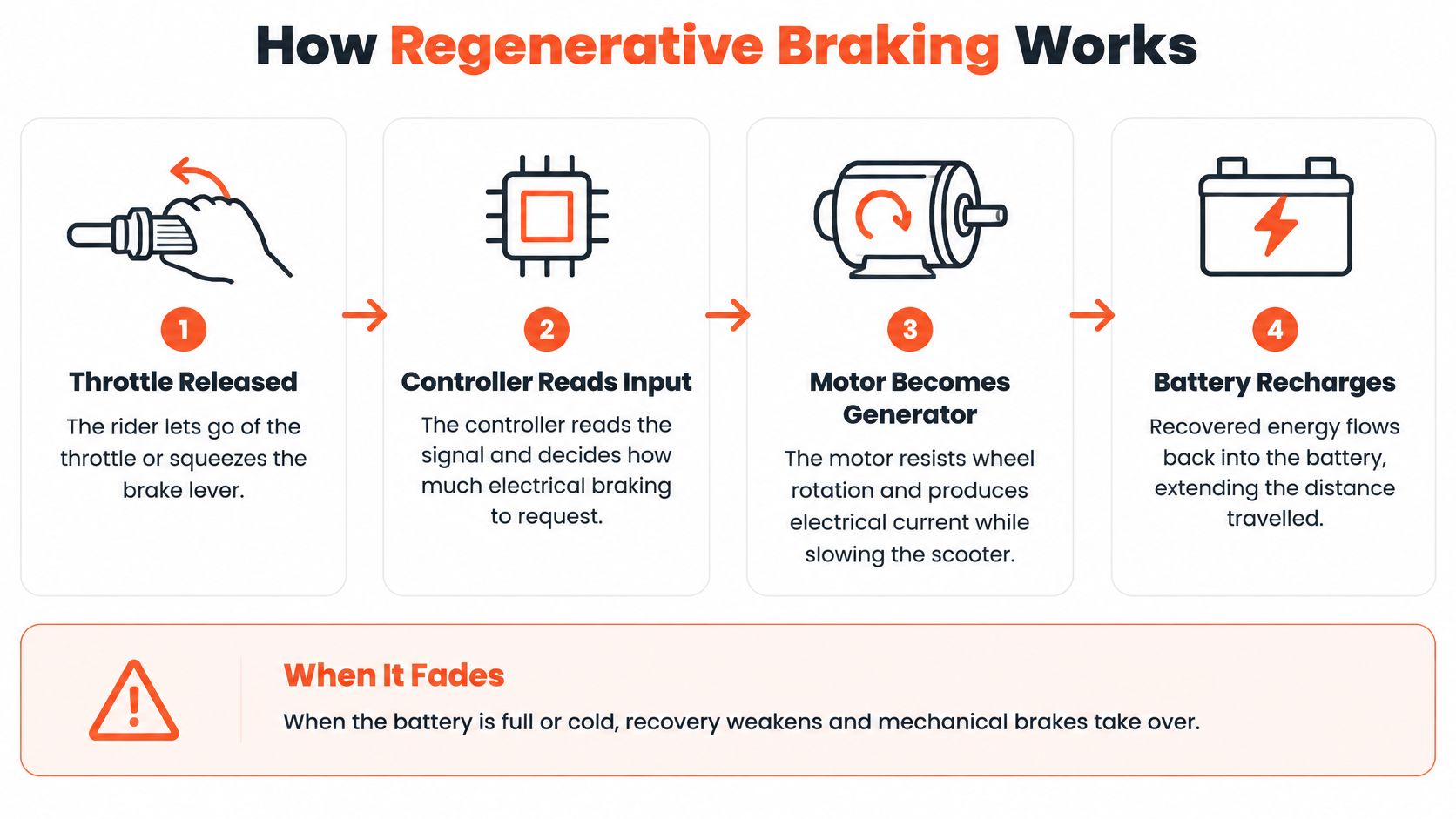
When you release the throttle or squeeze the lever, the controller reads that signal and requests generator torque from the motor. It then manages the recovered current into the battery within the limits permitted by the battery management system.
Blended braking coordinates regeneration with friction braking. However, a lever that activates both systems doesn't necessarily provide intelligent automatic compensation when regeneration disappears. Ask whether the system truly maintains the requested deceleration, or merely adds electrical braking alongside a mechanically operated brake.
When regenerative braking weakens or switches off
ConditionWhat happensWhat the rider should doBattery nearly fullRegen weakens or cuts out to protect the cellsBrake with the friction lever and expect less dragCold batteryCharge acceptance is limited, so regen is reducedRide gently until the pack warms upBattery outside permitted charging temperatureController blocks charging and regen stopsUse friction brakes only and allow more distanceLong descent with full batteryRegen may be disabled entirelyControl speed with friction brakes; don't expect abrupt throttle release to hold speedLow speed, near walking paceLittle energy remains to recover and electrical slowing fadesUse the friction brake to finish the stopController limit or low regen settingRegen force is capped by the chosen levelCheck the setting before relying on its familiar slowing effect
A cold pack won't necessarily become ready for strong regeneration just because you've ridden briefly. Watch the display for warnings and follow the manufacturer's operating instructions; don't try to force recovery by selecting a stronger setting.
The video offers another way to follow the operating principle.
Independent friction brakes remain available when electrical recovery is restricted, provided they're correctly maintained. They don't need the battery to accept charging current to create stopping force.
A sudden loss of regeneration can feel as though the brake has gone soft, even when the mechanical hardware hasn't changed. Use the friction-brake lever progressively when that familiar drag disappears. If the lever itself becomes spongy or changes travel, treat that as a separate brake fault.
Regenerative Versus Mechanical Braking Side by Side
The useful comparison isn't which system is better. It's which job each system can reliably perform.
For UK rental e-scooter trials, government trial guidance requires two independent braking systems, with a friction brake required as the other system when kinetic-energy recovery counts as one. That's a rental-trial requirement, not a universal approval standard for every electric moped or motorcycle.
This comparison shows the different roles, although neither system can overcome poor tyre grip or neglected maintenance.
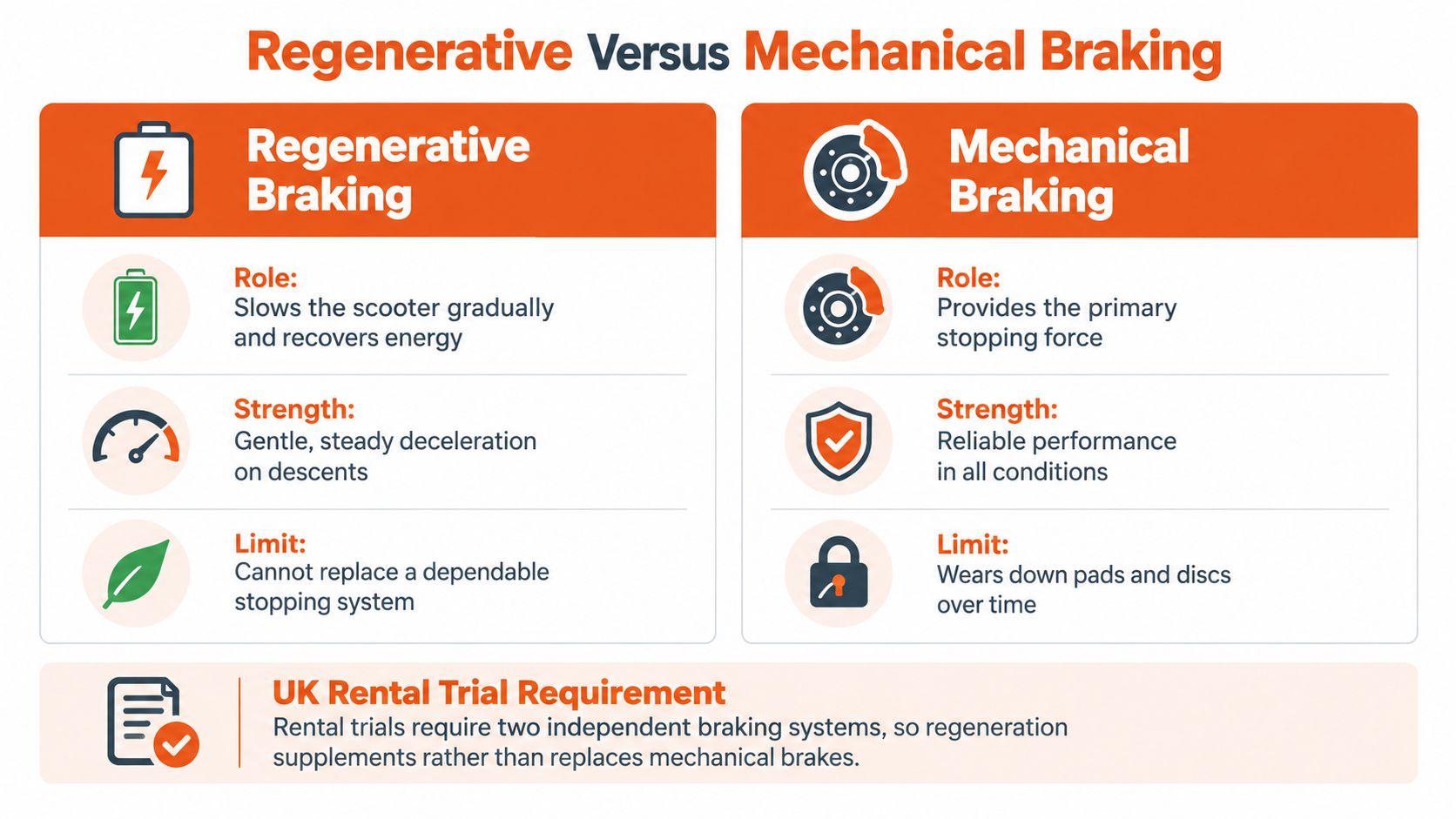
Regenerative braking compared with friction braking
CriterionRegenerative brakingFriction brakePrimary roleSupplementary slowing and energy recoveryMain stopping force on each road wheelWhen the battery is fullOften weak or unavailableOperation is unaffected by charge acceptanceHeat and pad wearReduces friction-brake use and pad wearGenerates heat and wears pads or shoesModulationCan be difficult to control finely; force changes with chargeA sound system provides progressive, repeatable lever controlWet or low-grip roadsStrong regen can bring the driven wheel close to slipStill grip-limited; apply progressivelyEnergy effectReturns part of braking energy to the batteryTurns braking energy into heat without recoveryRole in emergency stoppingMustn't be relied onMust remain independent and sufficient
Drum brakes press shoes against the inside of a drum. Disc brakes clamp pads onto a rotor; foot brakes press a friction surface against the wheel or tyre. Those arrangements have different maintenance needs, so ask exactly what's fitted rather than accepting a description that says only dual braking.
For lever consistency, I favour properly maintained hydraulic discs over a poorly adjusted cable system. Hydraulic operation doesn't make a brake immune to contaminated pads, worn rotors, overheating or air in the line.
A relaxed commuter on a flat route can use regeneration for gentle, planned slowing. A delivery rider approaching a wet junction needs progressive friction-brake control, suitable tyres and enough stopping space, not a stronger recovery setting.
Ask for independently specified front and rear friction brakes, an explanation of any blending, and documented stopping performance. A prominent regen badge answers none of those questions.
Riding Settings and Techniques That Get the Most From Regen
Set regeneration for predictability, not maximum drag. A setting that makes the scooter lurch whenever you close the throttle is a poor choice for busy traffic, even if it looks impressive on an energy display.
Use this setup process where riding is permitted, away from traffic:
- Find the control. Look for regeneration, energy recovery or motor-braking settings in the display or manufacturer's app.
- Start at a medium level if one is available. If you're unfamiliar with the scooter or the response feels abrupt, reduce it before continuing.
- Compare settings on a familiar route. Notice how much slowing follows throttle release and whether lever application adds electrical braking.
- Choose the level that gives smooth, predictable deceleration without an unexpected tug at the driven wheel.
- Keep it consistent in traffic. Make setting changes while stationary, then reacquaint yourself with the response before entering busy roads.
Anticipate rather than chase recovery
Look further ahead for changing lights, queues and junctions. Roll off early enough to slow progressively, but don't coast into a closing gap while watching the battery display.
Release the throttle smoothly rather than snapping it shut. On a scooter with abrupt throttle-off regeneration, controlled hand movement helps avoid an unnecessarily sharp change from driving torque to braking torque.
Don't repeatedly accelerate and regenerate to keep the battery indicator moving. Every conversion loses energy; avoiding unnecessary acceleration is the better habit.
Practical rule: Use the strongest setting you can control smoothly, not the strongest setting the menu offers.
Keep the scooter upright for substantial braking wherever the road situation allows. On wet paint, drain covers, loose grit or greasy surfaces, avoid abrupt throttle changes and sudden lever inputs.
Plan the final stop with the friction-brake lever. Keep your fingers ready to apply the controls as taught during rider training, rather than treating the lever as an emergency accessory.
One-pedal or one-lever marketing describes a control arrangement, not a stopping-performance guarantee. Gentle throttle-controlled slowing can suit an uncomplicated flat route, but it isn't equivalent to a motorcycle-grade hydraulic brake. The friction lever remains your planned stopping control in traffic.
How to Test and Maintain Both Braking Systems
Use a quiet, dry, flat area where you're allowed to ride, with no pedestrians or other obstacles. Wear your normal protective equipment and keep the exercise at walking pace.
- Check throttle-off slowing. Ride steadily, release the throttle and leave the friction lever untouched. Note the coast distance and whether regeneration engages.
- Repeat using the friction-brake lever and compare the stopping response. If that lever also triggers regeneration, this isn't a friction-only test unless the manufacturer provides an approved way to disable recovery.
- Check combined operation. Apply the controls normally and progressively. Compare the response with throttle-off slowing alone.
- Confirm independent friction braking through the manufacturer's approved procedure or a workshop inspection. Don't unplug sensors or alter wiring to isolate systems.
Pass benchmarks for the two-brake test
The UK Government technical report on e-scooter construction standards recommends mechanically or hydraulically actuated braking on each road wheel and redundancy after a component failure; the rental-trial benchmarks are at least 3.5 m/s² or a stop within 7 m from 15.5 mph combined, and at least 1.5 m/s² or a stop within 15 m for each independent system.
TestDistance limitDeceleration limitCombined braking from 15.5 mphStop within 7 mAt least 3.5 m/s²Each system on its ownStop within 15 m from the specified test speedAt least 1.5 m/s²
A walking-pace check cannot establish compliance with these limits. Use it to identify unexpected behaviour, then ask for documented testing. Don't attempt a high-speed stopping-distance certification exercise in a car park.
Inspect hardware even when pads last longer
Check pad thickness against the manufacturer's minimum, rotor condition, drum adjustment and cable condition. Inspect hydraulic systems for leaks and abnormal lever travel; check fluid level using the specified procedure and never mix fluid types.
Measure cold tyre pressures with a gauge and inspect tread and damage. After demanding descents, check temperature warnings and allow hot components to cool before inspection.
Reduced friction-brake use doesn't remove corrosion, contamination or uneven-wear risks, particularly in wet service. Stop riding if the lever becomes soft, pulls unusually close to the grip, or braking becomes inconsistent. Have the fault repaired before repeating the test.
Delivery Rider and Fleet Economics for Regen
Regen is more likely to save brake parts and a little energy than transform delivery range. In its sampled e-scooters, Transport Research Laboratory's performance investigation found that most combined a mechanical drum, disc or foot brake with supplementary regenerative or electronic braking, activated through throttle release or the brake lever.
For riders working through Deliveroo, Uber Eats or Stuart, measure the benefit against your own delivery pattern:
- Choose a fixed loop. Ride it at least three times with regeneration enabled and three with it disabled, if the manufacturer permits that setting. Keep load, pressures, starting charge and conditions comparable.
- Record starting and finishing battery percentage, distance, weather and unusual delays.
- Estimate energy used. Multiply the battery-percentage drop expressed as a fraction by the pack's usable capacity in kWh. Treat this as an estimate because dashboard percentages aren't precision energy meters.
- Multiply estimated kWh by your electricity unit rate, then divide by miles travelled for an estimated energy cost per mile.
- Add maintenance evidence. Use service records to compare pad replacement costs. Count tyre savings only if your records actually demonstrate them.
Separate recovery from riding differently
Log throttle applications when safely stationary afterwards, or use available ride telemetry. If the regen-enabled runs also involve less acceleration, you've measured a combined technique-and-setting benefit, not isolated recovered energy.
Keep downhill starts with a full battery separate. Where practical, compare wall-metered charging energy across equivalent runs to capture charging losses rather than relying entirely on the dashboard.
For fleets, brake-service savings may matter more than range claims. Specify both braking systems in writing with Flex Electric, and log inspection findings, replacement parts and service intervals per vehicle. Budget from demonstrated savings, not an assumed extension of every delivery shift.
Confirm the Brakes Before You Buy or Ride
Ask for these details before choosing a scooter:
- Independent friction brakes at the front and rear, with their specifications.
- Documented deceleration performance, not just a brake-type label.
- Supplementary regeneration, with full-battery and cold-battery behaviour explained.
- The legal category, supported by continuous motor power and design speed rather than peak output.
The UK vehicle-approval application guidance places a two-wheeled electric moped at a maximum design speed of 45 km/h (28 mph) and maximum continuous power of 4 kW, while electric power above that boundary falls into motorcycle or motor-tricycle classification. Power alone doesn't establish moped status.
Questions worth asking
Can you lower or switch off regen? Check the model's available settings. Don't assume adjustability.
Does it reduce pad wear? Yes, when electrical slowing reduces friction-brake work. Inspections remain necessary.
Does it make a scooter road legal? No. Liverpool City Council's trading-standards guidance distinguishes privately owned e-scooters, which aren't permitted on public highways, from approved rental schemes.
For a commercial electric moped such as the Vmoto VS2 Citi, request the braking specification and continuous power rating alongside published range before committing.
Flex Electric offers electric mopeds, scooters and motorbikes for commuting and commercial use, with practical model-selection advice. Visit Flex Electric and ask for the independent brake specifications, regeneration behaviour and continuous power rating of the models you're considering. Choose on dependable stopping performance first, then assess what regeneration can save on your route.
Find us
You will find us at 74 Dalry Road, Edinburgh, EH11 2AY
Showroom Opening Times:
Monday: By Appointment
Tuesday to Friday: 11am - 5:00pm
Saturday: 10am - 5pm
Sunday: By Appointment
