
Motorcycle CBT: Start Riding in 2026
Flex Electric
The UK's #1 Electric Moped and Electric Motorbike dealer.

An electric motorbike CBT is the standard UK Compulsory Basic Training, and if you're 17 or older it lets you ride an electric motorbike with up to 11kW continuous power, which is the electric equivalent of a 125cc petrol bike, on L-plates. That's the key rule most new riders need to know before they buy a bike or book training.
If you're reading this, there's a good chance you're fed up with the usual commute. The bus is late again, traffic barely moves, parking is expensive, and petrol prices never feel friendly. An electric motorbike starts to look less like a niche idea and more like a practical answer.
That's where the confusion starts. People hear the phrase electric motorbike CBT and assume there's a separate licence or a special electric-only test. There isn't. It's the same CBT that learner riders use for petrol bikes and scooters. The difference is understanding which electric motorbike is legal to ride on it, and that's where many first-time riders get caught out.
At Flex Electric, we speak to plenty of people in exactly this position. They're ready to start riding, but they want the rules explained in plain English, not buried under technical jargon. The good news is that the path is straightforward once you know what to look for.
Your First Step into the World of Electric Motorbikes
You finish work in town, check the sat nav, and see the same slow crawl home you saw yesterday. A car feels wasteful for one person. Public transport gets you there eventually. Walking is healthy, but not when you've got shopping, kit, or a delivery shift ahead of you.
An electric motorbike changes that equation. It gives you a compact, road-legal way to get across the city without relying on fuel stops or gear changes. For a lot of new riders, it's the first machine that feels both modern and manageable.
The first legal step is the CBT. That applies whether you want a petrol 125, an electric scooter, or an electric motorbike. The phrase electric motorbike CBT really just means doing your normal CBT with the aim of riding an electric model afterwards.
Why this feels bigger than it is
Many learners build the process up in their head. They worry they need motorbike experience, mechanical knowledge, or the confidence of someone who has ridden for years. You don't.
CBT is designed for beginners. In practice, many electric riders find the lack of gears and clutch less intimidating than a petrol bike. You can focus on observation, road position, braking, and throttle control instead of thinking about stalling.
CBT isn't a test in the usual pass-or-fail sense. It's basic training to make sure you can ride safely on the road as a learner.
What usually confuses first-time electric riders
A few questions come up again and again:
- Is there a special electric licence? No. You do the standard CBT.
- Can any electric bike be ridden on a CBT? No. The bike still has to fit the learner-legal rules.
- Does fast acceleration make a bike illegal? Not necessarily. The legal detail that matters is more specific than that.
That last point matters more than is often appreciated. It's also the reason some riders buy the wrong bike, or avoid the right one because the specs look confusing.
Decoding the UK Electric Motorbike Licence Rules
You are standing in a showroom, looking at an electric bike that feels perfect. The spec sheet says 11kW. Another line mentions strong torque and quick acceleration. It is easy to assume those figures all mean the same thing. For CBT eligibility, they do not.
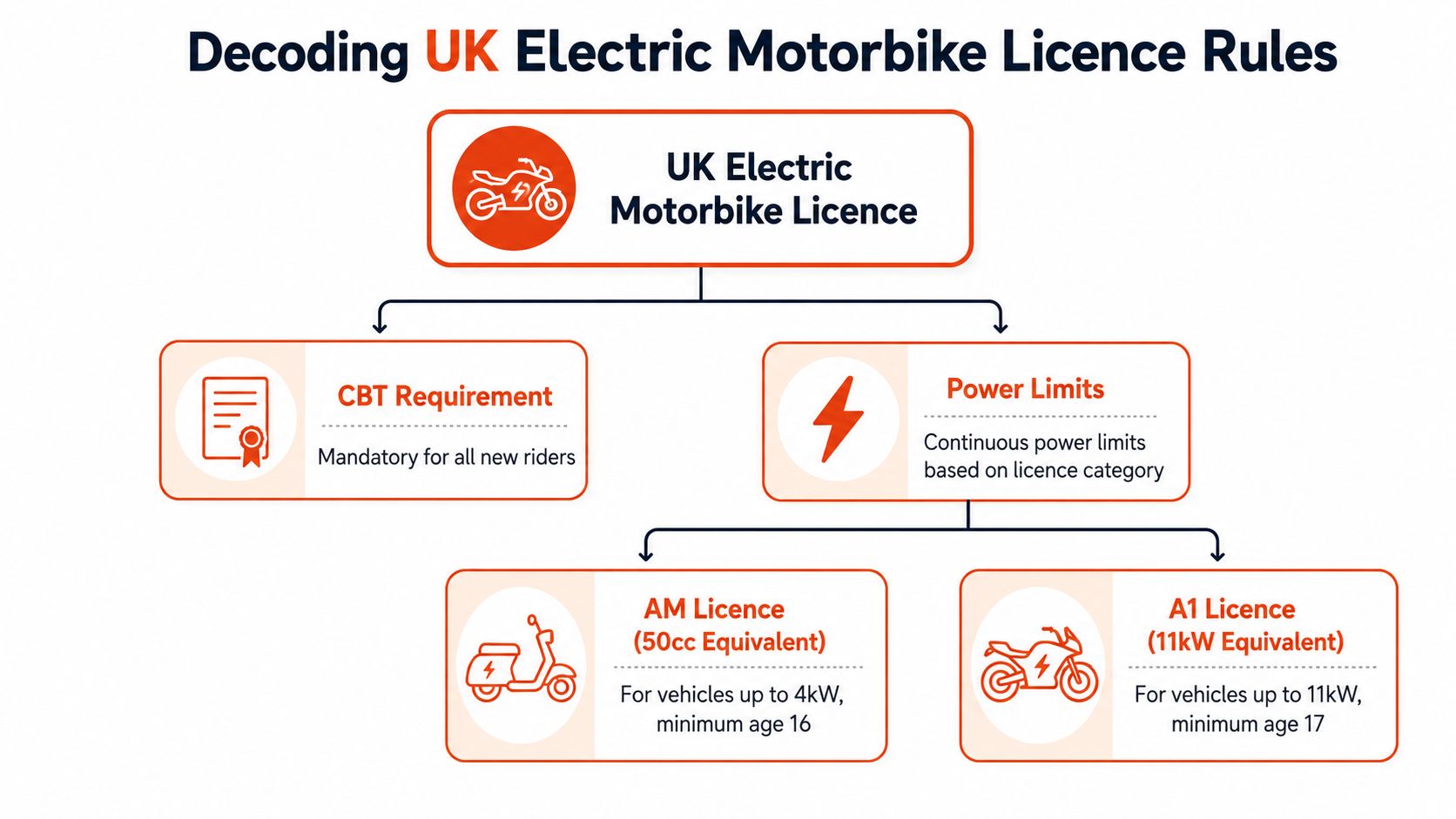
For riders aged 17 or over, the key learner rule is this: a CBT lets you ride an electric motorbike in the 125cc-equivalent learner class if its continuous rated power is no more than 11kW. That is the figure to focus on.
The word continuous does a lot of work here.
A petrol learner bike is usually described by engine size, such as 125cc. An electric bike is judged differently. The law is interested in the power the motor can sustain, not the hardest shove it can give for a few seconds away from the lights.
Continuous power and peak torque are not the same thing
This is the point many first-time electric riders miss, and it is also where marketing language can muddy the water.
Continuous rated power is the legal reference point for CBT eligibility. Peak power is the higher output a bike may produce briefly. Torque describes the turning force that gives an electric bike that instant, punchy pull. A bike can feel much sharper than a petrol 125 at low speed and still sit within the learner rules if its continuous rating stays inside the limit.
A simple way to read the spec sheet is this. Continuous power is the pace you can keep up all day. Peak power is the short sprint. Torque is the strength of the first push.
That distinction matters when you look at bikes such as the Yadea Keeness. You may see a headline figure such as 11kW peak power and a 65mph top speed. Useful performance details, yes. Proof of CBT legality, no. To answer that, you need the bike's continuous rated power and its formal vehicle classification.
Practical rule: if you ask, “Can I ride this on a CBT?”, ask for the bike's continuous rated power, not just its peak output, top speed, or torque figure.
What to check before you pay a deposit
A quick check now can save a lot of hassle later with training, insurance, or delivery.
- Confirm the continuous rated power
Ask the dealer to state it clearly, in kW. - Check your age against the category
For the 125cc-equivalent learner route, you need to be 17 or older. - Ask for the vehicle classification
“125 equivalent” is helpful shorthand, but you want the formal category, not only a marketing label. - Ask whether any restriction is official
If the bike uses a restricted mode to fit licence rules, make sure that setup is documented properly.
Ask your CBT centre one extra question
The legal side is only half the picture. Training quality matters too, especially on an electric bike.
When you book, ask the CBT centre whether they are comfortable teaching riders on electric motorbikes, and whether they cover the differences in low-speed control, regenerative braking, and instant throttle response. Electric bikes remove the clutch and gears, but they introduce a different riding feel. New riders often find them easier overall, yet the first few metres can be surprisingly brisk if throttle control is sloppy.
A good centre should be able to explain how they handle that. If they sound unsure, ask what bike you will train on and whether the session includes specific guidance for electric power delivery. That one conversation often tells you whether the day will feel clear and confidence-building or rushed and generic.
The short version is simple. For CBT legality, continuous power is the rule. Peak torque may change how the bike feels, but it does not decide the licence category by itself. Understanding that difference helps you choose the right bike and ask much better questions before you commit.
Choosing Your First CBT-Legal Electric Motorbike
Picking your first bike usually comes down to two questions. What kind of roads will you use, and do you want something just for training or something you'll keep using afterwards?
For many new riders, the practical choice is between a lower-powered moped-style machine and a 125cc-equivalent electric motorbike. The second option is often the better fit if you need to keep pace with urban traffic and want more flexibility for commuting.
50cc equivalent or 125cc equivalent
A simple comparison helps:
If you're planning to cross town daily, join busier roads, or work delivery shifts, many riders prefer the 125cc-equivalent category because it feels less constrained in normal traffic.
A useful real-world example is the Vmoto TS Street Hunter Pro, a 125cc Equivalent Electric Motorbike with a top speed of 58mph and a 5kw peak power motor.

Why electric learner bikes can feel quicker than expected
Performance on paper doesn't always match what you feel from the saddle. While CBT-legal electric motorbikes are capped in the same learner class as 125cc petrol bikes, they can still feel much sharper in everyday city riding. Magnet Motos notes that models like the Super Soco TC Max can offer up to 4x faster acceleration, with 0 to 60 mph in about 4 seconds versus about 14 seconds for petrol, thanks to instant torque delivery.
That matters for one simple reason. A bike that responds cleanly at low speed can feel easier in stop-start traffic. It can also surprise a learner who's too abrupt with the throttle.
Strong electric pull can be helpful in town, but only if your training has prepared you for it.
Should you buy before your CBT or use the training school bike
There isn't one right answer. It depends on your confidence, budget, and how sure you are about the model you want.
Using the school's bike first
This is often the lower-pressure route.
- Lower commitment
You can complete training before choosing a machine. - Less admin upfront
You won't be sorting storage, transport, or early ownership questions before you've even ridden. - Good for comparisons
Your CBT experience may confirm what riding position and bike style suit you.
Buying your own bike before CBT
This can make sense if you've already done your homework.
- Familiarity helps
Training on the same model you'll ride later can build confidence. - Ownership questions come earlier
You'll need to think about insurance, charging, and where the bike lives. - You need to choose carefully
Buying before training makes it even more important to check learner legality properly.
If you're torn, a balanced approach is to shortlist bikes first, complete your CBT, then make the final purchase with a clearer sense of what felt comfortable.
What to Expect on Your Electric CBT Training Day
A CBT day has a clear structure, but the experience on an electric motorbike has its own feel. The bike is quieter. There are no gears to juggle. The throttle response can be immediate. For a beginner, that can either feel reassuring or slightly strange in the first hour.
A 2025 UK Motorcycle Industry Association survey found that only 12% of UK CBT centres have formalised electric training modules, and 65% of instructors report needing to retrain on electric-specific safety protocols such as sudden acceleration and the stability of battery-heavy chassis. That gap matters because electric riding has some distinct handling traits.
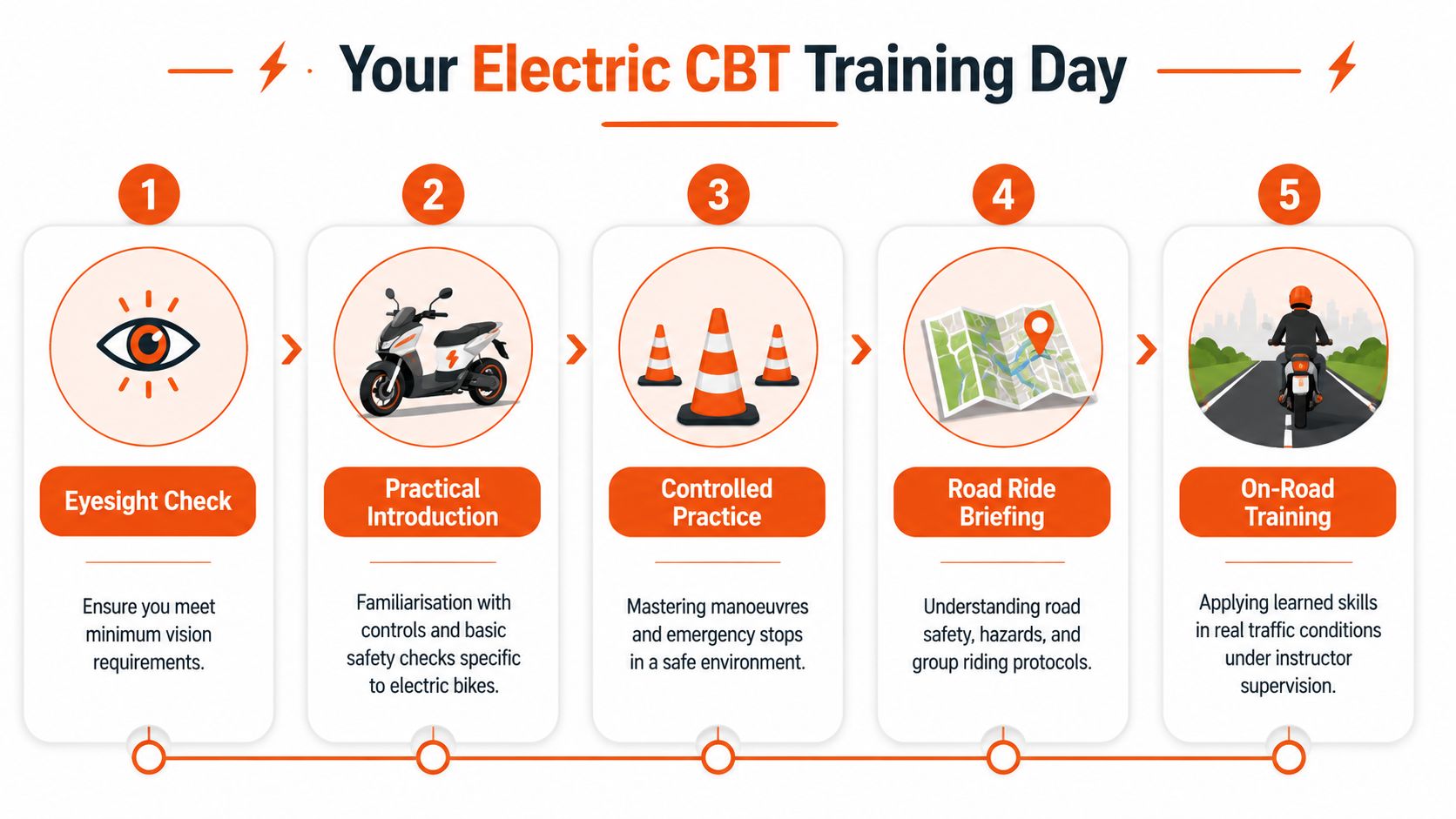
The five parts of the day
Most CBT courses include the same broad stages, whether the bike is electric or petrol.
- Eyesight check
You'll need to meet the minimum vision requirement before riding. - Practical introduction
An electric bike requires a proper explanation. You need to know the controls, the start-up procedure, and how the throttle responds. - Controlled off-road practice
You'll work on moving off, stopping, slow control, and basic manoeuvres. - Road ride briefing
Instructors go through hazard awareness, positioning, and what to expect on the route. - On-road riding
On-road riding brings your observation and control together in real traffic.
What feels different on an electric bike
The lack of gears often makes the first session calmer. But electric bikes bring their own learning points.
- Throttle response
Electric power arrives quickly. A small wrist movement can have a bigger effect than a learner expects. - Silence at low speed
Because the bike is quiet, some riders need a little time to get used to judging speed and presence differently. - Weight balance
Battery placement can change the way the bike feels at walking pace and during tight turns. - Braking feel
Some riders notice a different deceleration feel compared with what they expected from petrol training.
What to ask the CBT centre before you book
Don't be shy about asking direct questions. You're not being difficult. You're making sure the training fits the bike you want to ride.
Ask things like:
- Do you train learners on electric motorbikes or only petrol bikes?
- Will the instructor cover instant throttle response and smooth low-speed control on electric bikes?
- Do you explain how battery weight affects balance during U-turns and emergency stops?
- If I plan to ride electric after CBT, can you tailor the briefing to that?
If a centre sounds unsure when you ask about electric-specific handling, that's useful information in itself.
Riders who are interested in off-road electric machines later on may also find this ultimate electric dirt bike guide helpful, especially for understanding how electric power delivery changes the riding experience in a different setting.
A calm mindset helps more than bravado
You do not need to turn up pretending you already know how to ride. In fact, instructors usually prefer learners who listen, ask sensible questions, and take time to build smooth habits early.
If you've never ridden before, electric can be a friendlier place to start. Just make sure your centre treats electric handling as something worth teaching, not something they assume is self-explanatory.
Your Pre-CBT Costs and Paperwork Checklist
You book your CBT, feel ready, and then the avoidable problems appear. A missing licence, the wrong boots, or a training centre that assumed you were happy to learn on a petrol bike can create more stress than the riding itself.
A short checklist fixes most of that.
The training fee is usually the easiest part to budget for. In many parts of the UK, CBT prices often sit somewhere in the low hundreds of pounds, but the exact figure depends on the centre, location, and whether bike or kit hire is included. Ask for the full price in writing before you pay, including any charge for using the school's bike, protective clothing, or a rebooking if the weather turns poor.
Your practical checklist
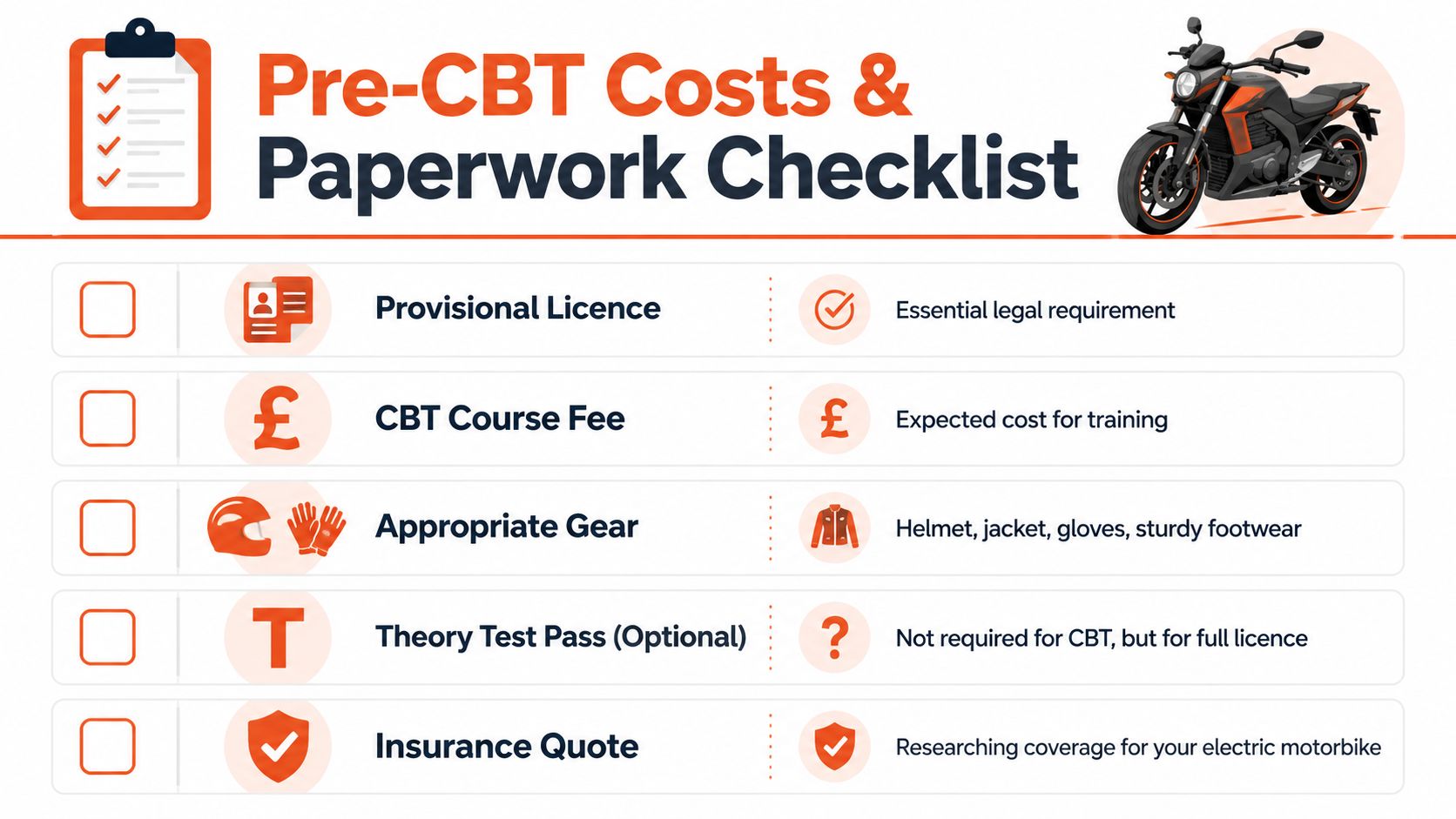
Use this once before booking and again the night before your training day.
- Check your provisional licence
You need the correct provisional motorcycle entitlement before you can take CBT legally. - Confirm the total cost
Ask what is included. Some centres provide helmet, jacket, gloves, and the training bike. Others expect you to bring some of your own kit. - Ask exactly what clothing is acceptable
Sturdy boots, long sleeves, and tough trousers are usually the minimum. Trainers and thin fashion clothing are often refused for obvious safety reasons. - Read the Highway Code
CBT is practical training, but you will still be expected to understand basic road signs, junction priorities, and safe road behaviour. - Check whether the centre can train you with electric riding in mind
Even if they use petrol bikes, ask whether the instructor will cover the feel of instant drive, gentle throttle inputs, and slow-speed balance on a heavier battery-powered machine. - Bring any glasses or contact lenses you need for riding
If you need them to see clearly on the road, you need them on CBT day too. - Look at insurance before you buy
That gives you a realistic picture of running costs and can stop a cheap-looking bike from becoming expensive later.
The paperwork question that protects you from buying the wrong bike
Many first-time riders get caught by one detail. They look at a bike that feels quick, see strong torque figures, and assume it must be too powerful for CBT. Or they see "125 equivalent" and assume that settles it.
For UK licence rules, the figure that matters for learner legality is the bike's continuous rated power, not the burst of acceleration it can produce when you first open the throttle. Peak torque affects how lively the bike feels. It does not automatically decide whether the bike is CBT-legal.
A simple comparison helps here. Continuous power is like the speed you can comfortably maintain on a long climb. Peak output is the short hard push you can manage for a moment. Electric bikes often feel punchy because the motor delivers torque straight away, but the legal category still turns on the continuous rating.
So if you are comparing bikes before or after CBT, ask one direct question: What is the continuous rated power in kW? If the seller only talks about torque, top speed, or "equivalent" engine size, ask again until you get a clear answer.
Questions to ask the CBT centre before you pay
This part is often skipped, and it matters.
If you plan to ride electric afterwards, ask the centre:
- Will my instructor explain the difference between continuous power and how an electric bike feels off the line?
- Can you cover smooth throttle control for an electric motorbike with instant response?
- Will we discuss how battery weight can affect low-speed balance and manoeuvres?
- If I buy an electric 125-equivalent bike, can I ask the instructor about its licence category using the continuous power figure?
A good centre does not need to sell electric bikes to answer those questions calmly and clearly. You are checking whether they understand the bike you want to ride.
A simple way to stay organised
Some learners at Flex Electric find it helpful to sort their prep into three mental folders.
FolderWhat goes in itLegalProvisional licence, booking confirmationPracticalClothing, gloves, glasses or contact lenses if neededBuying researchBike shortlist, insurance notes, continuous power checks
That keeps the process clear. You do not need expert knowledge before CBT. You need the right documents, the right kit, and the confidence to ask the one legal question many new electric riders miss.
Life After Passing Your CBT What Comes Next
Once you've completed your CBT, you can start riding as a learner within the rules that apply to your licence position and bike category. That usually means riding with L-plates, not carrying a pillion passenger, and staying off motorways until you move on to a full licence.
For many new electric riders, this is where things become real. You stop thinking about “doing a course” and start building a routine around actual journeys. That includes charging, where you park, what your usual route looks like, and how much carrying capacity you need for work or commuting.
Turning training into daily riding
Electric ownership is often straightforward day to day. You're likely to spend more time thinking about charging habits and route planning than maintenance routines. For urban riding, many people find that simplicity is one of the biggest attractions.
If you enjoy riding and want fewer restrictions later, the next step is moving towards a full motorcycle licence. That path opens up more categories and removes learner limits, but many riders are perfectly happy to begin with CBT and build confidence first.
The first month after CBT is where smooth habits form. Short regular rides usually teach more than one overly ambitious journey.
Frequently Asked Questions About Electric Motorbike CBT
Can I do my CBT on a petrol bike and then ride an electric motorbike?
Yes, provided the electric motorbike you choose is legal for your licence position. The CBT itself isn't tied to petrol or electric in the way many people assume. What matters afterwards is that the bike fits the learner rules.
Does no clutch make an electric motorbike easier for beginners?
For many riders, yes. Removing clutch control and gear changes can free up attention for steering, observation, positioning, and braking. But “easier” doesn't mean effortless. Electric throttle response can still catch out a new rider if they're abrupt.
Should I avoid a bike if the spec sheet highlights peak power?
Not automatically. Peak figures are common in electric bike marketing because they describe the bike's punchier performance moments. They do not, by themselves, settle CBT legality. The right follow-up question is always about continuous rated power and formal classification.
If you're comparing learner-legal electric options and want straightforward help with real model specs, Flex Electric is one place to browse electric mopeds, scooters, and motorbikes while checking practical details before you commit.
Find us
You will find us at 74 Dalry Road, Edinburgh, EH11 2AY
Showroom Opening Times:
Monday: By Appointment
Tuesday to Friday: 11am - 5:00pm
Saturday: 10am - 5pm
Sunday: By Appointment
