
What Licence Do You Need for an Electric Motorbike in the UK?
Flex Electric
The UK's #1 Electric Moped and Electric Motorbike dealer.

Buying your first electric two-wheeler in the UK often starts the same way. You spot a bike you like, you check the speed, you compare the range, and then you hit the confusing part. Do I need a licence, is CBT enough, what does A1 or A2 mean, and why does one spec sheet say the bike is learner-friendly while another makes it sound like a full licence machine?
That confusion is normal. Electric motorbikes don't use the same language most new riders grew up hearing around petrol bikes, so terms like continuous power, peak power, L1e-B, A1, and MSVA can make a simple buying decision feel more complicated than it needs to be.
Your Guide to Riding Electric in the UK
A lot of riders reach this point when they're ready to swap buses, cut fuel stops, or start delivery work with something cleaner and quieter. They know an electric moped or motorbike could fit their daily life well. They just don't want to buy the wrong thing and discover later that their licence doesn't cover it.
That caution makes sense. In the UK, electric bikes that go on the road sit inside the same legal structure as petrol mopeds and motorcycles. The rules are clear once you break them down, but they're rarely explained in a way that matches how people shop.

Interest in going electric is no longer niche. As of March 2024, the UK had 1,100,000 licensed zero-emission vehicles on the road, representing 2.7% of the total vehicle fleet, according to the UK vehicle licensing statistics for January to March 2024. That rise in zero-emission vehicles goes hand in hand with more people trying to understand the right licence route.
The easiest way to think about an electric motorbike licence in the UK is this. First match your age and training to a licence category, then match that category to the bike's legal power class.
For most new riders, the journey starts with one simple question. Are you trying to ride a moped-style machine, a 125cc-equivalent electric bike, or something more powerful? Once you know that, the legal path gets much easier to follow.
The First Step For Everyone Compulsory Basic Training
You find an electric bike that looks right for the school run, commuting, or delivery work. The price works. The running costs look low. Then one detail stops the purchase. Are you allowed to ride it yet?
For first-time riders, that question usually leads to Compulsory Basic Training, or CBT. CBT is the starting point for riding on the road as a learner. It gives you the training certificate that allows you to ride within legal limits, but it does not give you a full motorcycle licence.
That matters long before test day. It matters when you are comparing bikes.
A lot of new riders shop by style, speed, or monthly cost first. The legal order is the safer order. Check your entitlement, then choose the bike that fits it. That avoids the expensive mistake of buying a machine you cannot legally use on the road.
What CBT actually lets you do
CBT teaches the basics of road riding and confirms that you have reached the learner standard for your category. In simple terms, it is the gate at the entrance, not the whole journey.
For an electric rider, CBT often sits between two practical buying choices. You may be looking at a moped-style machine for short urban trips, or at a 125cc-equivalent electric bike for faster day-to-day travel. CBT is often the first requirement for both routes, depending on your age and the bike's class.
The easiest way to understand it is to compare it with driving on L plates. You can get on the road, but only within specific rules. Those rules still matter when you choose the bike, arrange insurance, and plan how you will use it for work or commuting.
A real example is the Vmoto VS2 Citi. It is a road-legal electric scooter used for urban mobility and commercial fleets. If a bike sits in the kind of category you want to buy, you need to check three things together. Your age, your current CBT status, and the bike's legal power class. If one of those does not line up, the purchase can quickly become a headache.
The detail many riders miss
CBT does not last forever.
Your CBT certificate is valid for 2 years. If you have not passed the relevant full licence test before it expires, you need to take CBT again to keep riding legally as a learner.
This catches people out because the training day feels like a one-time milestone. In practice, it works more like a dated pass. If the date runs out, your legal right to ride as a learner runs out with it.
That small detail can affect the whole ownership plan. A rider who buys an electric bike for daily commuting may sort the bike, helmet, lock, and insurance, then realise the CBT certificate is close to expiry. A delivery rider can end up with lost working time. A first-time buyer can end up paying for a bike before sorting the training needed to use it.
How to use CBT in your buying decision
A sensible plan is simple:
- Check your CBT date before you buy. If you already have a certificate, make sure it is still valid for the period when you expect to collect and insure the bike.
- Match the bike to what you can ride now. Do not assume a bike is learner-legal just because it is electric or described casually as a scooter.
- Plan your next step early. If your CBT is nearing expiry, decide whether you will renew it or move on to a full licence route.
That last point saves money. It also saves frustration.
Electric bike licensing often becomes confusing because shoppers see marketing terms like “125cc equivalent” and assume that is the whole legal answer. It is only part of it. Your entitlement depends on the formal category rules, and for electric bikes those rules link to power classification in ways many buyers do not spot at first. CBT gets you started, but it only works if the bike you choose fits your learner entitlement.
Decoding UK Licence Categories for Electric Motorbikes
This is the part most buyers need in plain English. In the UK, electric motorbike licensing is based on continuous power output, not the headline burst figure you might see in adverts. The framework divides road-going electric two-wheelers into four licence classes, as explained by Magnet Motos' guide to electric motorcycle licence requirements.
UK Electric Motorbike Licence Categories at a Glance
Licence CategoryMinimum AgeMax Continuous PowerTest RequiredTypical Bike TypeAM16Up to 1kW / 28mphCBT or AM licenceElectric mopedA117Up to 11kWCBT or A1 licenceLight motorcycle / 125cc-equivalentA219Up to 35kWA2 licenceMid-power electric motorbikeA21 with progressive access, or 24 directUnlimitedFull A licenceUnlimited power electric motorbike
The categories look technical at first, but they become easier when you attach them to real use.
AM and A1 for everyday new riders
AM is the moped category. It suits younger riders and lower-powered urban machines. If you're looking at a compact electric moped for short city trips, this is often where the licensing conversation starts.
A1 is where many adult first-time riders land. This covers light motorcycles up to 11kW continuous power, which is the category that often gets described as 125cc-equivalent in everyday bike shopping language. That makes A1 especially important for commuters who want something that can keep up with normal town traffic and faster urban roads.
A bike like the Vmoto TS Street Hunter Pro helps make the category feel more concrete. It's described as a 125cc equivalent electric motorbike with a top speed of 58mph and a 5kw peak power motor. The useful lesson here isn't just the model itself. It's that riders need to look beyond the top speed and the peak figure and confirm the legal class properly.
A2 and A for bigger bikes
Once you move above learner-level machines, you reach A2 and then A.
For A2, the maximum is 35kW, and there's also a power-to-weight limit of 0.2 kW/kg. That means a 35kW bike must weigh at least 175 kg to fit the rule. The rider must be at least 19 and hold an A2 licence.
For A, the category is effectively unlimited. Riders can get there through progressive access from lower categories at 21, or through the direct route at 24 with a full A licence.
Don't shop by “feels like a 125” or “looks learner legal”. Shop by licence class, age requirement, and the bike's legal continuous power.
The buying shortcut that saves trouble
When you compare bikes, use this order:
- Your age
- Your current entitlement (CBT, AM, A1, A2, or A)
- The bike's continuous power
- Its road classification
That order keeps the purchase process simple. It also stops you falling for the common mistake of choosing a bike because its speed or styling looks right, while its legal category says otherwise.
From Provisional to Full Licence The Test Pathway
Once you've got the learner stage clear in your head, the full path becomes much less intimidating. Most riders move through it as a sequence, not as one giant leap.
The route in order
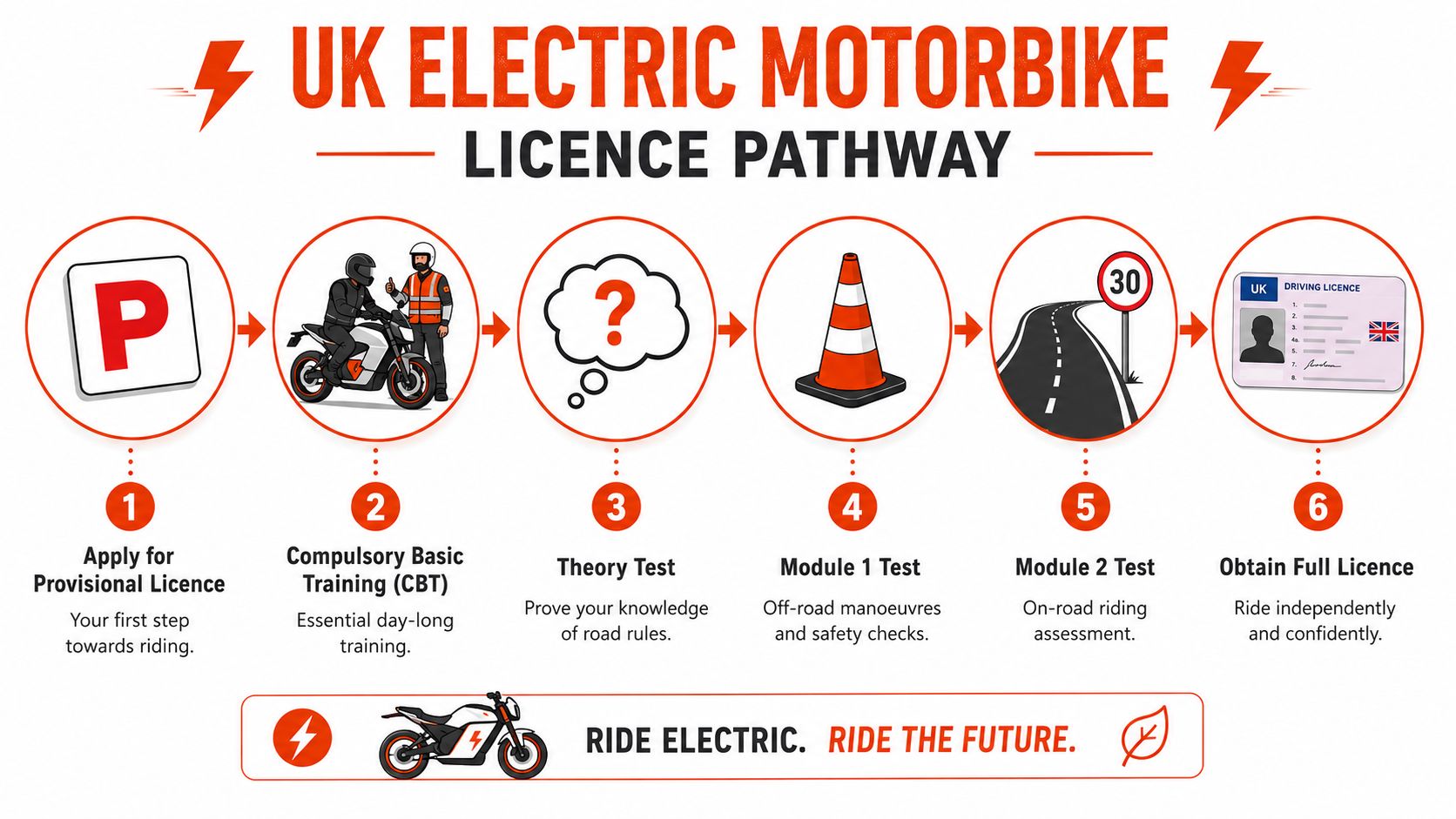
Start with a provisional licence if you don't already have one that covers motorcycle entitlement. Without that, you can't begin the normal learner route on the road.
After that comes CBT, which gives you the training basis to ride as a learner in the category your age allows. Many riders stop here for a while, especially if they're using a moped or 125cc-equivalent machine for local travel. Others use it as a short stepping stone before progressing quickly.
The next formal hurdle is the motorcycle theory test. This checks that you understand road signs, hazard awareness, and the rules behind safe riding. It matters more than many riders expect, because practical confidence on a bike doesn't replace legal and hazard knowledge.
The two practical tests
The practical licence process is split into Module 1 and Module 2.
Module 1
This is the off-road part. It focuses on machine control and safety exercises. Riders are assessed on manoeuvres rather than traffic interaction.
Typical elements include:
- Slow control: Handling the bike smoothly at lower speed
- Observation habits: Showing that you check properly before moving or turning
- Emergency responses: Demonstrating controlled braking and avoidance exercises
Module 2
This is the on-road riding assessment. An examiner watches how you ride in real traffic conditions and checks whether your decision-making is safe, legal, and consistent.
Most riders find the pathway easier once they treat each test as a separate skill set. Theory is knowledge. Module 1 is control. Module 2 is roadcraft.
Progressive access and direct access
There are two broad ways riders reach higher categories.
One is progressive access, where a rider moves up through the licence tiers over time. The other is the direct route to a full A licence for riders old enough to take it without stepping through every earlier category first.
If you're unsure which route fits you, work backwards from the bike you want to own. If your aim is a practical commuter in the lighter classes, there may be no rush to go beyond A1 or A2. If you already know you want an unlimited-power machine, it makes sense to plan training and testing around that longer-term goal.
Key Legal Details and Common Pitfalls to Avoid
You pass your CBT, spot an electric bike online, and the listing says it makes impressive power. It feels like you are ready to buy. Then the paperwork starts, and that is where new riders often make the costly mistakes.

Peak power is not the legal number
For licence purposes, the number that matters is continuous power, not peak power.
That catches many first-time buyers out because electric bike marketing often puts the biggest figure first. Peak power is the short burst the motor can produce for acceleration. Continuous power is the figure the bike can sustain, and that is the one used to place it in the correct UK licence category.
A simple way to read it is this. Peak power tells you how hard the bike can push for a moment. Continuous power tells you what class of machine it legally is.
This matters during the buying journey, not just during training. A bike might look too powerful for your licence if you only read the headline number. Another might look learner-friendly until you find the continuous rating buried lower down the spec sheet. At Flex Electric, this is one of the details we encourage riders to check before they pay a deposit, because getting it wrong can leave you with a bike you cannot legally ride home.
CBT expiry catches riders out
Another common problem is timing.
A CBT certificate lasts two years. New riders sometimes complete CBT, ride for a while on a provisional licence, then assume they can carry on indefinitely. They cannot. If your CBT expires before you pass the relevant full licence test, you usually need to renew it to keep riding legally on the road as a learner.
That can affect purchase decisions. If you are choosing between a bike you can ride now on CBT and a bike that will require you to complete the full test route soon, your certificate end date matters. A cheap deal on a bike is less attractive if you also need to rebook training because your CBT is close to expiry.
MSVA and road legality
Imported bikes and less familiar brands need extra care. If a machine sits outside EAPC limits of 250W and 15.5 mph, it is not treated like a normal pedal-assisted electric bike. It must meet the legal standards for the type of vehicle it is, and approval status matters.
If it does not have the right approval for UK road use, you may not be able to register it and ride it legally on public roads. The UK government's electric bike rules explain where the EAPC boundary sits, which helps you spot when a seller is describing something in misleading terms.
Approval checks usually cover things such as:
- Vehicle identification: The bike must be properly recorded and identifiable
- Lighting and braking: Road equipment must meet the required standard
- Classification and speed capability: The machine must match the class under which it is approved
If a seller is vague on approval, treat that as a warning sign, not a paperwork delay.
Here's a useful explainer that helps make those legal checks feel more real in practice.
The practical checks before you buy
Before you commit, ask the seller clear questions and get clear answers.
- Licence fit: Which licence category does the bike fall into, based on continuous power rather than peak power?
- CBT reality: Can you ride it on your current entitlement today, and will that still be true if your CBT is close to expiry?
- Approval status: Is it road-legal in the UK, and what approval or registration paperwork supports that?
- Registration basics: Can it be registered, plated, taxed, and insured for road use?
- Future obligations: Will it need the same road-going requirements as a petrol equivalent, including a number plate and MOT when it reaches the relevant age?
Buy the legal status as carefully as you buy the bike.
A good electric motorbike purchase is not just about range, speed, or price. It is about matching the bike's real legal category to your current licence position, so you do not spend money on a machine that creates problems on day one.
What to Budget Costs and Timescales for Your Licence
The legal route isn't just about rules. It's also about planning. Riders usually want to know two practical things before they begin. How much will the process cost, and how long will it take?
The honest answer is that both vary by training provider, test centre availability, and how quickly you progress from one stage to the next. Because those figures change and no verified fee data is provided here, the safest way to budget is to treat the process as a series of separate costs rather than one single bill.
The stages you'll usually pay for
Most riders should expect to budget for:
- Provisional licence application: This comes first if you don't already hold the right provisional entitlement
- CBT training: Often the first substantial training cost
- Theory test: Needed before the practical test route
- Practical training: Many riders book lesson time before Module 1 and Module 2
- Module 1 and Module 2 tests: Usually charged separately from general training
That structure helps because you don't have to spend everything at once. You can move step by step, paying as you progress.
Building a realistic timeline
Timescales vary just as much as costs do. Some riders book CBT quickly and start riding soon after. Others face delays because local training schools are busy or test slots are limited.
A sensible timeline usually depends on three things:
- How soon you can book CBT
- How ready you are for the theory test
- How easily you can access practical training and test dates
If you need a bike for commuting or delivery work by a certain month, leave breathing room. Don't assume every stage will line up perfectly back to back.
A budget mindset that works
Instead of asking, “What's the total cost of getting licensed?”, ask a more useful set of questions:
- What do I need to spend now to start legally?
- What will I need later if I move to a full licence?
- Will I renew CBT or progress to tests before it expires?
That approach makes the process feel manageable. It also helps you avoid buying a bike first and discovering you've squeezed out the money or time needed to get properly qualified for it.
Your Next Steps Choosing and Insuring Your Electric Bike
You have your licence route clear. Now the buying decision becomes more practical.
A lot of first-time riders make the same mistake here. They see a bike described as "125cc equivalent" or focus on top speed, assume it fits their entitlement, then find out later that the licence match depends on the legal classification and the continuous power figure. That can turn an exciting purchase into an expensive pause.
Buying your first electric bike works a lot like buying your first car. The right choice is the one you can legally use, afford to insure, and live with every day, not the one that only sounds impressive on paper.
A simple buying checklist
Before you commit to any model, check four things carefully:
- Licence match: Compare the bike's legal category with your actual entitlement
- Power figure: Check continuous power for licensing, not just peak output used in marketing
- Road legality: Make sure the bike is approved, registered where needed, and intended for road use
- Insurance details: Get quotes for the exact model, because insurers price the specific bike, not just "an electric motorbike"
Flex Electric lists practical details across electric mopeds, scooters, motorbikes, off-road models, and accessories, which helps when you are comparing what you can legally ride rather than just comparing looks.
Buy for the riding you will actually do
A learner commuting across town has different needs from someone riding faster A-roads every day. A compact electric moped may be ideal for short urban trips, easy parking, and lower running costs. A larger 125cc-equivalent machine may suit mixed commuting better if your route includes quicker traffic and longer stretches between stops.
The aim is fit, not fantasy.
If your current entitlement points you toward a lower-powered bike, that is not a compromise in the wrong sense. It is a sensible first step. Many riders start on a machine that suits their CBT or early licence stage, build confidence, and then move up later with a clearer idea of what they want.
A strong first choice is the bike you can ride legally, insure at a sensible cost, and use with confidence from day one.
What to line up before delivery
Treat delivery day like the last step, not the first. Have the paperwork and practical bits ready beforehand so the bike does not arrive before you are set up to ride it.
Check these points:
- Your documents: Provisional licence, valid CBT certificate, or full licence, depending on your route
- Your CBT date: CBT certificates expire after two years, so check it will still be valid when you plan to ride
- Your insurance start date: Make sure cover begins when the bike does
- Your security plan: Ask what security the insurer expects, such as locks or where the bike is kept overnight
- Your riding kit: Helmet, gloves, and weather-ready gear for your real daily use
- Your next step: Decide whether this bike is for your current CBT period or part of a plan to move onto a full licence
That last point matters more than riders often expect. If your CBT is already partway through its two-year life, buying a bike without a plan for renewal or test progression can create pressure sooner than expected.
Get the licence match right at the start, and the rest of the purchase becomes much easier. Your shortlist gets tighter, insurance questions get clearer, and you are far less likely to end up with a bike that looks right but does not fit your legal position.
Find us
You will find us at 74 Dalry Road, Edinburgh, EH11 2AY
Showroom Opening Times:
Monday: By Appointment
Tuesday to Friday: 11am - 5:00pm
Saturday: 10am - 5pm
Sunday: By Appointment
