
Electric Motorbike UK: Your 2026 Buying Guide

Flex Electric
The UK's #1 Electric Moped and Electric Motorbike dealer.

When considering an electric motorbike in the UK, the aim is often to solve a very practical problem. This means wanting something cheaper to run than petrol, easier to live with in traffic, and legal for the roads one uses. There's also the challenge of determining whether the machine seen online is a proper road bike, a moped, or one of the many throttle conversions that can land riders in trouble.
That confusion is normal. The UK market now includes everything from urban electric mopeds to fast premium bikes, but a lot of content still lumps them together and skips the parts that matter most. Riders don't need more vague talk about “the future of mobility”. They need straight answers on licence rules, charging, weekly running costs, and whether the bike fits commuting, delivery work, or weekend riding.
Why UK Riders Are Going Electric
The shift isn't just hype. The UK electric motorcycles market was valued at USD 1.41 billion in 2024 and is projected to reach USD 7.3 billion by 2034, with 17.21% CAGR from 2026 onwards, according to IMARC Group's UK electric motorcycles market report.

That matters because riders usually move for practical reasons, not ideology. They're looking at fuel spend, stop-start traffic, city access, and the hassle of maintaining a petrol bike that works hard every day. Electric motorbikes answer those problems well when the bike matches the job.
What pushes riders to switch
For commuters, the appeal is simple. Electric drive is quiet, smooth off the line, and easy in traffic. You don't deal with clutch work in every queue, and urban riding suits the strengths of electric power delivery.
For delivery riders and small businesses, the question is even more direct. If the bike is in use all day, running costs and downtime matter more than image. A bike that charges reliably, needs less routine mechanical work, and handles repeated short trips can make more sense than a petrol 125 used in the same pattern.
Practical rule: Electric works best when your riding is repetitive, local, and predictable. The less your day depends on long high-speed runs, the stronger the case gets.
Growth despite a weak wider market
Another useful signal is how the segment is behaving against the rest of the market. In 2025, total UK motorcycle sales fell 18.3% to 94,389 units, while the electric two-wheeler segment still grew 19.8%, and in the first four months of 2026 the electric segment was up 106.5% year-on-year, based on UK motorcycle market reporting from MotorCyclesData.
That contrast tells you something important. Riders aren't only buying electric when the whole market is booming. They're still moving into the category when the wider motorcycle market is under pressure. In plain terms, electric bikes are taking share because they solve real transport problems.
What this guide should help you decide
Before spending money, get clear on four things:
- Legality first: Is the bike road legal in the UK, and what licence do you need?
- Use case second: Is it for city commuting, food delivery, mixed-road riding, or performance?
- Ownership maths: Will it save you money week to week, not just in theory?
- Charging reality: Can you charge where you live or work without turning every trip into a logistics exercise?
If you get those four right, the electric motorbike UK market starts to make sense very quickly.
Electric Motorbike Types and UK Licence Rules
The biggest mistake UK buyers make is confusing a road-legal electric motorbike with a high-powered e-bike or scooter that isn't legal for road use in the form it's being sold or ridden. That mistake can cost you more than money. It can leave you with something you can't legally use on public roads.
Road-legal motorbike or illegal conversion
Police guidance has been clear on this point. Many people searching for electric motorbike UK are really trying to work out whether what they've seen online counts as a legal motorcycle or an illegal conversion. Throttle-only electric bikes are treated as motorbikes and require tax, insurance, registration, and the proper licence, as highlighted in this UK police guidance video on illegal electric bikes and road rules.

A lot of buyers only discover this after purchase. They assume that if it has a battery and two wheels, it's just another e-bike. It isn't. Once it crosses into motor vehicle territory, the legal requirements change.
If it's throttle-driven and built to perform like a motorbike, treat it like a motorbike from day one.
The licence categories that matter
The categories below are the ones riders usually need to understand before buying:
- AM licence: For electric mopeds up to 4kW, roughly the 50cc-equivalent class.
- A1 licence: For light motorcycles up to 11kW, roughly the 125cc-equivalent category.
- A2 licence: For medium motorcycles up to 35kW.
- A licence: For full-power motorcycles without the A2 restriction.
The common trap is focusing only on top speed or styling. In the UK, your legal fit starts with the bike's classification and power output. A machine can look learner-friendly and still sit outside the category you're licensed for.
A useful real-world example is the Yadea Keeness, which is a 125cc equivalent electric motorbike with a top speed of 65mph and an 11kW peak power motor. That puts it firmly into the kind of machine riders compare when they're looking at road-going learner or commuter options rather than low-speed urban mopeds.
A1 and A2 in real electric terms
Honda's UK-spec WN7 gives a good picture of how licence class changes a bike in practice. The A2 version is rated at 18kW continuous with 50kW peak, 100Nm torque, a 349.44V lithium-ion battery, CCS2 quick charging, and 140km WMTC Class 1 range. The A1 version is rated at 11kW continuous with 11.2kW peak, the same 100Nm torque, the same 349.44V battery, and 154km WMTC range, according to Honda's UK WN7 overview.
That comparison matters because it shows how electric bikes are tuned for licence category. Torque stays the same, but power delivery and range shift. For a commuter, the A1 version may be the easier fit. For a rider who wants more acceleration headroom and has the right licence, the A2 version changes the character of the bike significantly.
Here's a useful video overview of licence categories and motorcycle access in the UK:
What works when choosing legally
Use this checklist before you shortlist any bike:
- Check classification first: Is it a moped, 125cc-equivalent motorcycle, or higher-output motorbike?
- Match it to your licence: Don't assume an electric bike sits in the same category as a bicycle-shaped machine sold online.
- Verify road equipment: Registration, lighting, mirrors, and approved road setup matter.
- Check insurance and tax status: If the bike is treated as a motorbike, the rest follows with it.
- Ignore vague listings: If a seller won't state the category clearly, walk away.
That one bit of discipline saves a lot of wasted time.
Calculating the Real Costs and Savings
Most buyers don't ask, “Are electric bikes interesting?” They ask a narrower question. Will this save me money compared with a petrol 125? That's the right question, and it's the one too many guides avoid.
Recent market coverage has highlighted that UK buyers want proper ownership maths, especially commuters and delivery riders asking whether an electric bike will save them money week to week versus a petrol 125, rather than another list of speed and range claims. That gap is noted in Motorcyclist's electric motorcycle market coverage.
Stop comparing only purchase price
A fair comparison isn't just ticket price. You need to think in terms of total cost of ownership. That includes charging or fuel, routine servicing, wear items, downtime risk, insurance, finance structure, and how hard the bike is used.
Petrol bikes still make sense for some riders, especially if they need longer runs and universal refuelling convenience. But for urban riding and repeated short trips, electric often shifts the weekly numbers in a way that matters more than the sticker.
The cheapest bike to buy isn't always the cheapest bike to own.
Annual running cost comparison
Below is the right way to compare. This is a decision framework, not a made-up savings promise.
Cost ItemElectric MotorbikePetrol Motorbike (125cc)Energy or fuelCharging cost depends on where and how you charge. Often easier to predict for home or depot use.Fuel spend rises directly with mileage and pump prices.Routine servicingFewer routine mechanical service items. No oil changes.More regular engine-related servicing and fluid changes.Wear from stop-start workStill has tyres, brakes, and general consumables.Same, plus engine and transmission maintenance.Downtime riskDepends heavily on battery support, charger reliability, and dealer backup.Depends heavily on engine condition, service history, and mechanical wear.InsuranceVaries by rider, postcode, use case, and vehicle category.Same. No useful shortcut without a quote.Finance impactMonthly affordability depends on deposit, term, and agreement type.Same. Cheap used petrol can reduce entry cost but may raise upkeep.Delivery or fleet suitabilityStrong when usage is local, repetitive, and charging is controlled.Strong when riders need fast turnaround without charging planning.
What usually works in practice
For a commuter, the cost case improves when you have consistent mileage and somewhere reliable to charge. Home charging is the obvious win. Workplace charging can also help if the setup is stable and available when you need it.
For a delivery rider, the maths depends on utilisation. The more often the bike is moving through short urban runs, the more running cost and maintenance patterns matter. But this is also where bad buying decisions show up fastest. If battery support is weak, if charging takes too long for your shift pattern, or if parts backup is poor, a cheap deal can become expensive.
Questions to ask before buying
Use these instead of chasing broad claims:
- What will I spend each week on energy? Base it on your own mileage and charging setup.
- How many service visits am I avoiding? Electric usually reduces routine engine-related maintenance.
- What happens if the bike is off the road? This matters more for earning riders than enthusiasts.
- What are the finance terms really doing? A lower monthly payment can still cost more over the life of the agreement.
- Is battery support clear in writing? Ambiguity here is a risk, not a small detail.
Financing matters more than many buyers expect
A lot of riders could manage an electric bike monthly, but hesitate because they frame the decision as one upfront payment. That's too narrow. Hire Purchase and PCP can make the switch workable, especially for riders using the bike daily for transport or income.
The important part isn't “Can I get approved?” It's “Does the monthly structure match the way I'll use the bike?” A commuter might prioritise predictability. A fleet buyer may care more about service planning and replacement timing. A delivery rider often needs a setup that protects cash flow if work levels fluctuate.
If you want a clean comparison, build your own annual model with real local assumptions. Don't accept generic claims from any brand or seller.
Range and Charging in the Real World
Range anxiety is usually a planning problem, not a technology problem. Riders get caught out when they buy on headline range, then ride faster, carry more weight, use different roads, or charge in a way that doesn't suit their routine.
The number on a product page only becomes useful when you understand what kind of riding produced it.
Why one range figure rarely tells the full story
Electric motorbike range changes with speed, terrain, temperature, payload, and how hard you accelerate. A city-focused machine may feel excellent in urban traffic and much less convincing if you sit at higher road speeds for long stretches. That doesn't mean the bike is bad. It means the test condition and your actual use aren't the same thing.
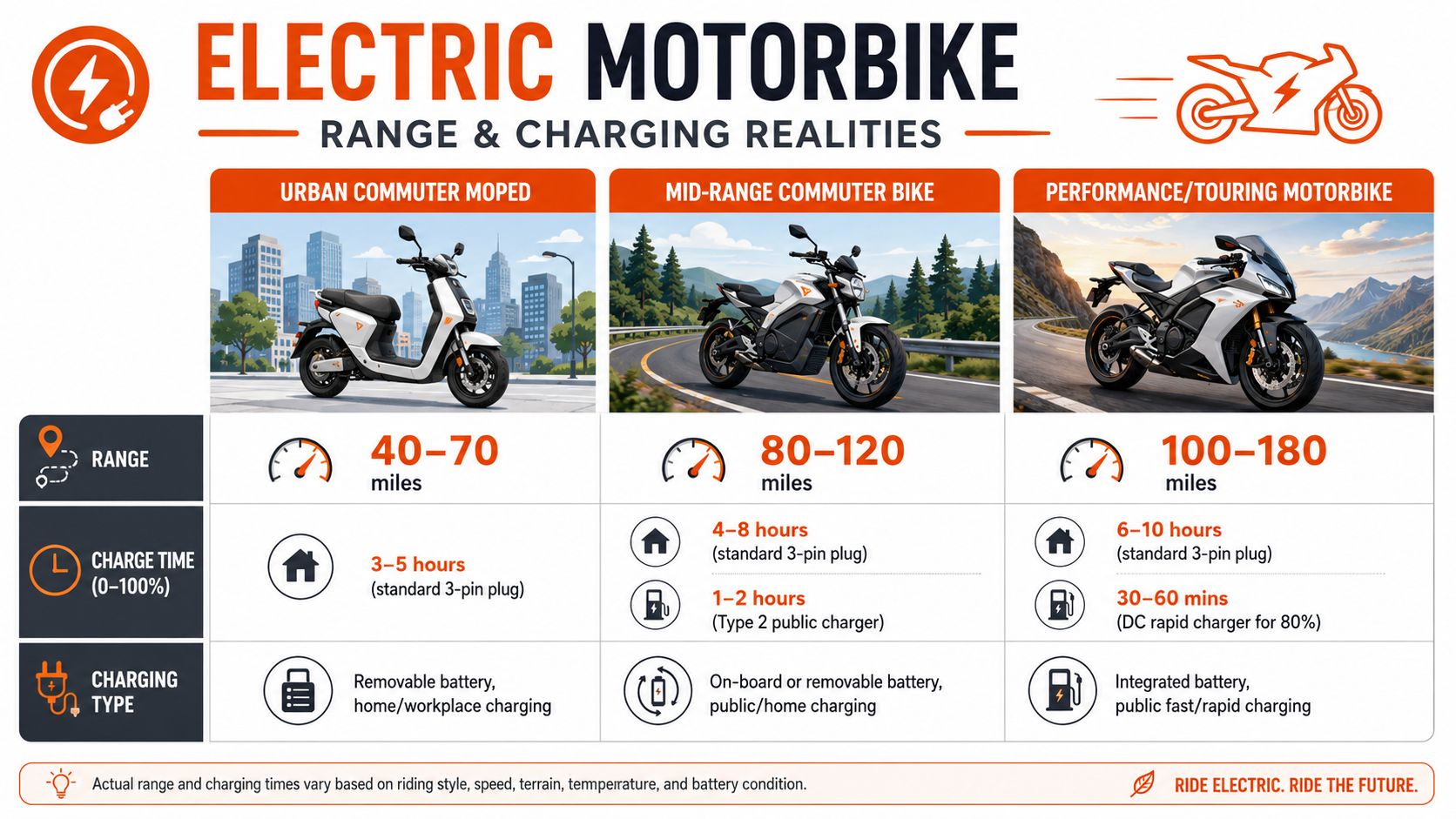
This is why riders should pay attention to the tighter real-use figure, not the most flattering one. If a bike lists multiple range contexts, the mixed or combined number is often the one to plan around for normal UK use.
Fast charging can matter more than maximum range
LiveWire's UK ONE is a good example of how to read electric bike specs properly. It uses a 15.4kWh battery, claims 0 to 80% DC fast charging in 40 minutes, and has a combined 55mph range of 95 miles, according to LiveWire ONE UK specifications.
That matters because the bike's day-to-day value isn't just about how far it goes on a full charge. It's about how fast you can recover usable range when you're out riding. For some users, especially mixed commuters or premium buyers doing varied trips, that charging speed changes the ownership experience more than a bigger headline figure would.
A bike with sensible usable range and good charging support is often easier to live with than a bike with a bigger claim and slower recovery.
Home, work, and public charging
Most riders should think about charging in three buckets:
- Home charging: Usually the easiest option if you have private access and a stable routine.
- Workplace charging: Useful if your employer or business premises can support regular daytime top-ups.
- Public charging: Important for riders doing longer or less predictable trips, but it shouldn't be your only plan unless the bike and your route are built around it.
Riders in flats or shared housing need to be especially realistic. If charging access is awkward, every ownership benefit gets harder to realise. In that case, removable battery models can be worth serious attention because they let you bring the battery to the charger, rather than bringing the bike to the socket.
How to judge whether a bike fits your routine
A simple way to test fit is to map your normal week, not your best day:
- List your actual routes: Commute, errands, delivery zones, and regular detours.
- Mark your charging points: Home, work, depot, or public charging locations you'd really use.
- Plan around the tighter range figure: Not the most optimistic number.
- Allow for bad-weather and winter use: Range planning gets easier when you build margin in.
- Check charging downtime against your schedule: A commuter and a delivery rider need different answers.
For city-only riders, a modest range with easy charging can work brilliantly. For riders who regularly need dual carriageways, mixed speeds, and fast turnaround, battery size and charge rate start to matter much more than styling or app features.
Who Should Buy an Electric Motorbike
Not every rider should buy electric. But some riders are a very strong fit, and the difference usually comes down to route pattern, charging access, and what they need the bike to do every day.
For the city commuter
If your normal week is home, station, office, gym, and back through traffic, electric is often a good match. The bike is easy off the line, quiet in town, and better suited to repeated short trips than many buyers expect.
A commuter should focus less on bragging-rights performance and more on fit. Does the bike handle your route comfortably? Is charging simple? Can you store it securely? If the answer is yes, electric can be a very clean urban transport tool.
For the delivery rider
This rider profile needs the hardest-headed buying decision of all. You're not buying a toy. You're buying a working asset, and every hour off the road matters.
A good delivery setup needs predictable charging, sensible running costs, and clear battery support. It also needs luggage compatibility and daily practicality. If you're building delivery income around the bike rather than just using it casually, it's also worth reading this guide to profitable delivery setup because the business side often matters as much as the vehicle itself.
For small fleets and local businesses
Restaurants, takeaways, venues, florists, and service businesses often have a strong electric use case when their transport pattern is local and repetitive. Fleet buyers should think less like private enthusiasts and more like operators.
Questions that matter here are simple. Can staff charge bikes consistently? Is after-sales support responsive? Can the business standardise around one class of machine and one maintenance process? If the answer is yes, electrification becomes much easier to manage.
For learners and first-time riders
Electric can be a friendly entry point because the riding experience is straightforward. There's less mechanical drama and less to think about in traffic. That can help newer riders settle more quickly into daily use.
For this group, the biggest risk isn't the riding. It's buying the wrong category. A learner needs to be strict about licence fit, road legality, and whether the bike is designed for UK road use rather than marketed with vague “equivalent” language.
For performance-minded riders
Some riders want electric because they enjoy the tech and the instant response. That's a valid reason, but it only makes sense if the rest of the ownership package works. Premium electric bikes can feel excellent, but they still need realistic charging planning and support.
If your riding is mostly leisure and mixed roads, the experience can be compelling. If your expectations are shaped only by top speed claims, you may miss the things that determine whether the bike suits your life.
How to Choose the Right UK Dealer
A weak dealer can turn a sensible electric motorbike purchase into an admin problem. The bike may be fine. The trouble starts later, when you need clear answers on registration, warranty, parts, or a charging question that was never sorted before delivery.
That matters even more in the UK electric market because some sellers blur the line between road-legal motorbikes and products that are not suitable for road use. A good dealer should be able to tell you, plainly, whether the machine is homologated for UK roads, what licence category it fits, and what paperwork comes with it. If that explanation is vague, walk away.
What a specialist dealer should give you
Start with clarity, not stock volume. A specialist dealer should explain whether you are looking at a moped-class machine, a 125cc-equivalent model, or a higher-category bike, and they should do it in plain English rather than hiding behind "equivalent" wording.

They should also handle the practical ownership questions that decide whether the bike works for your life or business:
- Road legality: Is it a UK road-legal model, and what documents are supplied for registration and use?
- Charging setup: Can you charge it at home, at work, or from a removable battery in the way you live?
- Warranty detail: What is covered, how battery cover works, and who you contact if there is a fault?
- After-sales support: Who deals with diagnostics, parts supply, and service coordination?
- Handover and delivery: Can the bike be delivered and explained properly, especially if you are buying for a fleet or from outside a major city?
- Finance options: Are the terms explained clearly, with monthly cost set against likely running costs?
Support matters more than a cheap listing
A vague online listing can look cheap and still cost more over a year of ownership. I see this most often when a rider buys on headline price, then finds out the seller cannot answer a battery claim, cannot source parts promptly, or never checked whether the bike matched the rider's licence.
For private commuters, dealer quality affects downtime and hassle. For delivery fleets and service businesses, it affects operating cost. A bike off the road because support is poor is not a small inconvenience. It is lost work.
Flex Electric is one example of a specialist dealer in this space. The business focuses on electric mopeds, scooters, and motorbikes, offers UK-wide delivery, and sets out warranty terms in its published information. That is the sort of detail worth checking before you commit, because ownership starts after handover, not at checkout.
Buy from a dealer that can still sort a problem months later, not one that only lists the bike well.
A quick dealer checklist
Before paying a deposit, ask these questions directly:
- Is this model fully road legal in the UK, and what category does it sit in?
- Can you explain clearly what licence I need to ride it?
- What does the warranty cover, especially for the battery and key electrical parts?
- Who handles faults, parts, and service support after delivery?
- Have you asked about my commute, charging access, or business use, or are you only repeating brochure specs?
A good answer is usually specific and boring. That is a positive sign. If the dealer stays vague on legality, support, or charging, expect problems later.
Your Next Steps to Going Electric
Monday morning. It is raining, traffic is stacked up, and you need a bike that starts every time, fits your licence, and does the week without turning charging into a chore. That is the point where electric either makes sense in the UK, or it does not.
Start with the job the bike needs to do.
Step one, confirm what you can legally ride
Check your licence category before you shortlist anything. It saves time and stops you comparing bikes that are either illegal for you to ride or plainly wrong for your use.
Licence class also changes what kind of machine you are choosing. Some road-legal electric models sit in a lighter A1-style bracket with commuter-friendly performance and range. Others move into A2 territory with far stronger acceleration and a different price, insurance, and ownership profile. That is the practical split to focus on, not the marketing label on the fairing.
Also separate road-legal electric motorbikes from off-road bikes and high-power e-bikes being sold with vague wording. If the seller cannot clearly state the bike's UK road status and licence category, walk away.
Step two, map your week honestly
Write down what the bike will cover in a normal week. Commute distance, extra errands, night shifts, delivery runs, pillion use, winter riding, and where it will charge.
In this context, riders avoid expensive optimism.
A bike that works well for a 12-mile urban commute with home charging can be a poor fit for a rider doing irregular long days with no socket access. The same applies to delivery businesses. A fleet only saves money if the charging routine, downtime risk, and shift pattern all line up with the bikes being bought.
Step three, run the ownership maths
Do not stop at the purchase price. Look at total cost of ownership.
For a private rider, that usually means finance or upfront cost, insurance, electricity, servicing, tyres, and expected battery warranty terms. For a delivery fleet, add rider downtime, charger placement, spare bike cover, and how quickly parts can be supplied if one bike goes off the road.
Cheap to buy can still be expensive to run. Expensive to buy can still make sense if it cuts fuel, service time, and breakdown disruption.
Use a shortlist like this:
- Licence fit
- Real weekly mileage
- Charging access at home, work, or depot
- Running costs, not just sticker price
- Payload, storage, or delivery use
- Support after the sale
Step four, test the claims
Brochure range figures are a starting point. Your route, speed, weather, load, and riding style decide what happens on the road.
Test ride the bike if you can. If you cannot, ask better questions. What speed was the range estimate based on? How long does a full charge take on the supplied charger? Is the battery removable or fixed? What happens if the charger fails? How long are parts likely to take?
Clear answers matter more than polished sales talk.
Step five, buy from a seller who understands ownership
The handover is the easy part. Support is what counts six months later.
A dealer should be able to explain legality, charging, service intervals, battery cover, and expected use without drifting into vague promises. Flex Electric is one example of a specialist in this area, with a focus on electric mopeds, scooters, and motorbikes for UK riders who need straight answers on daily use.
The right next step is simple. Narrow the bike by licence, match it to your real weekly mileage, check the full running costs, then speak to a seller who can answer practical questions without dodging them. That is how riders end up with a road-legal electric motorbike that works effectively in the UK, not just on a product page.
Find us
You will find us at 74 Dalry Road, Edinburgh, EH11 2AY
Showroom Opening Times:
Monday: By Appointment
Tuesday to Friday: 11am - 5:00pm
Saturday: 10am - 5pm
Sunday: By Appointment
