
Electric Motorbike vs Petrol: The 2026 UK Buyer's Choice

Flex Electric
The UK's #1 Electric Moped and Electric Motorbike dealer.

You're probably looking at two very different futures.
One has the familiar feel of petrol. Engine note, gear changes, quick fuel stops, decades of riding habits built around it. The other is quieter, simpler and, for the right rider, a lot cheaper to live with day to day. That's the shape of the electric motorbike vs petrol decision in the UK now.
The problem is that most comparisons stop at surface-level talking points. They'll tell you electric is clean and petrol is convenient, then leave out the harder bits that matter once you own the bike. Things like home charging routine, battery wear under heavy delivery use, servicing downtime, and whether your riding pattern fits electric naturally or only in theory.
That's where buyers usually get stuck. Not on headline specs, but on the question: which one will work for my week, my miles, and my budget?
The Choice Facing UK Riders Today
Monday, 6:30pm. One rider is heading across Birmingham for a final delivery run, watching battery percentage or fuel level because another two hours of stop-start work still needs to fit into the evening. Another is leaving the office in Leeds and just wants a cheap, reliable trip home with somewhere to park at the flat. A third is planning a weekend ride into Wales and does not want the route shaped by charge stops.
They are all buying a bike for different jobs. The right answer changes with the job.
That is the part many showroom comparisons miss. The electric motorbike vs petrol choice in the UK is less about headline performance and more about ownership routine. Where do you park at night? Can you charge where you live? How many miles do you do in a week? If the bike is earning money, how quickly does downtime start costing more than the saving on fuel?
Electric suits a very specific kind of use extremely well. Short urban trips, fixed commuting patterns, low-speed city work, and riders who can charge cheaply at home usually see the benefit fastest. Petrol still has an edge for long, unplanned journeys, riders without dependable charging access, and anyone who needs to get back on the road in minutes rather than hours.
The hidden cost question matters most for delivery riders and other high-use owners. Lower day-to-day energy cost is real, but it is only one part of the maths. Battery ageing under repeated charge cycles, lost earning time while charging, replacement cost outside warranty, and the practical limit of winter range all need to be counted properly. A petrol bike has higher routine running costs, but the refuelling pattern is simple and predictable, which still matters if the bike is working hard every day.
The UK market has shifted enough that electric is now a serious buying decision rather than a niche one. Government policy, clean air rules, and rising fuel costs all push buyers to look harder at total ownership cost instead of just purchase price.
| Factor | Electric motorbike | Petrol motorbike |
|---|---|---|
| Daily running cost | Usually lower with home charging | Usually higher because of fuel |
| Ownership routine | Works best with regular charging access | Works almost anywhere fuel is available |
| Maintenance profile | Fewer routine mechanical service items | More regular servicing and wear items |
| High-mileage delivery use | Can save money, but battery wear and charging downtime must be costed in | Easier to keep running through long shifts, but fuel and servicing add up |
| Urban commuting | Strong fit for predictable city miles | Still effective, but usually costlier to run in stop-start use |
| Long-distance flexibility | More planning required | Better for spontaneous longer rides |
| Future regulation | Better aligned with low-emission city policy | More exposed to future restrictions and higher running costs |
Performance and The Riding Experience
The first thing most riders notice on an electric motorbike isn't silence. It's the launch.
Electric motors deliver full torque from the moment you open the throttle. That changes how the bike feels in traffic, at junctions and away from lights. Petrol bikes build power differently. You manage revs, clutch and gears to stay in the right part of the power band, which is part of the fun for many riders, but it's also more work.

Off the line and through traffic
In city riding, electric has a clear behavioural advantage. The throttle response is immediate and smooth. There's no waiting for revs to climb and no interruption for gear changes on many models.
That's why electric often feels faster than its paper spec suggests in urban use.
A specific example helps here. Electric motorbikes deliver instant maximum torque from 0 RPM, and high-performance models such as the LiveWire S2 can reach 0 to 60 mph in under 2.7 seconds, as noted in Hovsco's performance comparison. For commuting in busy UK traffic, that matters more than top-end drama.
Practical rule: If most of your riding is pulling away, filtering, turning at junctions and dealing with stop-start traffic, electric performance usually feels better in daily use than a petrol spec sheet suggests.
Sound, vibration and rider involvement
Petrol still wins on one thing many riders care about. Character.
Some people want the engine note, the rise and fall of revs, the small physical cues from the machine and the satisfaction of getting each shift right. On a country road, that mechanical involvement is part of the ride itself. Electric replaces that with a more direct, calmer experience. You twist and go. Fast, yes. Engaging in a different way, also yes.
The lack of engine vibration can be a relief on daily journeys. It can also feel strange if you've spent years judging speed and effort by noise.
What this means on real bikes
The right electric motorbike can bridge some of that gap by still feeling like a serious motorcycle, not just a commuter appliance. The Vmoto Stash is one example. Its published snapshot includes a 75 mph top speed, a 15kw motor and up to 110 mile range, with styling shaped by designer Adrian Morton. Those details don't tell you whether you'll love the ride, but they do show how far electric motorcycles have moved beyond low-speed utility.
- Choose electric for town work: quicker response, less fuss, less noise.
- Choose petrol for mechanical engagement: clutch, gears and engine character still matter to many riders.
- Test before deciding: this is one area where written comparison only goes so far.
Total Cost of Ownership Decoded
A bike that looks cheap in the showroom can become expensive once it starts earning its keep. I see this most clearly with riders doing long urban days, especially delivery work, where the wrong buying decision shows up fast in cash flow, downtime and battery wear.
Purchase price matters. Monthly ownership cost matters more. Electricity or fuel is only one line on that sheet. Servicing, tyres, brake wear, charging access, lost working time and future resale all count.
Running costs favour electric, but usage pattern decides the outcome
For riders who cover regular miles in UK towns and cities, electric usually costs less to run day to day. Home charging is the big reason. If you can plug in overnight on a standard routine, your cost per mile is generally lower and more predictable than petrol.
Petrol still has one advantage here. Its costs are familiar. Riders know how to budget for fuel, oil services and occasional mechanical jobs because the market has worked that way for decades. Electric changes that pattern rather than removing cost altogether.
A more useful comparison looks like this:
| Cost Factor | Electric Motorbike | Petrol Motorbike |
|---|---|---|
| Energy or fuel | Usually cheaper per mile with home charging | Higher and tied to pump prices |
| Routine servicing | Fewer engine-related service items | More scheduled mechanical maintenance |
| Time off the road | Depends on charging setup and battery condition | Depends on workshop visits and mechanical wear |
| Long-term value | Strongly affected by battery health | Strongly affected by age, mileage and service history |
| Best fit for savings | Frequent urban use with reliable charging | Lower annual mileage or unpredictable long-distance use |
Servicing is simpler on electric, but not cost-free
Electric bikes cut out several standard petrol jobs. No oil changes. No spark plugs. No exhaust system. Fewer moving parts usually means fewer workshop visits and fewer chances for a small engine issue to turn into a bigger bill.
That said, electric bikes still use tyres, brake components, bearings and suspension parts. High-mileage riders sometimes underestimate this because the conversation gets dominated by charging costs. In city work, consumables still add up, especially if the bike is carrying a rider, luggage and stop-start loads all day.
For many commuters, simpler servicing is enough to tip the numbers. For commercial riders, uptime is often more important than the invoice total. A cheaper bike that misses shifts is not cheaper in practice.
Battery health is the cost many comparisons gloss over
Battery degradation needs to be part of the buying decision from day one.
For a commuter doing a predictable trip and charging sensibly, battery ageing is usually gradual and manageable. For a food delivery rider doing repeated fast turnarounds, full charge cycles and heavy weekly mileage, it becomes a business cost. Range can fall over time. Resale can weaken. If the battery no longer supports a full shift comfortably, the bike may still run fine but the ownership maths changes.
This matters most in the used market. With petrol, buyers look at service history, mileage, cold starts and general wear. With electric, battery condition carries much more weight. If that information is vague, price comparisons become misleading very quickly.
Read the numbers more carefully if any of these apply
- Food delivery riders: earnings depend on dependable shift range, not brochure range.
- Used-bike buyers: battery condition can matter more than cosmetic condition.
- Flat dwellers without charging access: low running costs on paper can disappear if charging is inconvenient or expensive.
- Occasional riders: savings take longer to recover a higher upfront price.
What usually makes financial sense
Electric often wins on total ownership cost for riders doing steady urban mileage with dependable charging at home or work. That is where lower running costs and simpler servicing show up clearly.
Petrol remains easier to live with for riders who cannot charge reliably, ride irregular long distances, or want the used market to be simpler to judge. For high-use commercial riders, electric can still be the better buy, but only if battery health, shift range and replacement risk are treated as part of the budget before purchase, not after.
Range and Refuelling in The Real World
It is 6:30pm, the dinner rush is building, and your bike still has another few hours of work ahead of it. That is the moment range stops being a brochure number and becomes an earning constraint.

For UK riders, the practical question is simple. Can the bike cover your actual day, in your weather, at your pace, with enough margin left that you are not watching the battery percentage on every job or every dual carriageway stretch?
Electric works very well when the routine is predictable. A commuter riding from Croydon to central London, or a rider doing local errands around Bristol with a driveway socket at home, can treat charging like charging a phone overnight. You come out in the morning with a full battery and skip petrol stations entirely.
That convenience is real. So are the limits.
Real-world range changes with speed, temperature, hills, payload and riding style. A bike that feels comfortably usable on slower city roads can drain much faster if you add winter temperatures, stop-start delivery work, or a heavier rider carrying a large box. Riders who spend most of the day under 30 mph in urban areas usually get closer to the usable range they expected. Riders mixing ring roads, A-roads and repeated hard acceleration often do not.
Petrol is easier when the day refuses to stay organised. If plans change, miles stack up, or you need to be back out in ten minutes, a short fuel stop still beats waiting on a charger. That matters for weekend distance riders, but it matters even more for commercial use. A rider doing food delivery in Manchester or Birmingham can lose more in missed jobs from charging downtime than they save per mile if the bike cannot finish a shift cleanly.
Public charging helps, but it is not a complete substitute for dependable private charging. Coverage is better than it was, yet availability, connector access, queueing and charging speed still vary by location. For a car driver, that is an irritation. For a rider trying to keep working, it can wreck the day.
A simple way to judge the fit is to look at your worst normal day, not your average one.
- Home charging and predictable mileage: Electric is usually easy to live with.
- Shift work, delivery use, or back-to-back trips with little downtime: Check usable range with a proper buffer, not just claimed range.
- No off-street parking: Public charging may turn a cheap-to-run bike into an awkward one to own.
- Regular long A-road or motorway miles: Petrol remains the less restrictive option.
I tell riders to leave headroom. If your normal day needs almost all of the battery on paper, it is the wrong setup. You want enough reserve for cold weather, diversions, traffic, and the fact that batteries do not behave the same at month 24 as they did on day one.
For a broader look at how charging fits day-to-day riding, this video is useful context.
Environmental and Urban Impact
A rider doing late takeaway runs through terraces in Leeds or Bristol feels this difference straight away. The issue is not only what the bike costs to run. It is what it puts into the street, outside flat windows, beside bus stops, and at restaurant doors shift after shift.
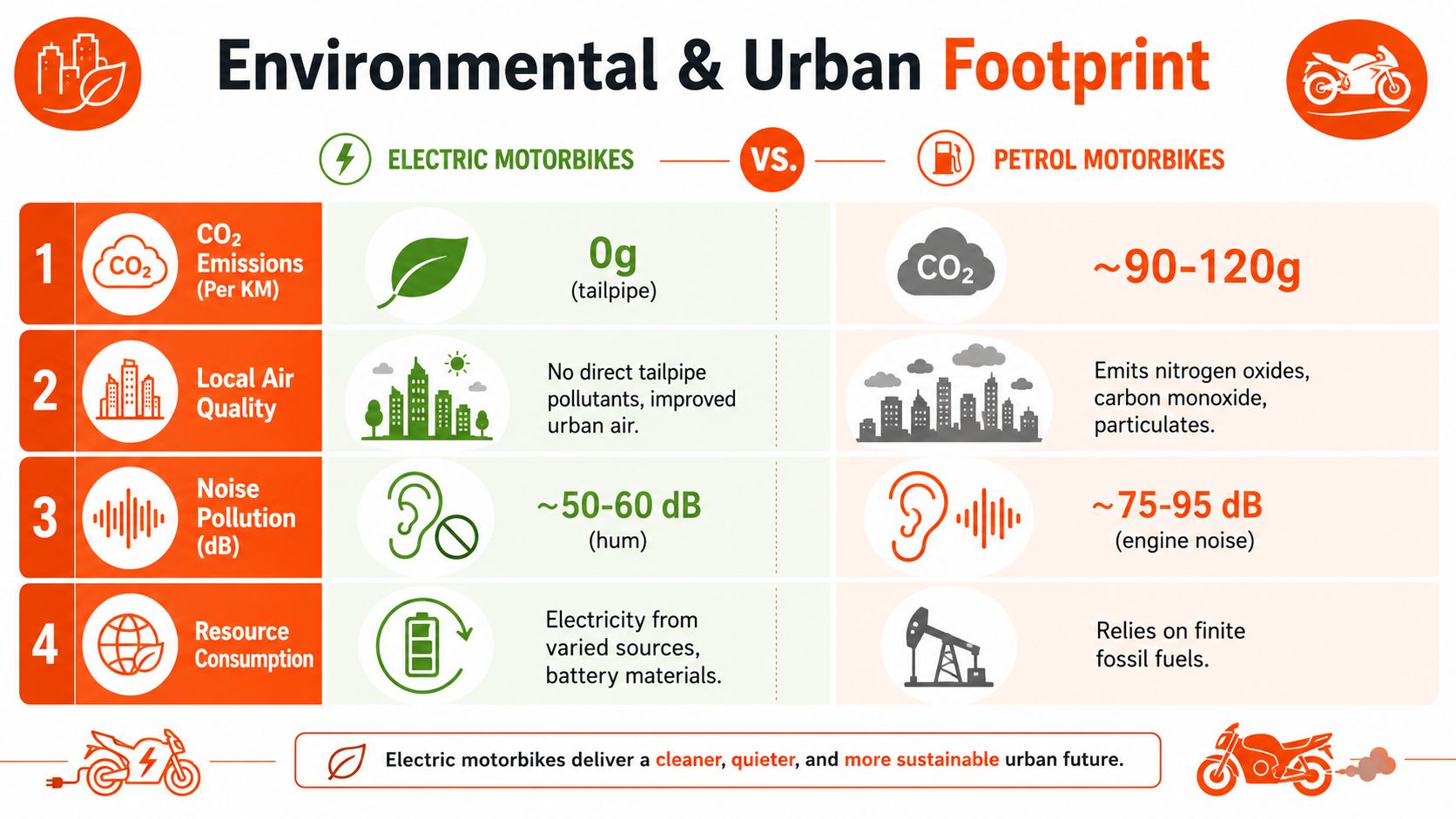
Emissions over the bike's life
At street level, the clearest difference is simple. An electric motorbike has no tailpipe emissions while riding. A petrol bike does.
That matters more in towns than many buyers admit. Delivery riders, commuters, and small fleets spend a lot of time in slow traffic, outside homes, and in areas where air quality is already under pressure. If the goal is to cut exhaust emissions where people live and work, electric has an obvious advantage.
The bigger question is the full life-cycle picture, because batteries are not impact-free. Manufacturing an electric bike, especially the battery pack, carries an upfront environmental cost. Even so, the gap still favours electric in UK use. A 2024 Zemo Partnership study cited by Bennetts BikeSocial found a typical electric motorcycle charged on the UK grid produces substantially less lifetime CO2 than a comparable 650cc petrol bike.
For high-use riders, there is a practical caveat. Battery replacement changes both the cost picture and the environmental one. If a delivery bike burns through heavy charge cycles and needs a pack earlier than expected, its practical advantage narrows compared with a lightly used commuter bike kept for years. That does not erase the benefit. It does mean usage pattern matters.
Noise matters in cities
Noise is not a minor point in urban riding. It affects rider fatigue, neighbour complaints, how acceptable early starts feel, and how a bike fits repeated commercial use.
Electric motorbikes are much quieter at low speed and during pullaways. In central London, dense parts of Manchester, or residential streets around takeaway clusters, that changes the character of the job. Riders notice less mechanical racket. People nearby notice less intrusion. Businesses doing morning, late-night, or repeat-stop work often value that more than they expected.
Quieter bikes also suit the direction many towns and cities are heading. Local pressure on traffic noise and urban air quality is not going away.
Why fleets and business riders pay attention
For a private buyer, environmental impact can be a values decision. For a business, it often becomes an operating decision.
- No direct exhaust emissions in use: Better suited to dense urban routes and enclosed collection points.
- Lower noise output: Easier to run repeatedly in residential and hospitality areas.
- A cleaner public impression: Useful for brands that want their transport to match the image they present to customers.
I would still keep this in proportion. Environmental gains do not rescue a bike that cannot finish the shift, charge properly, or hold up financially under hard use. But if your riding is mostly urban and the charging setup works, electric improves more than the fuel line on a spreadsheet.
Which Bike Suits Your Life
It is 6pm, raining, and you have another stack of deliveries to clear before the dinner rush ends. In that moment, the right bike is not the one that looked good in a showroom. It is the one that suits your route pattern, your charging or refuelling setup, and how hard you expect it to work every week.
That is the split between electric motorbike vs petrol. Usage decides the answer.
Urban commuter and new rider
For a rider doing the same city journey most days, electric usually makes life easier. Pull away, filter through traffic, park up, plug in at home. No gears on many models, less routine servicing, and less mechanical fuss on a cold Monday morning.
That matters even more for newer riders.
A lot of people coming off a CBT or stepping up from public transport do not want extra workload. They want something predictable in traffic and easy to own. Electric suits that well if the bike sleeps somewhere with reliable charging. If you live in a flat with no practical access to power, the case gets weaker fast, whatever the brochure says.
Food delivery rider
This is the category where glossy comparisons usually miss the point.
If you are riding for income, the bike is a working asset. Energy cost matters. Maintenance cost matters. Downtime matters more. Battery wear matters too, especially if the bike is doing long days, frequent rapid charging, or repeated deep discharge cycles. The short version is simple. High-use delivery work can make an electric bike cheap to run day to day, but more expensive than expected later if battery condition drops and the resale market discounts a hard-worked machine.
Ask harder questions before buying. How many miles will it cover in a busy week? Can you charge without losing earning time? What does a replacement battery cost, and how available is it? If the bike is off the road, how quickly can it be repaired?
For some delivery riders, electric still wins comfortably. For others, especially riders without dependable charging between shifts, petrol remains the safer business tool.
Business fleet and local operators
Businesses with fixed local routes often get the clearest answer. A restaurant group doing short urban runs, a florist covering a compact delivery area, or a venue moving staff between nearby sites can plan around overnight charging and predictable mileage.
That is where specialist suppliers are useful. Flex Electric supplies electric mopeds, scooters and motorbikes in the UK, including options aimed at delivery riders and businesses. The value is not branding. It is getting advice from people used to discussing route length, charge time, battery handling, and support, instead of only top-speed talk.
Weekend rider and enthusiast
Petrol still makes a strong case for riders who go out mainly for the feel of the machine. Engine character, gear changes, vibration, noise, and the old habit of filling up anywhere all remain part of the appeal.
Electric appeals to a different rider. Fast response, smooth drive, less interruption, and a quieter ride. Some riders prefer that immediately. Others miss the theatre of petrol and never really warm to electric, even if they respect the engineering.
If you want an electric motorcycle that feels closer to a full-sized bike than a basic commuter, the Yadea Keeness is one example, with a 62 mph top speed and a 10kw peak power motor.

A simple way to choose
- Choose electric if your riding is mostly urban, your mileage is predictable, and charging is easy where the bike is kept.
- Choose petrol if you want maximum refuelling flexibility, longer spontaneous rides, or the traditional feel that is part of why you ride.
- Compare both carefully if the bike will earn money. Delivery use changes the maths, and battery condition, charging downtime, and resale value belong in the decision from day one.
Making Your Decision and Next Steps
Most buyers don't need more hype. They need a clearer filter.
If your priority is lower running costs, simpler maintenance, quiet operation and urban practicality, electric is hard to ignore. If your priority is rapid refuelling anywhere, mechanical familiarity and classic riding character, petrol still holds a solid place.
The smartest way to decide is to test your own routine against the bike, not just the brochure.
Start with these questions:
- Where will you charge or refuel most often? Home charging makes electric far easier to own.
- How many miles do you ride in a normal week? Regular urban mileage favours electric economics.
- Is the bike for commuting, earning, or enjoyment? Those uses produce very different answers.
- Do you care more about simplicity or involvement? Electric reduces workload. Petrol adds mechanical interaction.
- Will resale value depend on heavy commercial use? If yes, battery condition deserves close attention.
If you're narrowing the field seriously, stop relying only on online comparisons. Sit on the bikes. Check your parking and charging setup. Ride an electric model in traffic and compare it with the petrol feel you already know.
Financing can also change the decision. Hire Purchase and PCP are worth reviewing if you want to spread cost rather than judge the bike only on upfront price. Just make sure the monthly figure doesn't distract you from the ownership pattern behind it.
The right bike is the one that fits your week without creating new problems.
If you're weighing up electric motorbike vs petrol and want a straight answer based on your riding style, speak to Flex Electric. The team can help you compare models, talk through commuting or delivery use, explain Hire Purchase and PCP options, and arrange a test ride so you can decide from real experience rather than guesswork.
Find us
You will find us at 74 Dalry Road, Edinburgh, EH11 2AY
Showroom Opening Times:
Monday: By Appointment
Tuesday to Friday: 11am - 5:00pm
Saturday: 10am - 5pm
Sunday: By Appointment
