
Your Guide to UK Electric Motorbikes in 2026
Flex Electric
The UK's #1 Electric Moped and Electric Motorbike dealer.

Electric motorbikes are no longer just a glimpse of the future; they're a real, practical choice for getting around UK roads today. Whether you're gliding silently through city traffic on your commute or making deliveries, these bikes offer a compelling alternative to their petrol-guzzling cousins.
The Quiet Revolution on UK Roads
You’d be forgiven for thinking electric motorbikes just appeared out of nowhere. While the technology feels incredibly modern, the idea itself has been around for ages—the first concepts actually date back to the late 19th century. Of course, the bikes we see today are a different breed entirely, with the market truly starting to gain traction around 2009 when the first road-legal models hit the showrooms. It's fascinating to see just how far they've come.
Today, electric motorcycles have moved firmly out of the niche category and into the mainstream. For a growing number of riders, it’s not about novelty anymore. It’s about simple, practical maths.
Why Are So Many Riders Making the Switch?
The logic becomes undeniable once you look at the daily realities of riding in Britain’s towns and cities. With fuel prices constantly creeping up, alongside ever-expanding congestion charges and Ultra Low Emission Zones (ULEZ), the cost of running a traditional motorbike is getting harder to justify. Electric motorbikes neatly sidestep all of these headaches.
It really boils down to a few key advantages:
- Drastically lower running costs: You can charge an electric moped or motorcycle at home for just a couple of pounds. Compare that to the cost of filling a petrol tank, and the savings add up incredibly quickly.
- Freedom from city charges: Most electric motorbikes are completely exempt from ULEZ and congestion charges, which can save daily commuters hundreds, if not thousands, of pounds every year.
- Minimal maintenance: There’s no oil to change, no filters to replace, and no spark plugs to worry about. Servicing is simpler and far less frequent, meaning less money spent and more time on the road.
Forget the idea that electric motorbikes are just a passing trend. These are hardworking, reliable, and surprisingly affordable machines that are perfectly suited to modern life in the UK—whether you’re a commuter, a delivery rider, or a business looking to modernise its fleet.
Think of this guide as your co-pilot. We'll walk you through everything you need to know, from licences and performance specs to charging and the real-world savings you can expect. By the end, you'll have all the knowledge you need to pick the perfect electric motorbike for you.
Finding Your Ride: Electric Motorbike Categories Explained
Getting your head around the different types of electric motorbikes is easier than you might think. The simplest way to understand the various classes available in the UK is to think in terms of their ‘petrol equivalent’. This handy comparison helps you instantly grasp a bike's power, speed, and, crucially, the licence you’ll need to ride it.
It's a diverse world, from nimble city mopeds to high-performance machines that will leave petrol bikes standing. Just to be clear, this guide focuses entirely on electric motorcycles, mopeds, off-road bikes, and kids' motocross bikes. We won't be covering electric bicycles, as they operate under a completely different set of rules.
Road-Legal Categories
For riding on UK roads, electric motorbikes are broken down into three main tiers, each tied to a specific licence. To help you quickly compare, here’s a summary of how the categories stack up.
UK Electric Motorbike Categories at a Glance
Electric CategoryPetrol EquivalentTypical Top SpeedRequired UK LicenceElectric Moped50ccUp to 28 mphCBT (AM Licence)125cc Equivalent125cc50-70 mphCBT & A1 LicenceHigh-Performance250cc+70 mph+A2 or Full A Licence
This table gives you a quick snapshot, but let's dive into what each category really means for you as a rider.
H3: Electric Mopeds (AM Licence)
These are the electric version of a classic 50cc petrol moped. They’re absolutely perfect for city living, with a top speed limited to 28 mph that’s more than enough for urban traffic. All you need is to be at least 16 years old and have a valid Compulsory Basic Training (CBT) certificate, making them the most accessible entry into electric riding.
H3: 125cc Equivalent Electric Motorcycles (A1 Licence)
Step up a level and you’ll find bikes that perform just like a 125cc petrol model. These offer a significant boost in power and speed, typically reaching 50-70 mph. This makes them a brilliant choice for longer commutes that involve faster A-roads. For these, you'll need to be at least 17 and hold a CBT with an A1 licence.
H3: High-Performance Electric Motorcycles (A2 or Full A Licence)
This is where things get really exciting. These machines are the equals of larger-capacity petrol bikes (250cc and above) and demand either an A2 or a full, unrestricted A licence. They serve up mind-bending, instant acceleration and are built to give experienced riders a proper thrill.
The infographic below neatly summarises some of the key differences you'll find between a modern electric motorbike and its petrol-powered cousin.
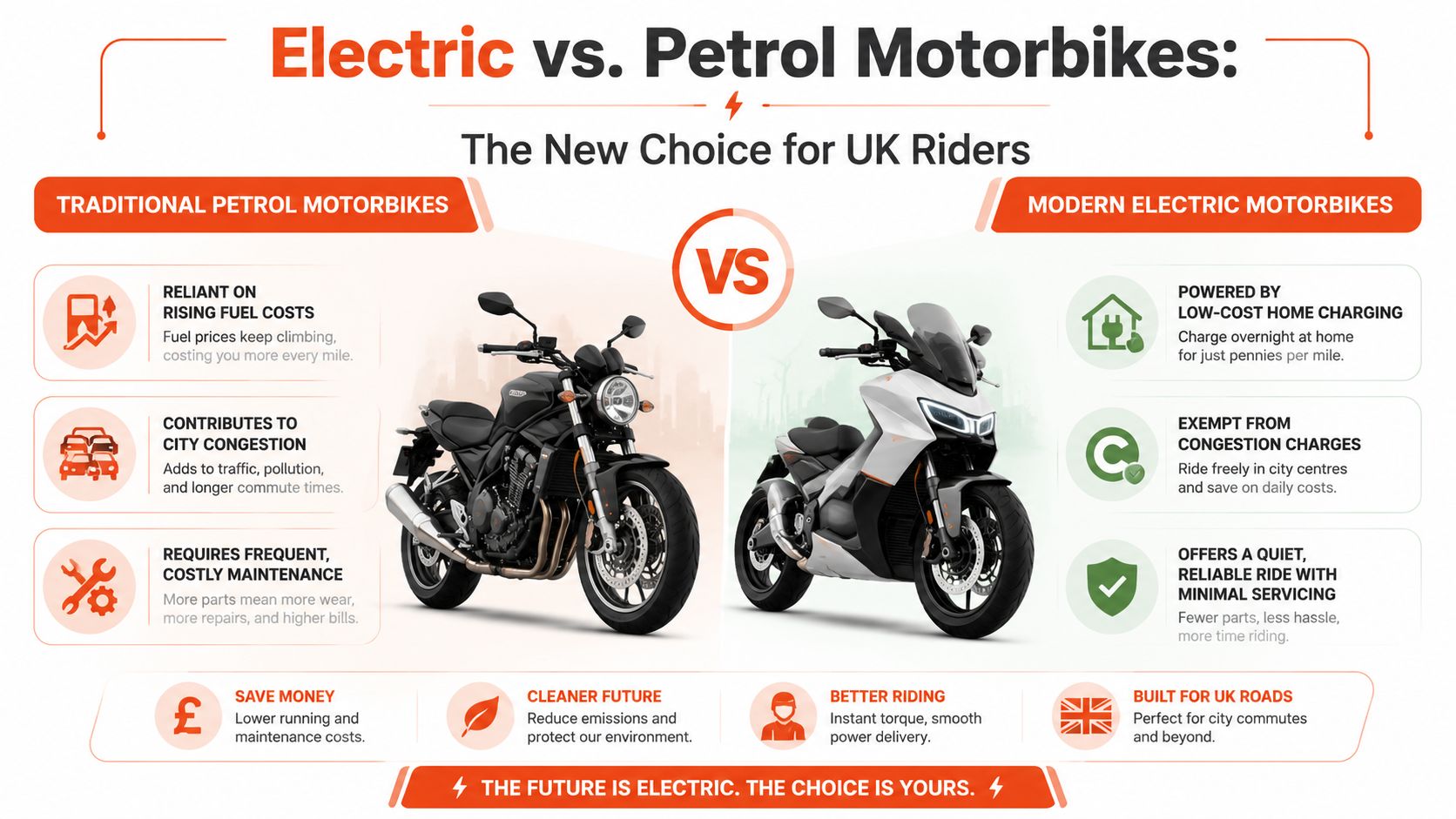
As you can see, the switch to electric often comes down to very practical benefits, like much lower running costs and freedom from city emission charges, making it an increasingly smart move for UK riders.
Off-Road and Youth Models
Away from the public highway, a whole other world of electric bikes opens up for fun and competition.
Off-road electric motocross (MX) and kids' bikes are built for one thing: enjoyment on private land. They are not road-legal, so they don’t have lights or registration plates. You must never use them on public roads, pavements, or in parks.
These bikes offer a fantastic, low-maintenance way to hit the dirt tracks without the noise and fumes that can upset neighbours. For younger riders, electric motocross bikes are a brilliant and manageable introduction to the sport, offering controllable power and a far simpler experience than a petrol equivalent.
Decoding Performance: What the Spec Sheet Really Means
Staring at an electric motorbike's spec sheet can feel like trying to decipher a secret code. It’s a jumble of acronyms like kWh and kW, but what do these numbers actually tell you about how the bike will handle your daily commute or a weekend blast through the countryside?
Let's break down these technical terms into what really matters: real-world performance. Getting to grips with these key figures is the secret to choosing a bike that genuinely fits your life, not just one that looks good on paper. By the time you're done here, you'll be able to glance at any spec sheet and have a solid idea of how that bike will feel out on the road.
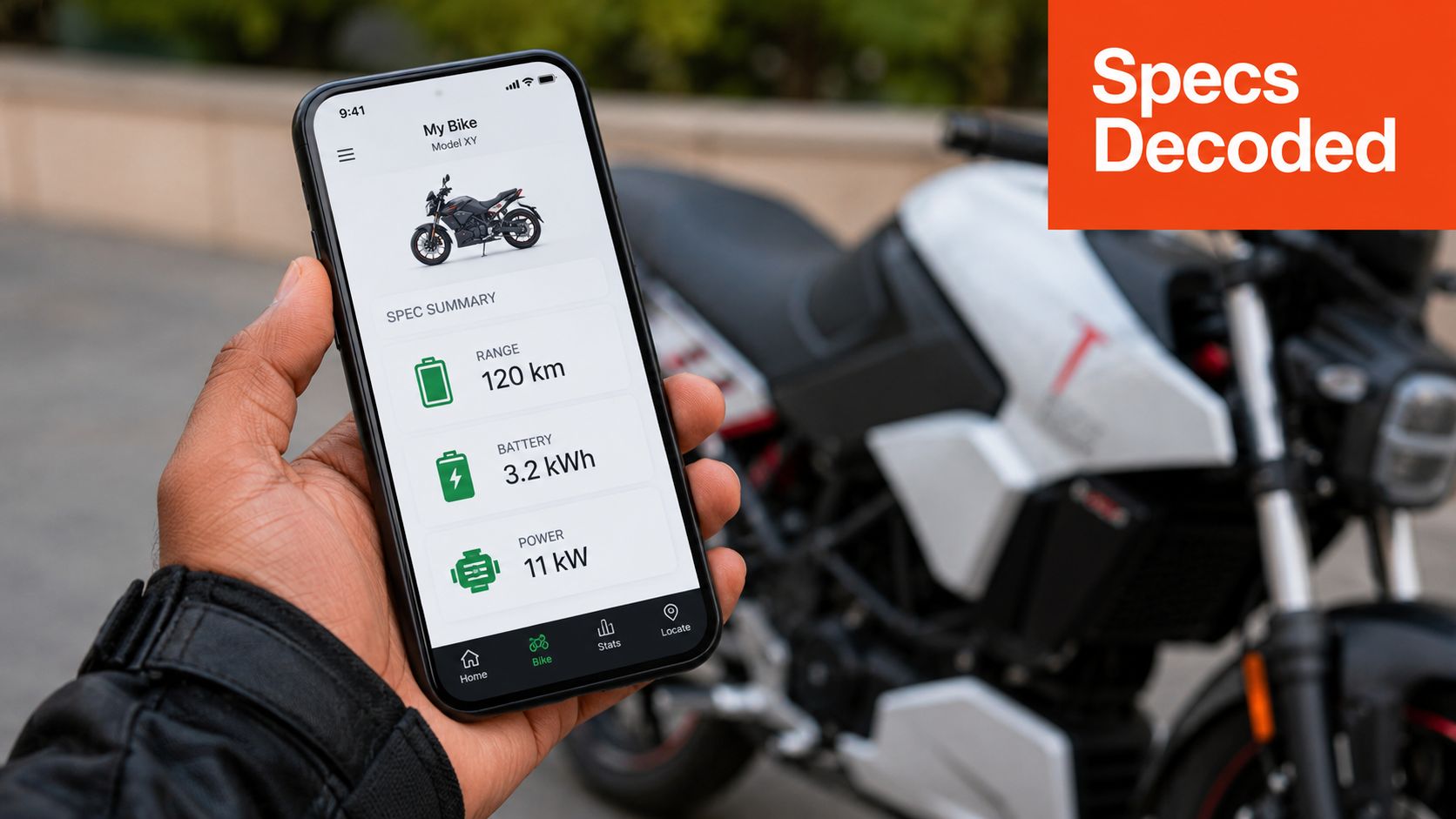
Battery Capacity (kWh): The Fuel Tank of Your Electric Motorbike
The simplest way to think about battery capacity, measured in kilowatt-hours (kWh), is to see it as the size of your fuel tank. A bigger number means more energy storage, which usually translates to more miles on a single charge. A nippy city moped might only need a 2 kWh battery, whereas a long-range touring motorcycle could have a hefty 10 kWh pack or more.
But here’s the important bit: the advertised range is a best-case scenario, achieved under perfect test conditions. Your actual mileage will always vary based on a few key factors:
- Your Riding Style: Constantly grabbing a handful of throttle and riding at top speed will drain the battery far quicker than a smooth, consistent pace.
- The Terrain: Every hill you climb demands extra energy from the battery, which eats into your overall range.
- The Weather: Batteries aren't fond of the cold. On a chilly day, you can expect a temporary drop in efficiency and range, sometimes by as much as 20%.
- Your Load: The more weight the bike has to carry—that’s you, plus any pillion or luggage—the harder the motor has to work.
Don’t get fixated on the maximum advertised range. Think about your typical journey. If you have a 10-mile commute across a flat city, even a bike with a smaller battery will have plenty of juice to spare.
Motor Power (kW): Your Engine's Strength
Motor power, measured in kilowatts (kW), is all about muscle. It's the electric version of horsepower, and it directly impacts how quickly your bike accelerates and its ultimate top speed. On most spec sheets, you'll see two different power figures:
- Continuous Power: This is the motor's cruising power—the steady output it can comfortably maintain for long periods without overheating.
- Peak Power: This is the exciting number. It’s the maximum burst of power the motor can unleash for short sprints, like when you twist the throttle to pull away from the lights. This instant torque is what gives electric bikes their famously thrilling and immediate acceleration.
For most daily riders, a bike with a modest continuous rating but a healthy peak power figure will feel perfectly zippy and responsive enough for navigating urban traffic.
The Importance of a Good Warranty
Finally, pay close attention to the warranty, especially the cover for the battery. The battery pack is the single most expensive part of an electric motorbike, so a long and comprehensive warranty is a huge vote of confidence from the manufacturer in their own technology.
At Flex Electric, we back our new bikes with a 3-year warranty on the battery. This isn't just a marketing line; it's your peace of mind. It’s an assurance that you are investing in a quality machine that's built to last and will give you years of reliable service.
Charging, Costs, and Real-World Savings
Let's get straight to the two biggest questions on everyone's mind: "How on earth do I charge one?" and "What’s this all actually going to cost me?". The answers are simpler than you might think, and the savings are both real and immediate.
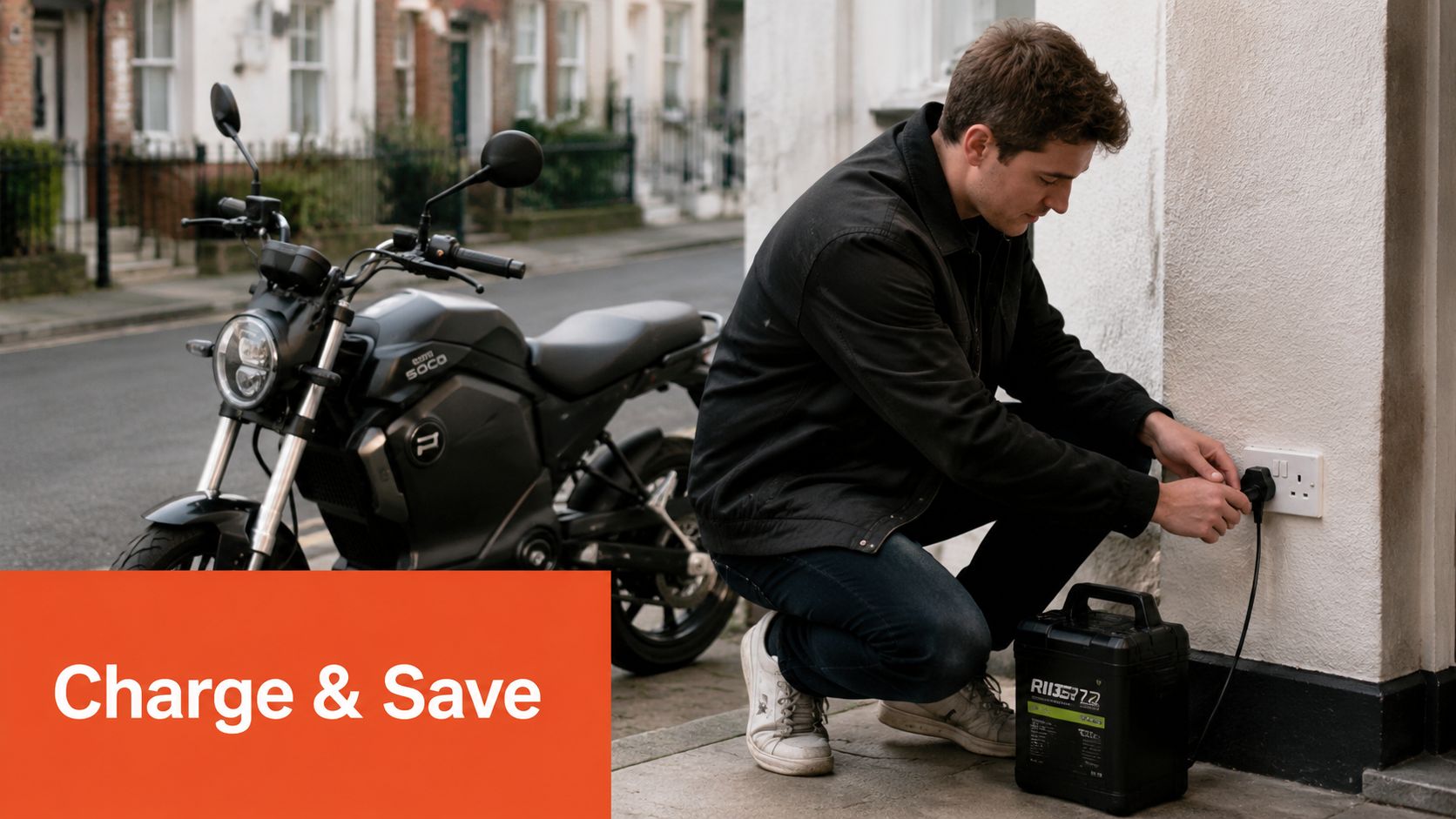
For most electric mopeds and motorbikes, you don’t need any special kit. Charging is often as straightforward as plugging in your phone. They use a standard 3-pin UK socket, which means you can top up the battery at home, in the garage, or even plug it in under your desk at work. A full charge will typically set you back just a couple of pounds — a tiny fraction of a tank of petrol.
The Removable Battery Advantage
"But what if I live in a flat or don't have a garage?" This is where removable batteries come into their own. It’s a simple solution that has completely opened up ownership for city dwellers.
Many urban-focused electric motorbikes have batteries you can simply lift out and carry inside. This solves a lot of problems:
- Charge it anywhere: Your kitchen, your office, a friend's house – anywhere with a standard socket becomes a "fuelling" station.
- Boost your security: Taking the battery with you at night is a brilliant theft deterrent.
- No driveway, no problem: It makes electric ownership a reality for thousands of people without access to off-street parking.
The ability to just plug in overnight with your standard household electricity is what makes the switch from petrol so compelling. It turns the daily chore of refuelling into a cheap and simple routine.
Calculating Your Real-World Savings
The financial case for going electric is incredibly strong, especially for riders in UK towns and cities. Think about it: the bikes that are really taking off here are the 50cc and 125cc equivalents used by commuters and delivery riders. Why? Because the economics just make sense.
Going electric gets rid of oil changes and drastically cuts down on routine servicing. Your daily running costs become predictable and tiny. You can see how these economic factors are shaping the market for yourself.
While some high-performance electric superbikes might need a public fast charger on a long tour, the average rider will almost never use one. Your savings come from a powerful combination of cheap home charging, zero road tax, and exemption from clean air zone charges in cities like London. It all adds up, making electric motorbikes a genuinely smart financial choice for getting around today.
Why Commuters and Delivery Riders Are Going Electric
While the general perks of electric motorbikes are impressive, their real worth becomes crystal clear when you see how they solve everyday problems for specific riders. For the daily commuter or the city-based delivery rider, switching to electric is less about following a trend and more about making a smart financial and lifestyle choice.
If you commute into a city, you'll feel the benefits almost immediately. Zipping through congested traffic is one thing, but the real victory is the financial relief. With most electric motorbikes being exempt from ULEZ and congestion charges, the daily cost of getting into city centres like London or Birmingham simply vanishes. It’s a move that transforms a stressful, expensive journey into a simple, affordable ride.
A Smarter Tool for the Job
For a food delivery rider, an electric moped is more than just a way to get around; it's a tool that directly boosts their profits. Every single pound not spent on petrol is a pound added straight to their earnings. This simple economic shift changes the game, turning a vehicle from a constant drain on income into a genuine business asset.
Downtime is another killer for self-employed riders. A petrol bike in the garage for a service means a day without pay. An electric motorbike, with its incredibly simple maintenance, offers reliability you can count on. There are no oil changes, no spark plugs to worry about, and no complex engine parts to fail—just dependable performance that keeps you on the road and earning.
This isn't just a niche trend. Across the UK, we're seeing this shift happen in city commuting, food delivery, and the decarbonisation of commercial fleets. As you can read more about how this is shaping the industry, the predictable mileage and straightforward maintenance schedules are a huge plus for delivery operators and small businesses needing to keep their vehicles moving.
Electrifying Business Fleets
The same logic applies perfectly to businesses running their own last-mile delivery fleets. Whether you're a local takeaway, a pharmacy, or a courier firm, making the switch to electric delivers a powerful one-two punch.
First, the predictable, low running costs and minimal servicing make budgeting a breeze and directly improve your bottom line. Second, it sends a clear, visible message about your commitment to greener operations, strengthening your brand's appeal to customers who care about sustainability.
When you look at these real-world uses—from the individual commuter dodging city charges to the business owner optimising their fleet—it's easy to understand why the switch is happening. An electric motorbike isn't just a novelty; it's a practical, modern solution to the real challenges of getting around our towns and cities.
Your Electric Motorbike Pre-Purchase Checklist
So, you’ve done the research and you’re close to taking the plunge. That’s fantastic. Before you do, let’s run through a final checklist. Working through these points now will give you total confidence that you’re choosing the perfect electric motorbike and will have a smooth start to your new life on two wheels.
First Things First: Licence, Commute, and Purpose
Before you get carried away with a particular model, it’s vital to check the practicalities. Getting these sorted from the outset means you’ll only be looking at bikes that are a genuine fit for you.
- Licence Check: First, grab your driving licence. Does it have the right entitlement for the bike you want? Whether it's a CBT for a moped, or an A1, A2, or full A licence for something more powerful, make sure you're legally good to go.
- Your Daily Mileage: Be honest about your commute or daily route. How many miles do you actually cover each day? Look for a bike with a real-world range that easily handles this distance, with at least 20-30% spare for peace of mind.
- Your Main Mission: What's the bike's primary job? Is it for darting through congested city streets, powering a delivery round, or just for weekend fun? Your answer will point you towards an agile electric moped, a zippy 125cc-equivalent, or something more specialised.
Making the Purchase
With the groundwork done, you can focus on the exciting part: choosing the right machine and figuring out the best way to pay for it.
Choosing a specialist retailer is about more than just the sale. It ensures you get genuine, expert advice from people who understand electric technology and can provide reliable after-sales support when you need it.
Think carefully about whether a brand-new or a pre-owned bike suits your budget. A new model gives you a full warranty—like our 3-year battery guarantee—which offers complete peace of mind. A used bike can save you money, but it's crucial to buy from a trusted source that has given it a thorough inspection.
Don't forget to look into finance options like Hire Purchase (HP) or Personal Contract Purchase (PCP). These plans can make even high-performance electric motorbikes surprisingly affordable by breaking the cost down into manageable monthly payments.
Getting Ready to Ride
You’re almost there! A few last-minute practicalities will mean you’re fully prepared the moment your new bike arrives.
- Budget for Your Gear: Don't let safety gear be an afterthought. Make sure you've budgeted for a high-quality helmet, a robust lock, and any other kit you might need, like a top box for storage or a phone mount for navigation.
- Plan Your Charging Spot: Where will the bike live and charge? If you have a garage or off-street parking, you're set. If not, does the model you want have a removable battery that you can easily carry inside to charge?
- Sort Your Insurance: Start getting insurance quotes before you buy. This way, you’ll have a policy ready to activate the second you take delivery, so there's nothing stopping you from hitting the road.
Frequently Asked Questions
It's only natural to have a few questions when you're thinking about switching to an electric motorbike. To help you get clear on the details, we've put together answers to the queries we hear most often from riders.
Licencing and Charging Basics
Do I need a special licence for an electric motorbike in the UK?
Yes, and just like with petrol bikes, the licence you need is all about the bike's power. For electric mopeds that top out at 28 mph, a Compulsory Basic Training (CBT) certificate and an AM licence will get you on the road.
If you’re looking at a 125cc equivalent, you'll need a CBT and an A1 licence. For anything more powerful, you’ll be looking at an A2 or full A licence. The key is to always check the bike's official classification before you buy.
How much does it cost to charge an electric motorbike?
This is where the savings really kick in. A full charge from a standard three-pin socket at home will typically only set you back between £1 and £2, depending on your electricity tariff.
When you compare that to the cost of a tank of petrol, the difference is huge. For daily commuters or delivery riders, those savings add up incredibly quickly.
Performance and Durability
How long do electric motorbike batteries last?
Modern lithium-ion batteries are designed to go the distance, easily lasting for thousands of charge cycles over many years. To show how confident we are in their longevity, all our new bikes come with a 3-year warranty on the battery.
Of course, how you use and care for it plays a part, but they are engineered from the ground up for reliable, long-term performance.
An electric motorbike's battery is its heart. A solid warranty is the best indicator of a manufacturer's confidence in its long-term health and your best guarantee of a reliable investment.
Can I ride an electric motorbike in the rain?
Absolutely. It's a common concern, but every road-legal electric motorbike sold in the UK is built to be weatherproof. You can ride them in the rain with total confidence.
All the important electrical systems and components are completely sealed to keep the water out, just as they are on a conventional petrol bike. Speaking of keeping things in top shape, good cleaning habits are essential. You can find some excellent motorcycle maintenance tips that will help you keep your ride looking factory-fresh, no matter what the British weather throws at it.
Ready to join the quiet revolution? The team at Flex Electric is here to help you find the perfect ride. Explore our full range of electric motorbikes, mopeds, and off-road bikes today. Visit us at https://www.flexelectric.co.uk
Find us
You will find us at 74 Dalry Road, Edinburgh, EH11 2AY
Showroom Opening Times:
Monday: By Appointment
Tuesday to Friday: 11am - 5:00pm
Saturday: 10am - 5pm
Sunday: By Appointment
