
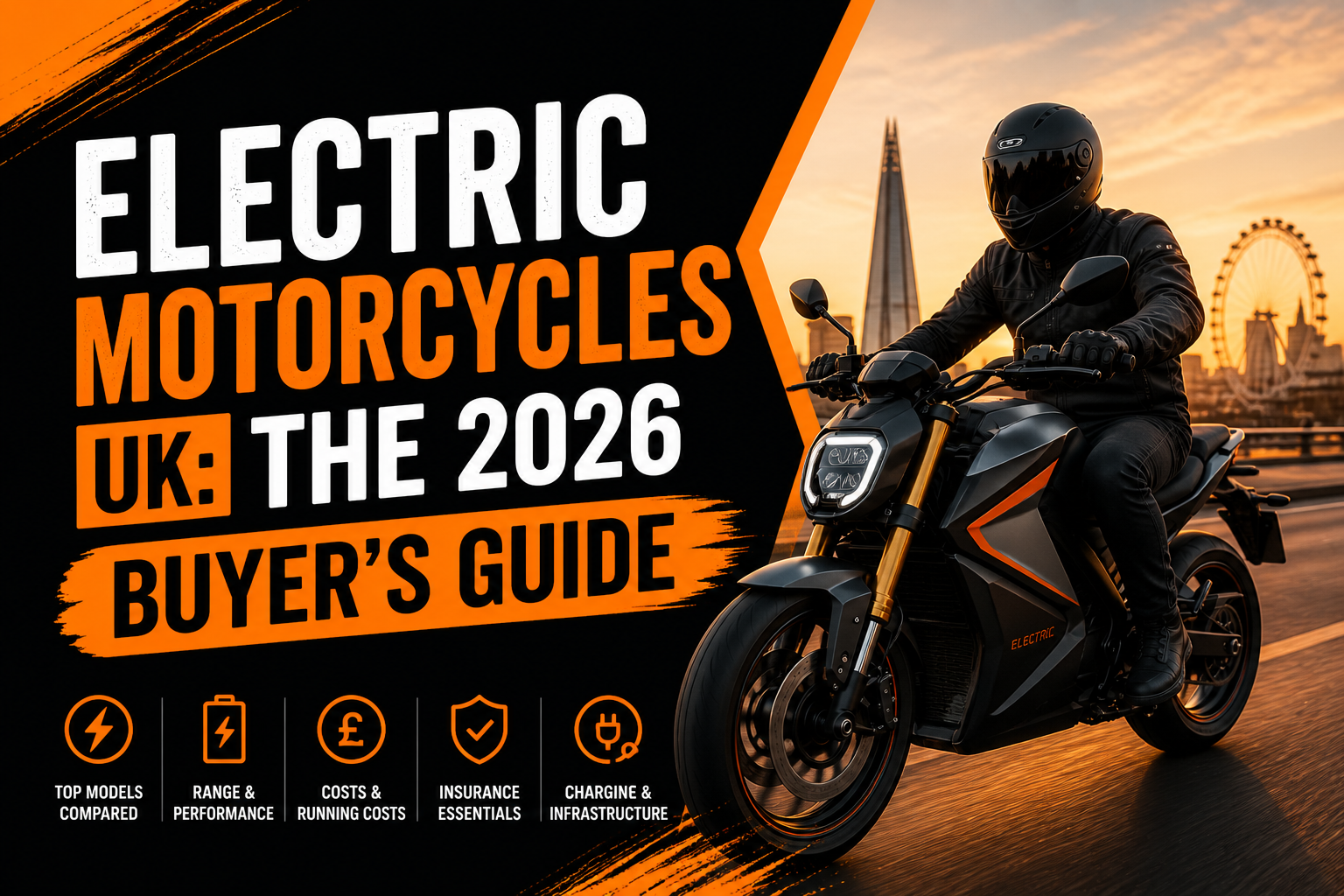
Electric Motorcycles UK: The 2026 Buyer's Guide
Flex Electric
The UK's #1 Electric Moped and Electric Motorbike dealer.

Traffic barely moves, petrol keeps climbing, parking is awkward, and if you ride into the wrong part of a city you also need to think about emissions rules and daily running costs. That’s the backdrop for a lot of riders looking at electric motorcycles uk right now.
For some, it starts as a commuter problem. The car takes too long, the train is unreliable, and a petrol scooter no longer feels as cheap to run as it once did. For others, it’s work. Delivery riders and small businesses need transport that starts every day, doesn’t spend half its life in the workshop, and doesn’t burn margin every time the throttle opens.
Electric motorcycles and mopeds now sit in that space as a practical option, not a novelty. The wider European electric motorcycle and moped market grew sharply in a single year, with motorcycle sales rising 81.6% and moped registrations rising 46.8%, a shift tied to congestion and emissions regulation that helped shape the UK market and its longer-term growth outlook through 2030, according to European market growth data.
That doesn’t mean every electric bike suits every rider. It doesn’t. Some are ideal for city hops and daily commuting. Some work well for delivery riders who can charge smartly between shifts. Some are built for experienced riders who want stronger performance. And some off-road and kids motocross bikes belong nowhere near the road in the first place.
The useful question isn’t “Are electric bikes the future?” It’s much simpler. Will one work for your week, your routes, your licence, and your budget?
The Quiet Revolution on UK Roads
Monday morning in Manchester. The ring road is crawling, fuel is up again, and a rider doing eight miles each way is still paying for an engine designed to sit happily on longer runs. By Friday, the question is usually less about new tech and more about wasted money, wasted time, and whether the current bike still fits the week.
That is why more UK riders are looking seriously at electric. For commuters, it can be a simpler answer to short urban trips. For delivery riders, it can reduce running costs if charging is sorted properly. For businesses, it can make fleet costs more predictable on local routes. The appeal is practical.
The wider shift is already visible across Europe, as noted earlier, and the same pressures apply in the UK. Congestion, clean air policy, parking headaches, fuel costs, and stop-start city work all push riders toward machines that suit short, repeatable journeys better than petrol alternatives.
On the ground, the buyer groups are easy to spot:
- Commuters who want a dependable city bike that is cheap to run and easy to park.
- Delivery riders who need low daily costs, strong low-speed response, and a charging routine that fits shift work.
- Businesses running local transport or last-mile jobs where predictable mileage matters more than motorway range.
- Experienced riders who like instant torque but still need to be honest about range, weather, and charging access.
Practical rule: Buy electric because it suits the job you do each week, not because the category sounds forward-looking.
Buyers usually go wrong by focusing on headline range and top speed before checking the basics: daily mileage, home or workplace charging, payload, pillion needs, and licence limits. In my experience, riders who start with those constraints make better decisions and spend less fixing a bad one later.
An electric motorcycle can be excellent value in the UK. It can also be the wrong tool. A rider doing predictable urban miles often saves money and hassle. A rider who regularly covers long distances without reliable charging may end up frustrated.
The shift on UK roads is quiet, but the reason behind it is straightforward. For the right rider, electric works well because the daily routine works well.
Understanding Electric Motorcycles and Mopeds
An electric motorcycle is mechanically simpler than a petrol bike. That doesn’t mean every model is simple to choose, but the core parts are easier to understand than many people expect.

The three parts that matter most
Think of the battery as the fuel tank. It stores the energy you’ll use for the ride. Bigger battery capacity usually means more range, but also more weight and often a higher purchase price.
The motor replaces the petrol engine. Instead of building power through revs and gears in the traditional way, it delivers drive much more directly. That’s why even modest electric mopeds can feel sharp pulling away from lights.
The controller is the part many new riders overlook. It manages how power is delivered from the battery to the motor. In practice, it shapes how smooth, responsive, or aggressive the bike feels.
The easiest way to judge an electric bike is not the brochure. It’s how the throttle responds at low speed, in traffic, and on repeated stop-start runs.
The main categories in the UK market
The electric motorcycles uk market isn’t one segment. It’s several distinct use cases.
TypeBest suited toTypical useElectric mopedsLearners, short urban ridersTown and city travel125cc-equivalent electric motorcyclesCommuters, regular ridersMixed urban and suburban useHigher-performance electric motorcyclesExperienced ridersStronger speed and accelerationOff-road electric motorcyclesPrivate land and tracksGreen lanes, trails, off-road riding where appropriateKids electric motocross bikesYoung riders under supervisionTraining, recreation, private land use
A useful market clue is that sub-3.6 kW electric motorcycles held a 44.21% global market share in 2024, according to motorcycle market research. That category meets the needs of learners and city riders well, which is why lower-power models are so common in UK urban transport.
What each category feels like in practice
An electric moped is usually the easiest entry point. It’s built for lower-speed city work, short runs, simple controls, and low-stress ownership.
A 125cc-equivalent machine is where many UK buyers land. It offers enough performance for commuting without becoming overkill for urban life. This is often the sweet spot for riders who need one bike to do weekday travel, errands, and some faster-road use.
Then you have bikes aimed at enthusiasts. Models from brands such as LiveWire, Vmoto, Horwin, Segway, and Super Soco all approach the category differently. Some prioritise city practicality. Others lean harder into design, acceleration, and premium technology.
Off-road and kids motocross bikes are their own category entirely. Don’t treat them as road bikes with knobbly tyres. They’re purpose-built and need to be bought with terrain, rider age, and supervision in mind.
UK Licence Requirements for Electric Bikes
Licence confusion stops a lot of buyers before they even start. The issue is simple. Most riders grew up thinking in cc. Electric bikes are rated by motor power, so people aren’t always sure what they can legally ride.
The first distinction that matters
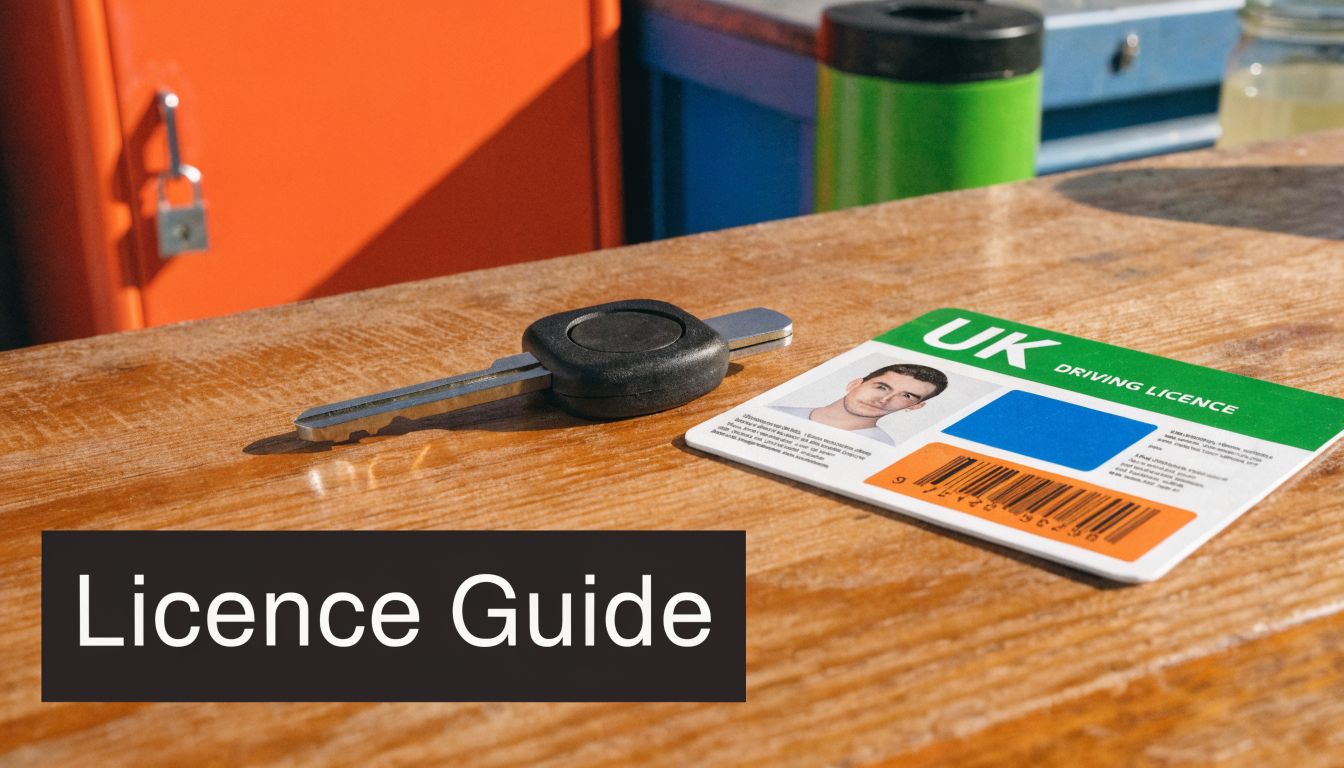
In UK regulation, vehicles with motors exceeding 250W are classified as light mopeds and require a licence, registration, and insurance, according to UK market and regulatory analysis. For buyers looking at road-legal electric mopeds and motorcycles, that line matters because nearly everything you’d realistically treat as a road-going powered two-wheeler sits on the regulated side of it.
That’s also why it’s important not to mix up electric bicycles with the road-legal electric motorcycles and mopeds discussed here. They sit under different rules. If you’re shopping for a proper moped or motorcycle, assume licensing and registration questions matter from the start.
How to think about licence fit
A practical way to choose is to work backwards from what you already hold.
- If you’re a new rider and you want a city-focused moped or low-power machine, you’re often looking at learner-friendly options first.
- If you’ve completed CBT and want a 50cc- or 125cc-equivalent road bike, your choice opens up, but only within the limits of what that entitlement allows.
- If you hold A1, A2, or a full A licence, you can look at progressively more powerful electric motorcycles in the same way you would when stepping up in petrol categories.
The translation isn’t always neat because electric delivery and acceleration feel different from petrol capacity numbers. Two bikes that look similar on paper can feel very different on the road.
What buyers should check before paying a deposit
Treat licensing as a checklist, not a guess.
- Confirm the bike’s road classification
Ask whether it’s a moped equivalent, 125cc equivalent, or a higher-performance motorcycle. Don’t rely on styling. - Match the bike to your current entitlement
A machine that suits your ambition may not suit your present licence. That’s common, especially with riders moving up from car travel. - Check whether you need registration and insurance
For road-going electric motorcycles and mopeds, you usually will. - Ask about pillion use, speed profile, and intended roads
A bike that’s legal for you may still be wrong for your route if you need dual carriageway confidence or regular longer commutes.
A short explainer helps if you’re trying to map licences to electric categories in plain English:
Where riders make expensive mistakes
The most common mistake is buying too much bike too early. The second is buying too little bike for the roads you ride.
Licence check: If your route includes faster roads every day, don’t buy purely around city specs and hope you’ll “manage”. Buy for the road environment you actually ride.
The legal side also affects ownership cost. Once a vehicle crosses into moped or motorcycle classification, registration, insurance, and compliance become part of the decision. That doesn’t make electric unattractive. It means the cheapest-looking option on day one isn’t always the most sensible option over time.
The Real Cost of Running an Electric Motorcycle
A rider doing 12 city miles a day and a delivery rider doing repeated urban loops can buy the same electric bike and get very different value from it. That is why headline price misleads people. The better question is simple. What will this machine cost you to run, maintain, and keep earning over the next few years?
For many UK riders, electric shifts the cost burden rather than removing it. You usually pay more attention to purchase price, charging access, battery warranty, and dealer support at the start. In return, day-to-day running can be cheaper and less fiddly than petrol if the bike matches the job.
Where electric usually saves money
The main savings are predictable.
An electric motorcycle has fewer service items tied to an engine. No oil changes. No spark plugs. No exhaust corrosion. On many models, no clutch wear in the usual way either. You still pay for tyres, brake components, suspension wear, bearings, and general servicing, but the routine workshop list is often shorter.
That matters in different ways depending on how you ride. A commuter may care most about lower weekly running costs and fewer garage visits. A courier or business owner usually cares more about uptime. If the bike is earning money, every hour off the road has a cost.
The saving areas usually look like this:
- Energy
Charging at home or at a depot is often cheaper and easier to budget than petrol, especially for riders covering regular local miles. - Routine servicing
There are fewer traditional mechanical jobs, which can reduce labour and time off the road. - Stop-start urban riding
Electric drivetrains suit short, repeated city journeys well, where petrol bikes can feel wasteful and wear-prone. - Mechanical simplicity
Fewer drivetrain components can mean fewer points of failure, provided the battery system and charger are well supported.
Costs that still catch buyers out
Electric ownership is not automatically cheap.
Insurance still varies by postcode, rider profile, and model. Tyres can disappear quickly if the bike carries loads or spends its life in stop-start work. Crash repairs can be awkward if parts supply is slow. Charger replacement, battery health, and dealer backup matter more than many first-time buyers expect.
Charging also has a real-world cost beyond the electricity bill. If home charging is straightforward, the ownership case improves quickly. If you rely on public infrastructure, the maths and the hassle both change. Understanding EV charging obstacles gives useful context on the UK issues that can affect daily use.
Finance needs the same level of honesty. Low running costs do not fix a bad monthly payment.
Cost areaPetrol bikeElectric motorcycle or mopedEnergyRegular fuel spend with price swingsCharging cost, often easiest to manage at home or workRoutine servicingMore engine-related service itemsSimpler service profile, but diagnostics and battery support matterUrban workLess efficient in heavy stop-start useOften better suited to repeated city ridingDowntime riskMore mechanical systems to maintainFewer drivetrain parts, but charger, battery, and electronics support matter
Why businesses look at total cost, not brochure claims
For a private rider, a saving of a few pounds a week is helpful. For a business running several vehicles, cost per mile, service intervals, and downtime become operational decisions.
I see the same mistake repeatedly. Buyers compare purchase prices between a petrol scooter and an electric model, then stop there. A better comparison looks at the whole working week. How many miles does the vehicle cover? Where does it charge? How much paid time is lost during servicing? How quickly can the rider get back on the road if something fails?
That is also why some small UK businesses still have to build their own spreadsheet before switching. Published UK-specific figures on return for smaller last-mile fleets are still patchy. Restaurants, florists, site services, and local delivery operators often need to test the numbers against their own routes, payloads, and shift patterns rather than rely on generic market claims.
If the bike is part of your income, buy around uptime, charging routine, and support network first. Running cost only matters when the vehicle is available to work.
A better way to judge affordability
Use your current transport as the baseline.
Ask what you spend now on fuel, servicing, and unplanned repairs. Then add the hidden costs. Time spent at petrol stations. Lost jobs from breakdowns. The second vehicle you keep because your main one is unreliable. For many commuters and urban businesses, that is where electric starts to make sense.
Use these questions before buying:
- How many of my weekly miles are local, predictable, and repeatable?
- Can I charge reliably at home, at work, or at a depot?
- How expensive is downtime for me in practice?
- Am I choosing a bike for real use, or for the idea of owning it?
The riders who get the best value from electric in the UK are usually the ones with boring, repeatable routines. That is not a drawback. It is exactly what makes the ownership maths work.
Real-World Range and Daily Charging Routines
Range anxiety is often overstated by people who’ve never lived with an electric bike, and understated by people taking brochure figures at face value. The truth sits in the middle.
Claimed range is one thing. Your range depends on speed, rider weight, hills, weather, payload, how aggressively you use the throttle, and whether the route is stop-start or open. A bike that feels perfect for a city commuter may be the wrong tool for a rider doing repeated, high-mileage delivery loops.
What range really means in daily use
For most private riders, the main question isn’t maximum range. It’s whether the bike comfortably covers the day with margin left. If your commute is predictable and you can charge overnight, electric ownership is usually straightforward.
For delivery riders, range becomes operational. You need to think in shifts, not trips. That means planning around pauses, charging access, and whether your model supports removable batteries or easy turnaround between runs.
A known problem in the market is that UK-specific data on charging density in delivery hotspots and real-world high-frequency commercial use remains thin, according to analysis of charging and range information gaps. That’s why real-world guidance matters more than generic EV advice in this category.
Charging routines that actually work
Most owners do best with a boring routine. That’s a compliment.
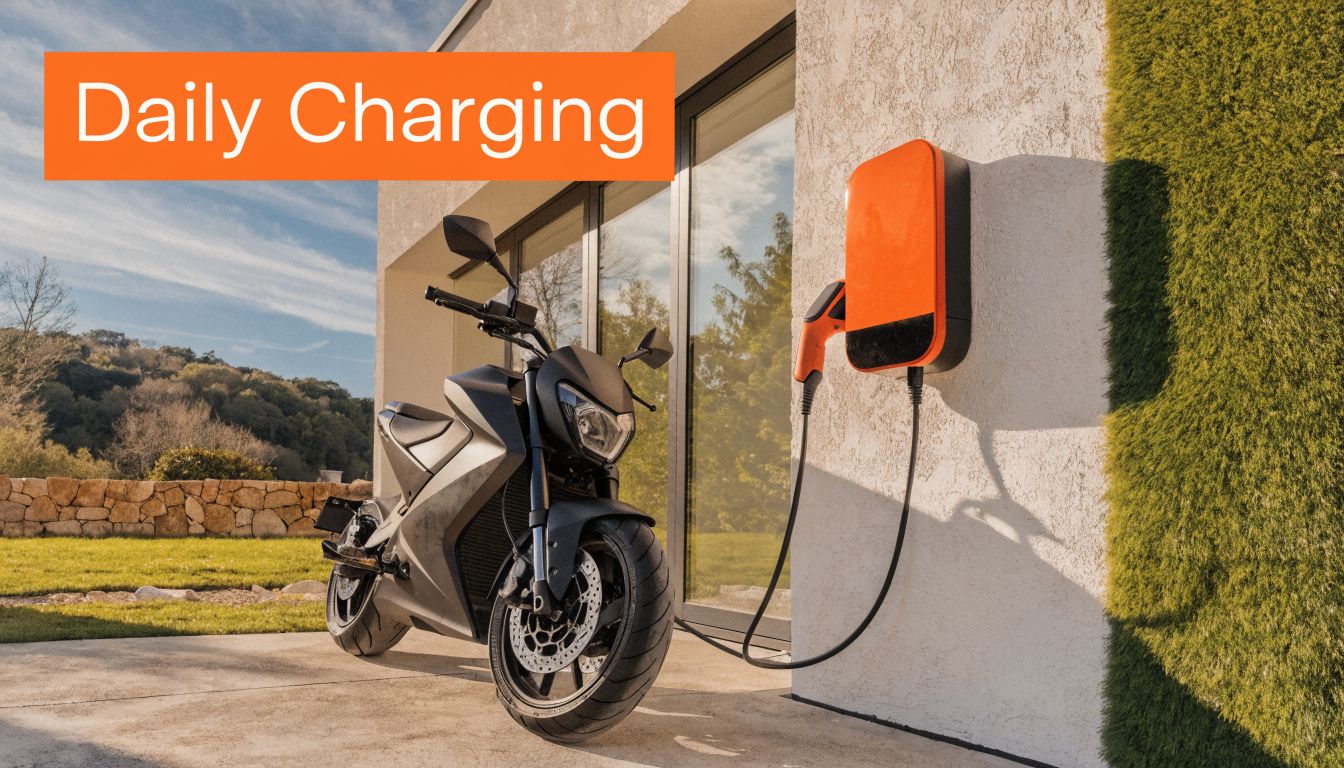
- Home overnight charging
This is the cleanest setup for commuters. Plug in after the day ends, unplug in the morning, repeat. - Workplace charging
If you can charge where you work, your usable routine becomes much easier, especially for business users and staff riders. - Mid-shift top-ups
Delivery riders often benefit from charging during natural downtime rather than waiting for the battery to become low. - Removable battery workflows
Some mopeds make sense precisely because the battery can be brought indoors, charged off-bike, or rotated more flexibly.
If you want broader context on the UK’s charging challenges beyond two-wheelers, Understanding EV charging obstacles gives a useful overview of the bigger infrastructure issues shaping rider confidence.
What doesn’t work
The worst approach is buying an electric motorcycle first and solving charging later. That’s backwards.
It also doesn’t work to rely on public charging as your only plan unless you’ve already checked your local reality. Public infrastructure may help, but for many riders it should be a backup or a bonus, not the whole strategy.
Range reality: If your riding pattern regularly pushes the edge of the battery, the bike is too small for the job, even if the brochure says it can just about do it.
A simple test before buying
Write down your actual weekly use.
Rider typeBetter question than “What’s the max range?”CommuterCan I do my round trip with reserve in poor weather?Delivery riderCan I finish a shift without scrambling for charge?Business fleet userCan staff repeat the routine without special effort?Weekend riderDoes the route include charging gaps that change the plan?
When range is planned properly, it stops being a fear and becomes just another operating detail.
Which Electric Motorcycle Is Right for You
A rider doing a 9-mile city commute, a takeaway courier working the dinner rush, and a weekend rider chasing B-roads can all walk into the same showroom and ask for an electric motorcycle. They should not leave with the same bike.
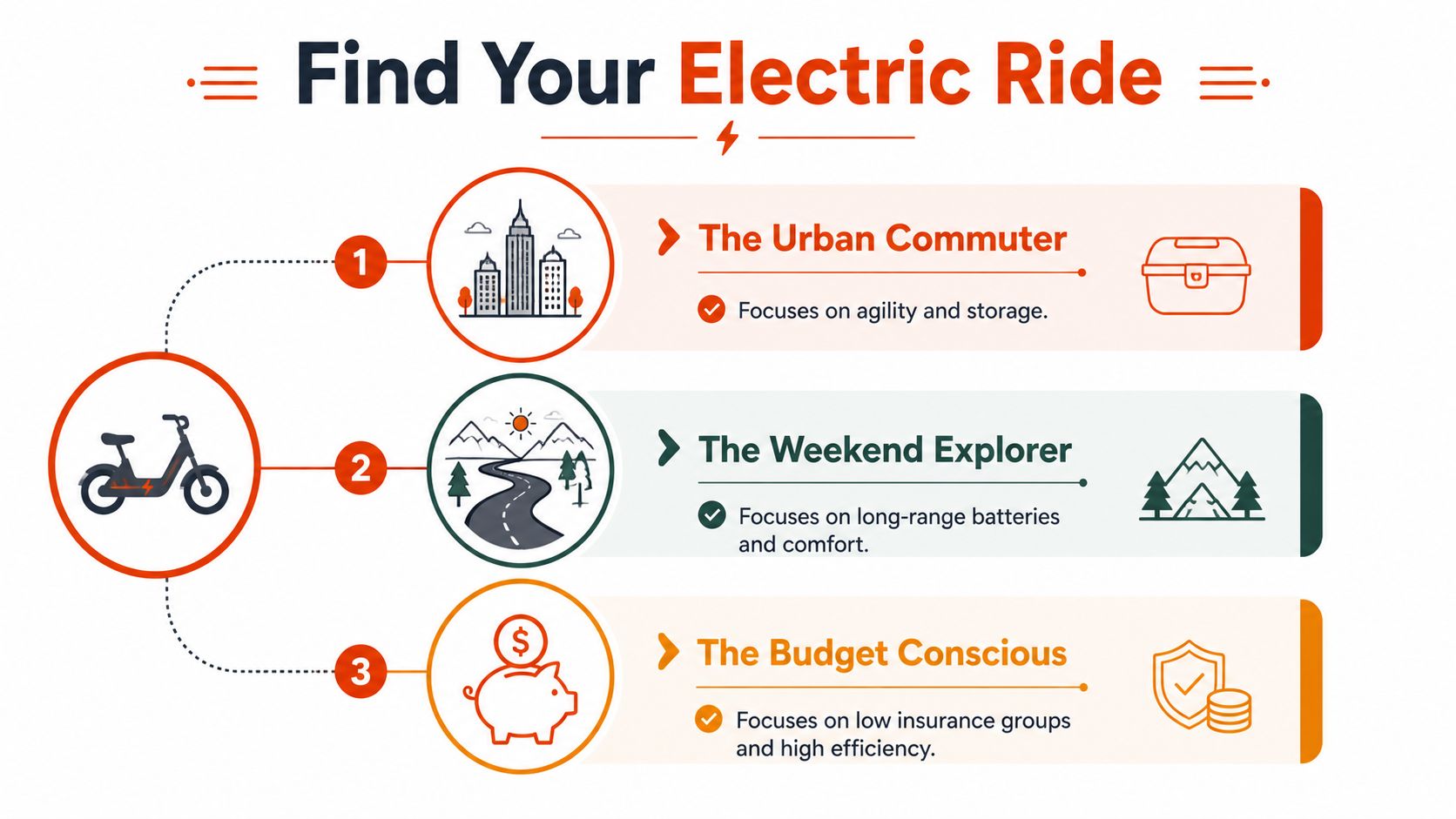
Category labels do not help much on their own. The better filter is daily use, road type, carrying needs, charging routine, and how much inconvenience you are willing to tolerate. That is what decides whether a bike will work for six months, not whether it looked right in a product photo.
The urban commuter
For most UK commuters, the right bike is smaller than they first expect.
If the route is mainly 20 to 40 mph roads with short stretches of faster traffic, a moped or 125cc-equivalent usually makes more sense than a larger machine. It is easier to filter, easier to park, and cheaper to insure and run. You also avoid paying for extra performance you rarely use.
What matters here is routine:
- Usable range with reserve
The bike needs to cover the round trip comfortably in poor weather, with lights on, and without arriving home empty. - Enough speed for the actual route
City riding, ring roads, and short dual carriageway sections place very different demands on the bike. - Storage and practicality
A top box, luggage rack, or space for work kit often matters more than outright power. - Low-speed manners
Smooth pull-away, predictable throttle response, and easy feet-down balance make everyday riding less tiring.
A common mistake is buying for the occasional longer ride rather than the five-day weekly commute. For that rider, a lighter city-focused machine usually gives the better ownership experience.
The food delivery rider
Delivery work is hard on any bike. It exposes weak range claims, awkward charging setups, poor luggage options, and slow parts support very quickly.
The best choice is rarely the flashiest one. It is the bike that earns consistently.
A delivery rider should judge a bike against shift structure, not brochure language. Dense city-centre drops are one job. Wider suburban runs with longer gaps between stops are another. The first can suit a smaller, highly manoeuvrable machine. The second may need more battery capacity or a stricter mid-day charging plan.
Check these points before buying:
- Can the bike complete a real shift pattern?
Use your busiest day, not your easiest one. - Does the luggage setup work properly?
A bike can feel fine empty and become awkward with a loaded box. - How quickly can support help if the bike is off the road?
Downtime costs income. - Is the charging routine realistic at home or between sessions?
If charging depends on perfect behaviour every day, the setup is fragile.
For riders earning from the bike, total cost matters more than ticket price. A cheaper model that interrupts work can cost more in practice than a better-suited one.
The small business fleet buyer
Small fleets need repeatable systems. That applies whether the business is a restaurant, florist, venue, estate team, or local courier operation.
The question is simple. Can staff use the bikes reliably without special workarounds?
Businesses should assess electric two-wheelers the same way they assess any working vehicle. Look at route length, staff turnover, parking, charging access, payload, and what happens when a bike needs service. As noted earlier, published small-fleet decision data is still limited, so workflow tends to be a better guide than generic market commentary.
This table is a better starting point than headline specs:
Business needWhat to prioritiseShort local deliveriesStraightforward charging and quick rider handoverMultiple staff usersPredictable controls and stable low-speed handlingDaily commercial useParts availability and service supportCustomer-facing useClean presentation and consistent reliability
For this buyer, supplier support matters as much as the bike itself. Flex Electric supplies road-going electric mopeds and motorcycles, along with accessories, finance options, and business delivery programmes. That is useful if the bikes are being bought as working tools and need to arrive set up for the job.
The performance enthusiast
Some riders want more than practical transport. They want strong acceleration, better chassis feel, stronger brakes, and the sense that the bike is still special when the road opens up.
That usually points away from commuter-focused mopeds and toward premium electric motorcycles. The trade-off is obvious. Purchase cost rises, insurance may rise with it, and range tends to matter more once speeds increase.
Buy for the riding you do most often. A machine that feels brilliant on a Sunday but is awkward, expensive, or unnecessary for the weekday job is often the wrong purchase.
The off-road rider and the parent buying a kids MX bike
This is a separate category with a different checklist.
Road licence questions and commuting logic do not help much here. Rider height, weight, terrain, runtime per session, charging time, and durability after drops matter more. For children in particular, manageable power delivery and correct sizing beat an aggressive spec sheet every time.
The right electric motorcycle is the one that fits your week without creating extra admin, charging stress, or wasted cost. That answer is different for a commuter, a courier, a business, and a leisure rider.
How to Buy and Own Your Electric Motorcycle with Confidence
A good electric bike on paper can still be a poor purchase in real life. The difference is usually support, setup, and honesty at the point of sale.
The bike should match your licence, your route, your storage, and your charging plan. If one of those is shaky, ownership becomes frustrating quickly.
What to check before you buy
Start with the fundamentals, not the styling.
- Road use and classification
Confirm whether the bike is road legal, what category it sits in, and what licence it requires. - Real-world suitability
Ask how the bike behaves in the type of riding you do. City centres, hills, dual carriageway stretches, pillion use, cargo. These details matter. - Charging method
Check whether it charges from a standard home setup, whether the battery is removable, and where the charger will physically live. - Warranty cover
You want clarity, not vague reassurance.
A buyer should also ask what happens after delivery. Can you get accessories that suit your use? Is there help with service questions? If a part fails, what is the support path?
Why specialist support matters
Electric two-wheelers still need explanation. General motorcycle sales experience doesn’t always cover the practical questions buyers have, especially around charging, battery use, and route fit.
That’s where a specialist dealer tends to be more useful than a generic seller shifting mixed stock. The right conversation should include:
- whether the bike fits your current licence
- what kind of range you can expect in your routine
- whether the bike suits commuting, deliveries, or leisure riding
- what ownership support exists after handover
What confident ownership looks like
Good ownership is usually unremarkable. The bike starts, charges, covers the miles you need, and doesn’t turn every week into a planning exercise.
For that, support matters. The publisher details practical ownership cover that includes a 2-year parts warranty and 3-year battery warranty, UK-wide delivery, and after-sales support. Finance is also available on a 0% APR basis with a minimum £500 deposit, according to the publisher information provided for this article. Those details matter because they shape the whole ownership experience, not just the buying moment.
The right bike should make your routine simpler within the first week. If it makes your life more complicated, something was mismatched in the buying process.
Your Next Ride Is Electric
Electric motorcycles uk buyers usually arrive with one concern in mind. Cost, licence rules, charging, range, or whether the bike will really suit daily life. The good news is that these are solvable questions when you look at the bike as a working tool rather than a vague trend.
For commuters, the appeal is obvious. Cleaner city travel, less mechanical fuss, easier filtering, and a charging routine that can become second nature. For delivery riders, the calculation is stricter, but the right moped or motorcycle can still make operational sense when the route and charging plan are realistic. For businesses, electrification works best when it’s tied to a clear delivery pattern and sensible support. For enthusiasts, electric offers a different kind of performance that’s immediate and engaging.
The key is fit. Not every electric bike suits every rider, and not every rider should switch today. But the category is now broad enough that many UK riders can find a machine that meets their travel needs.
If you choose with clear eyes, electric ownership doesn’t feel experimental. It feels normal. Quiet, simple, fast enough for the job, and often cheaper to live with over time.
If you’re comparing models, checking licence fit, or trying to work out whether an electric moped or motorcycle makes sense for your commute, deliveries, or business use, Flex Electric is a practical place to start. You can explore road-going electric mopeds, motorcycles, off-road bikes, and kids MX models, then narrow the choice based on how you ride.
Find us
You will find us at 74 Dalry Road, Edinburgh, EH11 2AY
Showroom Opening Times:
Monday: By Appointment
Tuesday to Friday: 11am - 5:00pm
Saturday: 10am - 5pm
Sunday: By Appointment
