
Electric Off Road Bikes UK: Types, Laws, and Buying Tips

Flex Electric
The UK's #1 Electric Moped and Electric Motorbike dealer.

You've found an electric dirt bike that looks perfect for the farm, trails or a short commute. Then the listing calls it an “e-bike”, the seller mentions a throttle, and you're left wondering whether you can ride it on the road, through a park or only on private land. In the UK, those aren't small details. The legal category and where you plan to ride should decide what you buy.
Electric off-road bikes in the UK fall into three distinct groups: EAPC-compliant pedal-assist bikes, road-registerable electric mopeds and motorcycles, and off-road motorbikes intended for permitted private land. They can look similar in adverts, but their legal treatment and day-to-day uses are very different. Start with your riding location, then choose the category that fits it.
Who Actually Buys Electric Off Road Bikes in the UK
A buyer might be weighing up a quiet machine for farm tracks, a first motorbike for a young rider, or something that can manage the commute and a weekend on permitted trails. Those uses point to different products, not three versions of the same e-bike.
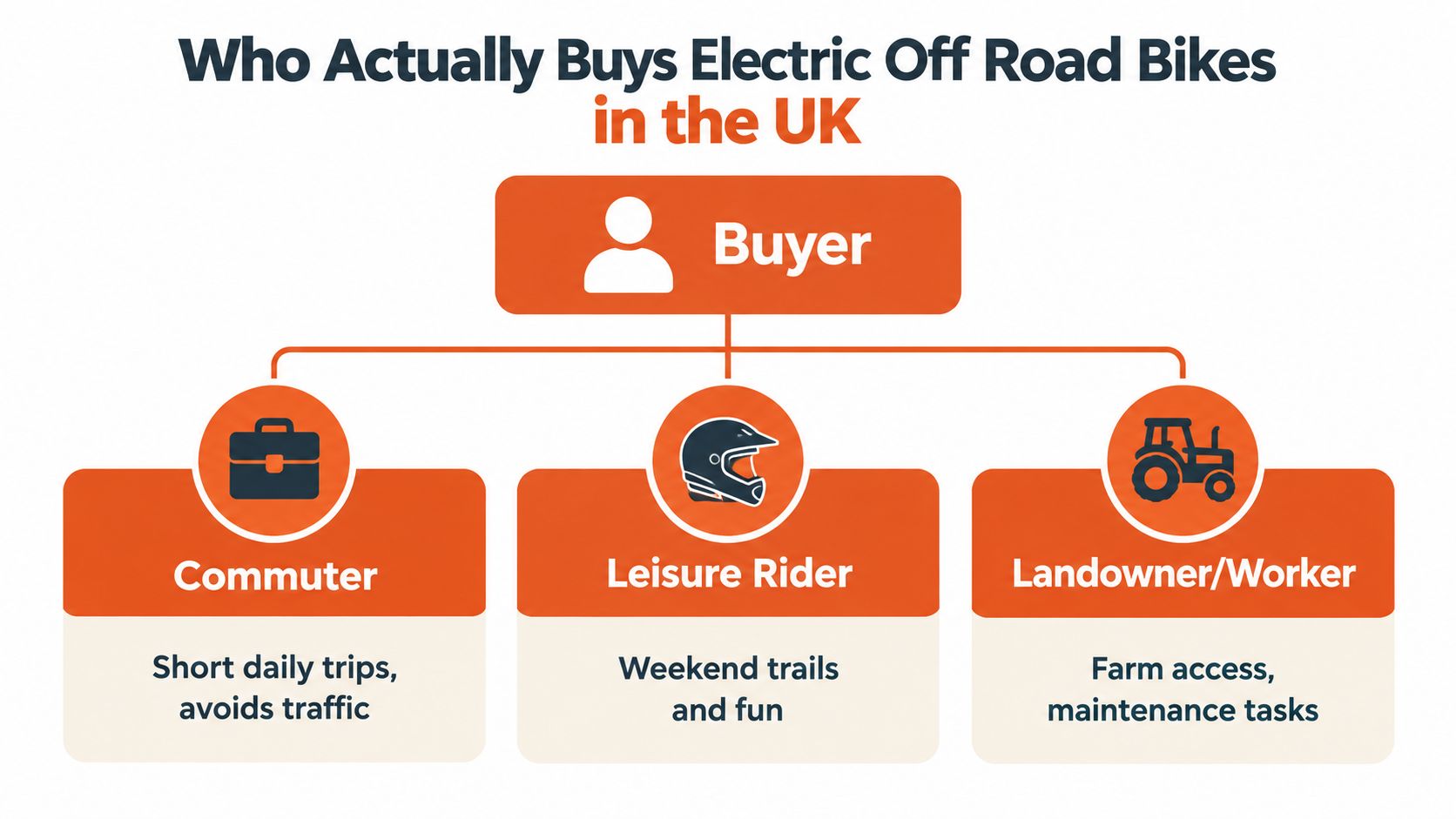
First, decide which of these three groups you're in:
- EAPC-style electric pedal-assist bike: It has usable pedals and meets the legal power and assistance limits. It suits someone who wants cycle-style access where those rules apply, such as a commute that includes cycle routes. It isn't a throttle-only dirt bike.
- Road-registerable electric moped or motorcycle: This is a motor vehicle, not an ordinary electrically assisted cycle. It can be used on the road only if the specific machine meets the required approval and registration rules and the rider meets the licensing requirements.
- Private-land electric motorbike: This includes many kids' motocross bikes and adult MX or enduro machines. It's for a track, farm or other private land where the landowner has given permission, not for a public path or park.
The market is established, but it's still developing. Motorcycle Industry Association data recorded 3,750 new electric mopeds and motorcycles in the UK in 2024, down 7.7% on 2023, with electric vehicles making up roughly 3.2% of new motorcycle, scooter and moped registrations (MCIA registration data). Registrations were weighted towards lower-power machines, which helps explain why learner-legal and urban models are more familiar than high-performance electric motorbikes.
That's useful context, not a reason to buy or avoid one. Electric two-wheelers are a real option, but buyers still need clear range expectations, charging information and support after purchase. Work out which of the three groups fits your intended use before you compare models.
What Counts as an Electrically Assisted Pedal Cycle
An Electrically Assisted Pedal Cycle (EAPC) is a legal category, not a description a seller can apply because a bike has pedals or an off-road look. The machine must meet the rules for motor power, assistance and pedalling. If it doesn't, it's treated as a motor vehicle instead.
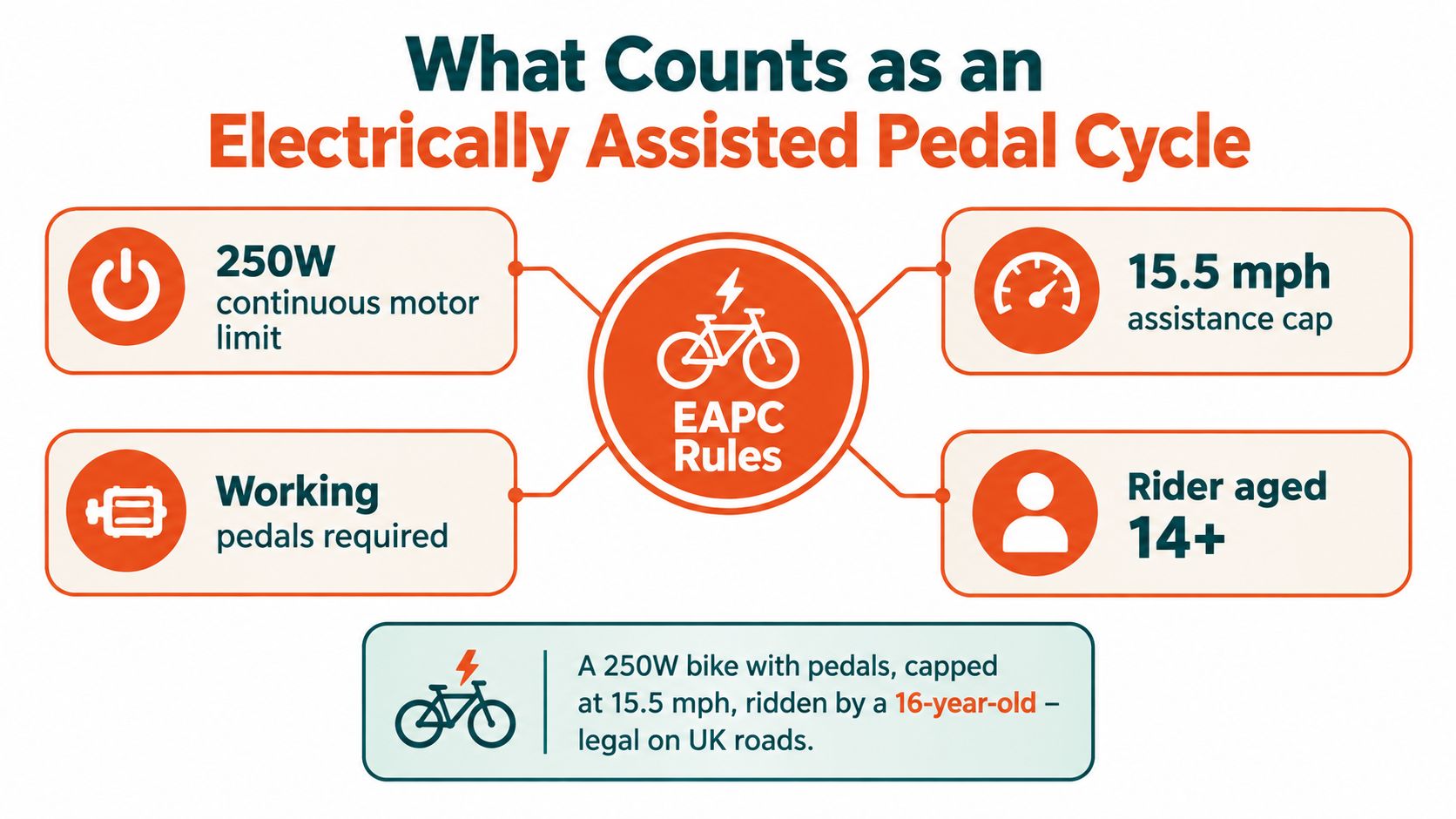
In plain English, an EAPC needs usable pedals, a motor with no more than 250 W continuous rated power, and assistance that cuts out at 15.5 mph. The rider must be at least 14. These are the limits to check when you want cycle-category treatment on public roads and cycle routes.
Consider a dirt-bike-shaped machine with no pedals and a throttle that drives it without pedalling. It isn't an EAPC, even if a listing calls it an electric bike. The same applies if it can propel itself above the assistance limit. GOV.UK states that an EAPC with an off-road mode capable of motor propulsion above 15.5 mph doesn't comply with EAPC regulations and is treated as a motor vehicle (GOV.UK EAPC guidance).
The useful test: Don't judge by the frame, the tyres or the name in the advert. Check the motor rating, whether the pedals work, and how the bike moves under power.
An EAPC classification doesn't grant permission to ride anywhere. Public roads, cycle lanes and cycle tracks have their own access rules, while private land still requires the landowner's permission. A high-power electric dirt bike doesn't become a cycle by being used slowly, and a removable limiter doesn't make it lawful if the machine's off-road mode can exceed the EAPC limits.
This distinction catches buyers out because manufacturers and retailers may use “e-bike” loosely. Ask for the exact classification and specifications in writing before paying a deposit. If the machine is throttle-only or exceeds the EAPC limits, treat it as a motor vehicle and check its approval and intended riding environment.
The Main Types of Electric Off Road Bike Sold in the UK
The main formats serve different riders, and their specifications shouldn't be compared as if they were interchangeable. Kids' MX machines prioritise manageable size and private-land fun. Adult motocross and enduro models are purpose-built for permitted off-road riding. Road-legal mopeds and motorcycles add registration and road equipment, which makes them more versatile but doesn't turn them into cycle-path bikes.
FormatTypical peak powerTop speedTypical rangeWhere it can be riddenKids' MX electric motorbikeVaries by modelVaries by modelVaries by modelPermitted private landAdult electric MX or enduroVaries by modelVaries by modelVaries by modelPermitted private land or an authorised trackDual-sport or adventure electric motorcycleVaries by modelVaries by modelVaries by modelPublic roads if approved and registered; access on trails depends on the route and vehicle rulesL1e-B electric mopedUp to 4 kW under the vehicle-classification materialUp to 28 mph under that classificationVaries by modelPublic roads when correctly approved, registered and insuredFarm or utility electric motorbikeVaries by modelVaries by modelVaries by modelPrivate land unless the machine is road legal
The table deliberately doesn't give generic ranges or speeds for unlisted models. Those figures depend on the individual bike, load, terrain and test conditions. For L1e-B, the UK classification material describes a two-wheel vehicle with power up to 4 kW or a qualifying pedelec capable of exceeding 25 km/h, with a maximum speed of 28 mph. It requires motorcycle-style compliance, including registration and insurance, rather than EAPC treatment (UK L-category vehicle classification).
A few road-registerable electric motorcycles can suit buyers who want an urban machine with occasional access to suitable routes. The Vmoto TC Max 2026, Night Edition is described as a 125cc-equivalent electric motorcycle with 5 kW peak power, a 60 mph top speed and a stated 60-mile range. That makes it a road-motorcycle comparison, not a substitute for a private-land motocross bike.
Riding style matters as much as the bike's label. A useful way to think about mixed-terrain choices is to compare gravel bike types, then apply the same discipline to electric machines: choose for the routes you're allowed to ride, not just the terrain shown in product photos.
Where You Can Legally Ride Each Type
Choose the riding location before the bike. A machine that's suitable for a permitted private track may be unusable for a commute, while a road-legal moped still can't be treated as a bicycle on cycle tracks.

Private land is the straightforward setting for a competition-style electric motorbike, but the rider still needs the landowner's permission. In England, Wyre Council says an off-road motorbike may be ridden off the public highway only on private land with that permission. Council-owned beaches, promenades, car parks and parks aren't private land (Wyre Council's off-road motorcycle rules).
Public roads require a road-legal vehicle. A high-powered bike that isn't approved and registered can't be made road legal by being quiet or electric. For an EAPC, the cycle rules apply, but a road-registerable moped or motorcycle needs its own correct approval, documents and road equipment.
Byways and public rights of way aren't a blanket invitation to take a motorbike off-road. The route's legal status and the vehicle's category matter. Don't assume a road-legal motorcycle is permitted on every trail, or that an off-road bike can use a byway because it's called a track. Check the route rules before setting off.
Pavements and cycle tracks aren't a workaround. An L1e moped remains a motor vehicle, and an unregistered MX machine doesn't gain access because its motor is electric. Transport for London's position is also clear for off-road e-bikes: use is limited to private land where the public has no unrestricted access and the landowner has explicitly granted permission.
Repeated illegal riding can bring enforcement, complaints and the risk of a bike being seized. Match the format to the place you'll ride: EAPC for cycle-category use where permitted, an approved and registered model for road use, or a genuine off-roader for land you're authorised to access.
The Pre-Purchase Legal Checklist for UK Buyers
Before paying a deposit, ask the seller to identify the machine's legal category and provide evidence for the claims. A vague answer about being “road legal” or “fine off-road” isn't enough. Check the bike itself, its documents and the riding you plan to do.

Use this checklist:
- Pedals and EAPC limits: If the seller describes it as an EAPC, confirm it has usable pedals, a continuous rated motor output within the EAPC limit, and assistance capped at the legal speed. A throttle-only or higher-powered model should be assessed as a motor vehicle.
- Approval for road use: Ask for the exact homologation or type-approval status. A product page or a number plate bracket isn't proof.
- Registration and running requirements: For road use, check DVLA registration, vehicle tax, insurance and an MOT where applicable. Confirm that the model is eligible for the use you intend.
- Rider requirements: Check the correct licence or training entitlement for the vehicle category. A road-legal motorbike or moped also requires an approved motorcycle helmet, not a cycle helmet.
- Intended location: Confirm whether the bike is for public roads, a permitted private track, or another specific route. “Off-road” on a listing doesn't give permission to ride on public land.
- Test suitability: If you intend to use the machine for a motorcycle test, check the test requirements before buying.
GOV.UK says an electric motorcycle or moped used for testing must have the same engine power as the equivalent petrol version and maintain that power for at least 30 minutes (motorcycle and moped test vehicle rules). That's a useful reminder to look beyond peak power when assessing whether a model suits sustained use.
If the seller can't tell you the homologation status, treat the bike as not road legal until they provide evidence.
The checklist prevents the most expensive misunderstanding: buying a machine that fits your budget and riding style but can't legally go where you planned to use it.
Range Reality on UK Trails and Lanes
Treat an electric off-road bike's quoted range as a test-condition figure, not a promise about your next ride. A smooth, steady run and a muddy, technical session place very different demands on the battery.
Repeated acceleration, slow sections, mud resistance, tyre drag, climbing and the combined mass of rider and equipment all increase energy use. Cold weather can reduce immediately available battery capacity as well. Independent technical reporting notes that motorcycle range can fall by up to 50% in cold climates, with battery-management systems and cell materials affecting low-temperature performance (technical reporting on electric motorcycle innovation).
That doesn't mean every UK ride will lose half its range. It means you shouldn't plan a route around the best-case number in a product listing, especially when the ride includes cold starts, steep ground or slow technical sections.
Assess a model on the whole battery setup, not claimed miles alone:
- Capacity: Compare battery capacity in kWh where the manufacturer provides it.
- Charging: Check charging time and where you can charge between rides.
- Thermal management: Ask how the bike manages charging and discharge in cold conditions.
- Practicality: Find out whether the pack is removable and whether you can store it indoors.
Plan around the worst realistic ride you expect to do, and leave a generous reserve for temperature, gradients and getting back to your starting point. Don't charge a severely cold battery until it's warmed within the manufacturer's permitted range. For commuting or delivery work, keeping the battery indoors and preconditioning it before departure can help reduce cold-start performance loss.
Total Cost of Ownership Versus a Small Petrol Bike
Electric isn't automatically cheaper. Compare the costs across the way you'll use the bike, rather than comparing electricity with petrol and stopping there.
An electric model's running-cost picture includes charging, tyres, brake wear, servicing, finance, battery warranty and downtime. Read the warranty wording carefully: battery defects, capacity degradation and charger failure are different issues, and a headline warranty term doesn't tell you whether all three are covered. Ask what's excluded and how the seller handles diagnosis, parts and repairs.
Petrol models bring fuel, servicing, exhaust and chain maintenance. A comparable used petrol off-roader may have a lower upfront cost, so a buyer who rides occasionally on private land can't assume an electric model will recover its purchase cost through lower running expenses. For regular work use, compare the full cost per working mile, including charging access and the effect of a bike being unavailable while it's serviced or charged.
Demand is selective, not guaranteed to rise. UK registrations of new electric motorcycles, scooters and mopeds fell to 517 in Q1 2026, down 20.2% year on year (UK motorcycling market reporting). That makes dependable range information, battery support and after-sales servicing more useful buying criteria than chasing peak power alone.
Policy support is targeted rather than universal. In 2025, the government retained a plug-in grant of up to £500 for eligible new electric motorcycles, with reported conditions including a purchase price below £10,000, a top speed above 40 km/h and a range above 50 km. The grant doesn't cover every electric two-wheeler, and motorcycles and mopeds weren't included in the consultation on phasing out new petrol and diesel cars and vans by 2030 (UK electric-vehicle policy context.pdf)). Check current eligibility and the vehicle's classification before treating a grant as part of your budget.
For delivery riders and small fleets, the decision should come down to cost per working mile and downtime risk, not headline BHP. A spare battery, accessible charging and responsive repairs can matter more than a top-speed figure.
Matching the Right Bike to the Right Rider
For a family buying for a young rider on private land, choose a kids' MX electric motorbike sized for that rider. An adult who wants weekend riding without disturbing neighbours should look at an electric MX or enduro bike and use it only on permitted land. If you need a commute plus occasional suitable green-lane riding, consider a road-legal L1e-B moped or a road-registerable 125cc-equivalent motorcycle, then confirm the licence, insurance, tax and route rules.
For a higher-performance road motorcycle, be realistic about licensing, running costs and where you can ride. On longer outings, plan hydration alongside range and route, using this hydration system guide for riders as a practical reference.
Before you commit:
- Confirm where you'll ride.
- Run the legal checklist and verify the bike's classification.
- Test the machine in person before buying.
Flex Electric supplies electric mopeds, scooters, motorbikes and off-road and kids' MX bikes, with nationwide delivery from its Edinburgh showroom and after-sales support. If you've narrowed down your riding location and want straight-talking advice on a suitable electric machine, visit Flex Electric to explore the range.
Find us
You will find us at 74 Dalry Road, Edinburgh, EH11 2AY
Showroom Opening Times:
Monday: By Appointment
Tuesday to Friday: 11am - 5:00pm
Saturday: 10am - 5pm
Sunday: By Appointment
