
Electric Scooters UK Law Change: Electric Scooters UK Law

Flex Electric
The UK's #1 Electric Moped and Electric Motorbike dealer.

You've probably had the same thought as everyone else standing at a junction in any UK town right now. Private e-scooters are everywhere, so surely they must be legal by now.
They aren't.
That gap between what people see on the street and what the law says is exactly why so many riders are getting caught out. The electric scooters uk law change conversation has dragged on for years, and the result is a messy half-state where rental trials exist, private ownership is common, and legal clarity is still missing.
Table of Contents
- The UK's E-Scooter Confusion and the Coming Law Change
- Why private e-scooters are still illegal
- What happens if you ignore the rules
- Can I ride my privately owned e-scooter on the road if law changes are being discussed?
- Will my current private e-scooter automatically become legal later?
- Are rental e-scooters treated the same as privately owned ones?
- Should delivery riders wait for the new rules?
- What should I do if I already bought a private e-scooter?
- Is a legalised e-scooter likely to replace a moped for serious transport?
The UK's E-Scooter Confusion and the Coming Law Change
Walk through a city centre, a station forecourt, or a takeaway row on a Friday night and you'll see the same thing. Riders on private e-scooters moving through traffic as if the law has already changed.
That's the trap.
Government-backed rental schemes have been running for years, and they've expanded to over 50 towns and cities. At the same time, government surveys have documented an estimated 1.2 million private e-scooters in illegal use across the UK, which tells you how badly the public has misunderstood the rules (analysis of the UK trials and illegal use).
Practical rule: If it's a privately owned e-scooter, don't assume street use is legal just because you keep seeing other people doing it.
A lot of riders are waiting for one headline that says e-scooters are now legal. Real law doesn't work like that. What's coming is likely to be narrow, technical, and far more restrictive than anticipated.
That matters because many buyers aren't looking for a novelty vehicle. They need dependable transport. They need something that can cope with commuting, food delivery, or business use without sitting in a legal grey area. For those riders, the decision isn't just whether e-scooters become legal. It's whether the new class will be useful enough to bother with at all.
Understanding Current UK Electric Vehicle Law in 2026
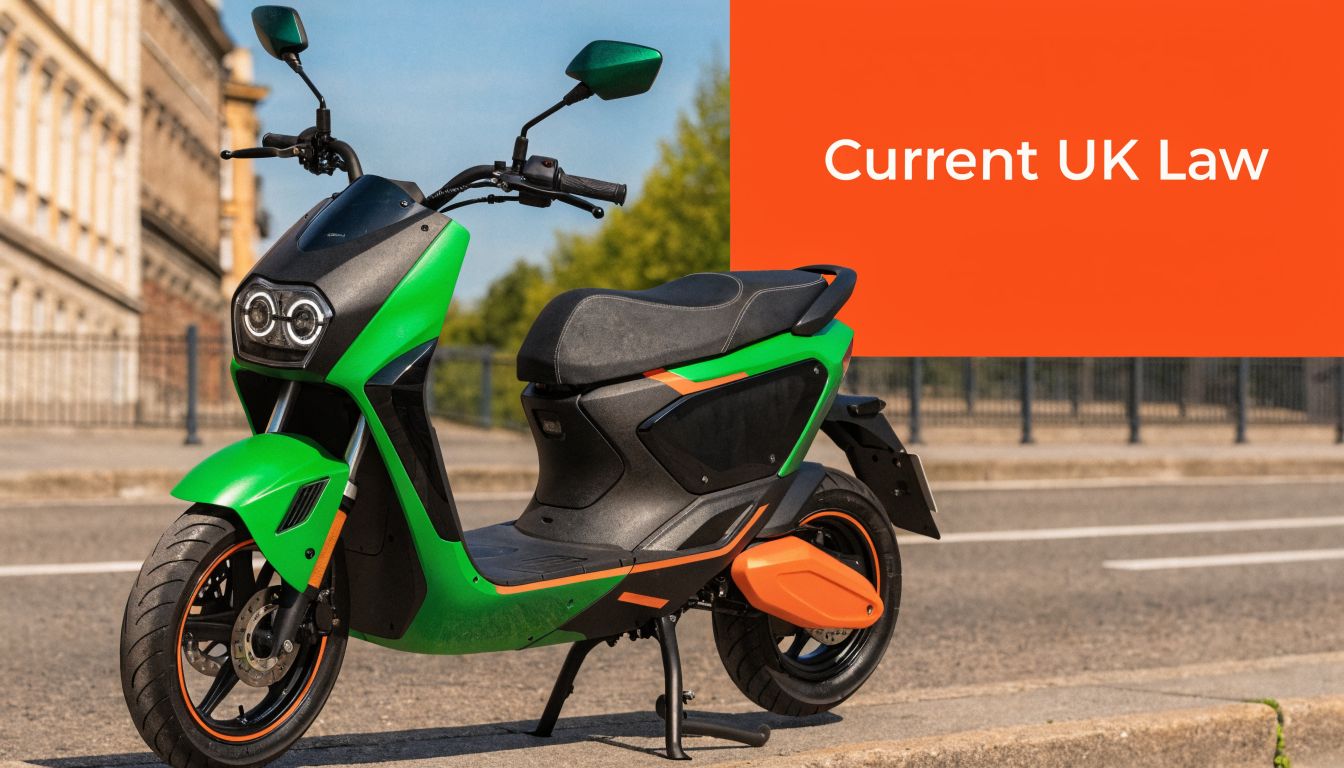
Why private e-scooters are still illegal
As things stand in 2026, a privately owned e-scooter still isn't legal for normal public road use. It also isn't legal on pavements, and it isn't legal in cycle lanes because it feels similar to other small electric vehicles.
The reason is straightforward. Private e-scooters are treated as motor vehicles under existing law. That classification pulls them into a system built around insurance, registration, tax, and vehicle construction rules. Current private e-scooters generally don't fit that system in a compliant way, which is why they remain restricted to private land with the landowner's permission.
If you're also looking at electrifying transport more broadly, home charging matters just as much as the vehicle choice. These tips for homeowners on EV charger setup are worth reading before you commit to any electric two-wheeler you'll charge at home.
What happens if you ignore the rules
This isn't one of those areas where the law is technically unclear but rarely enforced. Riders can face fines up to £300, six penalty points on a driving licence, and scooter seizure by police, with many forces using a “seize first” approach for illegal public-road use (Weightmans on penalties and enforcement).
That should change how you think about a purchase.
- If you already own a private e-scooter, public use is still a legal risk.
- If you're thinking of buying one now, you're buying into uncertainty, not guaranteed future freedom.
- If you ride for work, the risk isn't theoretical. Points, fines, and losing the scooter can disrupt your income fast.
The current setup punishes people who assume visibility equals legality. It doesn't.
A lot of buyers compare private e-scooters with road-legal electric mopeds and think they're close substitutes. They aren't. One sits in a legal deadlock. The other already fits a settled road-use framework.
What the Proposed E-Scooter Law Change Actually Means

The law change is a review first, not a free pass
The big misunderstanding in the electric scooters uk law change debate is that people hear “law change” and picture open legal access for the kinds of private scooters already being sold online. That's not the sensible reading.
In February 2026, Parliament introduced the E-scooters (Review and Awareness) Bill, which pushes government to review and publish a formal assessment of current legislation and improve public awareness of the rules. That's useful, but it isn't the same thing as saying every private scooter will suddenly become road legal.
Many buyers are acting early. They're trying to get ahead of legalisation by purchasing now and hoping the rules will catch up later. That's a poor strategy when the likely framework is much tighter than the market people have been buying from.
The proposed technical limits change everything
The most important part of the likely framework is the spec. The emerging standard is expected to require a maximum continuous-rated motor power of 250W and an automatic cut-off at 15.5 mph (25 km/h), and most private e-scooters currently on the market exceed that (technical summary of the expected framework).
That changes the whole conversation.
A lot of current buyers are picturing a practical everyday machine with enough pace to keep up with real urban traffic conditions. The proposed class looks more like a tightly restricted low-power category. Good for short, light, controlled trips. Not automatically good for riders who need dependable performance, payload capacity, and stronger compliance certainty.
Here's the practical consequence:
- Existing private scooters may not qualify. Buying one now doesn't mean it will fit the eventual rules.
- Higher-powered personal models are the wrong benchmark. The legal category looks set to be much narrower.
- Delivery use gets awkward fast. Low speed and low power don't mix well with time-sensitive work.
There's also a major gap that still hasn't been properly answered for private ownership. The insurance picture after legalisation remains unclear, especially for riders using scooters for work or mixed personal and commercial use.
For a fuller public discussion of that uncertainty, this video captures the issue well:
The Regulatory Cliff E-Scooters vs Electric Mopeds
The biggest mistake in this market is talking about “electric scooters” as if one legal answer covers everything. It doesn't. A proposed low-power e-scooter category and a road-legal electric moped are not near-identical options with different styling. They sit on opposite sides of a regulatory cliff.
Why this distinction matters
Current public discussion still fails to clearly separate the proposed Powered Transporters style category from existing 50cc and 125cc-equivalent electric mopeds and motorcycles, leaving riders and businesses unclear on compliance, cost, and capability (coverage of the regulatory distinction gap).
That confusion costs people money. Someone buying for food delivery, commuting across a wider town, or building a small fleet doesn't just need “something electric”. They need a vehicle class that already has a known legal route, known insurance route, known registration route, and practical road capability.
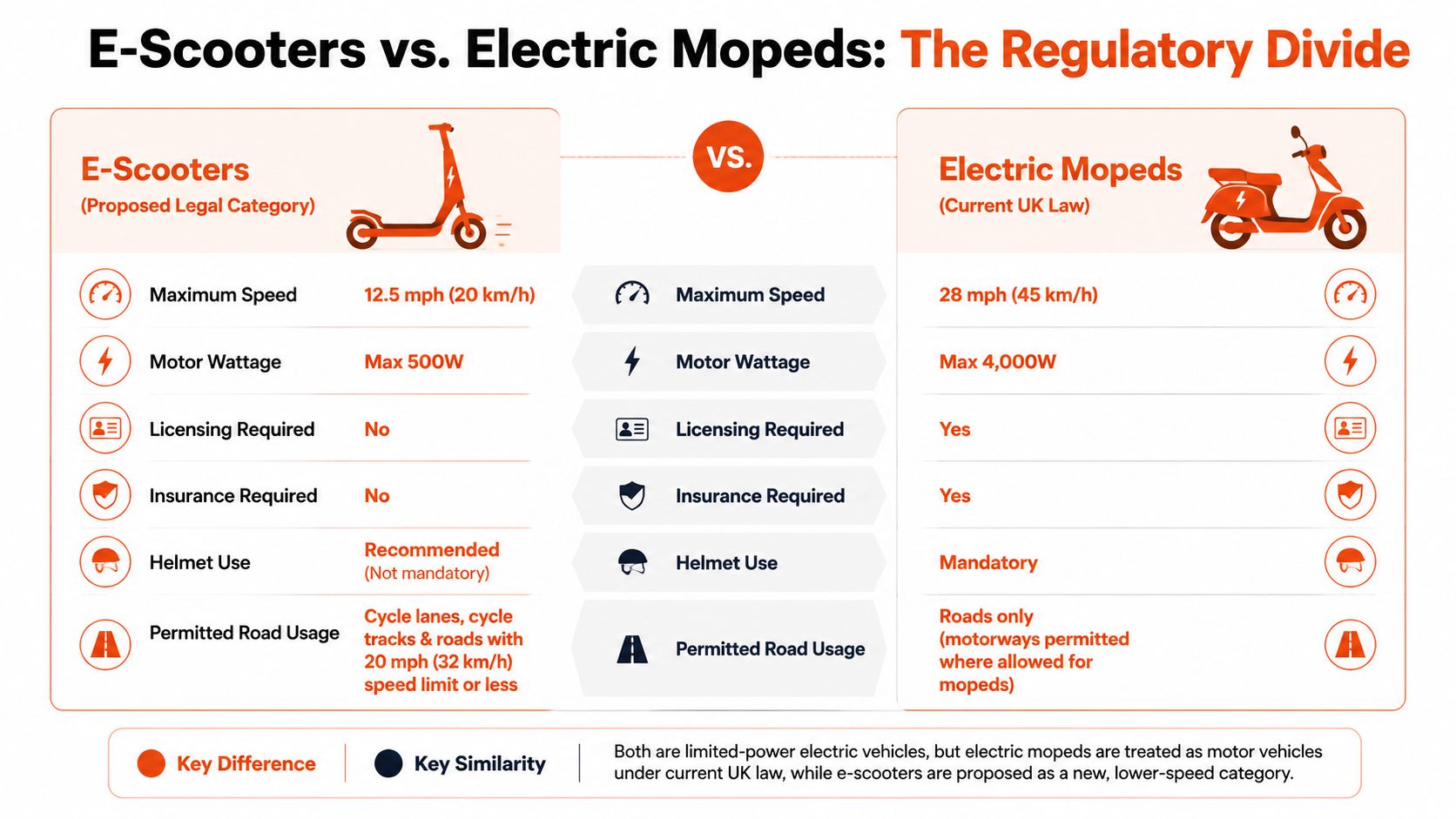
If you want a broad legal primer on moped rules and how lawmakers typically treat this category, BDISchool for moped law information is a useful comparative read, even though UK riders should always follow UK-specific requirements when buying and riding here.
New E-Scooter vs. Electric Moped What's the Difference?
| Feature | Proposed E-Scooter | Electric Moped (L1e-B) | Electric Motorcycle (L3e-A1) |
|---|---|---|---|
| Legal status | Proposed and still limited by emerging rules | Established road-legal category | Established road-legal category |
| Power profile | Expected to be low-power | Built for regular road use | Built for stronger performance and broader use |
| Top speed approach | Expected auto cut-off at 15.5 mph | Higher-capability road use | Higher-capability road use |
| Insurance clarity | Still unclear for private owners | Established route | Established route |
| Suitability for delivery work | Poor fit for serious use | Stronger fit | Stronger fit, depending on route and need |
| Commuting flexibility | Best for short, simple trips | Better for longer and mixed routes | Best for riders needing more pace and headroom |
| Upgrade path | Uncertain category development | Clear category with known requirements | Clear category with known requirements |
The proposed e-scooter class looks like a compromise vehicle. Electric mopeds and motorcycles are actual transport tools.
That's the dividing line serious riders should care about.
How the Law Change Affects You Practical Scenarios

Urban commuters
If your trip is short, flat, and local, a legalised low-power e-scooter might sound appealing. But most commuters don't live inside that perfect use case. They need reliability in mixed traffic, a safer feeling at junctions, better visibility on the road, and enough vehicle presence to handle daily travel without compromise.
A road-legal electric moped makes far more sense for that kind of routine. You're buying into an established category rather than waiting for a restricted one to settle.
- Short hops only: A low-power e-scooter may suit the station-to-office crowd.
- Mixed route commuting: A moped is the cleaner answer when your journey includes busier roads or longer urban stretches.
- Bad-weather realism: A proper moped setup with secure storage and full riding kit is more practical.
Food delivery riders
At this juncture, the gap gets brutal.
Delivery riders don't need a legal curiosity. They need something that works all day, carries kit properly, handles repeated stop-start riding, and doesn't leave them guessing about whether their insurance or vehicle use falls into a grey area.
The unresolved insurance gap around private e-scooters is a serious problem. Rental schemes include insurance, but there is still a major information gap around what privately owned e-scooter riders will need after legalisation, especially for delivery work and liability exposure (discussion of the post-legalisation insurance gap).
Reality check: If your income depends on the vehicle, don't build your work around a class that still has unanswered insurance questions.
A road-legal electric moped or motorcycle is the more rational tool for delivery because the category already supports the basics riders care about: legal certainty, route flexibility, and the ability to fit work-ready accessories such as top boxes.
Business fleets
Fleet buyers should be even more hard-headed. The question isn't whether a proposed e-scooter category sounds modern. The question is whether it gives your business fewer operational headaches.
For most businesses, the answer will be no.
A restricted e-scooter class introduces uncertainty around procurement, policy, rider training, and liability. A road-legal electric moped or motorcycle gives you a cleaner framework for operations, especially if staff are using vehicles repeatedly for deliveries, site-to-site travel, or customer-facing work.
Consider the basics:
- Compliance certainty: Settled legal categories are easier to manage than evolving ones.
- Operational capability: Businesses need transport that can do the job, not just technically move.
- Liability planning: Insurance clarity matters more than novelty.
If you're running a takeaway, florist, venue, or service fleet, stability beats experimentation every time.
Your Compliance Checklist for Buying and Riding in 2026
Buying the wrong electric two-wheeler usually starts with the wrong question. People ask, “Will this become legal soon?” The better question is, “Will this be compliant and useful for what I need to do?”
Checklist for personal buyers
Run through these before you buy anything.
Where will you ride most often?
Private land use is one thing. Daily public-road use is another. Don't blur them.How much legal certainty do you want?
If you want settled rules, look at categories already recognised for road use.What kind of journey do you make?
A short flat urban hop is very different from a cross-town commute with faster sections.Do you need carrying capacity?
If you need luggage, shopping, or work kit, a proper moped or motorcycle setup is far better.Are you buying for now or gambling on later?
Hoping future rules rescue a current purchase is risky.
Buy for the law that exists, not the one people keep predicting on social media.
Checklist for business fleets
Fleet managers should be stricter than private buyers.
- Route fit: Are your riders covering short local loops or broader delivery areas?
- Vehicle class: Does the vehicle already sit inside a recognised road-use framework?
- Insurance position: Can you arrange cover clearly for staff and business use?
- Operational equipment: Can the vehicle take boxes, racks, locks, and day-to-day accessories?
- Downtime risk: What happens if a vehicle falls into a disputed or changing compliance category?
A sensible fleet choice usually comes down to one principle. If a vehicle needs caveats, legal footnotes, and future policy guesses before it makes sense, it's probably the wrong fleet vehicle.
The Smart Choice How Flex Electric Can Help
A lot of riders are waiting for an e-scooter law change to solve a transport problem they already have. That is the wrong approach.
The proposed e-scooter class looks likely to serve a narrow use case. Short trips. Low speeds. Tight limits. For anyone commuting daily, carrying kit, covering mixed roads, or buying for work, that is a poor foundation for a serious vehicle decision.
The sensible move is to choose a road-legal electric moped or motorcycle that already fits an established category. You get a clear compliance route, a straightforward insurance position, and a machine built for real journeys rather than future legal speculation. That matters more than headline chatter about legalisation.
Flex Electric helps riders cut through that noise. We advise on electric mopeds, electric motorcycles, off-road electric motorcycles, and kids motocross bikes based on how you will use them. We also offer UK-wide delivery, finance options, and practical guidance for private buyers and businesses that need dependable electric transport now.
If you want certainty, range of use, and a vehicle you can build daily travel around, start with the class that already works under UK law. That is usually where the better long-term value sits.
Frequently Asked Questions About E-Scooter Laws
Can I ride my privately owned e-scooter on the road if law changes are being discussed?
No. Discussion is not legalisation. If you own a private e-scooter now, public-road use remains a legal risk unless and until a compliant framework is in force.
Will my current private e-scooter automatically become legal later?
Don't count on it. The expected framework points toward a low-power category with strict limits. Many current consumer models may not fit that standard.
Are rental e-scooters treated the same as privately owned ones?
No. Rental schemes operate under approved trial arrangements. That is very different from private ownership.
Should delivery riders wait for the new rules?
Not if they need a dependable work vehicle now. Delivery riders need legal certainty, insurance clarity, and practical capability. A road-legal electric moped or motorcycle is usually the safer decision.
What should I do if I already bought a private e-scooter?
Use it only where it's lawful, which means private land with permission. Don't assume a future announcement will validate your current setup.
Is a legalised e-scooter likely to replace a moped for serious transport?
For most serious riders, no. The proposed class looks too limited for many real commuting and work demands.
If you want clear advice on the right electric two-wheeler for commuting, delivery work, or fleet use, speak to Flex Electric. They specialise in already-legal electric mopeds and motorcycles, plus off-road electric motorcycles and kids MX bikes, and they'll tell you plainly what fits your needs and what doesn't.
Find us
You will find us at 74 Dalry Road, Edinburgh, EH11 2AY
Showroom Opening Times:
Monday: By Appointment
Tuesday to Friday: 11am - 5:00pm
Saturday: 10am - 5pm
Sunday: By Appointment
