
Enduro Bikes 125cc: The Complete UK Learner's Guide 2026
Flex Electric
The UK's #1 Electric Moped and Electric Motorbike dealer.

You're probably in the same spot as most first-time buyers looking at enduro bikes 125cc. You want one machine that won't empty your bank account, won't scare you on day one, and won't feel useless once you've got a bit of confidence. It needs to cope with the weekday ride into town, then still make sense when you fancy a muddy lane, a farm track, or a bit of off-road practice at the weekend.
For years, the obvious answer was a petrol 125cc enduro. Tall stance, proper dirt-bike looks, road kit bolted on, and just enough versatility to feel like you'd bought a motorcycle that could do a bit of everything. That appeal is real. I get it.
But if you're buying in the UK now, I think a lot of riders are asking the wrong question. They ask which petrol 125 enduro to buy, when they should really be asking whether a 125cc-equivalent electric motorcycle would suit them better. For commuting, learning, and low-cost off-roading, I'd say electric often makes more sense.
The Allure of One Bike for Road and Trail
A lot of riders start with the same fantasy. One bike. One insurance policy. One set of keys. You ride it to work, park it outside college, use it for local errands, then head out on Sunday and get it properly dirty.
That's exactly why 125cc enduro bikes have stayed popular for so long. They look adventurous, they sit taller than a road bike, and they promise freedom without demanding a huge budget or years of riding experience. For a learner, that's hard to ignore.
There's also something honest about them. A petrol 125 enduro doesn't pretend to be a race bike or a luxury bike. It's a basic, usable motorcycle that says yes to rough roads, bad weather, and amateur mistakes. Plenty of people need that more than they need headline speed.
A first bike should make you want to ride more, not make you worry about dropping it, scratching it, or stalling it at every junction.
The catch is that the traditional answer isn't always the smartest answer anymore. Petrol 125s still work, but they come with noise, servicing, fuel stops, and a lot of mechanical compromise. If your main goals are commuting, learning, and affordable fun off-road, electric now solves several of those problems in one go.
That doesn't mean petrol is dead. It means you should stop assuming it's automatically the right choice.
What Defines a 125cc Enduro Bike
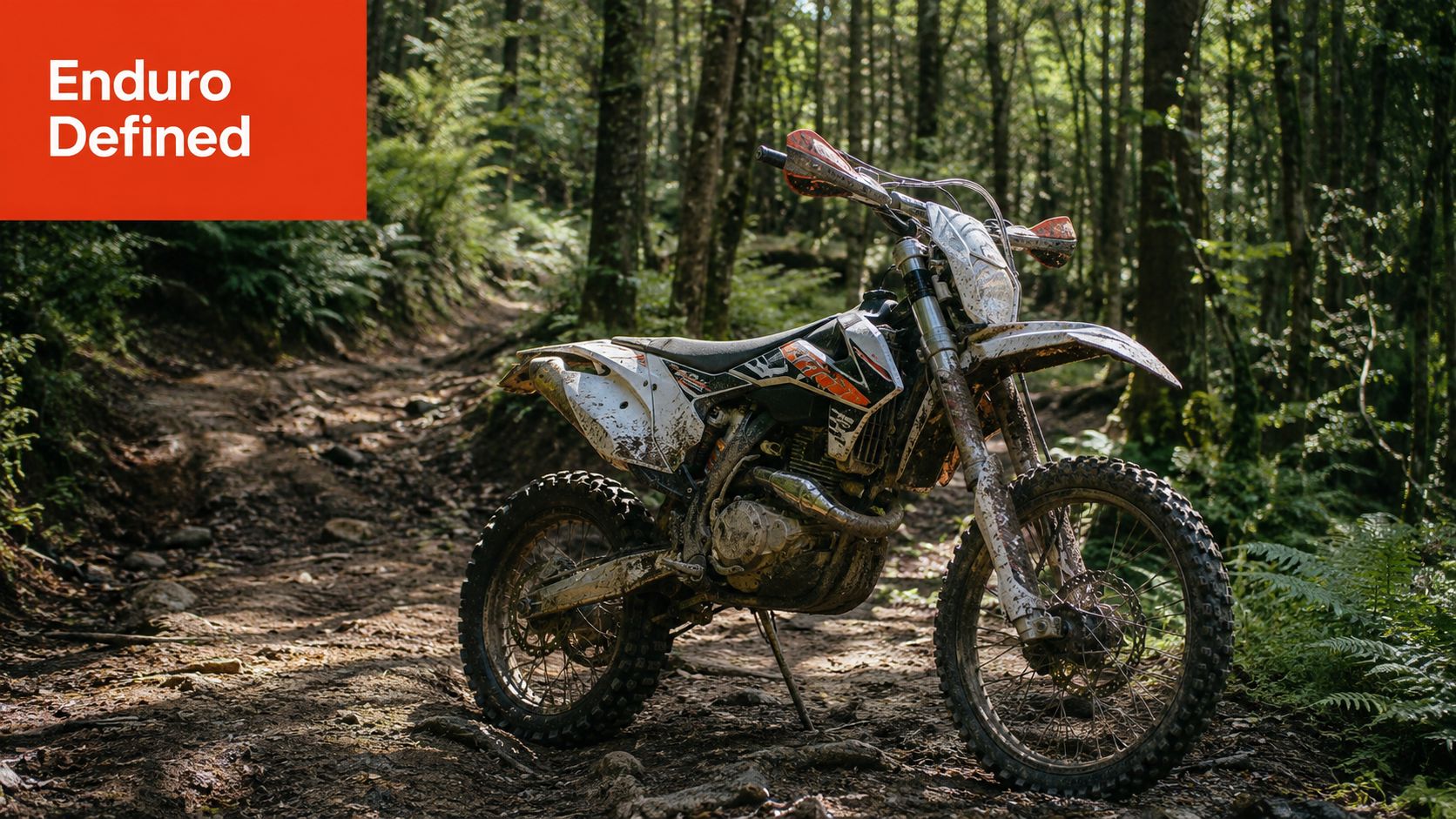
A 125cc enduro bike is basically a road-legal off-road motorcycle with enough practical equipment to survive normal public-road use. That's the simple version. It's not a pure motocross machine, and it's not just a small commuter with chunky tyres.
Built for compromise in a good way
The whole point of an enduro is balance. You get long-travel suspension, more ground clearance, and tyres that can cope with loose surfaces, but you also get the parts needed for legal road use such as lights, mirrors, and a registration plate. That mix is the appeal.
Think of it this way:
- A road bike is happiest on tarmac and usually feels sharper and calmer there.
- A motocross bike is a specialist tool for closed-course dirt riding.
- An enduro bike sits in the middle and accepts that it won't be perfect anywhere, but it'll be useful in more places.
That's why beginners like them. They forgive rough surfaces better than many road-focused 125s, and they feel more adventurous even at modest speeds.
How it differs from motocross and trail bikes
People often lump everything with high mudguards into one category. That's a mistake.
A motocross bike is like a track sprinter. It's focused, intense, and built for a specific job. A simple trail bike is more relaxed. It's the bike you want for casual off-road plodding and easy-going riding. An enduro bike sits closer to the serious off-road side, but with a practical streak.
The classic signs you're looking at an enduro-style machine are:
- Suspension travel: It's there to absorb ruts, rocks, and rough tracks.
- Tyre choice: Usually more aggressive than a road bike, but still chosen with mixed use in mind.
- Riding position: Upright, roomy, and easy to control when standing on the pegs.
- Road equipment: Lights and legal kit matter because many buyers want road access too.
Practical rule: If the bike only makes sense on a closed dirt track, it isn't the kind of machine most UK learners are really searching for when they type in enduro bikes 125cc.
That's also where electric alternatives have become interesting. They can give you the same upright stance, low-speed control, and dual-purpose feel, without copying the old petrol formula exactly.
UK Licence Rules for Riding a 125cc Bike
If you're in Britain, this matters more than horsepower charts or styling. A bike can look perfect online and still be the wrong choice if you can't legally ride it the way you plan to use it.
What learner legal actually means
In the UK, the 125cc class is a long-established entry point for road riders and learners because category A1 motorcycles are limited to 125 cm³, 11 kW (14.75 hp), and a power-to-weight ratio of 0.1 kW/kg, with a minimum age of 17, as noted in this summary of UK A1 class limits and learner rules. That's why the phrase learner legal matters so much when you're shopping.
A lot of riders looking for enduro bikes 125cc don't need a competition machine. They need something they can ride on public roads under learner rules, then maybe use for light off-road fun where legal and appropriate. That's a completely different buying decision.
The biggest mistake I see is people shopping by appearance. Tall seat, knobbly tyres, rally-style bodywork. Fine. But if it doesn't fit your licence position, it's the wrong bike.
The simple route most riders take
Most first-time riders want the shortest clear answer possible. Here it is.
- Get your provisional entitlement sorted
You need the correct entitlement in place before you start riding on the road. - Complete CBT
For many new riders, this is the practical first step that gets them onto a suitable learner machine. - Ride within learner restrictions
The road-legal, learner-appropriate 125 market is most important for learner riders. - Move to full A1 if it suits your plans
That route is there for riders who want to ride a 125 without learner plates and with the added freedom that comes with the licence.
The licence path is easier to understand visually:
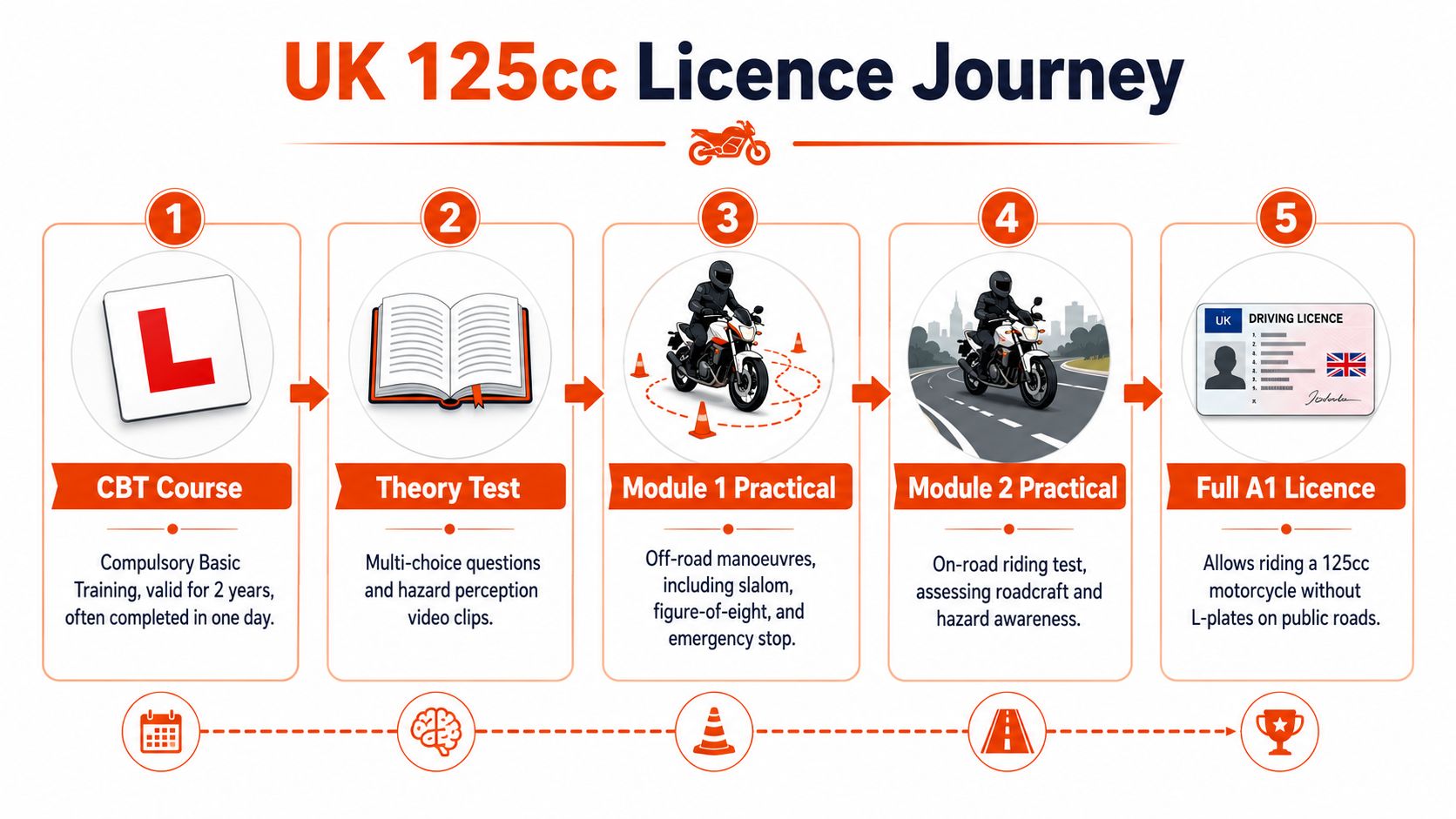
What matters for your buying decision is simple. If you're a learner, don't just ask whether a bike is “about 125”. Ask whether it fits UK learner use in a road-legal form. That's why many shoppers end up better served by 125cc-equivalent electric motorcycles or mopeds built specifically around UK everyday riding needs, rather than by petrol off-road bikes that only sort of fit the brief.
Most buyers don't want a licensing puzzle. They want a bike they can ride legally, charge or fuel easily, and trust on Monday morning.
There's also a clear gap in a lot of online advice. Much of the existing content around this topic skips the basic UK question of legality and practical use, even though that's exactly what first-time buyers usually need answered, a problem highlighted in this discussion of the UK learner-legality information gap for 125cc enduro searches.
Petrol 125cc Performance and Running Costs
Petrol 125s deserve an honest assessment. Not a romantic one.
What the performance feels like in real life
For enduro-style riding, a 125cc bike typically sits in the 45–70 mph range, with two-stroke versions often reaching 65–70 mph and producing around 15–30 hp, while four-stroke trail models are usually closer to 8–15 hp, according to this overview of typical 125cc enduro speed and power. That tells you a lot before you've even thrown a leg over one.
In plain English, a petrol 125 enduro is usually fine in town, fine on slower roads, and decent fun in the dirt. It's not the bike I'd choose for repeated fast-road slogs if I had a better option. Small-capacity engines can feel busy, especially when you're asking them to hold pace for longer stretches.
That doesn't make them bad. It just means you need realistic expectations. A learner who thinks a petrol 125 enduro will feel relaxed everywhere usually finds out otherwise pretty quickly.
The costs people forget about
The purchase price is only part of the story. Petrol ownership comes with a list of ongoing jobs and little annoyances that new riders often underestimate.
- Engine servicing: Oil changes, filters, and routine checks don't disappear because the bike is small.
- Wear items: Chains, sprockets, and consumables still need attention.
- Fuel stops: They're normal with petrol, but they're still time and money.
- Mechanical fuss: Cold starts, vibration, and general tinkering come with the territory.
Some riders enjoy that. If you like spannering, a petrol 125 can be part hobby, part transport. But if you want a machine that works with as little fuss as possible, the old-school petrol setup starts to look less charming.
A petrol 125 enduro makes the most sense if you enjoy the engine as much as the riding. If you only care about getting on and going, electric is usually the cleaner answer.
There's another issue. Many first-time buyers look at raw top speed and miss how they'll use the bike day to day. Tight junctions, stop-start traffic, muddy climbs, awkward low-speed turns, short hops. Those situations often reward smooth delivery and easy control more than they reward a peaky little engine.
That's where electric starts to pull ahead.
The Electric Enduro A Modern and Smarter Choice
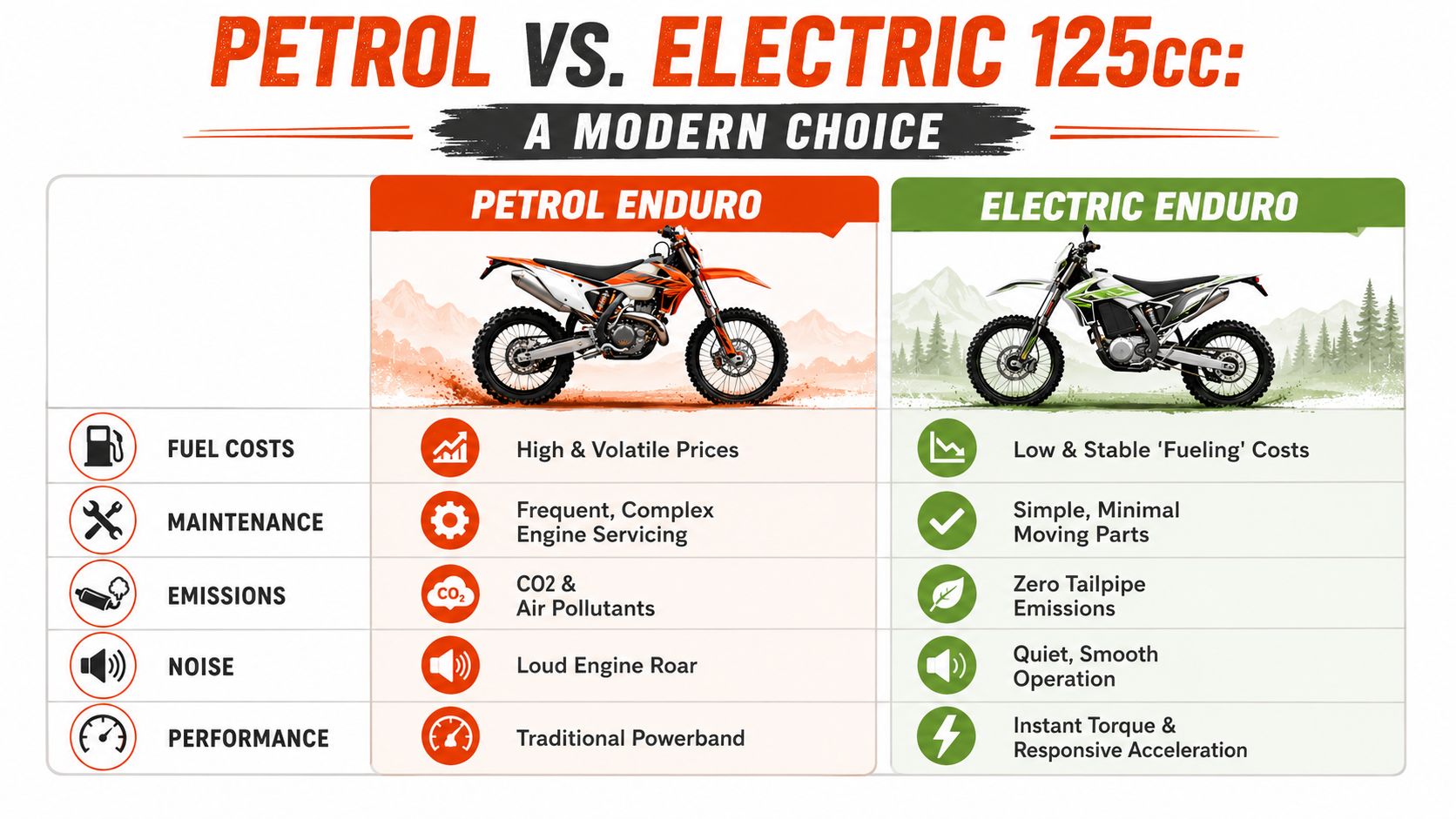
If your plan is commuting, learning, and affordable off-road fun, I'd steer you toward an electric 125cc-equivalent motorcycle before I'd push you toward a traditional petrol 125 enduro.
Why electric suits new riders
The strongest argument for electric isn't image or novelty. It's ease.
A learner doesn't need more complication. They need predictable control, less maintenance stress, and a bike they'll readily use. Electric gives you that in a very direct way. Twist and go. No gear changes to juggle. No stalling at a busy mini-roundabout. No peaky engine that only feels happy in a narrow part of the rev range.
For low-speed riding, off-road practice, and urban commuting, that's a big deal. Instant drive at the point you ask for it makes a bike feel calmer and more responsive. New riders usually gain confidence faster when the machine isn't fighting them.
Here's a good example of the broader electric riding style in action:
Where electric makes the biggest difference
The biggest wins are practical, not theoretical.
- Maintenance is simpler: You're not dealing with the same engine servicing routine as a petrol machine.
- Running costs are easier to live with: Charging is generally less painful than feeding a thirsty little bike with regular petrol stops.
- Noise is lower: That matters in built-up areas and for casual riding where you don't want to announce yourself everywhere.
- Control is better at low speed: This is huge for learners and very useful off-road.
- The experience feels modern: Smooth, direct, and less fussy.
I'm not saying electric is perfect for every rider. If you want the full traditional motorcycle ritual, the sound, the shifting, the mechanical character, petrol still has its place. But for the actual jobs most buyers have in mind, electric often does the job better.
That's especially true if your riding falls into one of these groups:
Rider typeBetter fitUrban commuterElectric, because simplicity and low day-to-day hassle matter more than petrol characterNew learnerElectric, because smooth take-up and reduced complexity build confidenceCasual off-road riderElectric, because quiet operation and easy control make practice less intimidatingTraditional enthusiastPetrol can still appeal if engine feel is part of the point
If you're buying with your head rather than nostalgia, electric deserves to be top of your shortlist.
Your Buying Checklist New Electric vs Used Petrol
The comparison of enduro bikes 125cc often leads to a choice between a used petrol machine with unknown history and a new electric bike with dealer backup.
Those are not equal-risk purchases.
When used petrol still makes sense
A used petrol 125 can work if you know what you're looking at. It helps if you've got mechanical confidence, a trusted seller, or someone experienced to inspect it with you.
Check these points carefully:
- Service history: Gaps matter. A cheap bike gets expensive fast when neglected maintenance shows up later.
- Signs of hard off-road use: Scrapes and cosmetic wear are one thing. Hidden damage is another.
- Cold-start behaviour: Problems often show themselves when the engine isn't already warm.
- Paperwork and road legality: Don't assume anything. Verify it.
There's also a technical point many buyers miss. In UK learner-focused enduro-style bikes, tuning is often shaped more by licence limits and practical setup than by displacement alone. This summary of learner-legal 125cc tuning, torque and gearing priorities notes that many bikes in this space prioritise tractable midrange torque and low mass over peak output. That's exactly why chasing bragging rights on paper is usually a waste of time.
Why new electric is the safer buy for most beginners
For a first-time buyer, I think new electric is usually the more sensible move.
You're reducing the number of things that can go wrong, and that matters when you don't yet know what “normal” is supposed to feel like on a bike. You also get a cleaner ownership experience from day one.
A good buying checklist for a new electric motorcycle or off-road electric bike looks like this:
- Warranty cover: Flex Electric supplies bikes with a 2-year parts warranty and 3-year battery warranty, which gives a new rider far more certainty than a random used advert.
- Pre-delivery inspection: That matters because beginners shouldn't be debugging a bike in their first week.
- Finance options: Useful if you'd rather spread the cost than gamble on the cheapest petrol bike you can find.
- After-sales support: If something confuses you, you can ask someone who knows the product.
Buy your first bike for reliability and ease, not for pub-talk horsepower.
That last point is more significant than commonly understood. Confidence comes from riding, not from owning a machine that spends half its time waiting for parts or attention.
Find Your Perfect Electric Ride at Flex Electric
You search for a 125cc enduro because you want one bike that can handle the weekday ride to work and a muddy lane at the weekend. Fair enough. For a UK learner, though, the smarter answer is usually not an old petrol trail bike. It is an electric 125cc-equivalent that gives you easier ownership, quieter running, and far less fuss.
Flex Electric is a sensible place to start. Check the 125cc-equivalent electric motorbike range if you need a road-legal learner machine. Check the adult off-road bikes if your plan is private-land riding and low-cost fun in the dirt. That split makes choosing much easier, and it keeps you focused on what you will use.

My advice is simple. Buy for your real riding life, not the fantasy version of it.
If you need dependable transport, look at electric motorbikes and mopeds built for UK roads. If you want a bike for fields, tracks, and casual weekend riding, focus on off-road electric motorcycles and kids motocross bikes for family use. Skip the electric bicycle section if you are comparing it with a 125 enduro. It is a different category and solves a different problem.
A good first bike should be easy to ride, easy to charge, and easy to live with. That is exactly why electric makes so much sense for commuters, learners, and riders who want the fun part of off-roading without the usual petrol hassle.
If you want straight advice on a 125cc-equivalent electric motorcycle, moped, off-road electric motorcycle, or kids MX bike, have a look at Flex Electric. You can browse the range, compare finance options, and speak to a team that deals with UK riders every day.
Find us
You will find us at 74 Dalry Road, Edinburgh, EH11 2AY
Showroom Opening Times:
Monday: By Appointment
Tuesday to Friday: 11am - 5:00pm
Saturday: 10am - 5pm
Sunday: By Appointment
