
Your Guide to a Full UK Motorcycle Licence for Electric Motorbikes in 2026
Flex Electric
The UK's #1 Electric Moped and Electric Motorbike dealer.

Thinking about getting your full UK motorcycle licence so you can ride an electric motorbike? It can feel like a maze of rules and tests, but honestly, it’s a straightforward process once you know the steps.
This guide is designed to be your roadmap. We’ll walk through the entire journey together, from your first taste of two wheels at the Compulsory Basic Training (CBT) all the way to ripping up your L-plates for good.
Your Path To A Full UK Motorcycle Licence
We're going to break down every stage, covering the paperwork you’ll need, how much you should budget, and what a realistic timeline looks like. Whether you're a total beginner with your eye on a nippy electric moped or a seasoned rider ready to unlock the power of a high-performance electric motorbike, this is where it all begins.
Think of it as a series of milestones. Each one is there to build your skills and, just as importantly, your confidence on the road. The end goal? That incredible feeling of freedom you only get on two wheels.
Why Go Electric for Your Licence?
Choosing an electric motorcycle for your training and tests is a smart move, and it's becoming a popular one. From my experience, learners often find electric motorbikes much easier to get to grips with, especially under the pressure of a test.
- No Gears, No Fuss: Nearly all electric motorbikes are automatic. This is a game-changer. It means you can forget about clutch control and gear changes, and instead pour all your focus into what really matters: your road positioning, spotting hazards, and mastering the test manoeuvres.
- Smooth, predictable power: An electric motor gives you instant, smooth torque. This makes those tricky slow-speed exercises, like the figure-of-eight and U-turn, feel surprisingly stable and much less intimidating than on a juddery petrol motorbike.
- Quietly Confident: The silent hum of an electric motorbike means you can hear your instructor’s directions clearly. More importantly, you're more tuned in to the sounds of traffic around you, boosting your awareness.
It's crucial to remember that the process for getting a full UK motorcycle licence is identical for both petrol and electric motorbikes. The key difference? If you pass your test on an automatic electric motorbike, your licence will have an ‘A’ restriction, limiting you to automatics. For the electric market, that's no restriction at all.
What Does The Journey Look Like?
From your first day in a training school car park to passing your final on-road test, the entire system is designed to make you a safe, competent rider for life. It's not just about ticking boxes to pass an exam.
We'll dive into the different licence categories and how your age dictates your route. For example, a 16-year-old can start on an electric moped, while someone over 24 could use the Direct Access Scheme (DAS) to go straight for a full, unrestricted licence, opening the door to the most powerful electric motorbikes on the market.
We’ll even touch on the rules for kids' electric motocross bikes, which don't need a licence as long as you're on private land.
Consider this your definitive guide. It’s here to help you plan your training, manage your budget, and walk into your tests feeling prepared and confident. Let’s get you on the road.
Choosing Your Licence Category and Access Route
Getting your head around the different routes to a full UK motorcycle licence can feel a bit confusing at first. The path you take really boils down to two things: your age and the kind of electric motorbike you want to ride. Nailing this choice from the get-go is crucial, as it saves you from heading down a dead-end road, wasting both time and money.
The whole system is built around a simple idea: you learn the ropes and build confidence on smaller, less powerful motorbikes before you can legally jump on the really powerful electric motorcycles.
The Progressive Licence Path
For most new riders, getting a full licence is a journey you take in stages. Think of it like levelling up in a game—each licence tier you pass unlocks more power and fewer restrictions, and it’s all tied to your age and how long you've been riding.
This progressive approach is a cornerstone of UK motorcycle licensing. While there are around 5 million people with a full motorcycle licence, the journey to get one is deliberately stricter than for a car. You can see how this breaks down across different regions and age groups in research from the Road Safety Knowledge Centre.
No matter which licence you're aiming for, there are three key milestones everyone has to hit. This flowchart gives you a bird's-eye view of the whole process.
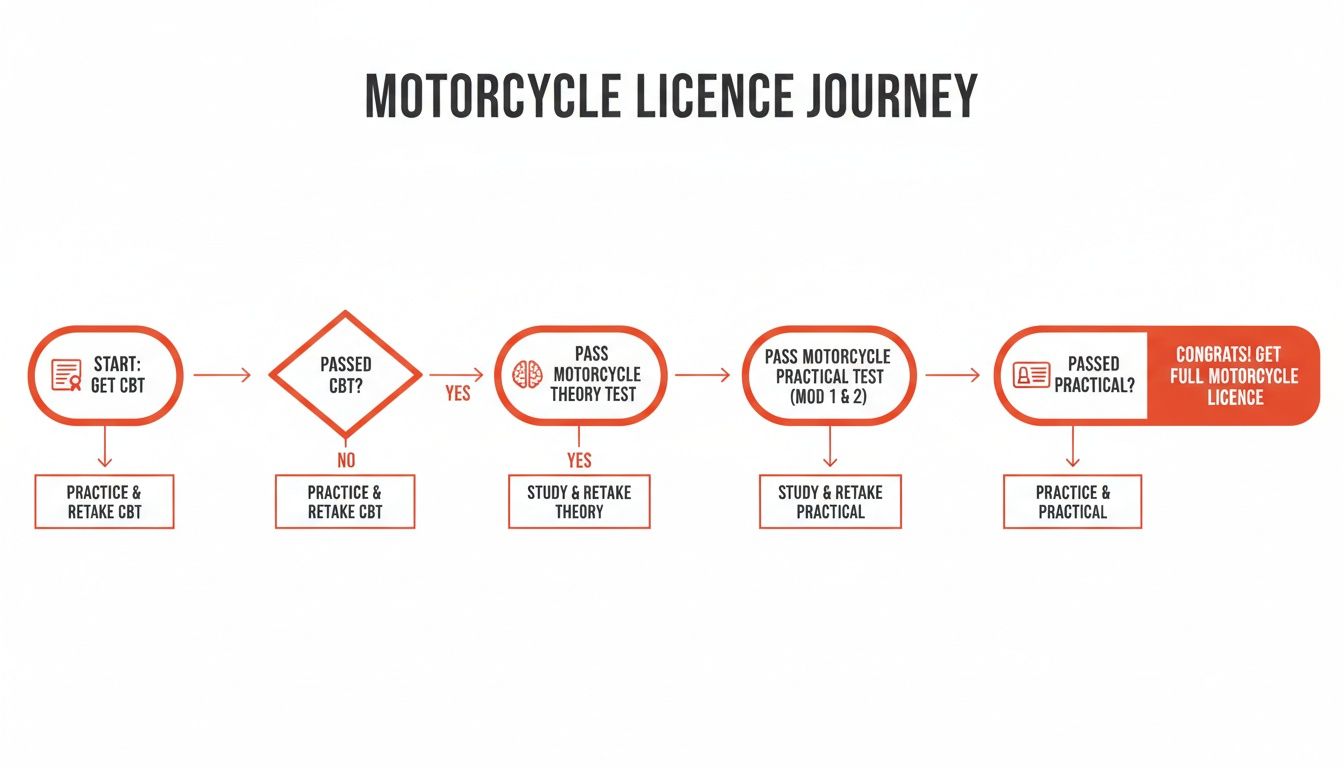
As you can see, the core components—CBT, theory test, and the two-part practical test—are the same for everyone. It's the motorbike you take your test on, and what you can ride afterwards, that changes.
Understanding the Licence Categories
So, what does this look like in practice? Your age is the main factor determining which licence category you can go for.
Category AM Licence (16+)
- This is where the journey starts for 16-year-olds.
- It lets you ride an electric moped that can't go faster than 28 mph.
- Once you’ve passed your theory and practical tests, you can take off your L-plates and even carry a passenger.
Category A1 Licence (17+)
- At 17, you can step up to the A1 licence.
- This opens the door to electric motorcycles with a power output of up to 11kW (roughly the same as a 125cc petrol motorbike).
- Passing this means you're free to ride on motorways and you won't need L-plates anymore.
Category A2 Licence (19+)
- The A2 is your ticket to medium-sized electric motorbikes up to 35kW.
- You can get this at 19, either by upgrading after two years on an A1 licence or by starting from scratch at this age.
- It's a really popular choice, offering a decent power boost without having to wait until you're 24.
Expert Tip: If you take the progressive route, remember the two-year rule. You need to hold a licence for two years before you can take the practical test for the next category up. For example, if you have an A1 licence, you can take your A2 test at 19. If you have an A2, you can take your full Category A test at 21.
The Direct Access Scheme (DAS)
But what if you're a bit older and have your eye on a high-performance electric motorbike right away? That's where the Direct Access Scheme (DAS) comes in. It’s the fast track to a full, unrestricted licence.
If you’re 24 or over, you can skip the progressive stages entirely. You'll still need to complete your CBT and theory test, but all your practical training and tests (Module 1 and Module 2) will be on a proper, big motorbike—an electric motorcycle with at least 50kW of power.
Pass the DAS, and you'll walk away with a full Category A licence straight away. This means you can legally ride any electric motorcycle on the market, with no power restrictions. From a nimble city commuter to a top-spec model like a LiveWire or a Vmoto Stash, the choice is yours. For many who discover two wheels later in life, the DAS is by far the most direct and popular route.
Your First Steps: The CBT and Theory Test
Every rider's journey towards a full UK motorcycle licence kicks off with two key milestones: your Compulsory Basic Training (CBT) and the theory test. Don't think of these as annoying hurdles to jump over. Instead, see them as your official welcome to the world of motorcycling, where you’ll build the essential skills and knowledge to ride with confidence.
Before you can even dream about booking your full practical tests, that CBT certificate is non-negotiable. It’s the starting line for everyone.
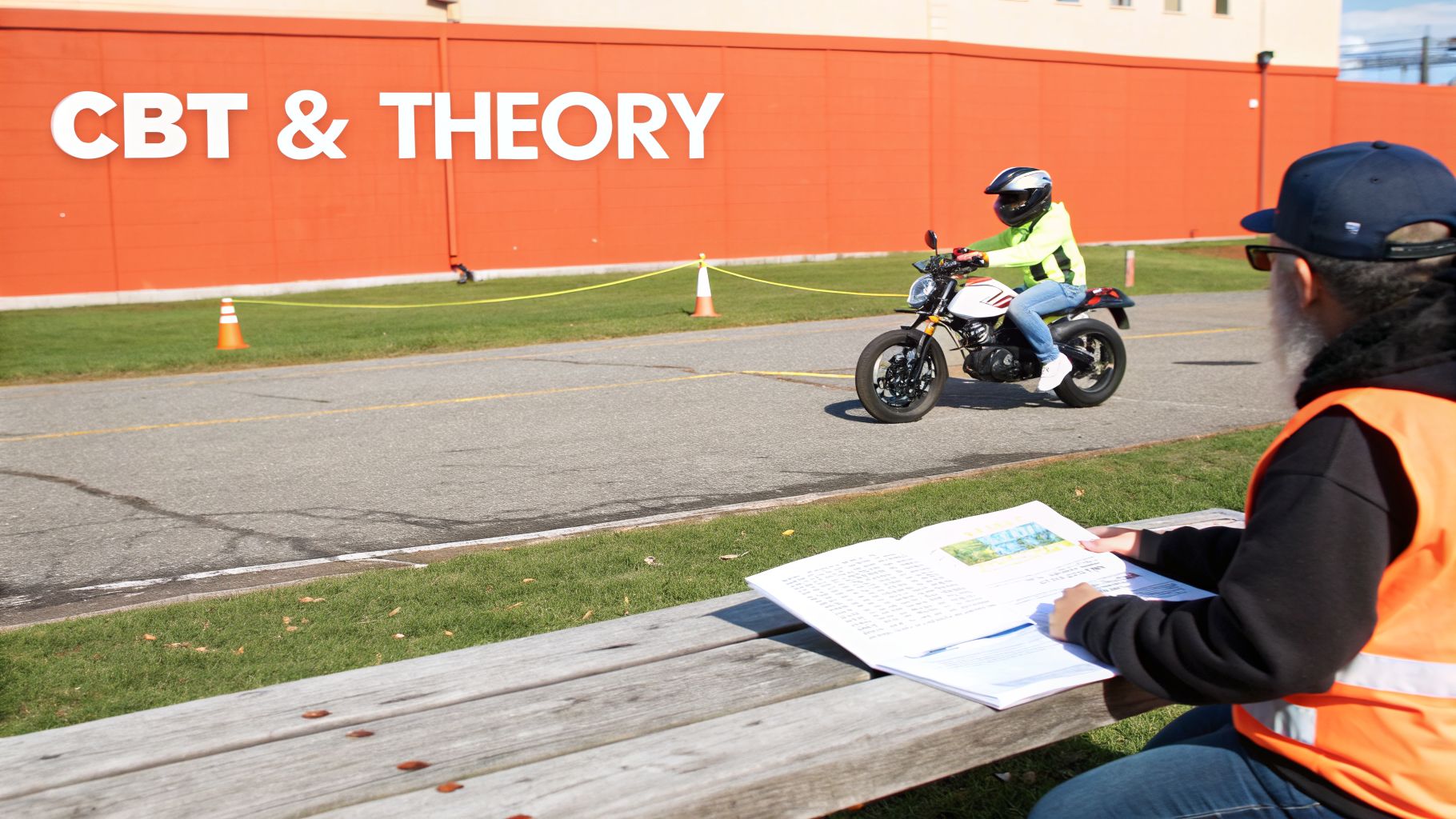
What to Expect on Your CBT Day
Right, let's get one thing straight: the CBT is not a test you can pass or fail. It’s a day of training, pure and simple. The whole point is to make sure you can handle a motorbike safely on your own before you're let loose on the roads. It takes a full day and is split into five distinct parts.
The introduction of Compulsory Basic Training back in 1990 was a game-changer for rider safety. It’s easy to forget how bad things were before then. In the early 1980s, the UK was seeing over 20,000 serious motorcycle injuries and more than 1,000 deaths every single year. After the CBT became mandatory, deaths halved by 1991 alone, showing just how vital this basic training is. You can read more about the history of CBT and its impact on rider safety at Phoenix Motorcycle Training.
So, what does the day involve? It’s broken down like this:
- Introduction and Eyesight Check: A classroom chat about gear and safety, plus a quick check to see if you can read a number plate from 20 metres away. Simple.
- On-Site Training: Time to get acquainted with your motorbike. You'll learn the controls, how to get it on and off the stand, and how to wheel it around.
- On-Site Riding: Now for the fun bit! You’ll start riding in a safe, off-road area. It’s all about slow control, smooth braking, and getting the hang of the throttle and brakes on an electric motorcycle.
- On-Road Training: It's back to the classroom for a vital briefing on road positioning, the law, and how to stay safe in traffic.
- On-Road Riding: This is what it's all been leading up to. You’ll spend at least two hours on public roads with an instructor talking to you via radio, proving you can handle yourself in the real world.
Once your instructor is happy that you've got the hang of it, they'll issue your CBT certificate (the DL196). This is your ticket to ride an electric moped or a 125cc-equivalent electric motorcycle on the road with L-plates for two years.
Getting to Grips with the Motorcycle Theory Test
With your CBT certificate proudly in hand, the next target is the motorcycle theory test. You absolutely have to pass this before you can book your practical Module 1 and Module 2 tests. It’s a computer-based exam at an official test centre, designed to check you have the theoretical knowledge needed to be a safe rider.
The test comes in two parts, and you have to pass both on the same day to get your certificate.
A common pitfall is underestimating the theory test. Lots of people think it's just common sense, but with a pass rate hovering around 44%, it's clear that dedicated revision is essential. Don't get caught out.
Part 1: The Multiple-Choice Questions
- You get 57 minutes to answer 50 questions.
- The pass mark is 43 out of 50.
- The questions cover everything from The Highway Code and road signs to riding techniques and basic motorcycle maintenance.
Part 2: The Hazard Perception Test
- This is all about spotting potential dangers early.
- You’ll be shown 14 video clips of everyday road scenes.
- You score points by clicking the mouse as soon as you see a "developing hazard"—something that would make you take action as a rider. One of the clips has two hazards to spot.
- You can get up to 5 points for each hazard. The pass mark here is 44 out of a possible 75.
Your theory test pass certificate is valid for two years. That gives you a two-year window to get both your Module 1 and Module 2 practical tests passed. If it expires, you’re back to square one—you’ll have to take and pass the theory test all over again.
Mastering Your Module 1 and Module 2 Practical Tests
You’ve got your CBT certificate and your theory test pass certificate tucked away safely. Now for the final hurdle: the two-part practical motorcycle test. This is where all the practice pays off, proving you have the skills to be a safe and confident rider on UK roads.
The whole thing is split into two separate tests, and you'll often take them on different days. First up is Module 1 (the off-road bit), and then comes Module 2 (the on-road assessment). You have to pass Mod 1 before you're even allowed to book Mod 2, so let's start there.
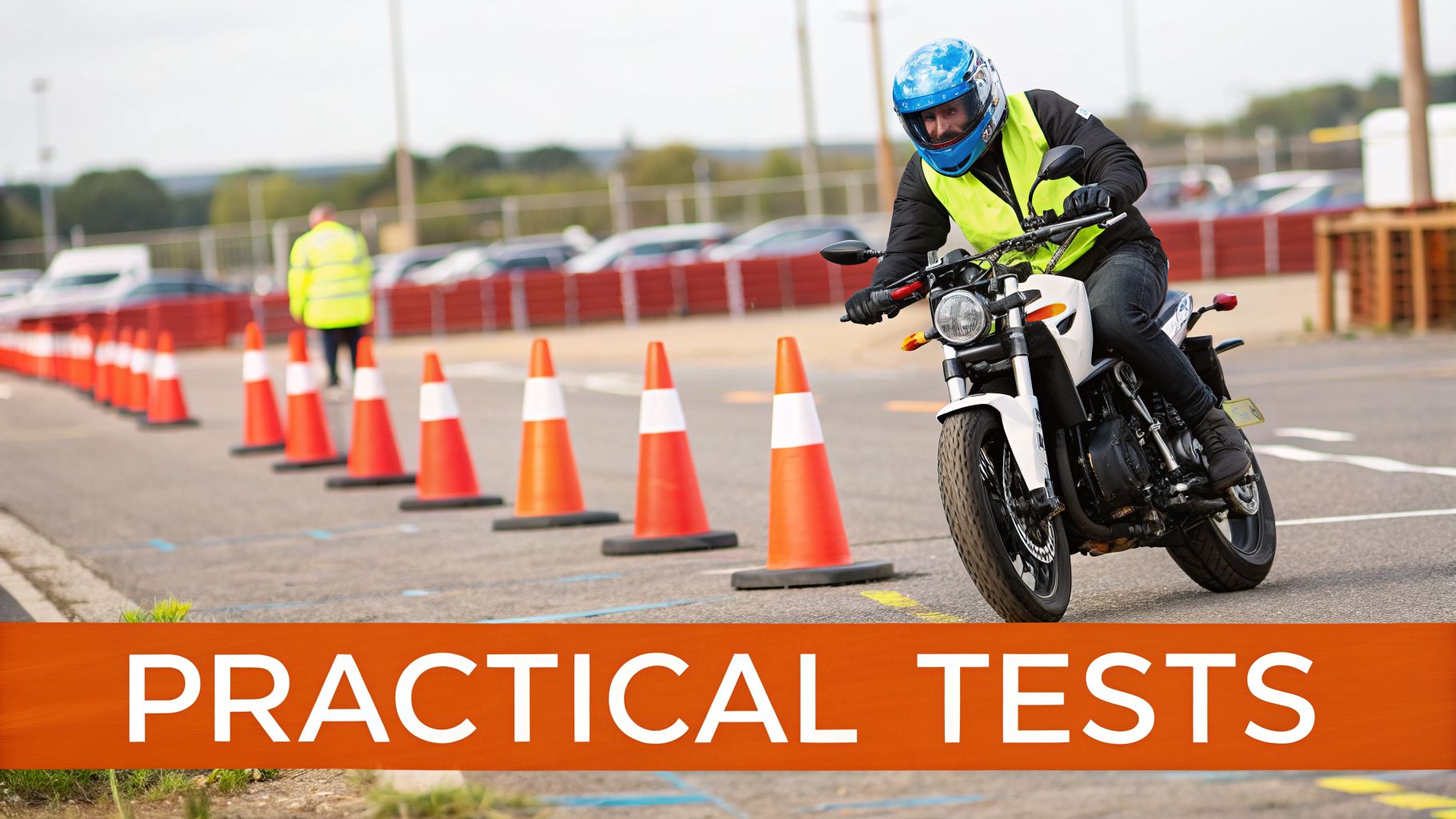
Conquering Module 1: The Off-Road Manoeuvres
Module 1 all happens in a dedicated off-road space called a Motorcycle Manoeuvring Area (MMA). Think of it as a closed-off car park filled with orange cones. It’s designed purely to test your control over the motorcycle, both at walking pace and higher speeds, with no traffic to worry about.
If you’re taking your test on an electric motorcycle, you have a real head start here. The instant, smooth power and lack of a clutch make those tricky slow-speed exercises like the figure-of-eight and U-turn much less daunting. You can put all your focus on balance and steering, without the fear of stalling or lurching.
Here’s a rundown of what the examiner will ask you to do:
- Wheeling the motorbike and using the stand: This is just to show you can handle the bike's weight safely when you're not riding it.
- Slalom and figure-of-eight: A classic test of low-speed control. The golden rule here is to keep your head up and look where you want to go—not at the cone right in front of you.
- Slow ride: You'll be asked to ride as slowly as possible, simulating crawling in traffic. It’s a piece of cake on an electric motorcycle with its perfect throttle response.
- U-turn: A tight turn in a marked area. Observation is everything. You absolutely must perform a good look over your shoulder (a 'lifesaver' check) before you start the turn.
- Cornering and controlled stop: You’ll ride a curve and bring the motorcycle to a stop smoothly inside a marked box.
- Cornering and emergency stop: Same curve, but this time you’ll be doing a full-on emergency stop when the examiner signals. Be ready for it.
- Cornering and hazard avoidance: You’ll come through the curve at a minimum speed of 31 mph / 50 kph and then swerve to avoid a cone that represents a hazard. This tests your reaction time and ability to keep the motorbike stable under pressure.
A huge number of people fail Mod 1 for one simple reason: not hitting the minimum speed on the hazard avoidance or emergency stop. Don't be shy with the throttle. Your instructor will have practiced this with you, so you know exactly what 31 mph feels like. Trust your training and give it enough juice.
Excelling in Module 2: The On-Road Test
Once Mod 1 is in the bag, it’s time for the main event. Module 2 is your chance to show the examiner you can apply all your skills in the real world. You’ll be on the road for around 40 minutes, with an examiner following either on their own motorcycle or in a car, giving you instructions through a one-way radio.
The examiner isn't just checking if you can follow directions. They're assessing your entire approach to riding—your awareness, your decisions, and your ability to anticipate what other road users might do.
What the Examiner is Really Looking For:
- Observation: This is the big one. Are you constantly scanning for hazards? Are you using your mirrors effectively and, crucially, are you doing your shoulder checks (lifesavers) before moving off, changing lanes, or turning? They will be watching for this constantly.
- Road Positioning: Good positioning makes you visible and safe. This means holding a 'commanding' position in your lane (not hugging the kerb), moving to the correct side for junctions, and giving other vehicles plenty of space.
- Independent Riding: For about 10 minutes, the radio will go quiet. The examiner will ask you to follow road signs to a particular destination. This is to see if you can navigate and ride safely on your own initiative, without being told every single turn to make.
- Appropriate Speed: Safe riding isn't just about going slow. The examiner wants to see you make good progress, keep up with traffic flow when it's appropriate, and ride confidently at the speed limit when conditions allow.
Nailing both modules is the final achievement on your journey to a full UK motorcycle licence. It’s the moment all your training comes together, proving you have the skills and mindset to enjoy a lifetime of safe riding.
Costs, Timelines, and the Paperwork Mountain
Getting your full UK motorcycle licence isn't just about what happens on the road; a big part of the journey is managing the budget, the schedule, and the paperwork. If you get your head around these practicalities from day one, you’ll save yourself a lot of headaches and unexpected costs down the line.
So, what's this all going to set you back? While some fees are set in stone by the government, the biggest variable is training. Your final bill will depend on where you live, the school you choose, and frankly, how quickly you get the hang of it.
A Realistic Look at the Costs
Let’s talk money. All in, you should budget for somewhere between £700 and £1,500 to get your full licence. That might sound like a wide range, but it all comes down to how much time you need with an instructor.
Here’s where your money will go:
- Provisional Licence: Your first official step. Applying online costs £34.
- Compulsory Basic Training (CBT): This day-long course is your gateway to riding on the road. Expect to pay between £120 and £180, depending on the training school and whether you're hiring a motorbike and gear.
- Motorcycle Theory Test: A fixed government fee of £23.
- Practical Test Fees: The practical test is split into two parts. Module 1 is £15.50, and Module 2 will cost you £75 for a standard weekday slot. If you need an evening or weekend test, that goes up to £88.50.
- Riding Lessons: This is the big one. Professional instruction typically runs from £35 to £50 an hour. Most riders find they need 10 to 20 hours to get test-ready, but it's different for everyone.
It’s an interesting fact that while around 5 million people in the UK have a full motorcycle licence, only about 1.1 to 1.2 million have a taxed motorbike on the road in any given year. It seems many get their ticket to ride but then hit pause, often because of the ongoing costs of owning and running a motorbike.
How Long Does It All Take?
The journey from your first CBT to a full licence can be surprisingly quick or a bit of a slow burn. Realistically, it can take anywhere from a few weeks to several months. The main hold-up is almost always the waiting list for theory and practical tests, which can be significant, especially in busier towns and cities.
If you’re really motivated, pass everything first time, and get lucky with test dates, you could potentially get it all done in 1-2 months. A more common timeframe, however, is closer to 3-6 months. This gives you a comfortable buffer for practice, potential re-sits, and fitting it all around your life.
As you get closer to passing, you’ll probably start shopping for your first proper motorcycle. Before you part with any cash, make sure you know what you're buying. Learning about checking motorbike history is a crucial step to avoid buying someone else's problems.
Your Document Checklist and Medical Rules
Don't let a simple paperwork mistake cost you a test fee and a wasted trip. Getting this right is non-negotiable.
Expert Tip: Before you leave for any test or training session, lay out your documents and check them. Originals only—photocopies will get you sent straight home. It's the easiest way to fail before you've even started the engine.
Here’s what you need to have in your hand at each stage:
- For All Tests (CBT, Theory, Practical): Your UK photocard provisional driving licence.
- For the Theory Test: Just the provisional licence.
- For the Practical Tests (Mod 1 & 2): You’ll need the triple-threat: your provisional licence, your valid CBT certificate (DL196), and your motorcycle theory test pass certificate.
Finally, you have to meet the basic medical standards. The eyesight check is straightforward: you need to be able to read a standard car number plate from 20 metres. If you wear glasses or contacts to do this, you must wear them every time you ride, including during your test. You are also legally required to tell the DVLA about any medical condition that might affect your ability to ride safely.
Common Questions About Electric Motorcycle Licences
As you get ready to book your tests, it’s only natural for questions to start bubbling up, especially when you’re looking at an electric motorcycle. The rules can seem a little hazy at first glance, but they're often much simpler than you might think. We get asked these all the time, so let's clear the air.
Getting these details straight gives you the confidence to plan your path to a full licence properly. Knowing the score for electric models—from nifty mopeds right up to powerful machines—means no nasty surprises down the line.
Can I Take My Motorcycle Test on an Electric Motorcycle?
Absolutely, and for many people, it’s a smart move. Taking your test on an electric motorcycle can actually make things easier. Since they’re all automatic, you can forget about the clutch and gears and put all your focus into your road skills, observations, and acing the manoeuvres.
If you pass your practical test on an automatic electric motorcycle, your licence will get a restriction (code 78), which means you can only ride automatic motorcycles. For the vast majority of electric riders, this is no big deal—almost every electric moped and motorcycle on the market is automatic anyway. You get the freedom of a full licence without the faff.
What Licence Do I Need for Food Delivery Riding?
We hear this one a lot. The good news is, if you’re looking to start earning on two wheels, the barrier to entry is pretty low. For most food delivery gigs on an electric moped or a 125cc-equivalent motorcycle, all you need is a provisional licence and a valid CBT certificate.
Your CBT lets you ride a learner-legal electric motorcycle (up to 11kW) with L-plates on public roads. While you don’t need a full licence to start, aiming for your full A1 licence is a great long-term goal. It means you can ditch the L-plates, and more importantly, you won’t have to retake your CBT every two years. It’s more convenient and looks a lot more professional.
Do I Need a Licence for an Off-Road Electric Motorcycle?
No, you don’t need any kind of driving licence to ride an off-road electric motorcycle or a kids' electric motocross bike. This is a point that often trips people up.
The rule is simple: if the motorcycle is only ever ridden on private land, and you have the landowner's direct permission, no licence is needed. These machines are not 'road legal' and should never be used on public roads, pavements, or even bridleways and parks. This makes them a fantastic, accessible way for families and enthusiasts to enjoy motorcycling in a safe environment without getting tangled up in DVLA paperwork.
Be warned, though: riding an off-road motorcycle on a public road is illegal. The consequences are serious and can include points on any future driving licence you get, a hefty fine, and the police seizing your motorbike. It’s just not worth it.
Does My CBT Certificate Ever Expire?
Yes, and this is a crucial date to keep in your calendar. Your CBT certificate (the DL196 form you get on the day) is only valid for two years.
This two-year lifespan is there for a reason—to encourage you to get your full licence. Before that certificate expires, you’ve got two choices:
- Go for your full licence: Pass your theory test, Module 1, and Module 2 to earn your A1, A2, or full Category A licence.
- Retake the CBT: If you're not ready for your full tests, you have to complete the CBT course all over again to stay legally on the road with L-plates.
If you let your CBT expire, you are no longer legal to ride on the road. Think of that two-year deadline as your motivation to finish the journey and get that full licence in your wallet.
Ready to make the switch to an electric moped or motorcycle? At Flex Electric, we offer straight-talking advice and a fantastic range of models to suit every rider, from CBT-friendly 125cc equivalents to high-performance machines. Explore our collection and find your perfect ride at https://www.flexelectric.co.uk.
Find us
You will find us at 74 Dalry Road, Edinburgh, EH11 2AY
Showroom Opening Times:
Monday: By Appointment
Tuesday to Friday: 11am - 5:00pm
Saturday: 10am - 5pm
Sunday: By Appointment
