
How to understand how do regenerative brakes work on electric motorbikes
Flex Electric
The UK's #1 Electric Moped and Electric Motorbike dealer.

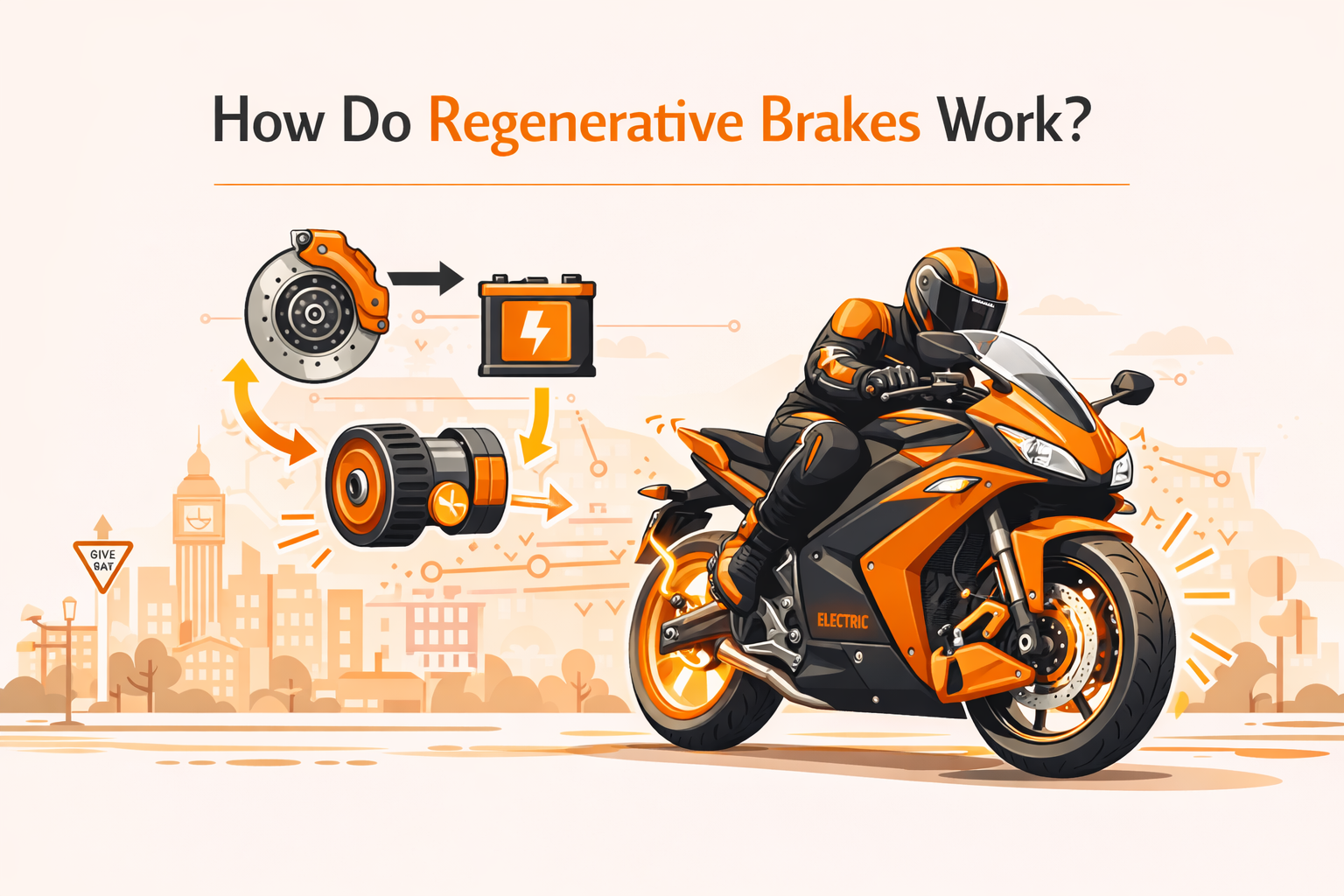
Ever felt your electric motorbike gain a little life back as you slow for a corner? That’s not your imagination. It’s regenerative braking at work, capturing the energy of your slowing momentum and turning it back into precious battery power.
This recaptured electricity is sent straight back to your battery, giving you a small but welcome boost to your range on every ride.
Slowing Down to Power Up Your Ride
When you roll off the throttle on your electric moped or motorbike, something quite clever happens under the surface. Instead of just relying on your traditional disc brakes to scrub off speed, the electric motor actually flips its role. This isn't just a neat party trick; it's a core feature that defines modern electric two-wheelers.
Think of your electric motor as a two-way valve. Most of the time, it's open one way, drawing power from the battery to drive the wheel and push you forward. But the moment you start to decelerate, that valve switches direction. Your motorbike's forward momentum starts to drive the motor, effectively turning it into a miniature generator.
This simple reversal converts your kinetic energy—the energy of movement—back into electrical energy. None of that power goes to waste, either. It’s channelled right back into your battery pack, adding a little extra charge. It won't top up your battery completely, of course, but you'd be surprised how much it adds up, especially in the right conditions.
The Benefits of Capturing Energy
This constant cycle of using and then reclaiming energy brings some fantastic real-world advantages for anyone riding an electric motorbike, from off-road bikes to a kid's first motocross bike.
- Extended Riding Range: In stop-start city traffic, where you're constantly on and off the throttle, regenerative braking can increase your range by a noticeable amount.
- Increased Efficiency: Rather than losing all your forward motion as wasted heat through your brake pads, you're recycling a portion of it into usable power. It simply makes every journey smarter.
- Reduced Brake Wear: With the motor handling a lot of the initial braking force, your brake pads and discs have a much easier life. That means less time and money spent on maintenance down the line.
For urban commuters on electric mopeds or delivery riders navigating busy UK streets, this technology is a real game-changer. Every stop for a traffic light or junction becomes a chance to put a little power back in the tank. You're turning what was once wasted energy into extra miles, making each trip more efficient and economical.
The Technology Behind Regenerative Braking
To really get your head around regenerative braking, you need to peek behind the bodywork of an electric moped or motorbike. It might sound like a bit of space-age tech, but it’s actually a beautifully simple partnership between a few core components working in perfect sync every time you ease off the throttle.
The Motor’s Double Life
At the very centre of it all is the electric motor. It’s the real star of the show. When you want to go, it draws power from the battery to turn the wheel and push you forward. Simple enough. But the magic happens the moment you decide to slow down.
As soon as you roll off the throttle, the motor performs a clever switcheroo. Instead of using power, it starts creating it. Your moped’s forward momentum keeps the motor spinning, and this mechanical force is converted back into electrical energy. It effectively becomes a generator. This single principle is the key to the entire system.
The Brains of the Operation
Of course, the motor can't just decide to do this on its own. It needs a manager, and that's the job of the controller. You can think of the controller as the bike's brain, a sophisticated piece of electronics that directs the flow of energy.
It’s constantly reading information from your throttle, your brakes, and the motor itself. The instant it senses you're decelerating, it flips the switch, telling the motor to start generating power. The controller also fine-tunes how strong this braking effect feels, making sure the switch from acceleration to slowing down is perfectly smooth and predictable.
This intelligent management is what makes a good regenerative system feel so natural to the rider. Clever software algorithms calculate the ideal amount of braking force needed for any situation, blending it seamlessly with the traditional friction brakes for a safe, consistent feel.
All that recaptured energy has to go somewhere. It’s channelled straight back to the battery, which acts like a small power reservoir. This recycled electricity is then stored, ready and waiting for your next burst of acceleration. It’s a closed-loop system that’s constantly putting energy back in the tank. If you want to dig a bit deeper into the physics, this guide explains what a regenerative braking system is and how it works in more detail.
This flow diagram breaks down exactly what's happening, showing how kinetic energy (your momentum) is converted back into stored battery power.
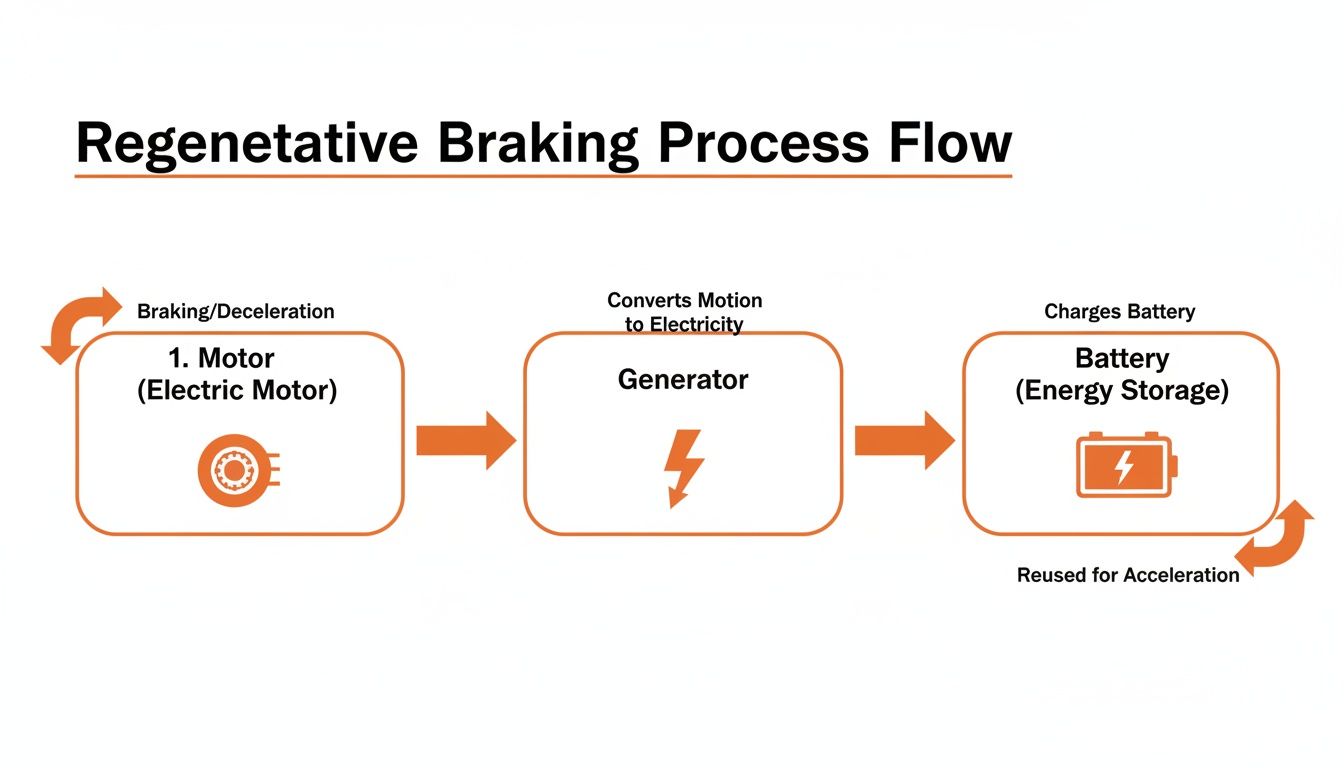
As you can see, it’s an elegant process. Your motor simply reverses its role to top up the battery, creating an incredibly efficient energy-saving loop every time you ride.
How Much Extra Range Can You Really Gain
All the clever tech is one thing, but what every rider really wants to know is what this means for their daily ride. How many more miles can you actually squeeze out of a single charge?
Honestly, it all comes down to where and how you ride. For most of us in the UK, though, the benefits are very real and you can definitely feel the difference.
Regenerative braking really comes into its own in the city. Just picture yourself riding through the stop-start traffic of London, Manchester, or any busy town centre. Every time you ease off for a junction, a red light, or a pedestrian stepping out, you’re giving the system a chance to put a little power back in the tank.
This is where all that braking energy, which would normally just be lost as heat, gets a second life. For a city commuter or a delivery rider, regenerative braking is constantly chipping away in the background, turning wasted momentum into extra miles.
Putting Numbers on It
So, what kind of numbers are we talking about? When you ease off the throttle on an electric moped, the motor instantly switches roles and becomes a generator. In that moment, it can capture and send back up to 30% of the braking energy to the battery.
This isn't some futuristic concept; with well over a million plug-in vehicles on UK roads, it's a well-established and effective technology. You can find some great real-world data about this on CITA EV Charger's blog.
For riders on 50cc or 125cc equivalent electric motorbikes, especially in urban areas, this translates into a noticeable range boost. While it’s hard to give an exact figure, adding several extra miles to your total range per charge is pretty standard. If you’re a delivery rider, those extra miles could mean completing another job or two before you need to plug in, which directly impacts your earnings.
On an electric off-road bike, the benefit is a bit different but just as useful. When you're heading down a long, steep trail, strong regen acts a lot like engine braking. It gives you incredible control over your speed, meaning you don’t have to cook your friction brakes on the way down.
Your Riding Style Makes All the Difference
Ultimately, you are the one in control. The amount of energy you recover is directly tied to how you ride.
If your style is all about late, aggressive braking, the system simply won't have enough time to do its job effectively.
On the other hand, if you're a smoother rider who looks ahead, anticipates traffic, and gently rolls off the throttle to slow down, you'll see the biggest gains. This approach lets the motor do most of the braking work, maximising the time it spends generating power. By riding smoothly, you're not just getting more miles from your battery — you're making every single journey that little bit more efficient.
Mastering Your Bike’s Regenerative Braking Modes
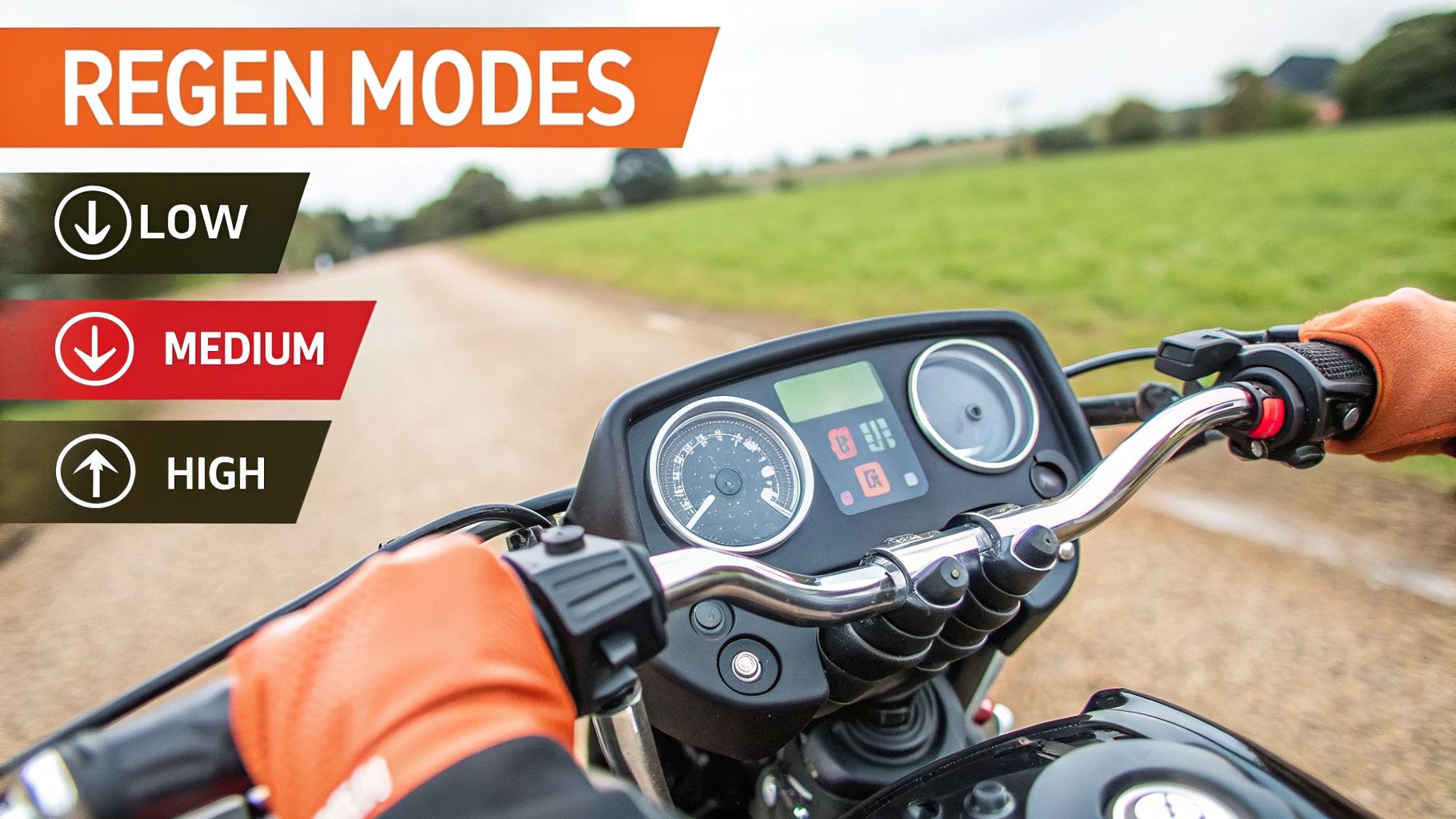
Knowing the theory behind regenerative braking is great, but the real magic happens when you start playing with your bike’s settings. Most modern electric motorbikes and mopeds don't just have regen; they let you control its strength.
You’ll usually find these options presented as simple, adjustable levels, often labelled 'Low,' 'Medium,' or 'High.' Each setting completely changes how the bike behaves when you roll off the throttle. Picking the right one for the right situation can transform your ride and give a welcome boost to your battery.
Finding the Right Regen Setting for Your Ride
A great way to think about these modes is to compare them to engine braking on a petrol bike. A high setting gives you a strong, immediate slowing effect, whereas a lower setting lets you coast more freely.
- High Regen: This gives you the most aggressive braking the moment you ease off the throttle. It's fantastic for dense city riding and enables a sort of 'one-throttle' riding style. You can easily manage your speed in traffic just by modulating the throttle, rarely needing to touch the brake levers. For a delivery rider on an electric moped, this is the key to efficiency on busy streets.
- Low Regen: At the other end of the scale, this setting offers a much gentler slowing force. When you roll off, the bike coasts along much more freely, feeling closer to a traditional two-stroke. It’s perfect for open A-roads or motorways where you want to maintain your speed without the bike constantly trying to slow you down.
Your choice directly impacts both the feel of the ride and, crucially, your overall efficiency.
Sticking it in high regen mode for stop-start city traffic can noticeably increase the energy you claw back, adding precious miles to your range.
The Rider's Role: Practical Tips for Maximising Regen
Beyond just picking a mode, your riding style is what truly makes or breaks your efficiency. To get the most out of your regenerative braking system, you need to start thinking a few steps ahead.
Instead of grabbing the brakes at the last second, learn to anticipate stops. Look far down the road and start easing off the throttle early, letting the regen system do the work of smoothly slowing you down. This smooth, gradual deceleration gives the motor the maximum amount of time to act as a generator and feed juice back into your battery.
This approach doesn't just stretch your range; it also makes for a far smoother and more controlled ride. It’s a classic win-win that saves energy and makes you a better, more thoughtful rider.
Choosing Your Regenerative Braking Mode
Not sure which setting to use and when? This quick guide breaks down the feel and best use case for each level, helping you match the mode to your journey.
Regen ModeFeeling and EffectBest ForExample ScenarioHighStrong, immediate deceleration when you release the throttle. Feels like heavy engine braking.Stop-and-go city traffic, steep downhill sections.Navigating a busy town centre with lots of traffic lights and junctions.MediumA balanced blend of braking and coasting. Noticeable but not aggressive slowing.General-purpose riding, suburban roads with mixed conditions.A daily commute that involves a mix of faster roads and residential streets.LowMinimal braking effect. The bike coasts freely with little resistance.Open roads, motorways, or when you want to maintain momentum.Cruising along a fast, clear A-road where you want to keep a steady speed.
Ultimately, the best way to get a feel for these modes is to experiment. Try each one out in different environments to see what works best for you and your bike. You’ll soon find your preferred settings for every situation.
The Hidden Savings in Lower Brake Maintenance
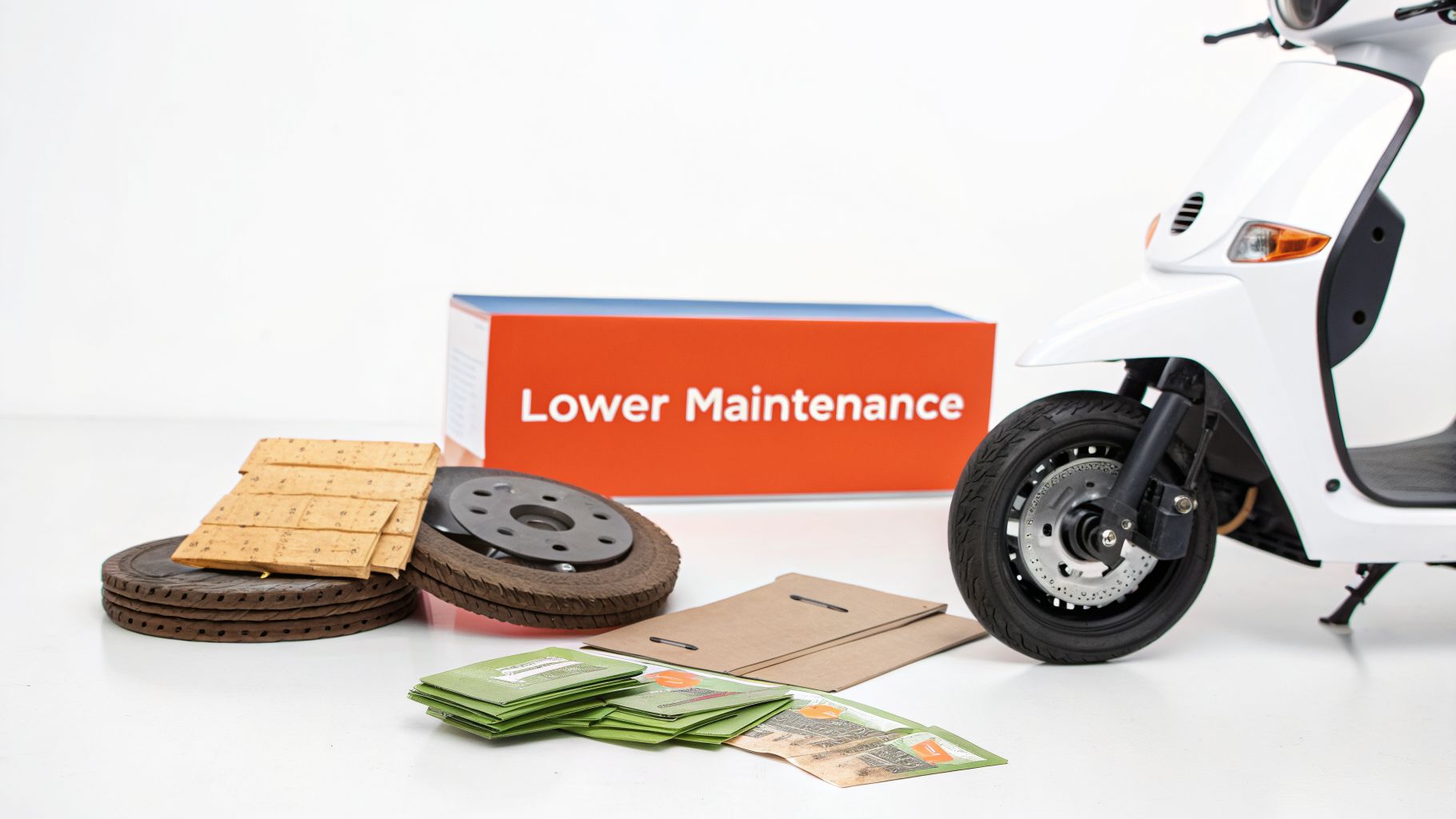
While the extra range from regenerative braking is a fantastic bonus, there’s another huge benefit that often goes unnoticed: a massive reduction in brake maintenance. It's a quiet advantage that adds up to some serious financial savings over the life of your electric motorcycle or moped.
Let's think about your standard friction brakes for a moment. Every time you pull the lever, brake pads squeeze a disc. That friction is what slows you down, but it also creates heat and wears out both the pads and the discs, which eventually need replacing. It’s a necessary cost.
With regenerative braking, however, the electric motor does a huge chunk of the work. Instead of immediately grinding pads against a disc, the motor reverses its role to slow you down, converting your momentum back into electricity. Your regular brakes are still there, of course, but they become a supporting act for sudden stops or when you need every bit of stopping power.
Quantifying the Financial Benefit
This simple change makes a world of difference to how long your brake components last. Because they’re used so much less often, and less aggressively, the brake pads and discs on an electric motorbike can last dramatically longer than on a comparable petrol model.
We’re not talking about a small improvement, either. In the stop-start traffic of UK cities, regenerative braking is in its element, letting the motor handle most of the deceleration. It's not uncommon for friction brake use to drop by as much as 70-90% in typical urban riding. As a result, many EV owners report their brake pads lasting three to five times longer than they're used to. You can find out more about how regen reduces wear and its other advantages.
For riders who clock up a lot of miles, this really hits home. A delivery rider on an electric moped covering 50 to 100 miles a day could easily save the £200-£300 in annual brake maintenance costs you’d expect with a petrol equivalent.
Lower Total Cost of Ownership
These savings on parts and labour directly lower your total cost of ownership, which is a big part of why so many riders are making the switch. The perk isn't just for commuters; it applies to everything from high-performance electric dirt bikes to a kid's first motocross bike, where less time in the garage means more time riding.
Ultimately, regenerative braking gives you a powerful two-for-one benefit. It cleverly recycles energy to top up your battery, all while protecting your wallet from the recurring cost of brake servicing. It’s a hidden saving that makes owning an electric motorbike that much smarter.
Your Regenerative Braking Questions Answered
Even after getting your head around the basics of regenerative braking, a few common questions always seem to pop up. It’s a clever bit of tech that really changes how you think about slowing down, so let’s bust a few myths and get those lingering queries sorted.
We'll tackle the most frequent questions we hear about regen on electric motorbikes, mopeds, and even off-roaders, giving you clear, straight-to-the-point answers.
Does Regenerative Braking Replace My Normal Brakes?
In a word, no. This is the single most important thing to understand. Regenerative braking is a fantastic complementary system, but it doesn't replace your traditional brakes. It’s brilliant for smoothly shaving off speed as you head into a corner or for gently slowing down in flowing traffic.
However, your conventional hydraulic or mechanical disc brakes are still absolutely vital. They provide the serious stopping power you need for an emergency stop or for bringing the bike to a complete standstill. Think of regen as your first line of defence; it does the easy work, saving your main brakes for when you really need them.
The two systems work in harmony. Regen handles the gentle work to save energy and reduce wear, while your friction brakes provide the ultimate stopping power for maximum safety.
Can It Overcharge My Battery?
This is a very common worry, but you can put your mind at ease. Every modern electric motorbike has a sophisticated brain called a Battery Management System (BMS), which acts as a guardian for your battery's health. Its whole job is to prevent things like overcharging.
If your battery is already at 100% charge, the BMS simply dials back or temporarily disables the regenerative braking. You might notice this yourself if you ride down a long, steep hill right after unplugging from the charger—the regen will feel much weaker until you've used up a bit of juice. It’s a smart safety feature designed to protect your battery for the long haul.
Do the Brake Lights Activate During Regen?
Yes, they do, and this is a non-negotiable safety feature. On any modern electric moped or motorcycle sold in the UK, the brake lights are triggered by deceleration, not just by you pulling the brake lever.
This means that as soon as you roll off the throttle and the regen kicks in hard enough to slow the bike noticeably, your brake lights will automatically come on. This is a regulated safety standard, giving drivers behind you a clear signal that you're slowing down. It's a small detail that makes a massive difference on the road.
Is It Effective on Off-Road Electric Motorcycles?
Absolutely. In fact, for trail riding, it’s a game-changer. On electric dirt bikes or kids' motocross bikes, a strong regen setting gives you incredible control, especially when navigating a tricky, steep descent.
The sensation is very similar to the engine braking you get on a traditional 4-stroke petrol bike. It lets you manage your speed without constantly dragging the brakes, which can cause them to overheat and fail—a dangerous situation known as 'brake fade'. Many off-road models even let you adjust the regen level on the fly, so you can tweak the bike’s behaviour to suit the terrain perfectly.
Ready to experience the benefits of smarter braking and extended range for yourself? At Flex Electric, we specialise in the UK's best electric mopeds, motorcycles, and off-road bikes. Explore our curated collection and find the perfect ride for your daily commute or weekend adventure at https://www.flexelectric.co.uk.
Find us
You will find us at 74 Dalry Road, Edinburgh, EH11 2AY
Showroom Opening Times:
Monday: By Appointment
Tuesday to Friday: 11am - 5:00pm
Saturday: 10am - 5pm
Sunday: By Appointment
