
How long do batteries last: 2026 Guide to Electric Motorcycles

Flex Electric
The UK's #1 Electric Moped and Electric Motorbike dealer.

Whether you’re eyeing up an electric motorcycle, a nimble moped, or even an off-road motocross bike, one of the first questions on everyone's mind is always the same: how long will the battery really last?
You can breathe easy. A modern, high-quality lithium-ion battery is built to last for 800 to 1,500 full charge cycles. For the average UK rider, that translates to a solid 5 to 10 years of reliable riding before you'd notice any significant drop in performance.
Your Electric Motorcycle Battery Lifespan Explained
Thinking about battery lifespan isn’t about pinpointing a day when it will suddenly stop working. It’s a gradual process, a bit like the tread wearing down on a good set of tyres. We measure this lifespan in two main ways: charge cycles and years.
A charge cycle is just a simple way of measuring use. One full cycle means you've used 100% of the battery's capacity—for instance, by riding it from 100% all the way down to 0% and then charging it back to full.
But it doesn't have to happen in one go. If you ride to work and use 50% of your battery, then plug it in and charge it back to full, you’ve only used half a cycle. Simple as that.
To give you a clearer picture, here’s a quick summary of what to expect from your battery.
Electric Motorcycle Battery Lifespan At a Glance
MetricAverage LifespanWhat This Means For YouCharge Cycles800 – 1,500Represents thousands of individual rides, especially with partial charges.Years5 – 10 yearsFor most commuters and leisure riders, the battery will outlast the time they own the machine.PerformanceGradual declineYour machine won’t just stop. You’ll slowly notice a bit less range over many years.
This table shows that for the vast majority of riders, a battery's cycle count translates into many years of hassle-free riding.
From Cycles to Years of Riding
An electric moped used for a daily 10-mile commute might only use a small fraction of a full cycle each day. This is why a battery rated for 1,000 cycles can easily serve you for thousands upon thousands of journeys. It’s this built-in longevity that makes motorcycles from top-tier brands like Super Soco, Vmoto, and Horwin such a fantastic long-term investment.
A battery's lifespan isn't about a single point of failure. It's about its ability to hold a charge over time, a metric we call State of Health (SoH). Most batteries are considered perfectly useful well above the 70-80% health mark.
This gradual decline happens much slower than you might think. In fact, the data from real-world use is incredibly reassuring. The UK's largest study of used EV batteries found that even after 4-5 years on the road, the median State of Health was a very strong 93.53%.
Even for much older vehicles between 8 and 12 years old, the median was still a very functional 85.04%—well above the level where a warranty replacement would typically kick in. You can read the full breakdown of these findings over at MEM UK News.
Here at Flex Electric, we’re confident in the durability of the batteries in every electric motorcycle and moped we offer. That’s why we provide a robust 3-year battery warranty as standard, giving you complete peace of mind from the very first twist of the throttle.
Understanding Battery Health Versus Daily Range
When people ask how long an electric moped battery really lasts, they're often juggling two different ideas: the battery's day-to-day range and its overall lifespan. It's a common point of confusion, but telling them apart is the key to understanding your machine's long-term value and performance.
Think of your battery like a water bottle. When it’s brand new, it has a set capacity—let's say it's a 1-litre bottle. That total size is its State of Health (SoH). Your daily range, on the other hand, is just how much water you use on a given trip. You might only use half the bottle on your commute, but the bottle itself is still a 1-litre bottle.
This simple analogy shows why a shorter range on one particular day doesn't mean your battery is failing. Maybe you were riding into a stiff headwind or just feeling a bit heavy on the throttle. You used more 'water', but you didn't shrink the bottle.
The Myth of Sudden Battery Failure
Here’s the good news: batteries don't just die overnight. Their decline is a slow, predictable process. Over thousands of miles and many years, the total capacity—the size of that water bottle—gradually gets a little smaller. It's not a sudden failure.
Your battery's State of Health (SoH) is simply its current maximum capacity compared to when it was new. A battery with 90% SoH just means it can now hold 90% of its original charge. This is a completely normal part of ageing, not a fault.
For the vast majority of UK riders, this gradual decline is something you'll barely notice in your daily routine. A battery that's at 90% or even 80% SoH still packs more than enough punch for typical commutes, errands, and weekend fun.
Real-World Performance Over Time
Let's look at how this plays out for different riders. You’ll see that even a slightly degraded battery remains incredibly practical.
- The Urban Commuter: Someone riding a Super Soco for an 8-mile round trip to work might only use 20% of their charge each day. Even after five years, when the battery's SoH might have dropped to 90%, it still holds four times the energy they need. The impact on their daily life? Pretty much zero.
- The Delivery Rider: A professional on a Segway moped, clocking up 50 miles a day, puts their battery through its paces. After two years of heavy use, its SoH might be around 92%. This is a tiny reduction in maximum range, and it’s still more than capable of handling a full shift, especially with a quick top-up charge on a lunch break.
- The Off-Road Enthusiast: A weekend warrior taking their electric motocross bike out might drain a full charge in a few hours of hard riding. After a few years, a battery with 85% SoH means their sessions might be a little shorter, but it will still deliver all the high-power performance they need for the trails.
In every case, the battery continues to be a reliable workhorse for years. It's this slow, manageable ageing process that makes an electric motorcycle such a dependable and solid long-term investment.
The Key Factors That Influence Your Battery's Longevity
Think of your electric moped's battery a bit like a marathon runner. Raw talent gets you to the starting line, but it’s the training, diet, and recovery that determine how long and how well they can compete. Your battery is no different; its real-world lifespan is shaped almost entirely by how you treat it.
By understanding the handful of crucial factors at play, you can take control and ensure your ride stays reliable for years to come. We’ll look at everything from your daily habits to the very chemistry packed inside the cells.
This infographic is a great starting point, showing how your battery's long-term health, its current capacity, and the range you get on any given day are all connected.
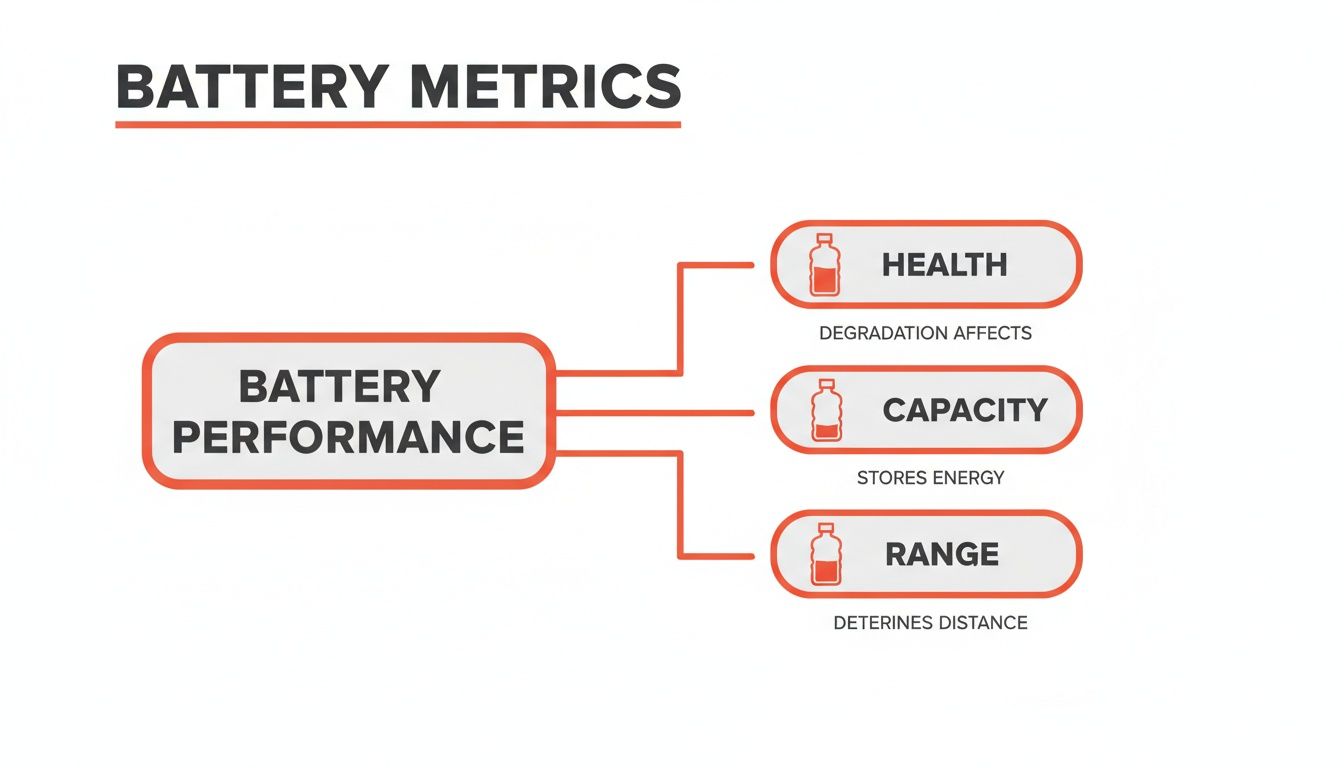
As you can see, the overall health dictates the maximum energy the battery can hold (its capacity). That capacity, in turn, determines your potential range. They are all linked.
Your Charging Habits
Of all the factors, your charging routine has one of the biggest impacts on long-term battery health. Imagine it like stretching a rubber band; gentle, regular use is fine, but constantly stretching it to its absolute limit will cause it to wear out and snap.
Constantly charging to 100% or, just as bad, regularly running it down to 0%, puts unnecessary stress on the lithium-ion cells. The science is clear: degradation speeds up dramatically when batteries spend most of their time at these extremes. For the best results, try to keep your battery between 20% and 80% for daily riding. Only push it to a full 100% when you absolutely need that maximum range for a long trip.
The Impact of Temperature Extremes
Lithium-ion batteries have a comfort zone, just like we do. They work best in moderate temperatures, so the extremes of a UK winter or summer heatwave can really affect their performance and health.
- Cold Winters: When it gets frosty, a battery's efficiency temporarily drops, which you'll notice as a reduced range. While your range will bounce back when it warms up, repeatedly charging a freezing-cold battery can cause permanent damage. It's always best to bring your battery inside and let it warm up to room temperature before plugging it in.
- Summer Heatwaves: Heat is the real enemy of battery longevity. It accelerates the chemical reactions inside the cells, causing them to age much faster. When the sun is blazing, do your battery a favour and park your moped in the shade or a cool garage.
Your Riding Style
How you twist the throttle has a direct link to how hard your battery has to work. It’s the difference between a gentle jog and an all-out sprint. Both will get you there, but one is far more demanding.
Aggressive riding – think jack-rabbit starts from the lights and holding it at top speed – draws a massive amount of power all at once. This high-drain activity generates extra heat and puts a real strain on the battery cells. A smoother, more measured riding style is much kinder to the battery, helping to preserve its health for the long haul.
Proper Storage Practices
If you’re storing your moped for a while, whether you’re off on holiday or packing it away for the winter, how you leave the battery is critical. Letting it sit for weeks on end either fully charged or completely dead is one of the fastest ways to degrade it.
The sweet spot for long-term storage is a state of charge between 40% and 60%. This 'storage charge' puts the least amount of stress on the cells, slowing the natural ageing process right down. Just be sure to store it in a cool, dry place and check on it every month or so, topping it back up to that 50% mark if it has dropped.
The Quality of Battery Chemistry
Finally, it’s important to remember that not all batteries are created equal. The quality of the materials and the engineering that goes into the pack are fundamental to its lifespan. This is precisely why we only work with top-tier brands like Vmoto, Super Soco, and Horwin, who use premium, energy-dense lithium-ion cells.
Just as important is the sophisticated Battery Management System (BMS) paired with these cells. The BMS is the battery’s brain, constantly monitoring everything from temperature to voltage. It acts as a bodyguard, protecting the cells from over-charging, balancing their power, and ensuring the whole pack operates safely and efficiently. A high-quality BMS is a non-negotiable for achieving a long and trouble-free service life.
Right, we’ve covered the theory of how your battery works. Now let’s get to the important part: how you can actively make it last longer. Think of these not as strict rules, but as smart habits that protect your investment and keep your electric motorcycle, moped, or off-road bike running strong for years to come.
These simple tips aren’t just about long-term health, either. They’ll help you squeeze more miles out of every single charge, whether you’re a delivery rider trying to maximise your income or a commuter enjoying those incredibly low running costs.
Nail Your Charging Routine
If there's one thing that has the biggest impact on your battery's lifespan, it's how you charge it. The easiest way to think about it is that your battery is happiest when it’s not under stress. Constantly pushing it to 100% or letting it die completely to 0% is like holding a muscle tensed for hours on end—it just causes unnecessary wear.
For day-to-day riding, the 'golden zone' for lithium-ion batteries is keeping them between a 20% and 80% charge. Sticking to this range minimises stress on the individual cells, which dramatically slows down the natural ageing process.
This doesn't mean you can never fully charge your motorcycle. If you've got a long trip planned and need every last bit of range, charging to 100% is absolutely fine. Just make it the exception, not your daily routine.
Another simple but critical point: always use the official charger that came with your machine. It might be tempting to grab a cheap third-party one online, but they often lack the precise voltage controls and safety features your battery needs. It's a gamble that could risk causing permanent damage.
Find the Sweet Spot When You Ride
Good charging habits are only half the story. How you twist the throttle has a direct and immediate effect on your battery. While the instant torque is one of the best things about riding electric, treating every traffic light like a drag race is the equivalent of sprinting everywhere you go—it’s exhausting and drains your energy reserves in a flash.
A smoother, more measured approach will pay you back in battery health.
- Go easy on the throttle: Try to avoid those sudden, jerky 'jack-rabbit' starts. A smooth, progressive acceleration is much kinder on the battery.
- Find your cruising speed: Every machine has an efficient cruising speed where it feels like it’s humming along effortlessly. Play around and find that sweet spot instead of constantly pushing for its top speed.
- Read the road ahead: Look up and anticipate what traffic is doing. Easing off the throttle early for a red light is far better than braking hard at the last second.
If your machine has regenerative braking, use it to your advantage! It's a brilliant feature that captures energy when you slow down and feeds it back into the battery. Each little bit adds up, and over a journey, it can genuinely extend your range and reduce the overall strain on your battery.
Dos and Don'ts For a Healthy Battery
To boil it all down, here’s a simple table comparing the good habits with the bad ones. Sticking to the 'dos' is your best bet for getting a long and happy life from your battery.
ActionDo This To Extend LifespanAvoid This To Prevent DamageDaily ChargingAim to keep the charge between 20-80% for regular use.Constantly charging to 100% or draining to 0%.Charger ChoiceAlways use the official manufacturer-supplied charger.Using cheap, third-party chargers that may lack safety features.Long-Term StorageStore the battery with a 40-60% charge in a cool, dry place.Leaving the battery fully charged or completely dead for weeks.TemperatureCharge and store your machine in a moderate, sheltered environment.Leaving your machine in direct summer sun or charging a frozen battery.
Following these simple guidelines will make a real, practical difference in how your battery performs not just next week, but for years down the road.
How to Spot the Signs of a Failing Battery
Every electric vehicle owner thinks about it: how will I know when my battery is actually on its way out? Thankfully, modern batteries don't just fail overnight. The process is almost always slow, predictable, and the real warning signs are far more dramatic than the minor range dips you might see over the years.
The number one red flag is a sudden and major drop in your maximum range. We’re not talking about losing a couple of miles on a freezing cold day. This is a permanent cliff-edge drop. Imagine your moped used to reliably get you 40 miles, but now it struggles to hit 20, even on a full charge in good weather. That’s a clear signal that something’s wrong internally.
Specific Warning Signs to Watch For
Aside from a nosedive in range, your machine’s own brain—the Battery Management System (BMS)—is your best friend here. It’s always monitoring the battery's health and will throw up some pretty clear clues if it detects a serious problem.
Here’s what you should look out for:
- It won't charge to 100%: You plug it in for the usual amount of time, or even overnight, but the display just won't tick over to full. Maybe it gets stuck at 85% and stubbornly refuses to go any higher.
- The charge vanishes on its own: You park your moped with a full charge, come back to it a day later, and find the battery has drained significantly without you even turning it on. This is known as rapid self-discharge.
- You see error codes on the dashboard: Most modern electric mopeds will display a specific fault code on the screen if the BMS has found an issue it can’t resolve.
It’s worth remembering these are signs of advanced degradation. For most riders, these symptoms will only appear after many years and thousands upon thousands of miles. Your battery should give you solid, reliable performance for the entire time you own the machine.
We know that peace of mind is everything. That’s why our diagnostic process is designed to give you a clear, honest answer about your battery’s health. It’s also why our standard 3-year battery warranty is there to protect you from any premature issues.
Our Diagnostic and Warranty Promise
If you think your battery is having problems, finding out for sure is simple. Just bring your motorcycle or moped in, and our technicians will run a full diagnostic test to measure its State of Health (SoH). This isn't guesswork. It's a proper data-led health check that compares your battery's current capacity to what it was when it was new.
If that test shows that your battery’s performance has dropped below the warranty threshold within those first three years, we'll get it replaced for you. No fuss. It’s our guarantee to you, ensuring you can ride for thousands of miles with total confidence in your investment.
Warranty Coverage and Replacement Options
Even with the best battery in the world, you want to know you’re covered for the long haul. We get it. That’s why we don’t just sell you a motorcycle and wave goodbye; we back our technology with a promise that gives you genuine confidence on the road.
We’re so sure of the batteries we put in our electric motorcycles, mopeds, and off-road bikes that we offer an industry-leading 3-year battery warranty as standard. This isn’t just marketing fluff. It’s our firm commitment that your battery is protected against any unexpected faults or serious drops in performance.
How Our Battery Warranty Works
We’ve kept our warranty process simple and transparent. There's no guesswork involved. If you ever feel your machine isn't performing as it should, our expert technicians are on hand to diagnose the issue.
The warranty hinges on a clear benchmark: State of Health (SoH). If your battery’s health dips below a specific threshold within those first three years due to a manufacturing issue, we've got you covered. We'll run the diagnostics, and if it's a valid claim, we’ll sort out a replacement.
This ensures your machine delivers the reliable performance you need, whether you're commuting daily, hitting the motocross track on weekends, or managing a commercial delivery fleet.
Beyond the Warranty Period
So, what happens after three years? It’s a common worry that when a battery starts to fade, the whole motorcycle is a write-off. Thankfully, that couldn’t be further from the truth.
Think of the battery as a replaceable part, just like the engine on a petrol bike. Our trained technicians can easily swap an old battery for a new one, bringing your machine’s range and performance right back to factory-fresh condition.
This kind of after-sales support is at the heart of what we do. We’re here to build a lasting relationship with every rider, ensuring your electric motorcycle serves you well for many, many years.
And when that day finally comes for a replacement, we all have a part to play in doing it responsibly. Once your battery has reached the end of its life, looking into sustainable battery recycling solutions is the final, crucial step. It ensures those valuable materials are recovered and reused, closing the loop on a truly green transport solution.
Frequently Asked Questions About Battery Health
Riders always have great questions about looking after their batteries day-to-day. We get asked these all the time, so we’ve put together some straightforward answers based on what we’ve seen in our workshop and out on the road with countless electric motorcycles, mopeds, and off-road bikes.
Can I Leave My Electric Motorcycle Charging Overnight?
This is probably the number one question we hear. Technically, yes—modern chargers for machines like Super Soco and Vmoto are smart and will shut off automatically. But as a best practice, we don't recommend making a habit of it.
Leaving a battery sitting at 100% charge for hours on end, even with the charger off, can put a tiny bit of stress on the cells. The best routine is to simply unplug it within an hour or so of hitting full. If you have to charge overnight, a simple smart plug with a timer is a great solution. It can cut the power for you, protecting your battery while you get some sleep.
Does Fast Charging Damage My Electric Motorcycle Battery?
Fast charging is a fantastic tool, but it's one to be used wisely. It works by pushing more power into the battery, which naturally generates more heat and puts everything under a bit more strain than a standard, slow charge.
Using a fast charger every now and then is completely fine; that’s what it’s designed for. But if you rely on it for every single charge, you might find it speeds up long-term battery degradation. For everyday top-ups, the standard charger that came with your electric moped is always the kindest option for your battery's health.
Key Takeaway: Think of fast charging like an espresso shot—it's perfect for a quick boost when you're in a hurry. For daily life, though, a standard charge is more like a steady cup of tea that's much better for your battery's long-term wellbeing.
How Much Range Will I Lose in Cold UK Weather?
Lithium-ion batteries are a lot like us—they really don't perform at their best in the cold. On a chilly UK day, especially when the temperature drops to around 0°C or below, it’s normal to see a temporary dip in your range, typically between 10% and 30%.
The key word here is temporary. This isn't permanent damage or a sign your battery is failing. As soon as the weather warms up, your full range will come right back. To help minimise this, try to store your motorcycle or moped in a garage if you can. Or, if you have a removable battery, bring it inside to charge at room temperature before you head out.
Is a Removable Battery Better for My Motorcycle?
Removable batteries offer incredible flexibility, especially for city riders in the UK who might not have an outdoor socket at their flat or terraced house. The ability to carry your battery inside to a warm, secure spot is one of the best things you can do for its lifespan.
On the other hand, many electric motorcycles with built-in, or integrated, batteries often have larger capacities, which can mean more maximum range on a single charge. The right choice really comes down to your personal situation: where you live, how you ride, and what your charging setup looks like. We're always happy to talk through the pros and cons to help you decide.
Ready to experience the future of riding with the confidence of a leading warranty and expert support? At Flex Electric, we offer a curated selection of top-tier electric motorcycles and mopeds.
Find us
You will find us at 74 Dalry Road, Edinburgh, EH11 2AY
Showroom Opening Times:
Monday: By Appointment
Tuesday to Friday: 11am - 5:00pm
Saturday: 10am - 5pm
Sunday: By Appointment
