
How to Calculate Energy Consumption for Electric Mopeds
Flex Electric
The UK's #1 Electric Moped and Electric Motorbike dealer.

You've charged overnight, checked the dashboard, and set off for work with a range figure that looked more than adequate. By the time you're halfway through a wet commute, the estimate has dropped faster than expected. A delivery rider faces the same problem from a different angle, because every extra charging stop affects both earnings and the working day.
That's why knowing how to calculate energy consumption matters. Battery size alone won't tell you what a moped costs to run, how far it'll travel in your conditions, or how much electricity it draws from the grid. You need a repeatable method that combines distance, battery energy, charging, riding conditions and your electricity tariff.
Introduction to Energy Consumption for Electric Mopeds
A brochure range is a useful starting point, but it isn't a personal forecast. Your result depends on speed, traffic, hills, payload, temperature, tyre pressure and whether you're measuring energy taken from the battery or energy drawn from the wall.
A commuter might ride a predictable route through town, with frequent junctions and modest luggage. A delivery rider may cover much greater daily mileage, carry food or parcels, stop and start repeatedly, and recharge at different locations. The same electric moped can produce very different figures for each rider.
What the calculation helps you decide
A practical calculation gives you four useful answers:
- Expected range: Estimate how many miles you can cover before charging.
- Running cost: Convert electricity use into a cost per mile or per shift.
- Charging routine: Decide whether home charging is enough or whether you need a workplace, depot or public option.
- Model comparison: Compare electric mopeds using consumption rather than relying only on headline range.
For example, a rider who knows their real consumption can record the distance covered, note the energy added during charging and calculate a personal average. That figure becomes more useful than a one-off manufacturer estimate because it reflects the rider's route and habits.
Practical rule: Treat the advertised range as a reference point. Treat your own measured Wh/km figure as the number that controls your budget.
UK electricity pricing adds another layer. Your bill contains a usage-based unit rate and a daily standing charge, so the cost of charging isn't the only line item. Public charging may also use a different tariff from your home supply, which makes it sensible to separate energy consumption from the price paid for that energy.
The rest of the calculation is straightforward once you keep the units consistent. Start with usable battery capacity, measure distance, convert miles to kilometres where needed, calculate Wh/km, then apply your electricity price. Charging losses belong in the cost calculation, even though they don't appear in the energy available to the motor.
Understanding kWh Wh per km and Efficiency Explained
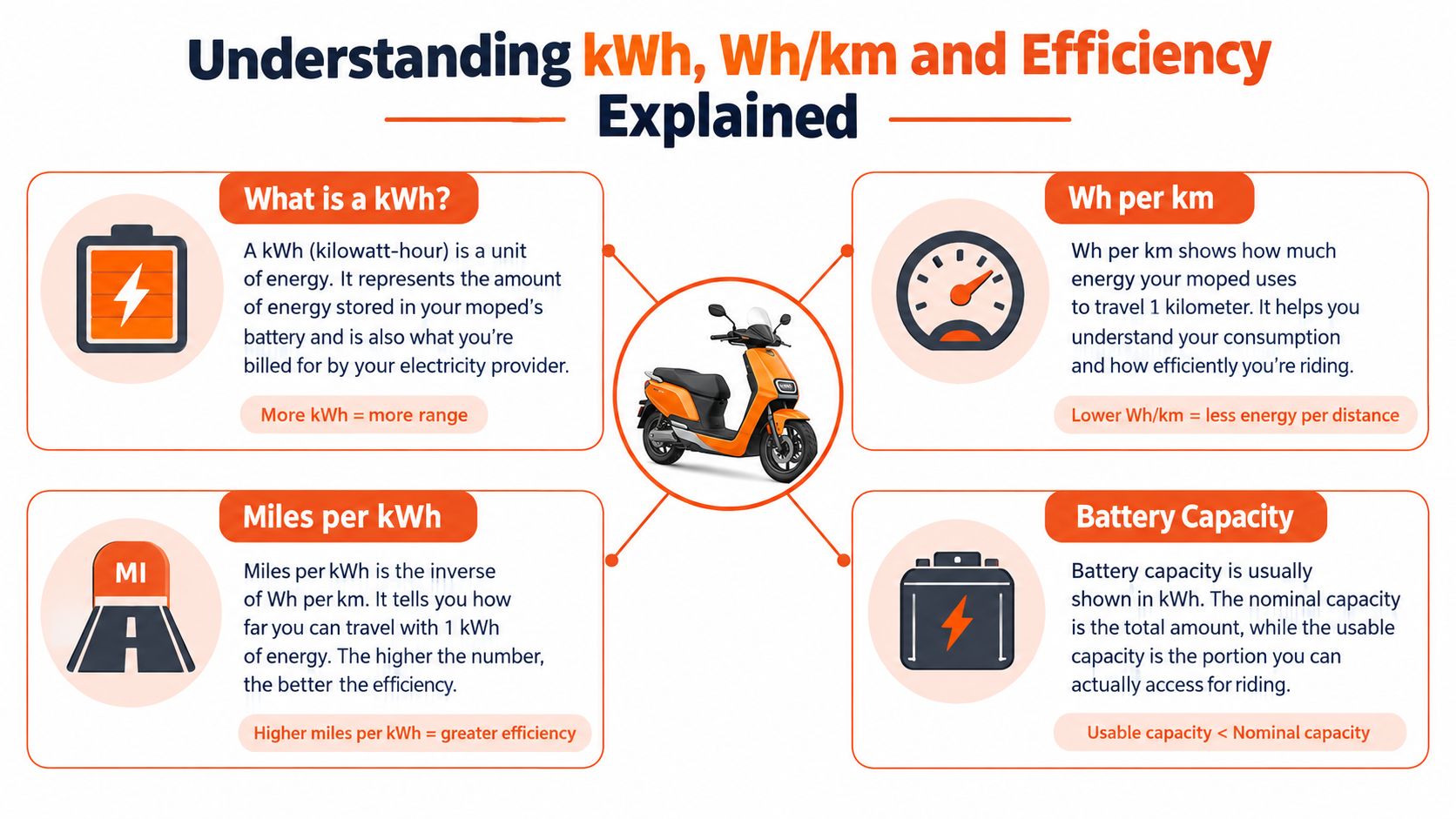
A kilowatt hour, or kWh, is a unit of energy. It's the amount your electricity supplier uses when charging for consumption. A battery's capacity is usually expressed in kWh, while a smaller battery specification may be shown in watt hours, or Wh. Divide Wh by 1,000 to convert it to kWh.
Wh/km tells you how much energy the vehicle uses to travel one kilometre. A lower Wh/km figure means the moped needs less battery energy for the same distance. The inverse measure, miles per kWh, tells you how far the vehicle travels using one kWh.
A simple analogy helps. Think of the battery as a tank of energy and Wh/km as the rate at which the journey uses that tank. A larger tank can support a longer journey, but a heavier load or faster riding can make the tank empty sooner.
Keep battery energy separate from wall energy
The energy stored in the battery isn't exactly the same as the electricity drawn from the socket. The charger and battery-management system use energy while charging, and some energy is lost as heat. For range calculations, use usable battery capacity. For bill calculations, use the electricity measured at the wall.
A specification sheet can also mix nominal capacity and usable capacity. Nominal capacity describes the battery's total rated storage, while usable capacity is the portion the vehicle allows you to access. If the manufacturer provides a usable figure, use it for range estimation.
For a practical example, the Vmoto VS2 Citi is described as a 125cc equivalent electric scooter with a 50mph top speed and a 66 mile range. Those figures provide context, but they don't replace a personal Wh/km measurement on your route.
Why common units matter in UK data
UK official energy statistics distinguish final energy consumption from primary energy consumption. Final energy is energy directly used by people and businesses, while primary energy also includes losses involved in converting fuel into usable energy. The UK government's ECUK 2025 methodology fixes one tonne of oil equivalent at 41.868 gigajoules or 11,630 kWh, creating a common conversion base for comparing fuels.
You don't need tonnes of oil equivalent for a personal moped worksheet, but the principle is important. Convert every input into one common unit before adding it. Don't combine miles, kilometres, Wh and kWh in the same formula without conversion.
If you want practical battery-care ideas alongside the maths, push-to-talk battery tips provide useful context on charging technology and battery habits.
How to Calculate Energy Consumption With Simple Formulas
Use one measured journey rather than relying only on the brochure. The most dependable worksheet starts with the battery energy you can use and the distance you cover.
Start with usable battery capacity
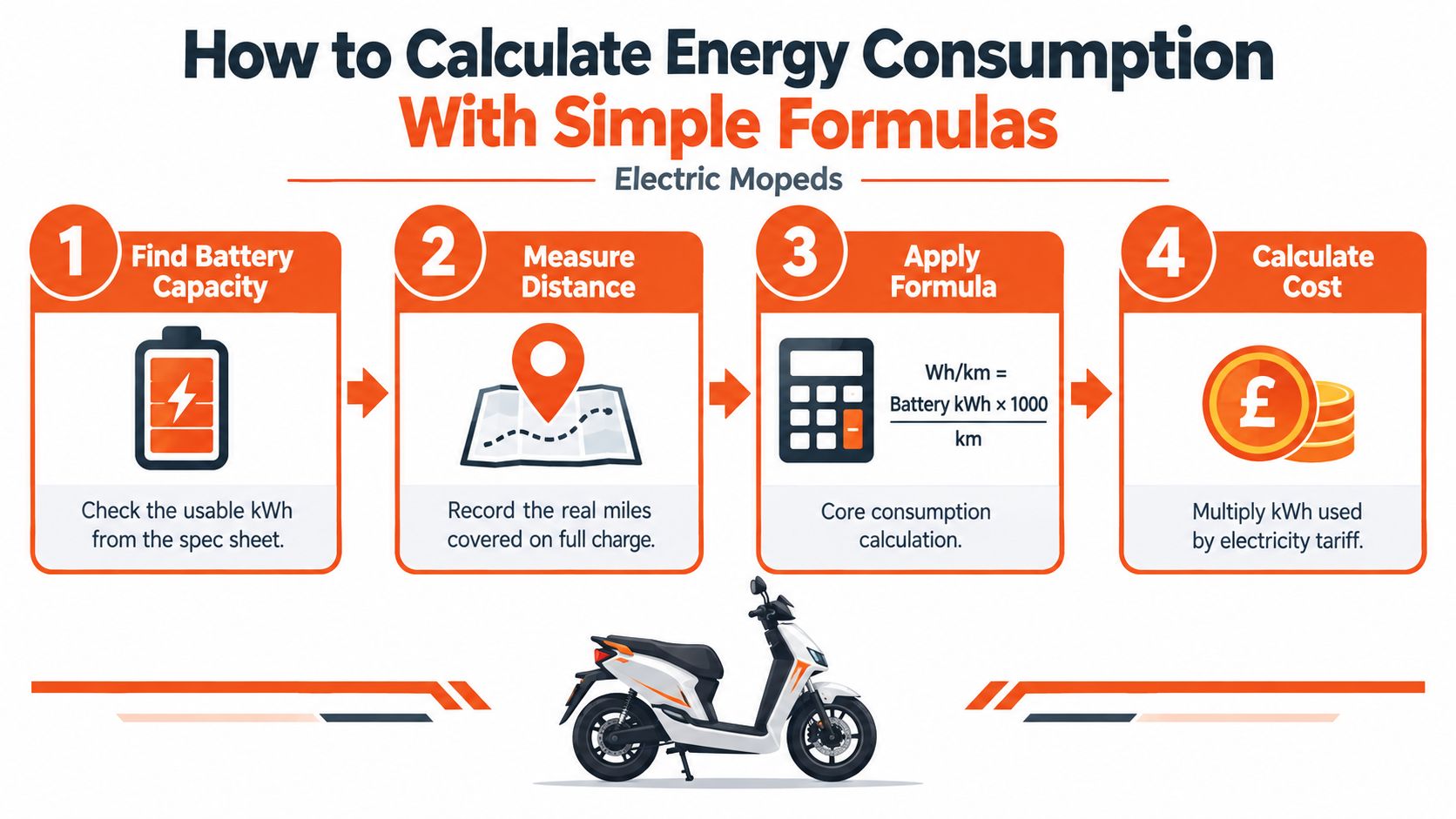
Write down the usable battery capacity in kWh. If the specification gives Wh, divide it by 1,000. Next, record the distance travelled in kilometres. Convert miles to kilometres before using the Wh/km formula.
The basic calculation is:
Wh/km = usable battery capacity in kWh × 1,000 ÷ distance in km
Suppose a battery provides 4 kWh of usable energy and the moped covers 80 km. The calculation is 4 × 1,000 ÷ 80 = 50 Wh/km. This means the vehicle used an average of 50 Wh for every kilometre in those conditions.
For more reliable results, repeat the measurement across several comparable rides. Record the route, weather, load and riding mode, because a single journey can be unusually easy or demanding.
Convert the result for familiar UK distances
Many riders think in miles, while Wh/km uses kilometres. To convert energy use into kWh per 100 miles, multiply Wh/km by 1.609, then multiply by 100, and divide by 1,000.
Using the 50 Wh/km example:
50 × 1.609 × 100 ÷ 1,000 = 8.045 kWh per 100 miles
To find miles per kWh, divide 1,000 by Wh per mile. First convert Wh/km into Wh/mile by multiplying by 1.609, then divide 1,000 by that result.
Calculate cost per mile
For a journey, calculate energy used like this:
Energy used in kWh = distance in km × Wh/km ÷ 1,000
Then:
Energy cost = kWh used × electricity unit rate
A home meter can provide a direct check. Subtract the previous reading from the current reading to find the units used, then convert those units to kWh and multiply by the price per kWh. Utility Matchmaker's UK energy-price guidance describes the conversion sequence and notes the prescribed 3.6 factor for converting gas units to kWh. Electricity meters normally already report kWh, so don't apply that gas conversion to an electricity reading.
Turn daily riding into annual demand
For annual consumption:
Annual kWh = daily distance in km × Wh/km ÷ 1,000 × riding days per year
Keep the number of riding days realistic for your own work pattern. A commuter should count actual commuting days, while a delivery rider can use logged shifts. Add charging losses when estimating electricity taken from the socket, rather than altering the battery's Wh/km figure.
For a larger scooter example, the Vmoto CPX 74V is described as a 125cc equivalent electric scooter with up to an 87 mile range and a 56mph top speed. To calculate its personal consumption, replace the range claim with your measured distance and the manufacturer's usable battery figure.
Real World Factors That Change Your Consumption
A clean formula can still produce an optimistic answer if the inputs come from ideal conditions. UK-facing efficiency references place most electric vehicles at about 2 to 4 miles per kWh, while common real-world consumption is around 16 to 24 kWh per 100 miles. The UK government's 2025 greenhouse-gas conversion factors also use activity in kilometres or miles multiplied by kWh conversion factors to calculate total energy.
Charging losses affect cost, not just range
The battery records energy available for riding, but the wall socket records energy supplied to the charger. Conversion losses occur between the socket, charger and battery. If you calculate cost from battery capacity alone, you'll understate the bill.
The cleanest method is to record the kWh added at the wall over several charging sessions. If your charger or smart meter doesn't provide a reading, apply a cautious allowance rather than presenting battery energy as exact grid consumption.
Weather changes the result
Cold weather can reduce practical range because battery performance changes with temperature. Rain can increase rolling resistance, while a wet road and strong wind may encourage slower riding but still demand more energy in other ways.
Payload matters too. A delivery rider carrying a loaded box or adding a passenger asks the motor to move more mass, especially when accelerating or climbing. Hills increase demand because the motor must raise the combined weight of rider and vehicle.
Speed and riding style matter
Hard acceleration uses more energy than smooth throttle inputs. High speed also increases aerodynamic demand, so a route ridden quickly can consume more than the same route in slower urban traffic.
Tyre pressure deserves a quick check because under-inflated tyres increase rolling resistance. Keep tyres at the manufacturer's recommended pressure, use the appropriate riding mode for the route and avoid carrying equipment you don't need.
Range calculation should be conservative. Build your working estimate from measured rides in the conditions you actually face, then keep enough reserve for weather, detours and charging access.
A useful test separates battery range from charging cost. Use the battery's usable capacity and measured distance for range. Use wall-plug kWh for cost. That distinction prevents charging losses from being hidden inside an apparently efficient Wh/km figure.
UK Cost and Range Examples for Commuters and Delivery Riders
A commuter travelling 20 miles each weekday and a delivery rider covering 80 miles can use the same calculation, yet their annual energy use differs sharply. These examples assume consumption of 20 kWh per 100 miles, within the UK real-world benchmark of 16 to 24 kWh per 100 miles cited in the government conversion-factor workbook.
For a like-for-like worksheet, both riders are assigned 260 riding days. That is an example schedule, not a prediction of every rider's year. The figures below describe battery energy. If you compare them with a home meter, include the charging losses measured at the wall.
Ofgem's average standard variable electricity price cap for England, Scotland and Wales is 26.11 pence per kWh, with a 57.19 pence daily standing charge, for 1 July to 30 September 2026, including VAT at 5%, as stated in Ofgem's price-cap information. The table applies the unit rate to moped energy use and leaves out the standing charge, because that fixed cost belongs to the whole electricity connection.
Rider ProfileDaily MilesConsumption Wh/kmAnnual kWhAnnual Cost at Price CapCommuter20124.271,040£271.54Delivery rider80124.274,160£1,086.18
The conversion prevents a common scale error. 20 kWh per 100 miles equals about 12.427 kWh per 100 km, or 124.27 Wh/km, not 12,427 Wh/km. At the same efficiency, the delivery rider travels four times as far each day, so the annual battery energy is also four times the commuter's figure.
To build a worksheet for your own calendar, multiply daily miles by 0.2 kWh per mile, then multiply by your annual riding days. Multiply the resulting annual kWh by £0.2611 for the cited price-cap period. Add charging losses when estimating what the meter will record. Add the standing charge separately if you are calculating the complete household electricity bill.
The Electric Insights report on EVs and heat pumps provides wider grid context. It reports UK electricity demand at about 322 TWh in 2025 and cites typical EV annual use of about 3,000 kWh. The comparison shows why annual kWh helps assess charging demand more clearly than battery size alone.
Range planning uses a different part of the worksheet. Divide usable battery energy by measured consumption, then keep a reserve for the conditions you ride in. Cost planning uses wall-plug kWh, because charging losses affect what you pay.
Home charging gives the clearest unit-rate calculation. Depot charging can follow the same method when the charger reports kWh. Public charging requires a separate price check, so record the energy supplied and amount paid independently from your home standing charge.
Tips to Lower Consumption and Track Your Savings
Start with measurement, not guesswork. Record the odometer, battery state, route conditions and kWh supplied at charging. After several comparable rides, divide energy used by distance and keep the result as your personal baseline.
Use a simple worksheet with these columns:
- Date and route: Note whether the ride was urban, hilly, wet or exposed to strong wind.
- Distance: Record miles, then convert to kilometres if you calculate Wh/km.
- Wall-plug energy: Enter the kWh supplied during charging.
- Payload and mode: Mark delivery load, passenger weight and riding mode.
- Result: Divide wall-plug kWh by distance for cost-focused tracking.
Smooth acceleration is usually the easiest habit to test. Keep a steady pace, anticipate junctions and avoid unnecessary bursts between traffic lights. Check tyre pressure regularly, reduce unused payload and select an efficient riding mode where it suits the road.
Charging timing can affect price on a time-of-use tariff, but don't assume an off-peak rate unless your own tariff confirms it. For broader household actions, practical bill reduction for homeowners can complement your vehicle-specific worksheet.
Remember that the standing charge continues even when the moped uses no electricity. Your measurable charging saving comes from reducing kWh drawn or paying a lower unit rate, while the standing charge belongs in your wider household budget.
Review the worksheet after a consistent run of rides. If Wh/km falls while distance, weather and payload remain similar, you've probably improved efficiency. If it rises, check tyre pressure, route changes, speed, load and charging records before blaming the battery.
Flex Electric offers electric mopeds, scooters and motorbikes for UK commuters, delivery riders and small fleets, with real-world specifications, nationwide delivery and after-sales support. Visit Flex Electric to compare suitable models and get practical advice on battery capacity, charging and running-cost calculations before you buy.
Find us
You will find us at 74 Dalry Road, Edinburgh, EH11 2AY
Showroom Opening Times:
Monday: By Appointment
Tuesday to Friday: 11am - 5:00pm
Saturday: 10am - 5pm
Sunday: By Appointment
