
How to Check Battery Health on Electric Mopeds and Scooters

Flex Electric
The UK's #1 Electric Moped and Electric Motorbike dealer.

You've charged your electric moped overnight, but the display says you've got less range than it used to. Perhaps your Niu or Super Soco now returns five miles fewer per charge than it did six months ago, or a warning light appears briefly before disappearing. That change may come from temperature, recent riding, tyre pressure, or battery ageing. Guessing from the dashboard alone won't tell you which one.
Battery health is measurable. The useful figure is State of Health, or SoH, which expresses the battery's current capacity as a percentage of its original capacity. A proper check combines that percentage with voltage behaviour, fault codes, cell balance, charge history and observed range. The process is different for a compact electric moped or scooter than for a car EV, especially when the pack is removable and the manufacturer app shows only limited information.
Why Battery Health Matters on Electric Two-Wheelers
Electric mopeds and scooters often use smaller battery packs than car EVs. A small loss of capacity therefore has a more obvious effect on a daily journey. If a scooter originally covered 40 miles in your normal conditions and now manages 30, you'll feel that change on every commute, even if the dashboard still shows a reassuring battery icon.
That's why battery health should be treated as a percentage, not a feeling. A range estimate is affected by temperature, riding style, hills, payload, wind and the charge level at which you read it. SoH, by contrast, attempts to compare the usable capacity now available with the pack's original specification. UK used-EV reporting defines SoH in exactly those terms, including the useful example that an 80 kWh battery at 80% SoH holds about 64 kWh when fully charged. See DEKRA's explanation of used-EV battery health for the underlying definition.
Why compact packs need careful handling
Heat accelerates stress inside lithium-ion cells. Vibration can affect connectors and mechanical joints, while repeatedly leaving a pack fully charged or regularly running it right down to empty increases the strain placed on the battery management system and cells. These effects matter particularly on removable packs, which may be charged in living spaces, transported separately and exposed to less consistent storage conditions.
A dashboard can miss early problems. The pack may still reach its normal top voltage while delivering less energy under load, or one cell group may sag sharply when you open the throttle. That's why the checks below move from simple observations to electrical testing and then to specialist diagnostics.
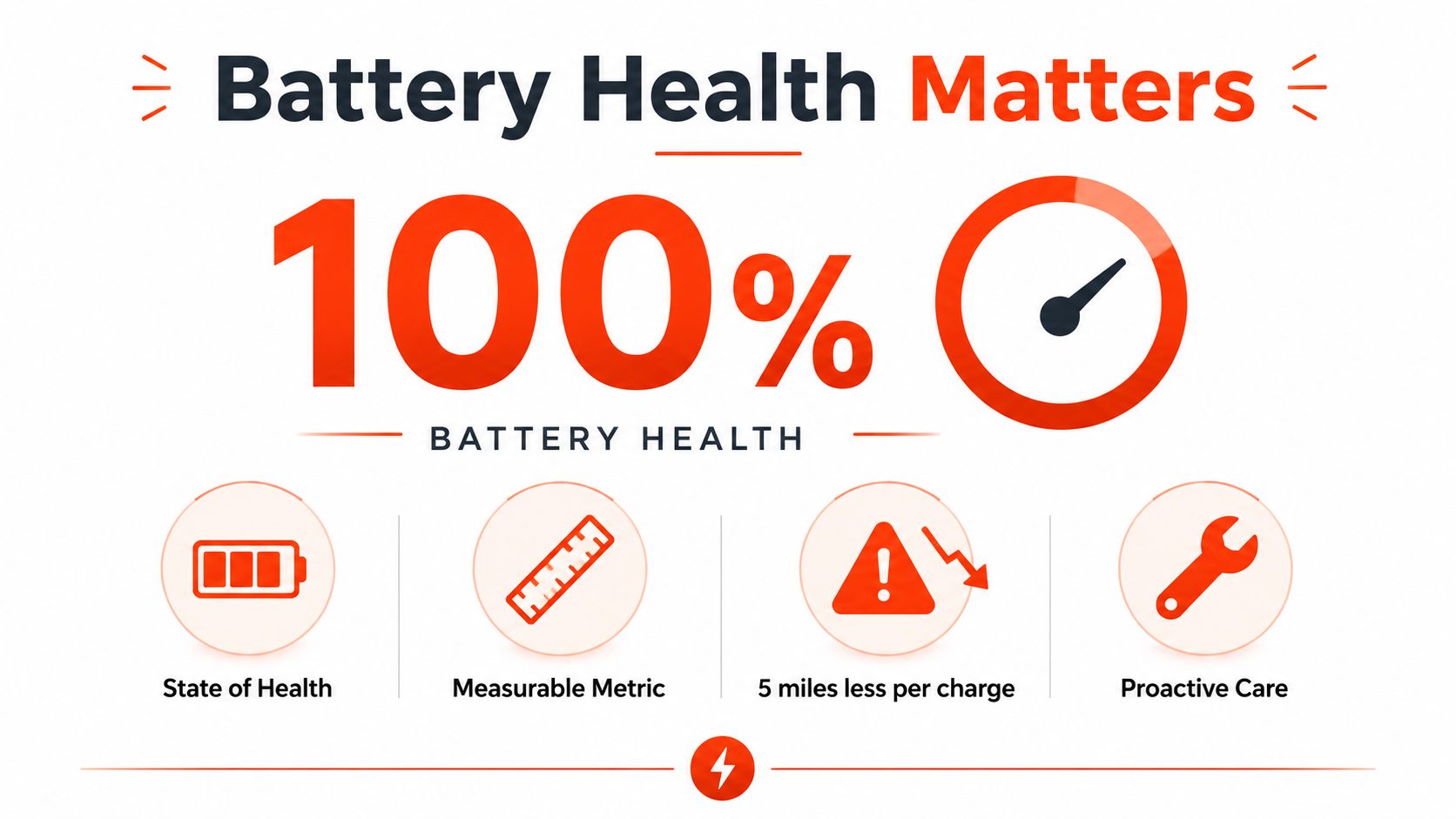
Workshop rule: A range complaint is a symptom. It isn't a battery diagnosis until you've checked conditions, voltage behaviour and battery-management data.
Quick Onboard and App Health Checks You Can Do Today
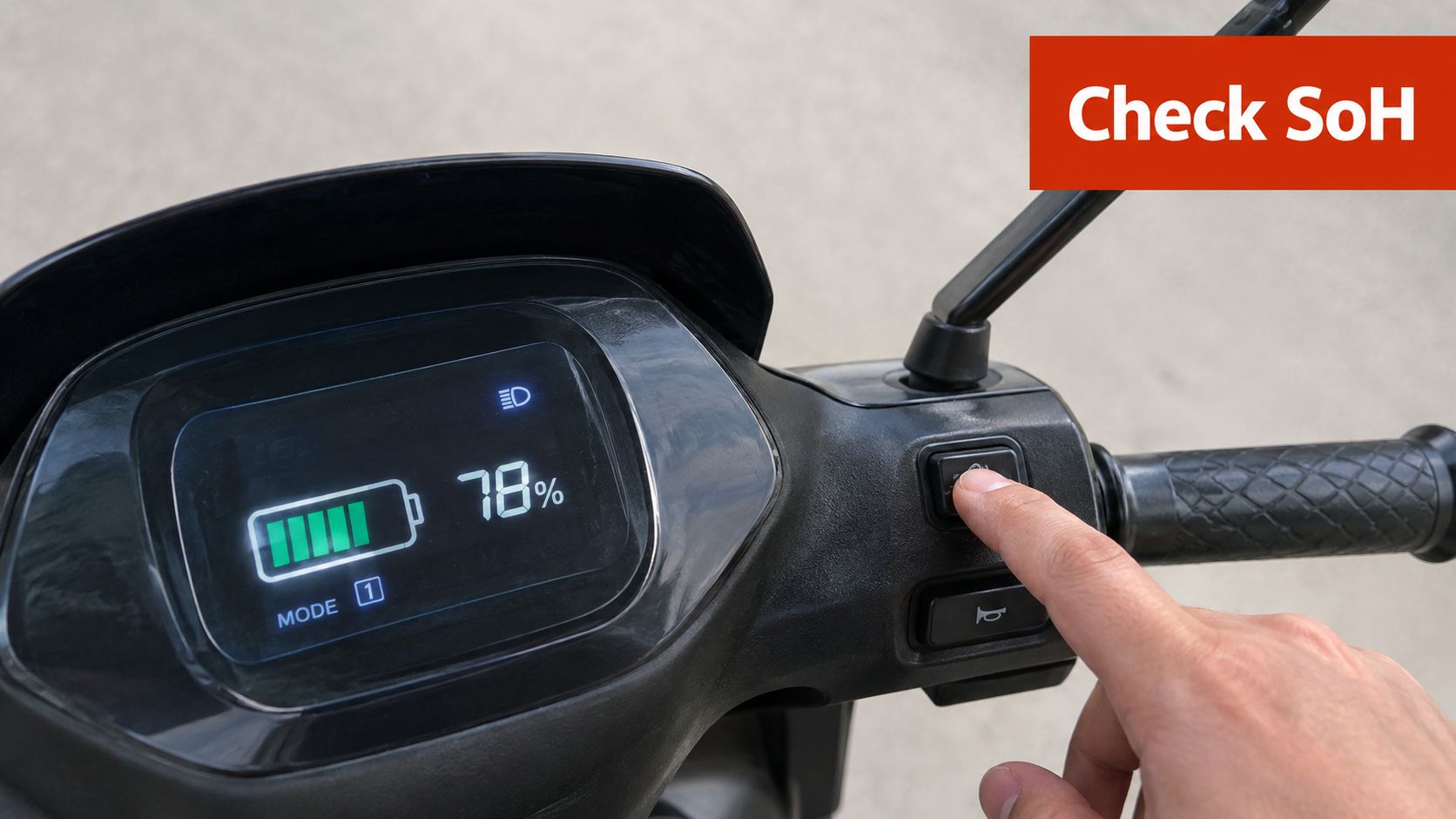
Start with the information the bike already gives you. Put the scooter on charge until the charger indicates completion, allow the system to settle, then check the dashboard before riding. Some models expose a battery-health or service value in settings, while others show only a state-of-charge bar. Don't confuse a bar showing current charge with SoH. One tells you how full the battery is today. The other describes how much capacity it retains compared with new.
A five-minute check
- Read the display carefully. Look for a named SoH percentage, service message, battery temperature, reduced-power symbol or turtle mode. If the display offers only a predicted range, record it with the date, charge level and weather instead of treating it as a health result.
- Open the manufacturer app. Niu, Super Soco, Segway-Ninebot, BMW and Kymco systems can present different combinations of battery status, location, fault notifications, charging information and service records. Some apps expose diagnostics or cycle information, but many consumer apps provide a simplified view rather than raw cell data.
- Check the error history. A battery service warning, repeated communication fault or reduced-power alert deserves more attention than a single low range estimate. Take a screenshot before clearing anything.
- Compare like with like. Charge fully, ride the same route at a similar pace and note the distance covered before the display drops through the same battery levels. Compare the result with the original manufacturer range or WLTP figure, but remember that claimed figures and real-world riding conditions aren't identical.
A small display may not show SoH until the system has accumulated enough operating history, and an app may update more slowly than the bike itself. Treat app data as a useful record, not the final authority. Vodafone's Battery Refresh health-check service and Samsung's Members battery diagnostics illustrate the broader UK approach, built-in checks can flag a problem, but professional testing remains necessary when the result affects safety, value or warranty.
DIY Voltage and Multimeter Tests for Removable Packs
A multimeter can tell you whether a removable pack is reaching a plausible voltage. It can't measure capacity on its own, and it won't identify every weak cell. Use it as a screening test, not as proof that the battery is healthy.
Before touching the terminals, switch the vehicle off, remove the key, disconnect the charger and work on a dry, non-conductive surface. Wear insulated gloves, keep metal jewellery and tools away from the terminals, and stop if the casing is swollen, cracked, hot, wet or damaged. A high-voltage pack can deliver dangerous current even when its voltage looks normal.
Measuring the pack
- Read the nominal voltage on the battery label. A pack described as 48 V, 60 V or 72 V has a nominal rating, not its maximum charging voltage.
- Set the multimeter to DC volts above the expected reading. A 48 V lithium-ion pack reaches roughly 54.6 V when fully charged, while a 72 V pack reaches roughly 84 V. Use the manufacturer's specification where available.
- Identify the main discharge terminals. Place the red probe on positive and the black probe on negative. Don't bridge the terminals with the probe tips.
- Record the reading after the pack has rested for at least two hours. Compare it with the expected state of charge for that battery chemistry, and repeat the check after a normal ride if the manufacturer permits it.
The following table is a practical reference for common lithium-ion moped pack voltages. It's only a broad reference, because cell chemistry, BMS cut-off settings and calibration vary between manufacturers.
Pack Nominal Voltage100% SoC (V)80% SoC (V)50% SoC (V)20% SoC (V)48 V54.652.049.046.560 V67.264.061.057.572 V84.080.073.069.0
A resting result more than 0.5 V below the expected open-circuit voltage is worth investigating further, because it may indicate imbalance or capacity loss. For safe disposal and broader household battery decisions, readers may also find it useful to compare paper shredding options when organising old paperwork and sensitive battery records.
For a real-world example of a larger scooter system, the Vmoto CPX 74V is a 125cc-equivalent electric scooter with an advertised range of up to 87 miles and a top speed of 56 mph. Its higher-voltage architecture reinforces why the meter must be set above the expected maximum and why terminal work should be approached cautiously.
Reading the Numbers and What State of Health Really Means
SoH measures capacity, not every aspect of performance. A battery can retain much of its original energy while developing higher internal resistance. That resistance creates voltage sag when the motor demands current, so the scooter may feel sluggish under acceleration even though the percentage on the display looks acceptable.
Cell drift is another separate issue. A pack contains groups of cells managed together by the BMS. If one group reaches its voltage limit earlier than the others, the BMS may reduce available energy or power to protect it. A capacity test can reveal the overall result, while cell-voltage logging helps identify whether the loss is evenly distributed ageing or a localised fault.
Practical SoH bands
The table below is a decision aid, not a substitute for the manufacturer's test procedure. Expected range depends on speed, temperature, payload, hills and riding mode, so use it alongside a repeatable route and measured energy consumption.
SoH BandExpected Range vs NewTypical Capacity LossRider Action100 to 90%Close to original in comparable conditionsLimited lossContinue monitoring and keep records89 to 80%Noticeably reduced on longer journeysModerate lossPlan routes conservatively and arrange a diagnostic if performance is poor79 to 70%Clearly reduced usable rangeSignificant lossCheck warranty terms and obtain a documented reportBelow 70%Substantially below original capacitySevere loss or possible faultStop relying on estimates and escalate to the dealer or specialist
A UK EV battery study released in February 2026 tested more than 8,000 passenger cars and light commercial vehicles and found average SoH of 95.15% of original capacity. It also reported median SoH of 93.53% for four to five-year-old vehicles, about 85% for eight to nine-year-old vehicles, and commonly 88 to 95% for vehicles with more than 100,000 miles. Those car findings don't transfer directly to a scooter, but they show why age and mileage alone are poor substitutes for measurement. The UK study reporting also notes that manufacturer warranty thresholds are typically around 70% SoH over eight years or 100,000 miles, a useful benchmark when interpreting a report.
Compare a full-charge range with the original specification only after controlling the variables. A cold morning, strong wind or fast riding can produce a lower estimate without permanent degradation. Voltage sag under throttle, repeated power limitation and a large difference between measured capacity and the original specification are stronger reasons to commission a professional test.
When to Book a Professional Battery Diagnostic
DIY checks answer basic questions. They can show whether the pack reaches a sensible voltage, whether the casing looks sound and whether the bike records obvious faults. They generally can't measure usable capacity accurately, log voltage across individual cell groups under load or retrieve every BMS event.
A competent workshop can connect manufacturer software or a suitable independent diagnostic platform to inspect SoH, cell-voltage deviation, fault codes, charge history and thermal-management data. Some specialists perform a controlled discharge or flash-style assessment and issue a certificate. UK testing services describe booking by registration or postcode, connecting an approved tester and receiving a report containing SoH and pack information. Depending on the provider and test type, listed prices are about £39.99 to £100, as shown by Battery Health Check's UK service information.
DIY and workshop checks side by side
DIY checksProfessional diagnosticsResting terminal voltageUsable capacity and SoH assessmentVisual inspectionCell-level voltage deviationDashboard and app recordsBMS fault-code retrievalBasic ride observationInternal resistance and load behaviourCharger and connector inspectionThermal-system and firmware checks
OBD-style dongles are not universal. A generic adapter may communicate with one platform but fail on another, and some manufacturers restrict meaningful battery data to dealer software. NIU, Yadea, Super Soco and Silence models can use different connectors, protocols and access permissions, so verify compatibility before buying a scanner. A workshop should explain exactly what its report measures rather than promising that a short plug-in scan proves the pack's full condition.
Book the test before authorising a replacement pack. Escalate promptly if you find swelling, a BMS lockout, persistent error codes, sudden range loss, repeated reduced-power events or a result relevant to a warranty claim. Independent UK services report coverage across most EV brands, including a stated 96% or more of brands on UK roads, which can help mixed fleets avoid relying entirely on brand-specific menus. Their vehicle coverage and diagnostic detail also illustrates why SoH should be checked alongside cell balance and fault history.
Using Battery Health for Warranty Claims and Pre-Purchase Checks
A warranty conversation goes better when you bring evidence rather than a general complaint that the scooter “doesn't go as far”. Start a dated record. Photograph the dashboard at full charge, save app screenshots, note ambient conditions and record the route, speed, payload and distance for repeat tests.
Build a usable evidence file
- Purchase proof: Keep the original invoice, registration details and warranty terms.
- Service history: Include dealer invoices, software updates and any previous battery inspection.
- Electrical records: Save voltage readings with the test date, battery temperature if available and the meter used.
- Fault evidence: Photograph BMS messages, service lights and reduced-power warnings before anyone clears the codes.
- Diagnostic reports: Ask for SoH, usable and total capacity, cell deviation, fault history and warranty status in writing.
Some UK battery reports can show the months and miles of battery warranty remaining, whether cover is active, usable and total capacity in kWh, and the original WLTP range. EVallDay's battery report information demonstrates the value of having those fields together, although your scooter manufacturer may provide a different report format. For a three-year warranty, check the exact terms for exclusions, servicing, charger use and approved repair routes rather than assuming every capacity complaint qualifies.
For a used scooter, spend half an hour checking the machine cold. Confirm the starting voltage, inspect the full-charge voltage, test throttle response away from the stand, ride a known loop and ask how the owner stored and charged the pack. Request the charger, look for heat marks around connectors and ask whether the battery has ever been replaced, locked by the BMS or left unused for long periods.
Evidence matters: A dated pattern of repeat readings gives a dealer something they can investigate. One screenshot taken after an unusually cold ride usually doesn't.
A seller who refuses an independent battery check is giving you useful information. UK buyer guidance confirms that SoH can often be read through the OBD port in minutes, while a full-charge range comparison can provide a practical fallback when no percentage is available. Honest John's used-EV battery advice explains that dashboard and menu access varies, so insist on a test method that matches the vehicle.

Maintenance Habits That Extend Real-World Battery Life
Battery care doesn't require laboratory-perfect behaviour. It requires avoiding the routines that repeatedly keep a pack hot, completely full or completely empty.
For daily commuting, charge to a partial level such as 80 to 90% when your route allows it. Use a full charge before a long trip rather than leaving the scooter at 100% for days. Occasional fast charging is reasonable when you need it, but routine high-power charging combined with heat creates a harsher operating pattern than slower charging in a cool environment.
Make storage less demanding
Keep the moped or removable pack indoors during cold snaps, away from direct summer sunlight and damp storage areas. For a winter lay-up, leave the battery around 40 to 60% state of charge, check it periodically and follow the manufacturer's instructions for its storage mode. Don't place a visibly damaged or swollen pack indoors. Isolate it safely and contact the dealer or an approved battery specialist.
Riding style affects the load placed on the cells. Repeated full-throttle launches, steep hills with a heavy payload and sustained high speed demand more current than gentle acceleration, especially when the battery is cold. Delivery riders should pay attention to this because frequent stop-start work can combine high load, repeated charging and limited cooling time.
Keep connectors clean and dry, and inspect them for looseness, discolouration or heat damage. Install firmware updates through the manufacturer app when the supplier says they're compatible, because updates can improve BMS reporting or address known faults. A periodic full charge may also allow the BMS to balance cells, but follow the model's instructions instead of leaving the pack unattended on charge.
For a wider explanation of practical charging and storage habits, DME Superstore's battery advice is a useful supplementary reference. The most effective routine is simple: record unusual changes early, avoid needless heat, store sensibly and arrange a diagnostic before a small performance complaint becomes a costly pack decision.
Flex Electric supplies electric mopeds, scooters and motorbikes, including new and pre-owned models, with real-world specification advice and after-sales support. If you're comparing a scooter, checking battery warranty considerations or arranging your next electric two-wheeler, visit Flex Electric to speak with the team and explore suitable models.
Find us
You will find us at 74 Dalry Road, Edinburgh, EH11 2AY
Showroom Opening Times:
Monday: By Appointment
Tuesday to Friday: 11am - 5:00pm
Saturday: 10am - 5pm
Sunday: By Appointment
