
How to Extend Battery Life on Your Electric Motorcycle
Flex Electric
The UK's #1 Electric Moped and Electric Motorbike dealer.

Wondering how to squeeze every last mile out of your electric motorcycle's battery? The good news is, modern batteries are tougher than you think. A few simple habits around charging, riding, and storage can make a huge difference, ensuring your battery doesn't just last, but performs brilliantly for years to come.
The Truth About Your Electric Motorcycle's Battery
Let's get one thing straight. A lot of riders, whether they're commuting on a Super Soco or hitting the trails on an off-road electric motorcycle, worry about battery degradation. There’s a lingering myth that an electric motorcycle’s battery has a short, fragile life, destined for a costly replacement and a frustrating drop in range. The reality is much more encouraging.
The lithium-ion batteries in today's electric mopeds and motorcycles are built for the long haul. Brands like Vmoto, Horwin, and LiveWire pour resources into sophisticated Battery Management Systems (BMS). Think of the BMS as your battery's personal bodyguard; this tiny onboard computer constantly monitors and regulates everything from charging speed to temperature, protecting it from damage and stretching its lifespan. It’s the main reason those horror stories of batteries dying after just a year or two are mostly a thing of the past.
Understanding Real-World Battery Lifespan
Instead of picturing a battery that suddenly fails, it’s better to think of its ageing as a slow, graceful process. Over thousands of miles and hundreds of charge cycles, its total capacity will gradually decrease, but this decline is typically very slow. For the average rider—be it a delivery pro covering dozens of miles a day or a parent with a kids' motocross bike—the change in performance is often barely noticeable from one year to the next.
Recent data paints a very reassuring picture. While the research includes cars and vans, the fundamental battery tech and the way it ages are directly applicable to good quality electric motorcycles.
A landmark 2026 study in the UK, the largest of its kind, analysed over 8,000 used electric vehicles. It found the average battery State of Health (SoH) was a remarkable 95.15% of its original capacity. Even after 160,000 miles, many batteries still held nearly 90% of their health.
This just goes to show that modern batteries are incredibly resilient. For a rider, this means less range anxiety and a lower total cost of ownership over your motorcycle's lifetime. You can dive into the complete findings in the 2026 Battery Performance Index to see just how well these batteries hold up.
What This Means for Your Ride
So, what does this all mean for you? Knowing your battery is robust is the first step. The rest of this guide is about giving you practical, simple tips to help you extend that life even further. These aren't drastic measures, just small tweaks to your routine that protect your investment. With a few smart habits, you can keep your electric motorcycle, moped, or off-road bike running reliably for many, many years.
These strategies are a game-changer for:
- Daily Commuters: Ensuring your motorcycle is always ready for the morning trip with a predictable range you can count on.
- Delivery Riders: Maximising your uptime and earnings by minimising battery wear during long, demanding days.
- Enthusiasts: Preserving the punchy acceleration and peak performance of high-end models like the LiveWire S2 or Vmoto Stash.
- Weekend Riders: Keeping your off-road or kids' bike in top shape, even when it’s not used frequently.
By following these practices, you're doing more than just preserving range—you're actively looking after the heart of your electric vehicle, ensuring it stays a dependable and cheap-to-run part of your life.
Before we dive into the details, here's a quick cheat sheet summarising the most effective things you can do to keep your battery healthy.
Quick Answers to Maximise Your Battery Life
ActionImpact on Battery LifeBest for...Avoid deep dischargesHighRiders who often run their battery to empty.Don't store at 100% chargeHighAnyone leaving their motorcycle unused for over a week.Charge in moderate temperaturesMediumEveryone, especially during very hot or cold weather.Use regenerative brakingMediumCity commuters and riders in hilly areas.Perform regular tyre checksLowAll riders looking for easy efficiency gains.
This table gives you the highlights, but the real magic is in understanding the 'why' behind each action. Let's get into the specifics.
Mastering Your Charging Routine for Peak Performance
When it comes to the long-term health of your electric moped's battery, how you charge it is the single biggest factor. Forget the generic advice you might have heard; let's get into what really works for UK riders and will genuinely help you extend its life.
Think of your lithium-ion battery like an athlete. Constantly pushing it to its absolute maximum (100% charge) or running it completely empty (0% charge) puts it under serious stress. While the motorcycle's Battery Management System (BMS) does a great job of preventing immediate damage, repeating these extremes will slowly but surely wear the battery down.
The 20-80 Percent Sweet Spot
The real secret to a long and happy battery life is simply avoiding those extremes. For a lithium-ion battery, the sweet spot is keeping its state of charge (SoC) somewhere between 20% and 80%. This isn't just a random tip; it's rooted in the chemistry of the battery cells. Staying in this range minimises stress and can dramatically slow down natural degradation.
For someone commuting on a Super Soco CPx, that might just mean plugging in after work and unplugging before it’s completely full. If you're a delivery rider, it could be a quick top-up during your lunch break instead of running the battery into the red. It's a small change in habit that pays off massively in the long run.
This isn't just theory, either. A recent UK-focused analysis in 2024 by Geotab found that modern electric vehicle batteries now degrade at just 1.8% per year on average. The study backs up the benefit of keeping the charge between 20-80%, confirming this 'sweet spot' is key to minimising cell stress. You can dig into their data and see how electric cars are proving their reliability by reading their breakdown of the findings.
The old myths about charging just don't apply to modern batteries anymore.
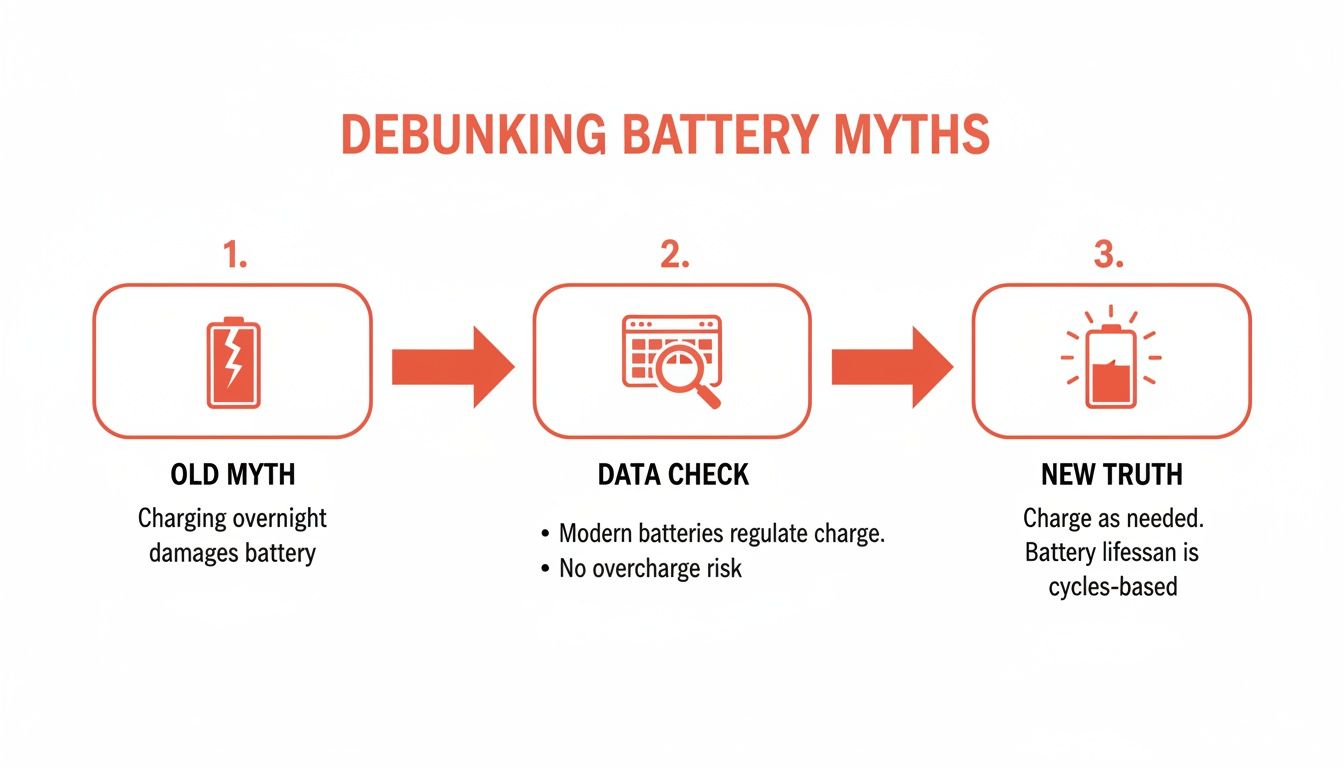
As you can see, outdated fears like overnight charging causing damage have been replaced by the reality that smart systems regulate everything. A battery's lifespan today is far more about charge cycles than how long it stays plugged in.
Fast Charging Versus Home Charging
The whole fast-charging versus home-charging debate really comes down to using the right tool for the job.
- Standard AC Charging (Your Home Charger): This is your battery’s best mate for everyday use. The slower, gentler current generates less heat and puts very little strain on the cells. It’s perfect for overnight charging or topping up at home or the office.
- DC Fast Charging (Public Rapid Chargers): These are a lifesaver when you're short on time or on a long trip. The catch is that frequent use of high-power DC chargers, particularly in warm weather, can speed up battery degradation because of the extra heat and current involved.
I tell riders to think of it like this: your standard charger is a balanced, healthy meal for your battery. A fast charger is an energy drink—fantastic when you need a quick boost, but not what you should be relying on every day.
Expert Tip: If you're a delivery rider needing a mid-shift boost, use a fast charger just enough to get you through your shift. Instead of going from 10% to 100%, maybe a 20-minute zap from 30% to 70% is all it takes. This simple trick minimises the time your battery spends at high temperatures and high states of charge.
Tailoring Your Routine to Your Riding Style
There's no single "best" charging schedule. Your ideal routine depends entirely on how you use your bike, whether it's a nimble moped for city runs, a rugged off-roader, or even a kids' motocross bike.
- The Daily Commuter: If a typical day uses up about 30-40% of your battery, there's no need to charge to 100% every night. Just bring it up to 80%, and you're sorted. This one habit will make a huge difference over the years.
- The Delivery Rider: Your battery is a workhorse. Try to wrap up your shift with at least 20% charge remaining. Stick to slower AC charging overnight and only use fast chargers for those crucial mid-day top-ups. This balanced approach helps offset the heavy wear from intensive use.
- The Weekend Enthusiast: If your off-road electric motorcycle is going to sit unused for a while, how you store it is critical. Never leave it fully charged or nearly empty. The ideal storage level is around 50-60%, which keeps the cells in a stable, low-stress state. Just check it once a month and give it a small top-up back to this level if it's dropped.
By getting a feel for these principles and tweaking them for your own needs, you're not just squeezing more miles out of each charge—you're actively investing in the future performance and longevity of your electric motorcycle.
Ride Smarter to Boost Range and Battery Health

How you ride has a huge, immediate impact on your battery's range and its long-term health. This isn't about crawling everywhere; it's about being clever with your inputs. The way you handle the throttle and brakes can genuinely change how many miles you squeeze out of each charge.
Think of your battery like a fuel tank. Aggressive, jerky riding empties it fast. Smooth, predictable riding, on the other hand, conserves that precious energy. By getting a few smart habits dialled in, you can put less strain on the battery, giving you more range day-to-day and helping it last for years.
Tame Your Throttle for Maximum Efficiency
Sudden, hard acceleration is the number one enemy of your battery range. Every time you yank the throttle wide open from a standstill, you're demanding a massive surge of power. It's fun, no doubt, but doing it constantly puts a lot of stress on the battery cells.
A much better way is to be smooth and progressive. Instead of launching like a drag racer from every traffic light, just ease into it. This gentler power draw is much kinder to your battery and uses far less energy to get up to speed. You'd be surprised how much extra range this one change can give you, especially if you do a lot of stop-start city riding.
This idea of efficiency isn't just for vehicles. Once you start thinking about how to get the most from your power, you'll see the same principles everywhere. You can even explore options for general energy efficiency upgrades in other areas to see how these concepts apply on a wider scale.
Master the Art of Regenerative Braking
One of the cleverest features of any electric moped or motorcycle is regenerative braking. When you roll off the throttle or gently apply the brakes, the motor essentially runs in reverse. It becomes a generator, turning your forward momentum back into electrical energy and feeding it back into the battery.
Learning to use regen effectively can add a noticeable amount of charge back into your battery. Here's how to get the most out of it:
- Look Ahead and Anticipate: Don't wait until the last second to brake. Spot the red light or slowing traffic early and simply roll off the throttle. This gives the bike maximum time to regenerate power as it slows.
- Tweak Your Regen Settings: Many electric motorcycles let you adjust how strong the regenerative braking feels. A higher setting gives you more "engine braking" and recaptures more energy, which is perfect for busy city streets.
- Feather the Brakes: When you do need the brakes, get used to a light initial touch. This often engages the regen system fully before the physical disc brakes even bite, saving energy and reducing wear on your brake pads.
For a delivery rider on a Vmoto, mastering regenerative braking in a city like London or Manchester could mean recapturing enough energy to complete an extra delivery or two before needing a charge. It’s free energy that you create just by riding smarter.
Plan Your Route and Manage Your Load
Beyond how you twist the throttle, a little forward planning goes a long way. The shortest route isn't always the most efficient one. A route with fewer steep hills and less stop-start traffic might actually use less battery, even if it's a bit longer.
Your payload matters, too. An electric moped loaded up with a heavy delivery box or an off-road motorcycle carrying extra kit has to work harder. While that's often part of the job, be mindful of any unnecessary weight. Every extra kilogram requires more energy to get moving, which eats directly into your range. Keep your load as light as you practically can.
Protecting Your Battery from the UK Weather
The British weather, with its damp, biting winters and surprisingly fierce summer heatwaves, plays a huge role in your battery’s long-term health and day-to-day performance. Lithium-ion batteries have what you might call a ‘Goldilocks’ zone – they work best when it’s not too hot and not too cold. Getting this right is key to protecting your investment.
Think of it this way: extreme cold slows down the chemical reactions inside the battery, which you’ll feel as a noticeable, temporary drop in range. On the flip side, excessive heat speeds up those reactions, which sounds good but actually causes faster, permanent degradation.
Taming the Winter Chill
Anyone who’s ridden an electric moped through a proper British winter knows the main challenge: range anxiety. It’s not your imagination; your range can temporarily plummet by as much as 20-30% in near-freezing conditions. This isn't permanent damage, but you definitely need a strategy to manage it.
Here’s how you can fight back against the cold:
- Bring it indoors. If you have a removable battery, always bring it inside to charge. Charging a freezing-cold battery is inefficient and puts a lot of stress on the cells. Just letting it warm up to room temperature first makes a world of difference.
- Shelter your moped. The best thing you can do is park in a garage or shed. Keeping the whole bike, and therefore the battery, out of the worst of the cold means it starts its day much happier and with more available power.
- Get a battery 'jacket'. For all-weather commuters and delivery riders, an insulated battery cover can be a game-changer. It helps trap the heat the battery generates while you’re riding, protecting it from the wind chill.
If you have to park outside, at least try to find a spot that’s sheltered from the wind and rain. Even a good quality waterproof cover provides more protection than you'd think, keeping the worst of the damp and cold away from your battery and electronics.
Surviving Summer Heatwaves
While they might not last as long, our summer heatwaves can actually be more damaging than the cold. High temperatures cause irreversible capacity loss, meaning your battery’s maximum range will permanently decrease.
When the mercury climbs, your strategy is simple: keep your battery as cool as you can.
- Chase the shade. This one’s non-negotiable. Direct sunlight can turn your motorcycle’s bodywork into an oven, literally baking the battery inside. Always find a shady parking spot, even if it means a slightly longer walk.
- Charge at cooler times. If you charge outdoors, do it in the early morning or evening. Charging creates its own heat, and adding scorching midday sun into the mix is a recipe for unnecessary strain.
- Give it a breather. After a long ride on a hot day, let your battery sit for at least 30 minutes before plugging it in. This gives its internal temperature a chance to stabilise, leading to a much healthier and more efficient charge cycle.
A Quick Checklist for Every Season
To make things simple, here’s a quick rundown of the most important seasonal tasks. Following these basic checks will go a long way in keeping your battery in top condition, whether you're battling winter frost or a summer scorcher.
Seasonal Battery Care Checklist
SeasonKey ActionWhy It's ImportantWinterBring removable batteries inside to charge and store.Avoids charging a freezing battery, which can cause stress and damage to the cells.WinterCheck tyre pressure more frequently.Cold air causes pressure to drop, increasing rolling resistance and reducing your range.SummerAlways park in the shade, never in direct sunlight.Prevents the battery from overheating, which causes permanent capacity loss.SummerWait 30 minutes after a ride before charging on hot days.Allows the battery to cool down, ensuring a safer and more efficient charging cycle.
Sticking to these simple habits will help you get the best possible performance and lifespan out of your battery, no matter what the unpredictable UK weather throws at you.
Long-Term Storage Done Right
Putting your electric motorcycle away for the winter? How you store it is absolutely critical. Just leaving a battery fully charged or, even worse, completely empty for months on end is a surefire way to cause permanent damage.
The sweet spot for long-term storage is a state of charge between 50% and 60%. This puts the least amount of stress on the battery's internal chemistry. Store the bike (or just the battery, if it's removable) somewhere cool and dry – a garage is ideal, but a dry shed or utility room works too.
Make a note to check the charge level every month or so. If it has dipped below 40%, give it a quick boost to get it back up to that 50-60% range. This little bit of maintenance prevents a deep discharge, which can be fatal for a lithium-ion battery. Do this, and your bike will be ready to go the moment you are.
Essential Maintenance That Supports Your Battery

It’s easy to think that battery life is all about charging, but that's only half the story. A well-oiled machine is an efficient one, and efficiency is your best friend for squeezing more miles out of every charge and reducing long-term strain on your battery.
Think of it this way: trying to run with your shoelaces half-undone. You'd get exhausted much quicker, right? It’s the same principle for your moped. If parts are creating unnecessary friction or drag, the motor has to work overtime, pulling extra power from the battery just to keep you moving.
Mechanical Health is Battery Health
This is where a little basic upkeep pays massive dividends for your battery. These simple, regular checks are all about reducing the effort your motor has to put in, which means less wasted energy.
Here are the three big ones I always tell riders to focus on:
- Proper Tyre Pressure: Under-inflated tyres create a wider contact patch with the road, which massively increases rolling resistance. Your motor has to fight that resistance, draining the battery much faster. Check your pressures weekly. It’s the single easiest and most effective thing you can do.
- Brake Function: A dragging brake, even a slight one, is like riding with the handbrake constantly on. It creates a persistent friction that your motor has to battle against. Spin your wheels by hand and make sure they move freely, and check that your brake callipers aren't sticking.
- Clean and Tensioned Drive System: Whether you have a chain or a belt, it needs to be clean, correctly lubricated, and properly tensioned. A dirty, loose, or overly tight chain is incredibly inefficient and wastes energy with every single rotation of the wheel.
A simple routine of weekly tyre checks and monthly brake and chain inspections can do more than just boost your daily range; it actively contributes to a longer-lasting battery. It ensures your bike is working with you, not against you.
Keeping Your Bike’s Brain Up to Date
Your moped's firmware isn't just for the display—it’s the software that controls the entire bike, including the crucial Battery Management System (BMS). Manufacturers like Vmoto and Horwin regularly release updates to improve performance, fix bugs, and, most importantly, refine how the battery is managed.
Think of these updates as a tune-up for your bike’s brain. They often tweak the algorithms that control power delivery and regenerative braking, helping you squeeze a little more range out of the exact same battery. When an update pops up, always install it.
Demystifying Your Battery Warranty
Understanding your warranty isn't just about the fine print; it's about peace of mind. Here at Flex Electric, every bike we sell includes a 3-year battery warranty. This is our promise that the heart of your bike will perform as it should.
A good warranty will cover you against premature failure or a significant drop in capacity that goes beyond normal ageing. For example, if your battery's maximum capacity falls below a certain point (often 70-80%) within the warranty period, you'd be covered for a repair or replacement. It’s a vital safety net.
Of course, even the best warranty doesn't replace good habits. Industry data backs this up. While the average UK driver covers just 142 miles a week, battery anxiety is common. Yet, data from 36 manufacturers shows that even 8 to 12-year-old EV batteries hold around 85% of their original capacity on average. Fleets that are serious about maintenance have even seen their operating costs fall by up to 40%. As detailed in this RAC breakdown of EV statistics, looking after your vehicle truly pays off.
This all proves that a few simple maintenance habits can easily keep your battery performing above 90% of its original capacity for years to come.
Your Top Electric Motorcycle Battery Questions Answered
Even after you've got the basics down, a few questions always pop up about keeping your battery in top nick. Let's get straight into the ones we hear most often from riders here in the UK, with some honest, real-world advice.
Is It Bad to Leave My Moped Charging Overnight?
This is the big one, and the short answer is: no, not really. Any modern electric moped or motorbike from a reputable brand like Super Soco, Horwin, or Vmoto will have a smart Battery Management System (BMS). Think of it as a built-in safety net that automatically cuts the power once the battery hits 100%, so you can’t overcharge it.
That said, for the absolute best long-term health, you don’t want your battery sitting at a full 100% all the time. If you can, make it a habit to charge to around 80-90%. Some bikes and chargers even have a setting for this, which is brilliant. But if yours doesn't, don't lose sleep over it. Charging overnight is a thousand times better than constantly running it down to zero.
How Much Range Will I Actually Lose Over Time?
Good news here – the drop-off is surprisingly slow. Based on recent UK data, you can expect a gradual decline of about 1.8% per year, assuming you're looking after it. On a bike that started with a 100-mile range, that’s less than two miles of range lost after a full year's riding.
Fast forward five years, and your battery should still hold over 90% of its original capacity. Your 100-mile bike would still be getting you around 90 miles on a full charge in the same conditions. For most of us, whether we’re nipping around the city or watching the kids on their electric motocross bikes, that slow degradation is barely noticeable day-to-day.
The core principles of battery ageing are pretty universal. To get a wider perspective on lifespan and the factors at play, it's interesting to look at how other technologies hold up, including how long solar batteries last, as many of the same concepts apply.
Can I Use a Fast Charger When I’m in a Hurry?
Absolutely. Fast chargers are a lifesaver, and they’re designed to be used when you need that speed. The key is just not to rely on them for every single charge.
All that extra speed generates more heat and puts the battery cells under a bit more strain than a standard, slow AC charge. I always tell people to think of it this way: your standard home charger is your battery's healthy, everyday meal. A DC fast charger is an energy drink – perfect for a quick boost when you need it, but not what you want to live on. Save it for those long-haul journeys or a critical top-up if you're a delivery rider trying to squeeze in more jobs.
What If I Don’t Use My Bike for a Few Months?
If you’re packing the bike away for winter or just not using it for a while, a little prep goes a long way. The worst things you can do are leave it completely full or totally empty – both are a fast track to damaging the battery permanently.
The sweet spot for storage is between a 50% and 60% charge. This is the happy place for battery cells, putting them under minimal stress.
- Get the battery into that 50-60% range.
- Store it somewhere cool and dry – a garage or shed is perfect. If the battery is removable, you can just bring that inside.
- Check the charge level every month or two. If it’s dropped, just give it a little boost to get it back up to that 50-60% mark.
Doing this simple routine means your bike will be healthy and ready to go the moment you are.
At Flex Electric, our job is to make your move to electric as simple as possible. Whether it's giving straight-talking advice or backing every bike we sell with a 3-year battery warranty, we're here to help. Check out our hand-picked range of electric mopeds, motorcycles, and off-road bikes at https://www.flexelectric.co.uk and find your perfect ride.
Find us
You will find us at 74 Dalry Road, Edinburgh, EH11 2AY
Showroom Opening Times:
Monday: By Appointment
Tuesday to Friday: 11am - 5:00pm
Saturday: 10am - 5pm
Sunday: By Appointment
