
How to Reduce Operating Costs: UK Motorcycle & Moped Guide

Flex Electric
The UK's #1 Electric Moped and Electric Motorbike dealer.

If you're riding all day, or running a small business that relies on bikes for local jobs, you already know where the pressure lands. Fuel keeps climbing, servicing never seems to stop, and one unexpected repair can wipe out a week's margin. For commuters, it's the same story in a different form. The bike gets you through traffic, but the monthly costs keep following you home.
That's why how to reduce operating costs starts with transport, especially if you're still on a petrol motorcycle or moped. For many UK riders, delivery businesses, and urban operators, the biggest gains don't come from trimming office supplies or shopping around for a slightly cheaper policy. They come from auditing what your current bike really costs, then cutting the parts of that bill that hit every week.
First Pinpoint Your Biggest Cost Drains
A London commuter tops up £15 here, replaces a rear tyre sooner than expected, pays for parking twice a week, then loses a morning to a workshop visit. A delivery rider does the same on a larger scale. The problem is not one dramatic bill. It is the stack of recurring costs that turn a cheap-looking petrol bike into an expensive work tool.
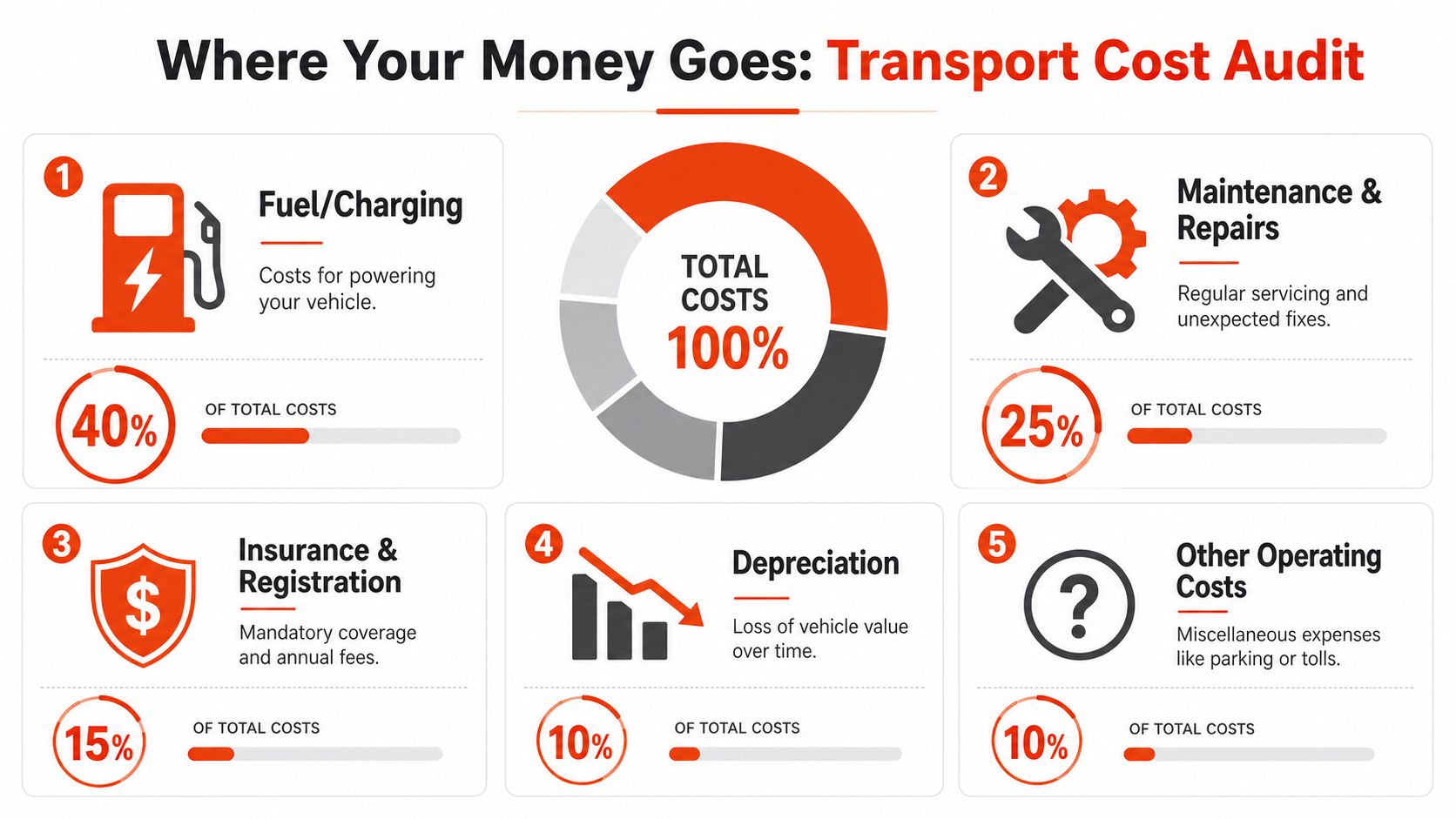
For UK riders and small businesses, this step matters because transport costs are often judged by fuel alone. That misses the parts that hit cash flow every month. Oil, filters, chain kits, tyres, brake wear, parking, insurance, finance, and downtime all belong in the same picture. If you want to cut operating costs properly, start by measuring the full running cost of the bike you already use.
Build a real monthly cost profile
Keep it simple. A spreadsheet, a notes app, or a paper logbook is enough if you update it every week.
Track these categories every month:
- Fuel spend: Log every fill-up.
- Routine servicing: Oil, filters, plugs, chain care, belts, and labour.
- Repairs and wear items: Tyres, brake pads, battery replacement, electrical faults, and exhaust work.
- Fixed costs: Insurance, registration, parking permits, and finance payments.
- Downtime cost: Missed shifts, delayed jobs, or the cost of hiring a backup vehicle.
Practical rule: If a cost shows up more than once a quarter, treat it as part of normal operating cost.
Cost analysis reveals distinct patterns. A commuter may find parking and short-trip wear matter more than expected. A courier usually sees fuel, tyres, servicing frequency, and lost earning time rise to the top. For a small business running two or three bikes, the same exercise often exposes one machine that is costing far more per mile than the rest.
If you are comparing petrol against electric, include charging setup in the numbers as well. Home charging can be cheap to run, but installation cost still affects the first-year picture. Stay Grounded Electric EV charger costs gives a useful overview of what to budget for on the charging side.
Look for the costs that repeat most often
A single repair bill gets attention. Repeating weekly spend does more damage over a year.
Use this check:
Cost areaWhat to reviewWhy it mattersFuelWeekly total and route typeSmall daily spend is easy to ignoreServicingFrequency and workshop timeLabour cost and lost working time add upTyres and brakesReplacement patternHeavy urban use wears them fasterInsuranceRenewal terms and declared useCourier and business use can raise the premiumMiscellaneousParking, tolls, cleaning, accessoriesThese leak cash
The goal is not a perfect finance model. The goal is to find the costs you can change. Once you have a clear monthly baseline, decisions about replacing a petrol bike, keeping a spare battery, or changing how the bike is used become far easier and far more grounded in real numbers.
Make the Switch to an Electric Motorcycle
A London courier doing six days a week can feel the cost difference fast. Petrol spend keeps ticking up, service bookings eat into working hours, and small mechanical jobs turn into lost shifts. Electric changes that cost structure in a way generic "reduce overheads" advice usually misses.
Why electric changes the maths
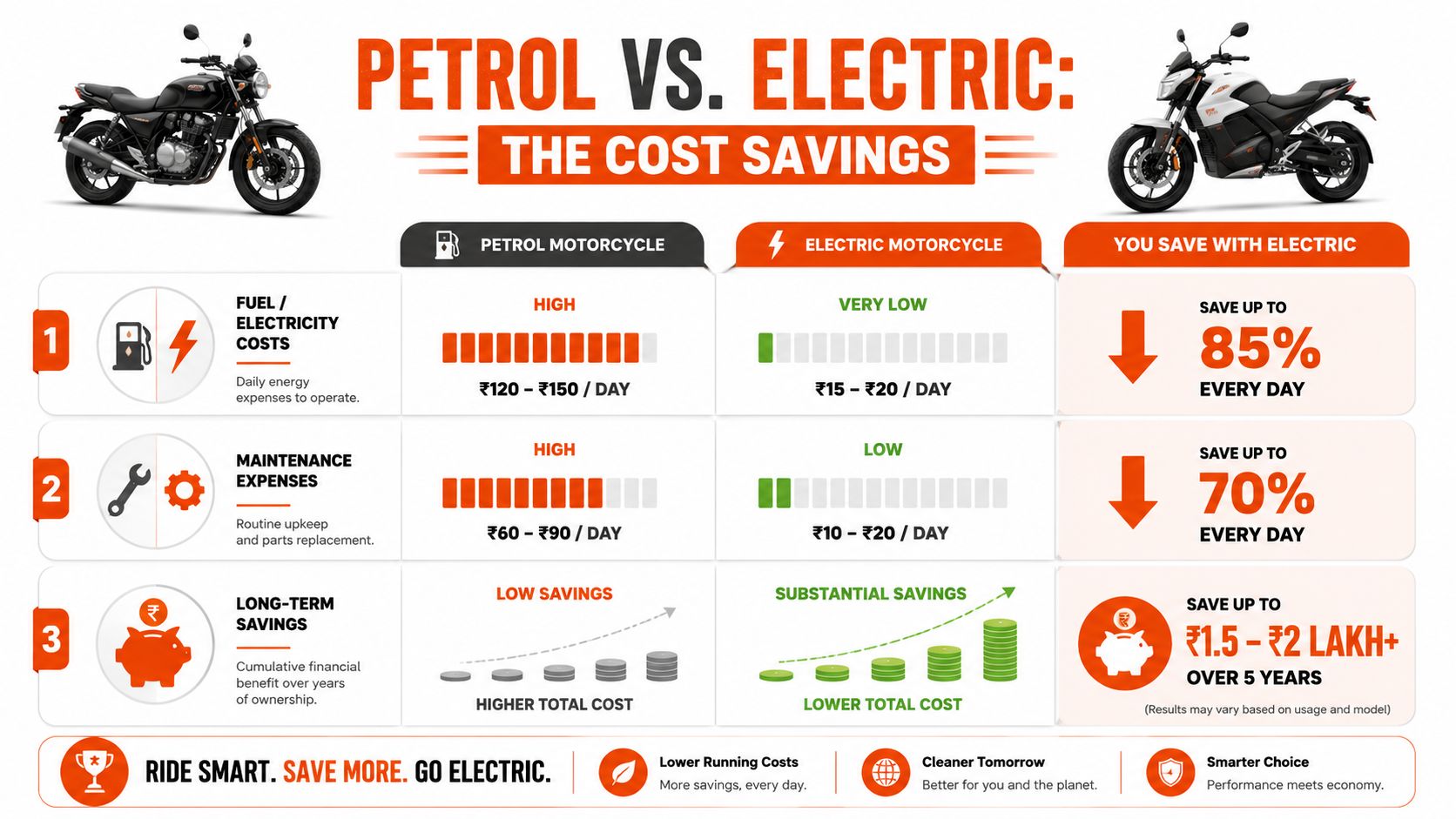
For UK riders and small businesses, the main gain is lower cost per working mile. This guide to operational efficiency cites UK government running-cost examples showing a typical electric vehicle at about 2-4 pence per mile in electricity, compared with around 12-15 pence per mile for a petrol equivalent. It also notes lower servicing and maintenance costs because electric drivetrains have fewer moving parts.
That advantage is strongest in exactly the kind of work many Flex Electric customers do. Local deliveries, commuter runs into town, estate management, campus use, and short repeat journeys with plenty of stop-start traffic. Petrol engines are least efficient there. Electric bikes are usually at their best there.
The savings are not only about energy.
Routine ownership is simpler:
- No oil changes: one regular workshop cost disappears.
- No spark plugs or exhaust system maintenance: fewer parts to replace and fewer faults tied to engine heat and vibration.
- Less drivetrain complexity: fewer wear points than a petrol bike with a conventional engine setup.
- Better low-speed control: useful for traffic, repeated drop-offs, and urban riding where smooth pull-away matters.
A short video helps show why more riders are making that switch:
Electric is not maintenance-free. Tyres, brakes, suspension, bearings, and consumables still matter. Battery charging discipline matters too. But for many urban riders, the expensive, repetitive petrol-bike jobs are reduced or removed, and that is where the operating-cost case gets strong.
Which electric bike fits the job
Buying the wrong type wipes out part of the saving. I see this most often when riders shop by headline range or top speed and ignore the actual pattern of use.
For urban commuting, a 50cc- or 125cc-equivalent electric moped is often the lowest-cost entry point. It suits shorter daily mileage, is easy to park, and keeps charging simple if you have access to home or workplace power.
For delivery work, choose around the job, not the spec sheet. A practical electric moped or motorcycle with storage options, predictable real-world range, and reliable charging access usually beats a faster bike that costs more to buy and spends more time off the road. For small businesses running several vehicles, uptime matters more than brochure numbers.
Off-road and private-land users have a different calculation. Off-road electric motorcycles and kids motocross bikes cut fuel storage, engine servicing, and a lot of the noise and hassle that come with petrol ownership at home or on-site.
Charging setup still needs to be priced in properly, especially in year one. Stay Grounded Electric EV charger costs gives a useful overview of what can affect installation cost if you are comparing a basic plug-in routine with a dedicated home charger.
Optimise Your Routes and Charging Strategy
It is 5pm, the dinner rush is starting, and one rider is crossing town for a single low-value drop while another is hunting for a public charger because they left it too late. That is how savings disappear. With electric, the gains come from disciplined route planning and a charging routine that fits the job.
Shorter routes beat faster riding
For UK delivery riders and small operators, cost control usually starts with density, not speed. A compact round with predictable stops will nearly always outperform a scattered shift full of dead miles, missed turns, and battery-draining sprints between jobs.
I see the same mistake repeatedly. Riders focus on top speed or headline range, then accept work spread across a patch that is too wide to run efficiently on a small electric bike. The result is more time off the throttle, more time stuck in traffic, and more reliance on expensive or inconvenient top-up charging.
A better approach is simple.
Group jobs by area. Build repeatable local rounds. Keep each rider inside a sensible zone if you manage a small fleet. In urban work, fewer empty miles usually matter more than shaving a few minutes off a single run.
A quick route review should answer:
- Which jobs create dead running: Some drops only look profitable until you include travel time and return distance.
- Where delays happen every day: Congested junctions, awkward parking, slow restaurant handovers, and access-controlled buildings all add hidden cost.
- Which areas suit batch work: Dense town-centre or neighbourhood runs tend to suit electric mopeds and motorcycles far better than wide suburban scatter.
- When bikes sit idle: If a vehicle is parked waiting between jobs, that is lost earning time and poor asset use.
For commuters, the principle is the same. The cheapest trip is usually the one with the fewest unnecessary miles, not the one ridden hardest.
Charging strategy matters as much as the bike
Charging needs the same level of planning as the route. Riders who charge cheaply and consistently usually spend less than riders who rely on public charging to rescue a poor schedule.
For most solo riders, the lowest-cost pattern is straightforward. Charge at home, at your business unit, or at a regular base whenever possible, then use public charging as backup. Public infrastructure helps, especially for riders without off-street charging, but it should support your plan rather than become the plan itself. Zapmap's UK charging statistics are useful if you want to check how coverage is improving in your area.
The trade-off is practical. Cheap charging often means slower, planned charging at home or base. Convenient charging on the road can save a shift, but it usually costs more and can add waiting time exactly when the bike should be earning.
That is why I advise riders and small businesses to set rules before the week starts:
- Charge during your lowest-cost and most convenient regular window
- Start each working day with enough range for the first block of jobs, not just the first trip
- Avoid running the battery low because of poor job spacing
- Use public chargers to protect uptime, not as your default daily routine
- Match the route to the bike's real-world range, payload, and traffic conditions
If you run more than one bike, even basic tracking helps. You do not need a full fleet platform to spot waste. A simple record of mileage, job locations, charge timing, and idle periods will usually show which routes are profitable, which riders are stretching the battery too far, and where a change in territory would cut cost fast.
The operators who keep transport costs down are usually the ones with boringly consistent routines. That is a compliment. Predictable routes and planned charging are what turn lower electric running costs into money you keep.
Adopt a Preventative Maintenance Mindset
Electric motorcycles and mopeds need less routine mechanical work than petrol bikes, but they still need attention. The good news is that the maintenance is simpler, faster, and easier to standardise. That matters because random downtime is one of the most expensive parts of running any vehicle.
Lean operations guidance makes this point well. 6Sigma's lean manufacturing overview notes that principles such as total productive maintenance can be adapted to any business, and that standardising simple, regular checks helps stabilise performance and prevent the defects and downtime that lead to unexpected costs.
Simple checks prevent expensive downtime
A petrol service schedule usually comes with a familiar list of pain points. Fluids, combustion parts, filters, vibration-related wear, and more workshop time. Electric changes that. The focus shifts from engine upkeep to keeping the bike safe, efficient, and reliable.
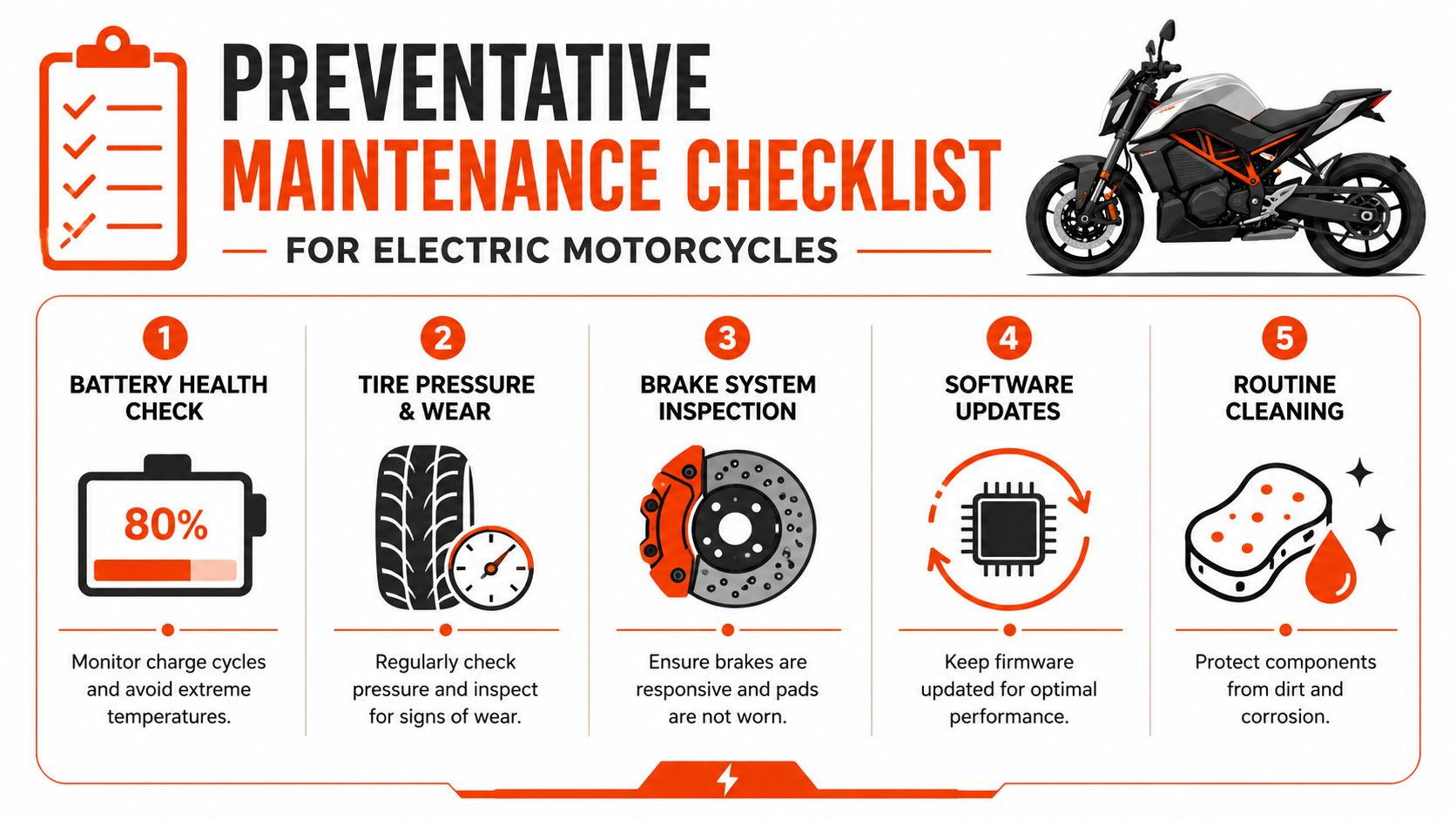
That means paying attention to:
- Tyre pressure and wear: Low pressure increases drag and shortens tyre life.
- Brake condition: Pads and fluid still matter, even if regenerative braking reduces wear.
- Battery care: Avoid poor storage habits and monitor how the bike is charging.
- Electrical connections: Keep them clean, dry, and secure.
- General cleanliness: Dirt and corrosion cause avoidable problems.
A bike that gets five quiet minutes of checking each week usually avoids the noisy, expensive failure later.
What a workable routine looks like
The routine doesn't need to be complicated. It needs to be consistent.
A commuter can usually work with a short weekly check and a more thorough monthly look-over. A delivery rider should check tyres, brakes, lights, and charge condition far more often because the bike is under daily load.
Use a practical rhythm:
- Before riding: Quick visual check, tyres, brake feel, charge level.
- Weekly: Tyre pressures, tread, lights, fasteners, cable condition, cleanliness.
- Monthly: Brake wear, charging leads, mounting points, and any signs of water ingress or damage.
- When behaviour changes: Investigate immediately if range, braking, or charging starts to feel different.
This mindset matters just as much for off-road electric motorcycles and kids motocross bikes. Mud, impacts, and storage conditions can all affect reliability. The basic principle stays the same. Small checks done often are cheaper than large repairs done late.
Negotiate Smarter Insurance and Financing
Insurance and finance don't get the same attention as energy and maintenance, but they shape your monthly outgoings just as much. Riders often accept the first workable quote, then spend the next year trying to save money elsewhere. That's backwards. Get the fixed costs under control first.
Cut the premium before you accept the quote
Insurers price risk, not your intentions. If the bike is used for delivery, commuting, or business journeys, declare that properly and compare like for like. A cheap quote with the wrong usage declared isn't cheap. It's a problem waiting for a claim.
You can usually improve the outcome by changing the risk profile around the bike:
- Security upgrades: Approved locks, ground anchors, and trackers can help make the policy more attractive.
- Storage details: Off-street parking or locked storage can matter.
- Mileage honesty: Don't inflate or understate your use. Accurate use tends to produce cleaner comparisons.
- Excess choice: A sensible excess can reduce the premium, but only if you could afford it after an incident.
Finance should support cash flow, not strain it
A lower-running-cost bike still needs to fit your monthly budget. That's why the right finance structure matters. Hire Purchase suits riders who want a clearer ownership path. PCP can work if you want lower monthly payments and planned flexibility at the end. The right answer depends on cash flow, mileage, and how long you expect to keep the bike.
Charging cost also belongs in this decision, because your electricity tariff directly affects the running cost of an EV. Ofgem-linked pricing examples cited in QuickBooks' guide to reducing expenses show that the Great Britain unit rate moved from 24.50 p/kWh in April to June 2024 to 22.36 p/kWh in July to September 2024, while the domestic electricity standing charge changed from 60.82 p/day to 60.97 p/day. The practical lesson is simple. Tariffs move, so charging at cheaper off-peak periods can help reduce operating costs further.
That makes finance easier to manage as well. The more predictable your charging cost, the easier it is to judge what monthly payment is comfortable.
Your Path to Lower Running Costs Starts Now
Lower running costs don't come from one clever trick. They come from a series of practical decisions that remove waste from the way you ride, charge, maintain, and pay for your bike.
Start with the audit. If you don't know what your petrol motorcycle or moped is really costing you, every decision after that is guesswork. Then look at electrification properly. For many urban riders, delivery operators, and small businesses, that single move changes the cost structure more than anything else.
After that, discipline matters. Better routes reduce wasted miles. Smarter charging protects your margins. Preventative checks reduce downtime. Better insurance and finance choices stop fixed costs from eating the savings you made elsewhere.
For readers comparing finance structures in different markets, it can also help to see how lenders explain the mechanics in plain terms. NZ motorcycle finance options is a useful example of the kind of decision framework worth reviewing, even if you're arranging finance in the UK and need to apply the same thinking locally.
If you're serious about how to reduce operating costs, don't wait for prices to improve on their own. Act on the costs you can control now.
If you're ready to cut transport spend with an electric moped, motorcycle, off-road bike, or kids MX model, speak to Flex Electric and compare options that fit the way you ride.
Find us
You will find us at 74 Dalry Road, Edinburgh, EH11 2AY
Showroom Opening Times:
Monday: By Appointment
Tuesday to Friday: 11am - 5:00pm
Saturday: 10am - 5pm
Sunday: By Appointment
