
UK Guide to Mopeds for Sale Used in 2026

Flex Electric
The UK's #1 Electric Moped and Electric Motorbike dealer.

Hunting for mopeds for sale used has become a very savvy move for UK riders, and it’s not hard to see why. Picking up a pre-owned electric model means you’re looking at serious savings on running costs, complete freedom from emission zone charges, and a much friendlier initial price tag. It’s a no-brainer for city commuting and delivery work.
Why a Used Electric Moped Is a Smart Investment
Let's be honest, the high cost of a brand-new electric moped or motorcycle can be a tough pill to swallow. This is precisely why the second-hand market is absolutely buzzing right now. It offers the perfect middle ground: all the perks of electric power without the showroom price.
As cities across the UK roll out more Ultra Low Emission Zones (ULEZ) and petrol prices remain stubbornly high, the argument for going electric gets stronger every day. A used e-moped is your ticket to bypassing all of that financial pain.
The market data backs this up. We're seeing consistent growth in the used moped and motorcycle space, with sales volumes jumping by over 8% year-on-year. A recent survey found that 42% of buyers are specifically choosing used models to avoid high interest rates on new vehicle finance. This demand is clear to see on selling platforms, where listings for used electric mopeds have shot up by 25% in the last year alone. You can dig deeper into these figures by checking out the latest motorcycle market trend reports.
The Financial and Practical Wins
Choosing a used electric moped goes way beyond just saving a few quid on fuel. Think of it as a complete overhaul of your transport costs.
Here’s where you’ll really feel the benefits:
- Drastically Lower Running Costs: Charging an electric moped battery costs pennies. Compare that to filling a petrol tank every few days, and the savings stack up incredibly fast.
- Freedom from City Charges: All electric mopeds are exempt from ULEZ and Clean Air Zone (CAZ) fees. For a daily rider in London, this alone can save you well over £3,000 a year.
- Minimal Maintenance: Electric mopeds are mechanically simple. There's no engine oil to change, no spark plugs to replace, and no complex exhaust system to fail. This means fewer trips to the garage and smaller bills when you do. For a small fleet, this can easily slash maintenance overheads by 40%.
- Get on the Road Quickly: Most electric mopeds are in the 50cc-equivalent category. All you need is a CBT certificate to ride one, making them incredibly accessible for new riders.
The real game-changer with a used electric moped isn't the initial purchase price – though that helps! It’s the incredibly low total cost of ownership. The day-to-day savings are where you truly win.
To put it into perspective, here’s a rough breakdown of what you might expect to spend over a year.
Used Electric vs Petrol Moped Ownership Costs
| Cost Factor | Used Electric Moped (e.g., Super Soco) | Used Petrol Moped (50cc/125cc) | Annual Savings |
|---|---|---|---|
| Fuel/Charging | ~£95 | ~£750 | ~£655 |
| Tax (VED) | £0 | £25 | £25 |
| Maintenance | ~£75 | ~£250 | ~£175 |
| ULEZ/CAZ | £0 | £3,250 (London, daily) | ~£3,250 |
| Total Annual Cost | ~£170 | ~£4,275 | ~£4,105 |
Note: Costs are estimates based on average use (e.g., 5,000 miles/year) in 2026. Petrol costs assume £1.65/litre. ULEZ cost assumes daily commuting in London.
As the table shows, the difference is staggering, especially for anyone riding inside a major city's clean air zone.
Who Benefits Most from Buying Used?
While pretty much everyone can save money, some riders are perfectly positioned to get the most value from a second-hand electric moped.
Urban Commuters
If you’re navigating a busy city every day, a used e-moped is a game-changer. You can slice through traffic, find parking anywhere, and forget about the crush of public transport, all while keeping your costs right down.
Delivery Riders
For anyone working in the gig economy for platforms like Deliveroo or Uber Eats, a vehicle is your main tool. Lower running costs mean higher profit margins. An affordable, reliable electric moped directly boosts your take-home pay on every single order.
Small Businesses
Think local: florists, takeaways, pharmacies. Any business making local deliveries can switch to an electric fleet without a huge capital investment. It’s a fantastic way to cut operating costs while also burnishing your green credentials, which is a powerful marketing tool in its own right.
Where to Find a Good Second-Hand Electric Moped
So, you’re ready to find a used electric moped. The big question is, where do you actually start looking? Finding the right place to buy isn’t just about seeing what’s available; it’s about the security and confidence you have in the purchase. Your search for mopeds for sale used will generally lead you down three main paths: specialist dealers, sprawling online marketplaces, and direct private sales.
Each route has its own trade-offs. The best one for you will really depend on your budget, how much you know about mopeds, and your appetite for risk. Let's break down what to expect from each.
Specialist Dealers: Your Safest Bet
If you're new to electric two-wheelers or simply want maximum peace of mind, heading to a specialist dealer like Flex Electric is the way to go. Yes, you'll likely pay a bit more than you would in a private sale, but you're not just buying a moped—you're buying assurance.
A reputable dealer lives and dies by their reputation. That means any pre-owned bike on their forecourt, whether it’s an electric motorcycle, an off-road model, or a zippy commuter moped, will have been given a proper once-over by people who know exactly what they’re looking for.
Here’s the real value you get from a dealer:
- Proper Workshop Inspections: These bikes are checked by trained mechanics. They know how to properly assess the health of the battery, inspect the motor, and check the frame for hidden damage.
- A Warranty: This is a big one. Many dealers offer a warranty on used bikes, often covering the most expensive parts—the battery and motor—for a few months. That’s invaluable protection.
- Help After You Buy: Got a problem a week later? You have a business to go back to. They can offer advice, handle repairs, and provide ongoing support.
- All the Paperwork, Sorted: They'll handle the V5C logbook transfer and make sure everything is legal and above board. No nasty surprises down the line.
This is especially important with electric vehicles. Gauging the true health of a used battery is almost impossible for the average buyer, so having that expert check is worth its weight in gold.
The Wild West: Online Marketplaces and Private Sales
Sites like AutoTrader and Gumtree are enormous pools of second-hand vehicles, and you can definitely unearth some fantastic deals. But be warned: this is the wild west of vehicle buying. You're dealing with private sellers, and all the responsibility for checking the moped's condition lands squarely on you.
It's worth knowing that different platforms attract different kinds of sellers and have different user bases. This guide on Facebook Marketplace vs. Autotrader gives some useful pointers on what to expect from each.
When you're sifting through listings, you have to put your detective hat on. You're looking for sellers who provide detailed, honest descriptions, plenty of clear photos from all angles, and a sensible reason for selling. Be very cautious of anything that feels off.
A few red flags to watch for in online listings:
- The "Too Good to Be True" Price: If a popular Vmoto or Segway model is listed for a fraction of its market value, something is almost certainly wrong.
- Lazy Descriptions: An ad that just says "runs great" is a warning. You want details. Ask them directly about the real-world battery range, when it was last serviced, and if there are any known faults.
- Dodgy Sellers: If someone is pushing for payment before you've even seen the bike or makes excuses to avoid a viewing and test ride, just walk away. It's not worth the risk.
- Missing Paperwork: A genuine seller will have the V5C logbook in their name, along with any service history and the original manual. No paperwork often means big trouble.
Going private can land you the best possible price, but it also carries the highest risk. You get no warranty and no comeback if the battery dies a month after you've paid. If you’re a confident mechanic and know what to look for, you can find a gem. If not, the security a dealer provides is often money well spent.
Getting Your Hands Dirty: The Essential Pre-Purchase Inspection
Right, you’ve found a promising-looking electric motorcycle or moped and it's time for the viewing. This is where the rubber meets the road, quite literally. Whether you're in a dealer's showroom or on a stranger's driveway, this is your chance to spot a gem and avoid buying a dud.
Don't be shy or feel rushed. A proper inspection takes time, and any genuine seller will respect that. This isn't just about kicking the tyres; it's a methodical check to protect your investment. Let's walk through exactly what you need to look at, listen for, and ask about to give you the confidence of a seasoned pro.
First and Foremost: The Battery
The battery is everything. It's the most expensive part of an electric moped or motorcycle, and its health dictates the machine's real-world range, performance, and ultimately, its value. A tired battery means a hefty replacement bill and a bike that won't get you very far. This is your number one priority.
Before you even touch the bike, have a chat with the seller. Ask them straight:
- Honestly, what's the real-world range on a full charge? See how this lines up with the "as new" figure. A big discrepancy is a warning sign of a degraded battery.
- Has it ever been replaced? If they say yes, ask to see the paperwork.
- Is there a battery health report from an app? Many modern bikes have this feature, showing its current capacity. If it’s available, you absolutely want to see it.
Now for the physical check. Look for any damage on the battery casing – cracks, deep scratches, or any signs of swelling. If you can take the battery out, do it. Inspect the connectors for any blueish-green corrosion or black burn marks, which point to serious electrical gremlins.
What's Driving It? The Motor and Power Delivery
Unlike a petrol engine, an electric motor should be smooth and almost silent. The only thing you should really hear is a faint, futuristic hum that gets higher as you speed up.
During your test ride, listen carefully. Any grinding, clicking, or loud whining noises are bad news. That could mean worn bearings or internal damage, both of which can be expensive to sort out.
Pay just as much attention to how it feels. The power should come on instantly but smoothly. If the moped or motorcycle stutters, hesitates, or the power cuts out when you accelerate, walk away. Make sure you cycle through all the power modes (Eco, Normal, Sport, etc.) to check they all work as they should.
The Frame and Bodywork: More Than Skin Deep
A moped's frame is its skeleton. Cosmetic scuffs are one thing, but structural damage is a deal-breaker. You need to get up close and personal here.
My advice? Get the torch on your phone out and properly inspect the headstock area – that's where the handlebars and front forks join the frame. It’s a high-stress point, and any hairline cracks in the paint or welds could indicate it's had a nasty front-end knock.
Run your hand along the underside of the main frame tubes. You're feeling for ripples or dents that might be hidden in the shadows. Check the swingarm at the back for any twists or damage. While a few scratches on the plastics are expected on a used machine, badly cracked or misaligned panels suggest it's been dropped, and possibly dropped hard. On steel frames, look for any bubbling under the paint, especially around the welds – that’s rust trying to get a hold.
Brakes, Tyres, and Suspension
These three are your primary safety systems. Their condition also gives you a huge clue as to how the bike has been looked after.
- Brakes: Grab the levers. They should feel firm and responsive, not soft and spongy. Check the brake fluid level and make sure the fluid is a clean honey colour, not black and sludgy. You should be able to see at least a couple of millimetres of pad material left.
- Tyres: Don't just glance at the tread in the middle. Check for wear across the whole width. Look for any cracks in the sidewalls – this means the rubber is old and brittle, and the tyres need replacing no matter how much tread is left.
- Suspension: With the bike off its stand, push down hard on the handlebars, then on the seat. The forks and rear shocks should compress smoothly and rebound in a controlled way. If it feels like a pogo stick or you hear any clunks, the suspension is past its best.
Getting this part right is more important than ever. The UK's used electric motorcycle market is booming. Recent Department for Transport (DfT) figures show sales of pre-owned e-mopeds shot up by 50%, with over 7,000 changing hands last year alone. With average prices hovering around £1,800 and running costs as low as 2p per mile, many delivery riders are finding they pay for themselves in under six months. You can see more analysis on this trend in this 2025 powersports business report.
Checking the Sparks: Lights, Horn, and Display
Finally, do a quick but thorough check of every single electrical item. It's easy to forget something, but a dodgy indicator relay or a faulty dash can be a real pain to fix.
Go through them one by one:
- Lights: High beam, low beam, tail light, and the brake light (check it works with both front and rear brake levers).
- Indicators: Make sure all four work and flash at a steady rhythm.
- Horn: Give it a good press. Is it loud enough to be heard in traffic?
- Dashboard: Check the screen powers up correctly. Are there any dead pixels or segments? Make sure the speedo and battery meter work properly when you're on your test ride.
Taking half an hour to be this thorough is the single best thing you can do. It puts you in a strong position to negotiate a fair price and, most importantly, helps you ride away on a reliable machine you can count on.
Sorting Out the Paperwork and Legal Bits
You've given the moped a thorough once-over and taken it for a spin. Now for the part that’s just as important: the paperwork. This is where you confirm the bike's history and make sure the sale is all above board.
Getting this right saves you from a world of future headaches. We're talking about everything from inheriting unpaid fines to discovering the bike has outstanding finance or, worst-case scenario, was stolen. Any genuine seller will have the documents ready and will expect you to check them. If they seem cagey, that's your first warning sign.
The V5C Logbook: Your Top Priority
The first and most critical document you need to see is the V5C, better known as the logbook. This is the DVLA's proof of registration, and you should never, ever agree to buy a used electric bike without inspecting the original.
Here’s what to zero in on:
- Seller's Details: Does the name and address on the V5C match the person selling the moped? Ask to see their driving licence to confirm. A mismatch is a major red flag, and you need a very good reason for it.
- Vehicle Identification Number (VIN): Find the VIN stamped on the bike’s frame—usually on the headstock or a small plate. This number must be identical to the VIN on the V5C. If it's not, walk away. No questions asked.
- Registration Number: A simple one, but easily missed. Make sure the reg on the logbook matches the moped's number plate.
Be wary of common scams. A seller might show you a photocopy or claim the original V5C is "lost" or "in the post." Insist on seeing the original red document. If they can't produce it, it’s probably best to kill the deal.
Run a History Check for Peace of Mind
Even if the V5C looks perfect, it doesn't tell the whole story. This is where a vehicle history check—often called an HPI check—is worth its weight in gold. For around £10-£20, you can get an online report that digs into the bike's past.
A quick check will reveal if the moped:
- Has outstanding finance: If the previous owner hasn't paid off their loan, the finance company still legally owns the bike, not the seller.
- Has been reported stolen: The check cross-references the Police National Computer, so you'll know instantly if it's listed as stolen.
- Has been written off: You'll find out if an insurer has ever declared it a write-off (like a Cat S or Cat N). This isn't always a deal-breaker, but you absolutely need to know about any past major damage.
Spending a few quid on this check is one of the smartest things you can do. It's a tiny investment to avoid a potentially huge and costly mistake.
Understanding MOT and Insurance
Finally, let's touch on the ongoing legal stuff. In the UK, mopeds and motorcycles need an annual MOT test once they hit three years old. If the bike you're considering is older than that, it must have a current MOT certificate. Ask to see it and check the expiry date.
Insurance is, of course, a legal must-have. The price can vary wildly, with a 50cc-equivalent electric moped being far cheaper to insure than a zippier 125cc-equivalent model. It's a good idea to get a couple of insurance quotes before you buy, so there are no nasty surprises.
To help you keep track of everything during your inspection, here's a handy checklist covering the key points.
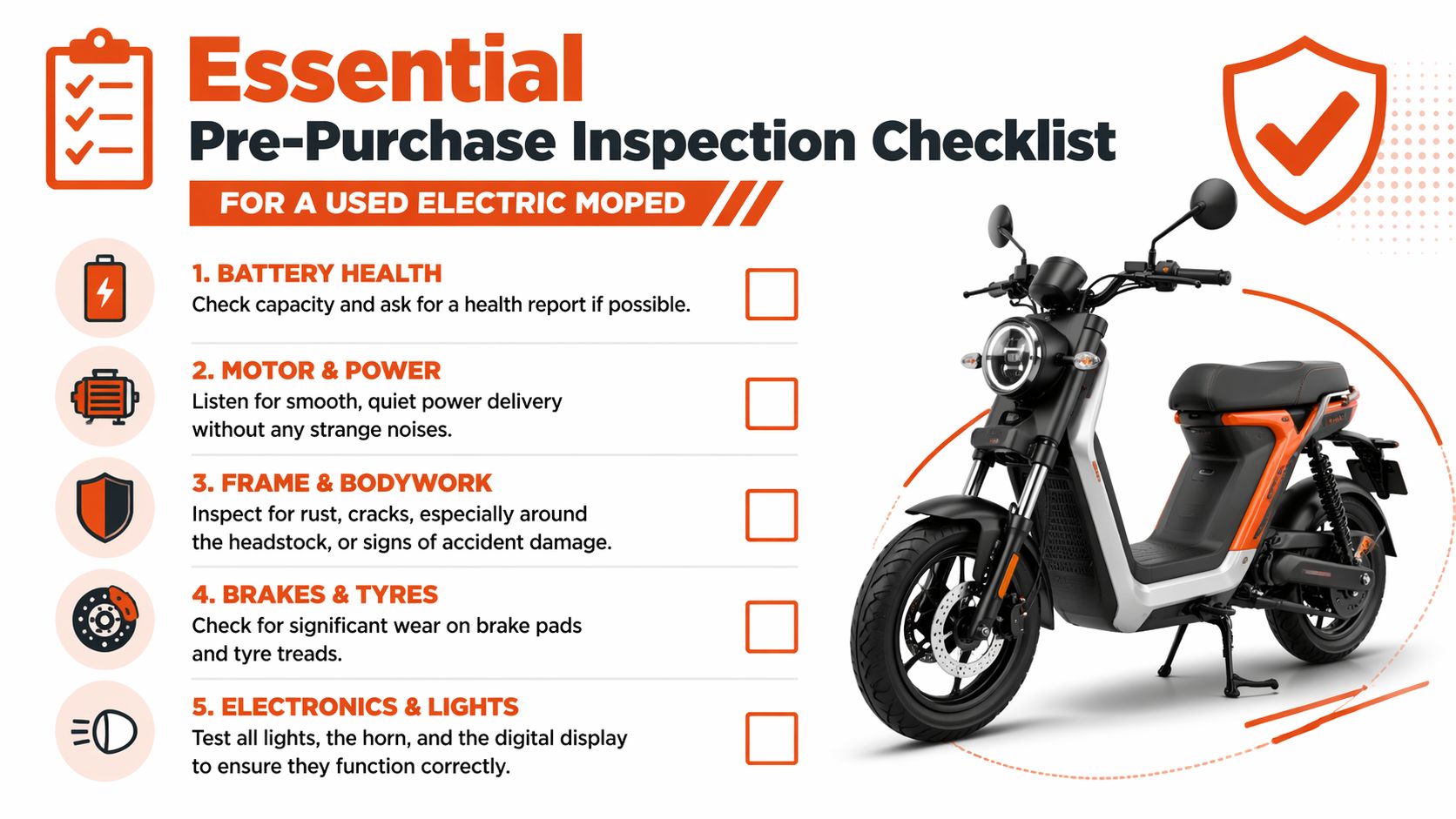
By working through these physical and administrative checks methodically, you can be confident that the electric bike you're buying is legit, safe, and ready to hit the road.
Agreeing a Fair Price and Making It Yours
You’ve checked the bike over, and you know exactly what you’re looking at. Now comes the part many people dread: talking money. But don't think of it as a battle. A good negotiation is simply about finding a price that feels right for both you and the seller, based on the moped's actual condition.
All that time you spent on the inspection? That's your best asset now. Every scuff, every slightly worn tyre, and every niggle you found gives you a solid, fact-based reason to adjust the price. The key is to be polite and objective, not confrontational.
How to Approach the Negotiation
It’s always a good idea to start on a positive note. Mention what you like about the bike first—it shows you’re a genuine buyer, not just a tyre-kicker.
Try something like: "It's a cracking machine, and the battery report looks great. My only concern is that the rear tyre is getting close to the legal limit, so I'll need to sort that out straight away."
This simple framing sets a collaborative tone. You're not criticising their pride and joy; you're just being practical about the immediate costs you'll face. Your market research also comes into play here. If you've seen similar mopeds for sale used for less, you have a benchmark.
- Be Specific: Instead of just saying "it needs work," point to the facts. "Factoring in the cost for new brake pads and the scuffs on the side, I could offer you £X."
- Set Your Limit: Before you even start the chat, decide the absolute maximum you're willing to pay and be prepared to walk away if the price isn't right.
- Expect a Counteroffer: Sellers rarely accept the first offer. Think of it as the start of a conversation, not the end.
Remember, the aim isn't to get the bike for a ridiculously cheap price. If it's in mint condition and already priced fairly, paying the asking price is the right move. The goal is a fair deal for everyone.
Knowing the market is half the battle. With city congestion worsening, demand for used electric mopeds has gone through the roof, especially among delivery riders and commuters. Recent transport figures show 1.2 million daily two-wheeler trips in our big cities, and 62% of sales to riders under 35 are for used models. For context, 45% of Uber Eats riders in the UK now use mopeds, with many opting for used electrics due to their £1,200 average price and 80% lower insurance premiums. More on this can be found in recent motorcycle market trend reports.
Closing the Deal Without the Drama
Once you've shaken hands on a price, you need to handle the payment and paperwork properly to protect yourself.
For a private sale, a bank transfer using the UK's Faster Payments service is your best bet. It's instant, leaves a clear digital trail, and you don't have to wander around with a wedge of cash. Whatever you do, avoid reversible payment methods like PayPal's "Goods and Services" for vehicles. They offer virtually no protection in these situations and are easily disputed.
Always, always get a receipt. It doesn't need to be fancy—a handwritten note is fine—but it is non-negotiable. Make sure it clearly states:
- The date and the final price paid
- The moped's make, model, and registration number
- Full names and addresses for both you (the buyer) and the seller
- A simple sign-off, such as "sold as seen and approved"
You and the seller should each sign two copies, so you both have a record. This piece of paper is your proof of purchase.
If you decide to buy from a specialist dealer like Flex Electric instead, you'll often find they offer finance options. These can range from 0% APR deals to flexible payment plans, making it easier to afford a higher-spec used electric motorcycle or even an off-road model. Going through a dealer gives you that extra layer of consumer protection and after-sales support, which is a massive plus for first-time buyers.
Getting Started as a New Moped Owner
Right, you’ve shaken hands, handed over the cash, and the keys are in your pocket. Congratulations! But the journey doesn't end there. In fact, getting your new-to-you moped on the road legally and safely involves a few crucial bits of admin. Let's get them ticked off.
First, you need to tell the DVLA you're the new owner. If you bought from a private seller, they should have given you the green ‘new keeper’ slip, which is part of the V5C logbook (often called the V5C/2). You'll use this to tax the moped online. Even though electric mopeds currently have zero vehicle tax, you absolutely must go through the official process. It’s not optional. The seller handles sending the rest of the V5C form off, and you'll get a shiny new logbook with your name on it in the post.
With the tax sorted, it’s time to get insured. You can't legally ride on a public road without insurance, so this is your next immediate task. Hopefully, you already got a few quotes while you were looking at mopeds for sale used, so now you just need to pick one and get that policy started.
Equipping Yourself and Your Moped
Once the paperwork is out of the way, you can get to the more interesting bit: getting the right kit for you and your bike. This isn't about style—it's about staying safe and making your daily ride as hassle-free as possible, whether you're nipping to the shops or doing a full shift of deliveries.
Here’s what you absolutely cannot skimp on:
- A Quality Helmet: This is, without a doubt, the most critical piece of safety gear you will ever buy. Look for one that meets the ECE 22.06 safety standard and make sure it fits you properly—it should be snug without being painful. Never, ever buy a used helmet. You have no idea if it’s been dropped or damaged.
- High-Security Locks: Mopeds and motorcycles are a massive target for thieves, especially in cities. You need a top-quality, heavy-duty chain lock and a disc lock, preferably one with an alarm. The key is to always lock your bike to something solid.
- Protective Clothing: At the very least, you need a proper motorcycle jacket, a good pair of gloves, and sturdy footwear. Trust me, even a low-speed fall on tarmac can do some serious damage if you’re only wearing jeans and trainers.
Don't think of security as a cost; it's an investment. Spending £100-£200 on a couple of brilliant locks feels a lot better than the feeling of walking out to find an empty space where your moped used to be.
With the essentials covered, think about a few extras to make life easier. A top box is a game-changer for storing your helmet, waterproofs, or shopping. A good phone mount is also a must-have for navigation. Getting yourself set up properly from day one means you can just get on and enjoy the ride.
A Few Final Questions Answered
Even with all the checks in the world, you probably still have a couple of questions nagging at you. That’s completely normal. Let's tackle some of the most common queries we hear from buyers looking for mopeds for sale used, so you can go into your purchase with total confidence.
The Big Question: What Licence Do I Need?
This is probably the number one question we get asked. The good news is, for most electric mopeds you'll find on the used market—those equivalent to a 50cc petrol bike with a top speed around 28mph—the rules are quite simple. You'll just need a valid Compulsory Basic Training (CBT) certificate.
There's a neat exception, though. If you passed your car driving test before 1 February 2001, you're in luck! You can ride one of these mopeds without needing a CBT at all.
For the more powerful electric motorcycles (the 125cc equivalents), you'll still need that CBT, but you'll also have to display L-plates and can only ride it until you pass your full motorcycle test.
How Much Battery Wear Is Too Much?
Let's be realistic about batteries: they all degrade over time. It's an unavoidable part of owning an electric vehicle. A healthy, well-looked-after lithium-ion battery should still hold over 80% of its original capacity after around 500 charge cycles. For the average rider, that’s several years of daily use.
So, when you're looking at a used moped, you should expect its real-world range to be a bit less than what it was brand new. However, if the seller mentions or your test ride reveals a range drop of more than 25%, that’s a major red flag. A new battery is a significant expense you'll want to avoid.
What Happens if I Find a Fault After Buying?
This is where the difference between a private sale and a dealer becomes crystal clear. When you buy from a private seller, the moped is sold "as seen." Legally, this means your options are extremely limited if a problem develops later. Unless you can prove the seller knowingly lied about its condition, the repair bill is on you. This is precisely why your pre-purchase inspection is so vital.
Buying from a specialist dealer is your safety net. Most reputable dealers will offer a warranty on their used bikes, which gives you invaluable peace of mind.
And once the deal is done, you’ve got to get it home. If you're buying from further afield, it’s wise to factor in transport. Getting a quick quote for motorcycle shipping costs can help you set a realistic budget for the whole process.
Ready to find the perfect used electric moped with the assurance of a full warranty and expert support? At Flex Electric, we offer a curated selection of pre-owned electric mopeds, motorcycles, off-road bikes, and kids' motocross models that have all passed our rigorous workshop inspections. Explore our range and make the switch to electric today by visiting https://www.flexelectric.co.uk.
Find us
You will find us at 74 Dalry Road, Edinburgh, EH11 2AY
Showroom Opening Times:
Monday: By Appointment
Tuesday to Friday: 11am - 5:00pm
Saturday: 10am - 5pm
Sunday: By Appointment
