
Second Hand 50cc Moped: UK Buyer's Guide (2026)

Flex Electric
The UK's #1 Electric Moped and Electric Motorbike dealer.

You’ve probably started in the same place most riders do. You want cheap, simple transport for town, college, work, or delivery shifts, and a second hand 50cc moped looks like the obvious answer.
That instinct isn’t wrong. In the UK, the used 50cc market is busy because these bikes are affordable, easy to park, and practical for short urban runs. Popular petrol models still attract buyers because they’re cheaper to get into than many new machines, and they’ve been part of city commuting for years.
The catch is that a cheap used petrol moped can stay cheap, or it can turn into a string of repairs, paperwork problems, MOT failures, and awkward private-sale surprises. First-time buyers usually focus on the purchase price. The better way to judge a moped is by total ownership stress. That means reliability, legal compliance, running costs, service needs, and whether somebody stands behind the bike after you’ve paid.
That’s where the decision has changed. A traditional second hand 50cc moped still works for some riders, but a pre-owned electric moped from a specialist dealer often makes more sense if you want cleaner ownership, fewer moving parts, and less chance of buying somebody else’s problem.
Your Guide to Buying a Second Hand 50cc Moped
You spot a used 50cc online at a price that looks safe for a first bike. The photos are tidy, the seller says it “runs well”, and the numbers seem to work. Then the critical buying decision starts. Is it a cheap way into riding, or the start of a string of repair bills and paperwork headaches?
That question matters more than the badge on the front.
A second hand 50cc moped can still be a sensible buy for short trips, college runs, and urban commuting. The trouble is that the used market lumps very different machines into the same search results. One bike has been serviced properly and kept standard. Another has been dropped, neglected, derestricted, or patched up just enough to sell. From a private advert, those two can look almost identical.
First-time buyers often judge the deal by entry price alone. In practice, the smarter test is ownership risk. A used petrol moped may look affordable on day one and become expensive within weeks if it needs tyres, brakes, transmission work, carb cleaning, battery replacement, or MOT repairs. Those costs are common enough that I always tell buyers to treat a low asking price as the start of the inspection, not the conclusion.
That is also why the petrol versus electric question matters earlier than many riders expect.
With an older petrol 50, you are buying the bike and whatever its previous owner leaves behind. Wear, missed servicing, cheap replacement parts, poor storage, and vague service history all come with the sale. With a pre-owned electric moped from a reputable dealer such as Flex Electric, the ownership picture is usually simpler. There is no engine oil, no spark plug, no exhaust, no carburettor, and fewer mechanical systems that can hide neglect.
That does not mean every used electric moped is automatically the right choice. Battery condition, charger supply, parts support, and dealer preparation still matter. But for a new rider who wants predictable costs and less workshop time, a properly checked pre-owned electric model often makes far more sense than taking a gamble on the cheapest private-sale petrol scooter available.
A good buying decision comes down to four practical questions:
- How likely is it to need money spent straight away?
- Can the seller prove the bike’s history and legal status?
- What will it cost to keep on the road over the next year?
- Who helps if something is wrong after the sale?
Private petrol sales usually give weaker answers to those questions.
That is a significant shift in the market. Buying used no longer has to mean accepting uncertainty as part of the deal. If your priority is simple, low-stress transport, a pre-owned electric moped from a specialist dealer can give you the lower-risk version of used ownership, without inheriting the usual petrol headaches.
Navigating the Used Moped Market Petrol vs Electric
You spot a cheap 50cc scooter on a marketplace app at 9pm. The photos look tidy, the seller says it “runs fine”, and the price is low enough to make you feel you need to act fast. That is how a lot of first-time buyers end up with someone else’s problem.
The used petrol market gives you volume, but not much certainty.
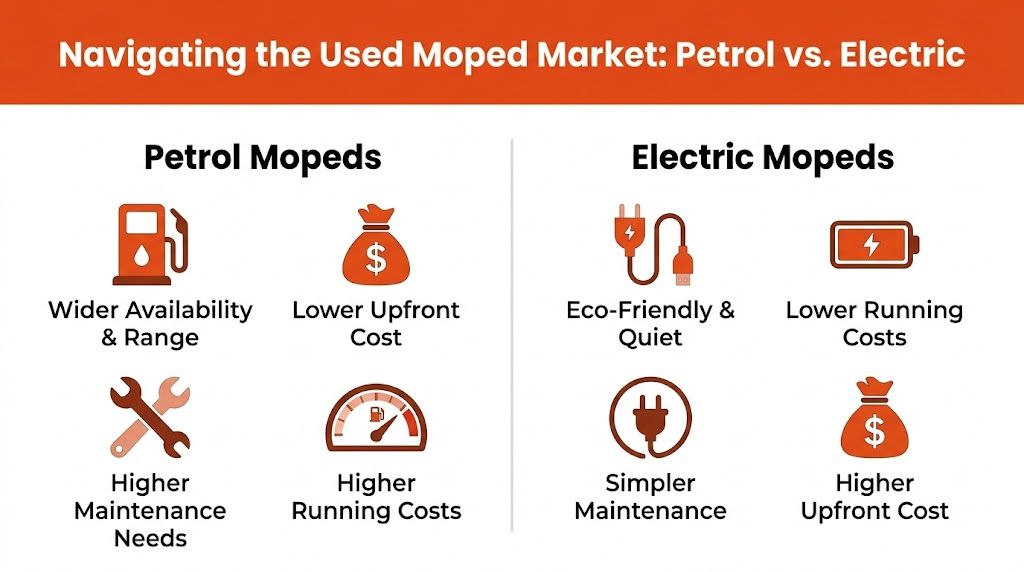
What the petrol market really looks like
There are plenty of used petrol 50cc mopeds for sale across the UK. That sounds helpful at first, but a crowded market also means more weak listings, more vague descriptions, and more bikes with histories that are hard to verify.
You will see everything from older Japanese scooters to low-cost Chinese imports and ex-delivery bikes. Some are honest, well-maintained machines. Plenty are not. A low asking price can mean a seller wants a quick, clean sale. It can also mean the bike needs tyres, brakes, a carb clean, a battery, plastics, and time in a workshop before it is properly usable.
That is the trade-off. Petrol gives you choice, but private sales often leave you doing all the detective work yourself.
A first-time buyer usually pays for mistakes twice. Once at purchase, then again in repairs.
What changes with a pre-owned electric moped
The used electric side of the market is smaller, but it is often easier to assess if you buy through a specialist dealer. You are usually looking at clearer stock descriptions, known model details, and a bike that has been checked before it is advertised.
That matters because the risk is different. On a private petrol sale, you are trying to work out what has been skipped, bodged, or hidden. On a dealer-supplied electric moped, the better question is whether the battery, charger, warranty cover, and parts support are all clearly documented.
Flex Electric is one example of that specialist route. The key benefit is not hype. It is process. A reputable dealer can explain what has been inspected, what is included, and what happens if a fault shows up after delivery. That is a very different buying experience from handing over cash in a car park and hoping the advert was accurate.
Used value is not just about sticker price. It is about how much uncertainty comes with the bike.
Side-by-side buying reality
| Factor | Private Sale Petrol Moped | Specialist Dealer Electric Moped |
|---|---|---|
| Availability | Wider choice, mixed quality | Fewer listings, easier to compare properly |
| Upfront price | Often cheaper at first glance | Usually dearer than the lowest private advert |
| Mechanical risk | More service items and more ways neglect shows up later | Fewer routine components to wear or leak |
| Seller accountability | Usually ends once payment is made | Dealer checks and warranty support may be included |
| History clarity | Often patchy, especially on older bikes | Usually clearer if prepared and documented by a specialist |
| Daily ownership | Can be fine, but neglected bikes become time-consuming | Simpler for short urban trips and easier to live with |
Where buyers go wrong
The biggest mistake in the petrol market is treating all used bikes as roughly equal and shopping by price alone. They are not equal. A cheap moped with poor servicing and unknown parts can cost more over the next six months than a better bike with a higher asking price.
Buyers also over-trust cosmetic condition. Fresh panels and a quick wash can hide neglect. Service history, cold starting, brake condition, tyre age, and legal paperwork matter more than shiny plastics.
With electric, the mistake is different. Buyers sometimes assume every used electric moped is simple by default. It is simpler than petrol in several ways, but you still need to confirm battery condition, charger presence, replacement parts, and who supports the bike after the sale.
The smart route is simple. Be cautious with private petrol bargains. Be selective with dealer-backed electric stock. If your goal is predictable costs and fewer surprises, a properly prepared pre-owned electric moped usually gives a new rider a much safer place to start.
The Essential Pre-Purchase Inspection Checklist
You arrive to view a cheap used 50cc, and the seller already has it running on the driveway. That is usually your first warning. A warmed-up petrol moped can hide poor starting, weak idle, smoke, and noise that would be obvious from cold.
Start with legality and safety. Mechanical faults cost money, but paperwork problems can leave you with a bike you cannot register, insure, or sell on properly.

Check the paperwork before the bike
Inspect the V5C logbook first and compare the frame number with the bike in front of you. If the numbers do not match, or the seller gives a vague explanation, walk away. On a private petrol sale, that sort of mismatch can turn a bargain into a problem very quickly.
Look at the MOT history if the moped is old enough to need one. You are looking for patterns, not perfection. Repeated notes for tyres, brakes, lights, or suspension usually mean the owner has done the minimum needed to keep it on the road.
Service receipts matter more than promises. A stack of invoices for routine work tells you far more than “it’s always been looked after”.
Inspect it cold and take your time
A proper cold inspection shows how the moped has really been kept. Touch the engine casing if you need to confirm it has not already been started.
Work from the ground up. Check the tyres for tread, cracking, sidewall damage, and cheap unknown brands. A legal tyre can still be poor in the wet, and low-cost replacements often tell you the bike has been maintained to a budget.
Then move to the brakes, forks, rear shock, wheels, lights, switches, and body panels. On older petrol 50s, seized rear drums, bent levers, broken fairing tabs, and rusty exhaust studs are common. None of these faults is unusual on its own. A bike with several of them usually has deeper neglect underneath.
Cosmetic tidying is cheap. Mechanical catch-up work is not.
Petrol checks that catch expensive problems
Cold starting tells you a lot. The engine should fire without a struggle, settle into a stable idle, and respond cleanly to throttle. Excessive smoke, rattling from the top end, bogging when you blip the throttle, or a tendency to stall all point to money being needed soon.
Twist-and-go petrol scooters also need CVT attention. Belt wear, worn rollers, clutch issues, and poor variator condition often show up as jerky pull-away, revs rising without proper drive, or vibration as speed builds. These are exactly the faults first-time buyers miss because the bike still “goes”.
Check for leaks around the engine, forks, and final drive. Look underneath as well, not just at eye level. Freshly cleaned cases can be a clue, especially if the rest of the bike is dirty.
For buyers who want a visual walk-through before viewing a bike, this video is useful:
The shorter electric checklist
A pre-owned electric moped is usually easier to assess because many of the awkward petrol failure points are gone. You are not dealing with oil leaks, exhaust corrosion, carburettor problems, inconsistent cold starts, or transmission behaviour caused by a tired small-capacity engine.
That does not mean you switch your brain off. Check battery condition, charge port condition, charger presence, dash warnings, brake wear, tyre quality, frame damage, and whether parts support is clear. Ask who will support the bike after the sale. That question matters far more than many buyers realise.
This is one reason I steer first-time riders toward dealer-supplied electric stock rather than private petrol classifieds. A reputable specialist should have already checked the bike, confirmed the paperwork, and made the battery and charging side easy to understand. That saves a lot of guesswork, and it usually saves money later as well.
Security also needs checking before you buy, especially if the moped will live outside. Practical guidance on vehicle security is worth reading before you commit to any used bike, petrol or electric.
Test Rides HPI Checks and Finalising the Purchase
This is the point where buyers make their biggest mistakes. They’ve looked at the bike, they want it to be good, and they rush the last checks. Don’t.
What a proper test ride should tell you
On a petrol 50, the test ride isn’t about speed. It’s about honesty. You’re checking whether the moped behaves consistently when cold, moving, slowing, and restarting. Jerky take-up, weak brakes, odd noises from the transmission, or a reluctance to idle after the ride all matter.
On an electric moped, the ride quality tells a different story. You’re judging throttle response, smooth power delivery, brake feel, dashboard function, and general straight-line stability. The absence of engine noise makes it easier to notice rattles, poor assembly, or brake drag.
HPI and history checks
For a private sale, an HPI-style history check is not optional. You need to know if the bike is stolen, written off, or subject to outstanding finance. The same caution applies to the paperwork trail. If the V5C story feels messy, walk away.
Security matters after purchase as well. If you’re comparing insurers or deciding what anti-theft kit to use, it’s worth reviewing practical guidance on vehicle security, especially if the bike will be parked outside or used regularly in city centres.
A bike that looks cheap at purchase can become expensive fast if its history is wrong or its security is weak.
Final payment and negotiation
Private-sale negotiation only works if you stay unemotional. Don’t start haggling because the advert says “no offers”. Start from facts. Missing service records, poor tyres, weak brakes, damaged plastics, and uncertain cold-start behaviour are all reasons to reduce your offer or leave entirely.
A cleaner route is fixed, transparent dealer pricing. That isn’t about avoiding negotiation for the sake of it. It’s about knowing what you’re paying for. If a bike comes prepared, checked, and backed with finance or warranty support, the deal is simpler to assess than a car park handover with a stranger and a handwritten receipt.
Before you transfer any money
Verify the bike’s identity
Registration, VIN, and documents should all line up.Confirm how payment will be recorded
You want proof of sale and seller details.Don’t ignore missing items
Spare keys, charger, mirrors, pillion hardware, and handbook all affect value.Be ready to walk away
The easiest way to avoid a bad used moped is to leave it where it is.
UK Legalities and Total Running Costs
You find a used 50cc online, the price looks sharp, and the seller says the paperwork is “all there”. Then you ask for the V5C details, MOT history, and insurance information, and the simple bargain stops looking simple.
For a first-time buyer, legal compliance is often the part that causes the most stress. Private listings can be vague on registration status, missing documents, past modifications, or whether the bike is insured and taxed correctly for handover. A UK-focused discussion of common 50cc buying issues highlights how often paperwork confusion creates problems in resale, insurance, and ownership checks, especially where the documents and listing details do not clearly line up.
What needs to be right in the UK
If you are buying a 50cc-class moped for road use, check the legal side with the same care as the bike itself.
Confirm that:
- The registration matches the bike
- The V5C is present and the seller’s details make sense
- The moped still fits its legal class and has not been badly modified
- The MOT record is current if the bike is old enough to need one
- You can get insurance based on the exact registration and model
That sounds basic. In the private petrol market, it often is not.
A missing document can mean delays. A wrong detail can mean trouble insuring it. A heavily altered petrol scooter can create questions about legality, reliability, and future resale all at once.
What the running costs really look like
Fuel is only one line on the cost sheet. The bigger issue with many second hand petrol 50s is how the costs arrive. They rarely come as one clear bill. They show up as a steady run of smaller jobs that are easy to underestimate when you buy the bike.
Typical petrol ownership costs include routine servicing, MOT preparation, drive belt and transmission wear, filters, oil, spark plugs, starter or battery issues, and age-related fuel system faults. None of those are unusual on an older scooter. The problem is that a cheap private purchase gives you no real control over what has been skipped before you arrived.
That is the trade-off. Lower entry price can mean higher uncertainty.
Why pre-owned electric is easier to budget
A pre-owned electric moped from a specialist dealer changes the ownership pattern. You still need tyres, brakes, and normal safety checks, but you remove a large chunk of the mechanical and fuel-related spend that makes used petrol ownership unpredictable.
No oil services. No exhaust issues. No carburettor or injector faults. No stale fuel problems after standing. Charging costs are usually much easier to forecast than petrol, especially for short urban trips where 50cc mopeds spend most of their lives.
The other advantage is clarity. A reputable dealer can tell you exactly what has been checked, what condition the battery is in, what support is included, and what documents come with the bike. That is a very different risk profile from meeting a private seller in a car park and hoping the “cheap runner” stays cheap.
A practical comparison
| Cost area | Used petrol 50cc | Pre-owned electric 50cc equivalent |
|---|---|---|
| Day-to-day energy use | Ongoing petrol spend, vulnerable to price changes | Lower and easier-to-predict charging cost |
| Routine workshop jobs | More engine and fuel-system maintenance | Fewer mechanical service items |
| MOT-related surprises | Higher risk on neglected older bikes | Lower risk where there are fewer engine-related faults |
| Fault-finding time | Can become expensive fast | Usually simpler if bought checked from a dealer |
| Paperwork confidence | Depends heavily on seller accuracy | Usually clearer with dealer-prepared stock |
The cheaper private petrol moped often costs more over the first year than buyers expect.
For new riders, that matters more than headline price. A used petrol 50 can still make sense if you know what you are looking at, can judge condition properly, and have a workshop you trust. If you want low-hassle transport with clearer running costs, a pre-owned electric model from a specialist dealer is usually the smarter buy.
Aftercare Servicing and Your Ownership Journey
The ownership experience often decides whether a cheap used moped was a good buy or a false economy.
With an older petrol 50, the sale is usually the easy part. The harder part starts a few weeks later, when a weak battery, sticky carb, worn drive belt, or corroded electrical connector turns up and you are the one chasing parts, booking workshop time, and working out what should have been picked up before money changed hands. For riders who know these bikes well, that can be manageable. For a first-time buyer who just needs reliable transport, it is often where private petrol ownership starts to feel expensive.

Good aftercare is not complicated. You need clear answers to three things. Who supports the bike if a fault appears, what routine work does it need, and how easy is it to get the right parts or advice?
That is where a pre-owned electric moped from a specialist dealer changes the picture. The machine itself is simpler, and the support is usually clearer from day one. You are less likely to inherit years of neglected engine maintenance, and more likely to get a straight explanation of battery condition, service intervals, and what is covered if something goes wrong.
What good aftercare looks like
A solid ownership setup usually includes:
Warranty cover
Useful where it matters most. If a major component fails, you know where you stand.Battery health guidance
Battery condition affects range, value, and long-term satisfaction. A reputable dealer should explain charging habits, storage, and expected performance in plain English.Parts and accessory support
Racks, top boxes, chargers, locks, and replacement consumables need to be easy to source. That matters even more if the moped is for commuting or delivery work.Straight servicing advice
Riders should know what needs checking, how often, and which jobs are routine wear items rather than warning signs.
Simpler bikes are easier to live with
Electric ownership still comes with responsibilities. Tyres wear, brake pads need inspection, lights must work, and fasteners should be checked regularly. But the list is shorter and easier to plan around than on an ageing petrol moped with fuel, ignition, exhaust, and starting systems all adding potential fault points.
That difference matters over a year of ownership. You spend less time diagnosing old-engine behaviour and more time just using the bike.
From a dealer side, this is the part many first-time buyers overlook. The right bike is only half the purchase. The other half is knowing what support exists after you collect it.
Practical kit worth buying early
A few sensible purchases make day-to-day ownership easier and cheaper than replacing damaged kit later.
Start with these
A quality helmet
Good fit matters more than style.A proper lock setup
Use layered security, not a basic cable.A top box or rack
Handy for work gear, shopping, or waterproofs.A secure phone mount
Better for navigation and safer than checking directions at lights.Gloves and waterproofs
New riders often underestimate how quickly bad weather drains confidence.
A good pre-owned electric moped should feel easy to own from the start. If you buy from a reputable specialist, aftercare is usually clearer, servicing is more predictable, and the chances of being dragged into somebody else’s deferred petrol maintenance are much lower.
The Smart Choice for Your Next Moped
A second hand 50cc moped can still be a sensible buy, but only when the bike is clean, legal, and properly maintained. Most first-time buyers underestimate the risks in the private petrol market. Missing paperwork, neglected servicing, MOT failures, and hidden faults are where the true cost shows up.
A pre-owned electric moped from a reputable specialist is often the smarter decision. You get a simpler machine, lower day-to-day running costs, and far less chance of inheriting somebody else’s neglect. For urban commuting and delivery work, that’s usually the better trade.
If you want a simpler route into moped ownership, browse the pre-owned electric range at Flex Electric. You’ll find electric mopeds, scooters, motorbikes, off-road models, and kids MX bikes, with straightforward support, UK-wide delivery, and clear information that helps you buy with confidence.
Find us
You will find us at 74 Dalry Road, Edinburgh, EH11 2AY
Showroom Opening Times:
Monday: By Appointment
Tuesday to Friday: 11am - 5:00pm
Saturday: 10am - 5pm
Sunday: By Appointment
