
What Is an Electric Motorbike: A Guide to Electric Motorbikes & Scooters

Flex Electric
The UK's #1 Electric Moped and Electric Motorbike dealer.

Ask someone what an "ebike" is, and they might picture something different from the powerful machines we specialise in. In the world of road-legal transport, the term has taken on a new meaning. We're talking about something much more powerful: fully electric mopeds and motorcycles built to go head-to-head with their petrol-powered cousins.
Defining the Modern Electric Bike for UK Riders
Let's cut through the confusion right away. When we talk about ebikes at Flex Electric, we aren’t discussing pedal-assist cycles. We’re focused on a new breed of high-performance electric vehicles. These aren't bicycles with a motor; they are purpose-built motorcycles that just happen to run on electricity.
Think of them as a direct, cleaner, and often more thrilling alternative to a petrol scooter or motorbike. The principle is straightforward: an electric motor powered by a rechargeable battery. This simple setup delivers a riding experience and benefits—like silent operation and incredibly low running costs—that petrol engines just can't offer.
The biggest game-changer is instant torque. A petrol engine needs to rev up to hit its powerband, but an electric motor gives you everything it’s got the second you twist the throttle. The result is lightning-fast, smooth acceleration from a complete stop, which is perfect for nipping through city traffic.
To get a real-world feel for what these bikes can do, it helps to compare them to the petrol equivalents most UK riders are already familiar with. This immediately clarifies their power and purpose.
Understanding Power Equivalents
So, how do you choose the right one? It all comes down to what you need it for, and the 50cc/125cc comparison is the best way to think about it.
- 50cc Equivalent Mopeds: These are your ultimate city slickers. Models like the Super Soco TC are typically limited to 28 mph. They’re the perfect choice for urban commuting, short-hop trips, and are a massive favourite for delivery riders thanks to their agility and rock-bottom running costs.
- 125cc Equivalent Motorcycles: Stepping up a level, you have more powerful machines like the Vmoto Stash or certain models from LiveWire. These bikes offer higher speeds and more range, making them perfectly capable on A-roads and for longer commutes. They are a genuine, exciting replacement for a traditional 125cc petrol bike.
This framework puts things into perspective. An "ebike," in our world, isn't a single legal class but a catch-all term for an entire category of powerful, road-legal electric vehicles. This includes everything from zippy city mopeds and muscular performance bikes to specialist off-roaders and even kids' electric motocross bikes. The one thing they all have in common? They are all legally classed as motor vehicles, requiring the correct licence, registration, and insurance to be ridden on UK roads.
Choosing Your Ride: Electric Mopeds, Motorcycles, and More
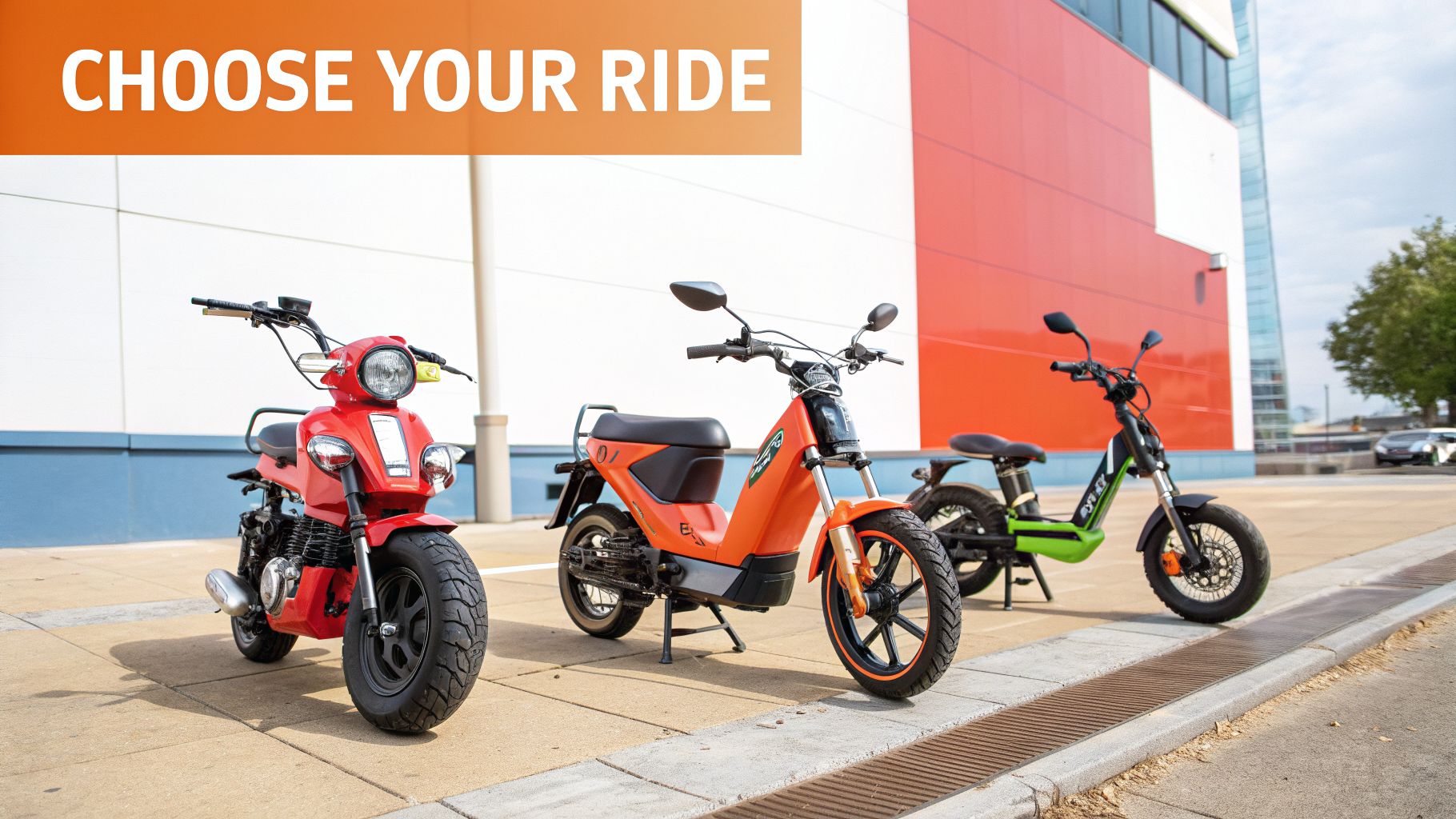
So, you’re thinking about going electric. Fantastic. The first thing to realise is that the term "e-bike" gets used for everything these days, but when we talk about road-legal electric motorbikes, we're talking about a whole different class of vehicle.
Your perfect ride is out there, but it all comes down to what you’ll be doing with it. Are you slicing through city traffic on your daily commute, or do you crave the power for a weekend blast on winding A-roads? Maybe you're looking to hit the dirt trails or get a young rider started. Each of these needs a different kind of machine.
Here at Flex Electric, we live and breathe these bikes. Let’s walk through the main types we offer, from nimble city runabouts to powerful electric motorcycles, to help you find the one that feels like it was built just for you.
Electric Mopeds: The City Champions
If you spend most of your time navigating town, an electric moped is your best friend. Think of it as the smart, modern version of a 50cc petrol scooter. They are brilliantly lightweight, a breeze to handle in traffic, and specifically designed to make city travel easy. With a top speed of 28 mph, they have all the punch you need to keep up with urban traffic flow.
It’s no surprise they’re a massive hit with commuters and food delivery riders. The running costs are incredibly low—we’re talking just a penny or two per mile—and the maintenance is next to nothing. A simple twist of the throttle gives you that instant acceleration to pull away from the lights, leaving cars standing.
A perfect example is the NIU UQi series. It’s a compact, agile moped that’s an expert at zipping through tight spots. Its battery is removable, which is a game-changer for charging; you just carry it into your home or office and plug it into a regular socket. Simple, practical, and affordable transport.
To ride an electric moped in the UK, you just need to be at least 16 years old and have a Compulsory Basic Training (CBT) certificate. Pop on some L-plates, and you’re good to go.
Electric Motorcycles: For Power and Performance
When your journey involves faster roads or you just want more of a thrill, it's time to look at electric motorcycles. These are the electric equivalent of 125cc petrol bikes (and up), built to comfortably handle A-roads, dual carriageways, and longer distances. They're a serious step up in power, delivering a riding experience that’s every bit as exciting as their petrol cousins.
These bikes pack powerful motors and the latest battery tech, giving you head-snapping acceleration and higher top speeds. They’re for riders who want all the benefits of electric without sacrificing an ounce of performance. A great showcase for this is the Vmoto Stash, which blends aggressive, sporty styling with a real-world range that can push well over 100 miles on a single charge.
This is the category for the rider looking for a genuine, no-compromise alternative to a petrol motorcycle. As you'd expect, the licence requirements are a bit stricter. You'll need to be 17 with a CBT for a 125cc equivalent, and a full A2 or A motorcycle licence for anything more powerful.
Finding Your Niche
To make things even clearer, here’s a quick breakdown of how these categories stack up. Think about your daily use and what licence you hold (or plan to get), and you’ll quickly see which category is the right fit.
Specialised Electric Motorbikes
Beyond the daily grind, the electric world offers some incredible specialist machines built for fun.
- Off-Road Electric Motorcycles: These are pure-bred dirt bikes. With heavy-duty suspension, aggressive knobbly tyres, and torquey mid-drive motors, they’re designed to conquer woodland trails and motocross tracks. Best of all, they're nearly silent, so you can enjoy the outdoors without disturbing the peace.
- Kids' Electric Motocross Bikes: A fantastic way to introduce the next generation to two wheels. These are essentially scaled-down motocross bikes, offering a safe and manageable way for kids to learn the ropes. They're quieter, easier to handle, and require far less maintenance than a small petrol dirt bike.
By breaking it down like this, you can stop asking "what's an e-bike?" and start asking the right question: "which electric motorbike is for me?".
How Electric Motorbikes Deliver Unmatched Performance
To really get what makes an electric motorbike so exhilarating, you need to look past the fairings. There’s no complex petrol engine here; the tech that powers these machines is elegant, potent, and surprisingly simple. It’s all about three core parts working together seamlessly.
Here’s a simple way to think about it: the motor is the muscle, the battery is the stamina, and the controller is the brain. When you twist that throttle, you’re telling the brain how much juice to pull from the battery and send to the motor. The result is that silent, instant wave of acceleration that gets you hooked. It’s this direct, no-fuss power delivery that feels so responsive and satisfying.
This straightforward approach to performance is a big reason electric motorbikes are taking off across the UK. With green policies and the delivery economy booming, the market is set to hit USD 832.9 million by 2029. For the riders we work with at Flex Electric—whether they’re managing business fleets or hitting the trails on the weekend—the numbers speak for themselves. Running costs can be as low as 1-2p per mile, a massive saving compared to the 20p or more you'd spend on petrol.
The Motor: Your Source of Power
The motor is what turns electricity into raw motion, and its design completely changes the feel of the bike. In the world of electric mopeds and motorcycles, you’ll mainly find two types: hub motors and mid-drive motors. Each has its own strengths, making them better suited for different kinds of riding.
Hub motors are built directly into the wheel hub, usually the rear one. It’s an incredibly neat design that’s quiet, efficient, and low-maintenance because it has so few moving parts.
- Best for: Zipping around town and daily commuting.
- What it feels like: You get a snappy, instant kick from a standstill, which is perfect for pulling ahead of traffic at the lights.
- Example: Lots of electric mopeds, like the popular models from NIU and Super Soco, use hub motors for that agile, responsive feel that makes city riding a breeze.
Mid-drive motors, as the name suggests, sit in the centre of the bike’s frame, right where a traditional engine would be. They drive the rear wheel with a chain or belt, much like a conventional motorbike.
- Best for: High-performance and off-road riding.
- What it feels like: You get fantastic torque and much more balanced handling because the weight is kept low and central. This translates to better grip when you're climbing steep hills and a more natural, planted feel when leaning into corners at speed.
- Example: You’ll find mid-drive motors on performance-focused bikes like the Vmoto Stash and proper off-road electric motorcycles, where power control and perfect balance are everything.
The Battery: Your Electric Fuel Tank
If the motor is the muscle, the battery is your fuel tank. Its capacity and condition are what decide your range and how much power you can draw. Today’s electric motorbikes almost exclusively use Lithium-ion batteries, which now hold over a 99% market share for very good reasons: they pack a lot of power, last a long time, and are relatively lightweight.
When you're looking at specs, two numbers are key: Voltage (V) and Amp-hours (Ah). Think of Voltage as the 'pressure' of the energy, influencing your top speed and acceleration. Amp-hours are the 'size' of your tank, telling you how long the battery can sustain that power.
Multiply the two (V x Ah), and you get Watt-hours (Wh)—the single best measure of a battery's total capacity. A bike with a higher Wh number will almost always give you a longer range. This is why we back our batteries with a 3-year warranty; it’s the most vital part of your bike and your peace of mind.
This focus on reliable, high-density power is what turns an electric bike from a city runabout into a machine capable of a proper journey, even through the Scottish Highlands. And the simple convenience of being able to remove the battery and charge it from any standard wall socket is something a petrol station just can't compete with.
Getting Road-Legal: UK Rules for Electric Mopeds & Motorbikes
Let’s be honest, figuring out the rules for electric motorbikes can feel like a bit of a minefield. The most important thing to get your head around is this: the electric mopeds and motorcycles we sell are legally classed as motor vehicles, not bicycles. It’s a common point of confusion, but that single distinction changes everything.
You’ve probably seen thousands of standard e-bikes (the pedal-assist kind) on the road. Legally, they’re just bicycles, so you don’t need a licence, registration, or insurance. That is a different class of vehicle to what we sell.
Our vehicles, however, are in a completely different league. With much more powerful motors, they fall under the same laws as their petrol-powered cousins. This means you’ll need the right licence, DVLA registration, vehicle tax (even if it's free!), and proper insurance before you can hit the road.
Your Licence and Training Explained
Before you can legally ride one of our electric mopeds or motorbikes, you have to complete your Compulsory Basic Training, or CBT. Think of the CBT as your "L-plates" for two wheels. It’s a day-long course designed to teach you the fundamental skills and safety know-how to ride confidently on your own.
Once you’ve got that CBT certificate in hand, you can ride with L-plates. The type of electric bike you can legally ride depends on your age and the licence you hold.
- Electric Mopeds (AM Category): To ride an electric moped with a top speed of 28 mph (what you’d think of as a 50cc equivalent), you need to be at least 16 years old and have a valid CBT.
- Electric Motorcycles (A1 Category): If you want a more powerful 125cc equivalent electric motorcycle, you’ll need to be at least 17 years old with a CBT. This opens up more roads, but you’ll still have to display L-plates.
It's important to realise that a CBT certificate is only valid for two years. Before it expires, you’ll need to either pass your full motorcycle test to get rid of the L-plates or simply retake the CBT to keep riding as a learner.
DVLA Registration, Tax, and Insurance
Just like any car or petrol bike, your new electric moped or motorcycle has to be registered with the Driver and Vehicle Licensing Agency (DVLA). Don’t worry, when you buy a new bike from us, we handle all the paperwork for you. You’ll receive a V5C logbook in your name, which proves you’re the registered keeper.
Next is vehicle tax. One of the best perks of going electric is that all zero-emission vehicles are currently exempt from road tax. You still have to 'tax' your vehicle online every year, but the cost will be £0. It’s a simple formality.
Finally, insurance is a legal must-have. You cannot ride on a public road without a valid policy. Whether you choose third party, third party fire and theft, or fully comprehensive cover is up to you, but you must have at least the basic level of cover in place.
Your Clear Path to Riding Legally
It might sound like a lot of hoops to jump through, but it’s actually a very straightforward process. We’ve broken it down into a simple checklist to get you on the road without any fuss.
- Get Your Licence: Book and complete your CBT at a local training centre.
- Choose Your Bike: Pick an electric moped or motorcycle that fits your age and licence.
- Register and Insure: We’ll help with the DVLA registration, and you just need to arrange your insurance policy.
- Tax Your Vehicle: Pop online and tax your bike for free.
- Ride Safely: Stick on your L-plates (if needed), get your helmet on, and enjoy the ride, knowing you're 100% legal.
Here at Flex Electric, our mission is to make this whole process as simple and transparent as possible. We give you straight-talking advice on every bike we sell, making sure you have the expert knowledge you need to ride safely and legally from day one.
The Real-World Benefits of Going Electric
So, why are so many riders making the switch to electric? It’s not just about being green or chasing the latest technology. When you get down to it, the move to an electric motorbike is a smart, practical decision that pays you back every single day. We’re talking about real, tangible benefits that lower your costs, reduce hassle, and completely change how you get around town.
The numbers really speak for themselves, especially if you’re commuting in a busy city. Forget ever having to stop for petrol again. With running costs sinking as low as 1-2 pence per mile, the fuel savings alone are staggering. Then, factor in £0 road tax and being exempt from charges like London's ULEZ, and the money left in your pocket each month starts to add up fast.
Boost Your Bottom Line
For delivery riders, this isn't just about saving money—it's about earning more. When your bike is your business tool, efficiency is everything. An electric moped delivers exactly that. Forget oil changes and complicated engine servicing; the minimal maintenance means less time in the garage and more time completing jobs. It’s simply reliable transport that keeps you earning.
This move to cleaner last-mile delivery is a huge trend. Major platforms and local businesses alike are looking for ways to trim expenses and shrink their carbon footprint. It's a fast-growing market, projected to hit USD 5,528.2 million by 2033, all driven by these clear economic and environmental upsides.
And it’s not just for individual riders. For businesses wanting to switch their fleets to electric, the perks go beyond lower running costs. Adopting electric transport is a powerful statement about your brand. It shows customers you’re a forward-thinking, environmentally conscious company. It's an investment that pays off in both real savings and public image. You can dig into these trends and find more stats in this detailed UK e-bike market report from Mordor Intelligence.
This flowchart is a great way to see where different electric bikes fit within UK law.
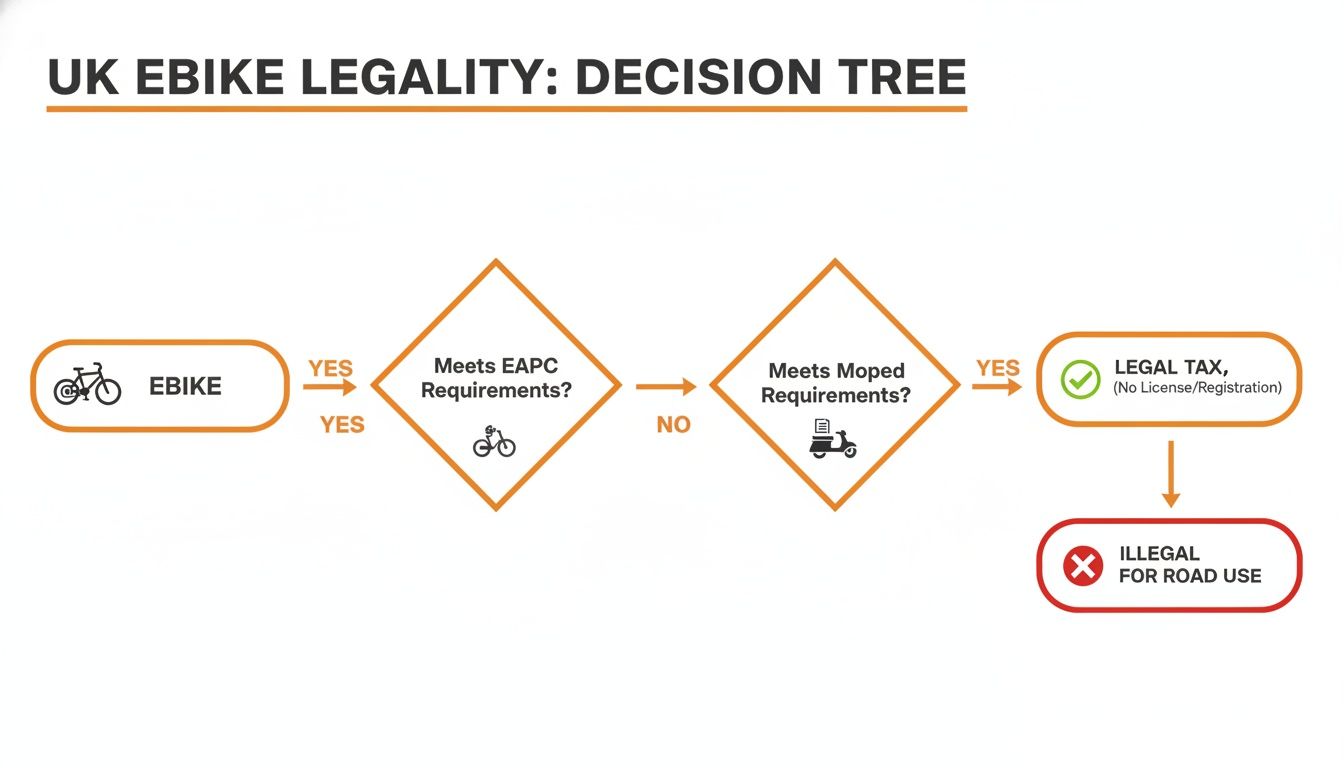
As you can see from the chart, our electric mopeds and motorcycles are proper road-legal motor vehicles. They require registration and a CBT, which sets them apart from the less powerful, pedal-assist bicycles (EAPCs).
A Smart and Secure Investment
Making the jump to electric shouldn't feel like a gamble. It should feel like a solid, intelligent move, and we back that up with robust support for every rider. Our goal is to make ownership completely straightforward and worry-free.
Here’s how we stand behind your decision:
- 0% APR Finance: We offer flexible finance plans with just a £500 minimum deposit. It’s designed to help you manage the upfront cost so you can get on the road without emptying your bank account.
- Comprehensive Warranties: Every bike we sell includes a 2-year parts warranty and a 3-year battery warranty. This is your peace of mind, protecting your investment from any unexpected problems down the line.
- Expert After-Sales Support: Our job isn't done once you ride away. We provide UK-wide support to answer your questions and handle any maintenance, making sure your bike always runs perfectly.
At the end of the day, choosing an electric motorcycle is a practical choice that delivers daily rewards. From the money saved on fuel and tax to the simple pleasure of riding a silent, responsive machine, the benefits are undeniable. It's a modern solution for today's transport needs.
Your Electric Motorbike Questions Answered
Stepping into the world of electric motorbikes can feel like a big move, and it’s natural to have questions. We speak to riders every day, so we’ve heard them all. To cut through the noise, we've put together straightforward answers to the most common queries we encounter. Think of this as a chat with an expert, designed to give you the confidence you need.
Do I Need a Licence for an Electric Moped in the UK?
Yes, you do. This is probably the most important point to get right from the start. Unlike electric pedal-assist bicycles (EAPCs), electric mopeds and motorcycles are legally classed as motor vehicles, so you'll need a licence to ride one on public roads.
For an electric moped that’s equivalent to a 50cc petrol model (usually limited to 28mph), you need to be at least 16 years old. You’ll also have to pass your Compulsory Basic Training (CBT), which allows you to ride with L-plates.
If you’re looking at a more powerful 125cc equivalent, the minimum age rises to 17, but you still start with a CBT. Don’t worry, we provide clear guidance on the specific licence needed for every bike we sell, making sure you know exactly what’s required to get you on the road legally.
How Far Can I Go on a Single Charge?
That’s the million-dollar question, and the honest answer is: it depends. The real-world range you’ll get hinges on the bike’s battery size, how you ride it, the terrain, and even the temperature outside.
Our city-focused mopeds are built for the cut and thrust of urban life. You can realistically expect between 40-60 miles from a full battery, which is more than enough for a few days of commuting or a full shift of deliveries.
For those with a bigger appetite for the open road, high-performance models like the Vmoto Stash or a LiveWire can easily top 100 miles on a charge. We’re always upfront about range, giving you figures based on real-world riding, not just the optimistic numbers you might see in a brochure.
What Maintenance Does an Electric Motorbike Require?
Here’s where going electric really starts to shine. The maintenance is incredibly simple compared to a petrol bike. Forget about oil changes, clogged filters, spark plugs, and clutch adjustments. There's none of that.
Your routine checks are boiled down to the essentials: tyres, brake pads, and brake fluid. This simplicity means far less time in the garage and much lower running costs over the bike's lifetime—a huge win for daily commuters and busy delivery riders.
Is Charging an Electric Motorbike Hard or Expensive?
It's neither. In fact, it’s easier and cheaper than a trip to the petrol station. Many of our most popular mopeds come with removable batteries. You just unlock it, lift it out, and carry it inside to charge from any standard 3-pin wall socket. It’s no different from plugging in your laptop.
A full charge costs next to nothing, typically somewhere between 30p and 60p, depending on your home electricity tariff. That works out to a running cost of about 1-2 pence per mile. It’s a game-changer for your wallet and a lot more convenient than queuing for a pump.
Ready to experience the future of riding? At Flex Electric, we offer straight-talking advice and a curated range of the UK's best electric mopeds and motorcycles. Explore our collection and find your perfect ride today at https://www.flexelectric.co.uk.
Find us
You will find us at 74 Dalry Road, Edinburgh, EH11 2AY
Showroom Opening Times:
Monday: By Appointment
Tuesday to Friday: 11am - 5:00pm
Saturday: 10am - 5pm
Sunday: By Appointment
