
What Is Hire Purchase Finance and How It Works
Flex Electric
The UK's #1 Electric Moped and Electric Motorbike dealer.

Hire purchase finance is a regulated UK agreement where you pay a deposit plus fixed monthly instalments to use an asset, and only take legal ownership after the final payment, including any option-to-purchase fee. For a £3,500 electric moped, that could mean paying £350 upfront and spreading the remaining cost across an agreed term before the finance company transfers ownership to you.
You may be comparing an electric moped with the cost of public transport, fuel, insurance and maintenance, while trying not to empty your savings on day one. Hire purchase, usually shortened to HP, can make that decision more manageable, but the ownership rules matter. You're using the moped during the agreement, yet the finance company remains the legal owner until the contract's conditions are completed.
What Is Hire Purchase Finance in Plain English
The simplest answer to what is hire purchase finance is this: it's a regulated credit agreement that lets you use goods while paying for them in instalments, with legal ownership passing to you only when you've completed the contract. That structure comes from the Consumer Credit Act 1974, which defines hire purchase as goods hired for periodic payments where ownership passes only if the agreement's terms are complied with. The legislation's hire-purchase provisions distinguish HP from a normal rental arrangement.
Take a commuter considering a £3,500 electric moped. They might pay a £350 deposit and then agree to pay £95 a month over three years. Those figures are a simple scenario, not a quotation, and the actual instalment depends on the lender's assessment, APR, fees and contract structure.
The commuter can ride the moped to work while making the payments. However, the finance company still owns it in law until the final contractual payment and any required option-to-purchase fee have been paid. The buyer is normally the registered keeper and responsible for looking after the vehicle, but they can't treat it as theirs to sell or transfer without the lender's permission.
The four parts to understand
- The asset: You choose the electric moped and agree its cash price.
- The upfront contribution: A deposit reduces the amount financed, although some agreements allow no deposit.
- The repayment agreement: You pay the borrowed balance, interest and applicable charges through scheduled instalments.
- The ownership condition: Ownership transfers only after the contract is completed.
Practical rule: Judge an HP offer by its total amount payable, not just the monthly figure.
The rest of the decision comes down to comparing HP with PCP and conditional sale, checking realistic moped repayment examples, understanding business tax treatment, and knowing your rights. It also means looking beyond affordability. Motor HP buyers should understand complaint routes and lender disclosures, particularly in light of the current FCA vehicle-finance redress framework.
How a Hire Purchase Agreement Works
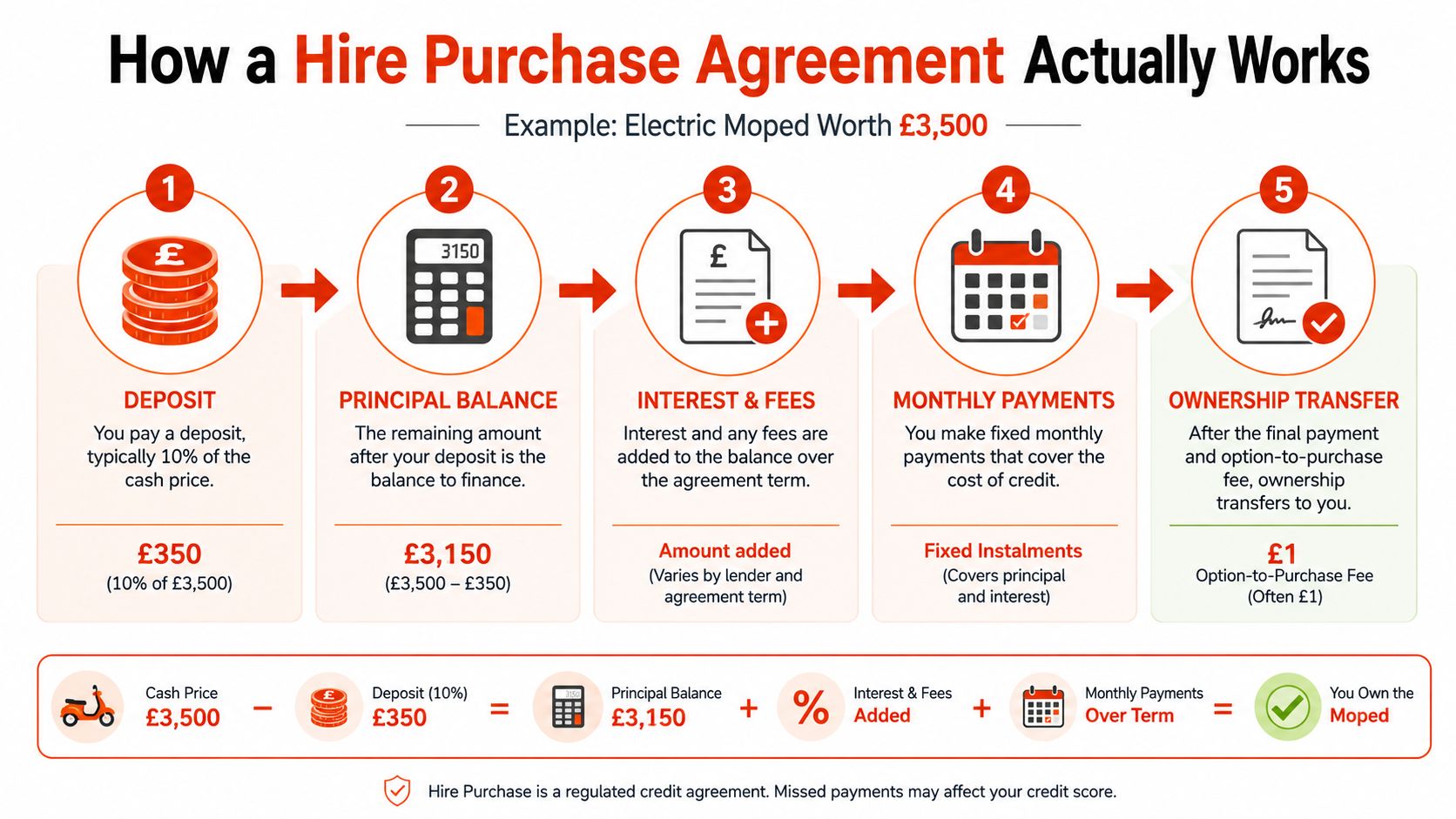
Suppose you are choosing a £3,500 electric moped for commuting or deliveries. The agreement's main parts are the upfront contribution, repayment term, borrowing cost and ownership condition. Changing one can affect the others, so review the full payment plan rather than judging the offer by its deposit alone.
Start with the amount you pay upfront
A 10% deposit of £350 would leave £3,150 to finance before interest and fees. Paying more upfront generally reduces the amount borrowed. Selected models from Flex Electric may be available with £0 upfront, but a no-deposit arrangement does not remove the moped's cost. It usually leaves a larger balance for the agreement to finance.
Choose the term and understand APR
The term is the period used to repay the agreement. Moped finance may be offered over 24, 36 or 48 months, depending on the lender and the applicant. A longer term can lower the required monthly payment, while giving interest more time to accumulate. The total repayment may therefore be higher.
The APR, or annual percentage rate, shows the cost of borrowing, including relevant charges. Each fixed instalment generally covers part of the capital balance and the finance cost. The lender calculates the actual payment from the contract terms and your application, so an example rate does not guarantee approval or a particular offer.
Finish the ownership process
The finance company remains the legal owner while you make the scheduled payments. An option-to-purchase fee may be due at the end, with the amount set by the agreement. After the final instalment and any required fee are paid, the lender completes the transfer and the moped becomes yours.
The Vmoto VS2 Citi is one electric moped a buyer might assess for urban or commercial use. It is described as a 125cc-equivalent electric scooter with a 50mph top speed and 66-mile range, plus low running costs and zero emissions.
Before signing, check how the dealer, lender and compliance process handle customer information, affordability and documentation. Businesses can also review why use this compliance system to understand the operational controls around regulated customer journeys.
Hire Purchase vs PCP vs Conditional Sale
The three products can look similar at the checkout, especially when the comparison starts with the monthly payment. Their end-of-agreement rules are different, which is why the cheapest-looking instalment may not match your actual objective.
FeatureHire PurchasePCPConditional SalePayment shapeFixed instalments repay the financed price and interestLower instalments because part of the price is deferredFixed instalments with ownership linked to completionOwnershipTransfers after all required payments and the option feeTransfers only if the optional final balloon is paidUsually transfers automatically when the contractual payments are completedEnd choiceKeep the moped after completing the agreementPay the balloon, return the moped, or potentially part-exchangeKeep the moped after completing the agreementMileage limitsNormally no PCP-style mileage allowanceMileage and condition requirements can apply if returnedUsually no PCP-style mileage allowanceBest fitBuyers planning to own the mopedBuyers who may change vehicles regularlyBuyers wanting a fixed-payment ownership structure without a separate option fee
Use the same hypothetical £3,500 electric moped over 36 months as a reference point. HP usually produces a higher monthly payment than PCP because it works towards paying off the full financed price rather than leaving a large optional balloon. Conditional sale can feel close to HP, but its legal structure and final ownership condition differ, so the agreement wording matters.
Pick the product around your riding pattern
- Daily commuter: HP is the clearest fit if you want predictable payments and certainty that the moped will become yours.
- High-mileage delivery rider: HP is preferable to PCP when you expect heavy use, because PCP return conditions can create excess-mileage or wear charges.
- Enthusiast who upgrades regularly: PCP may provide more flexibility if you're comfortable deciding at the end whether to return the moped, pay the balloon or change vehicles.
Don't compare products by monthly payment alone. Compare the total amount payable, the final payment, usage conditions and what happens if your plans change.
Worked Example Using Electric Moped Prices
A repayment table is useful for seeing the direction of travel, but it isn't a lender quote. The examples below are illustrative only, and the actual result depends on credit status, lender criteria, fees, deposit, term and APR.
Moped PriceDeposit24 Months36 Months48 Months£3,500 commuter£0Higher monthly paymentLower monthly paymentLowest monthly payment in this row£3,500 commuter10%Lower than £0 depositLower than £0 depositLower than £0 deposit£5,800 long-range10%Higher monthly paymentMid-range monthly paymentLower monthly payment, higher total interest possible£5,800 long-range20%Lower than 10% depositLower than 10% depositLower than 10% deposit£8,200 premium10%Highest monthly payment in this tableLower than 24 monthsLower monthly payment, longer commitment£8,200 premium20%Lower than 10% depositLower than 10% depositLower than 10% deposit
The first dial is the deposit. Moving from £0 to 10% or 20% reduces the amount borrowed, so the monthly figure generally falls. The trade-off is that you need more cash before collection.
The second dial is the term. Extending the agreement from 24 to 36 or 48 months can make the payment easier to fit into a monthly budget, but you're committed for longer and may pay more interest overall.
The third dial is the APR. A higher APR increases the finance cost. For a separate illustration, a £4,400 moped with a 10% deposit over 36 months at 12.9% APR produces roughly £127 a month, followed by a small option-to-purchase fee at the end. Treat that figure as an example, not an offer. Run your own numbers or request a quote before making a decision.
VAT and Tax Implications for Riders and Businesses
Tax treatment depends on how the moped is used, who buys it and how the finance agreement is documented. A delivery rider using a vehicle for work has a different question from an individual commuting privately.
For VAT, don't assume HP works exactly like a cash purchase. The finance structure can involve VAT on the asset transaction and finance charges, while the lender's interest margin is treated differently from the moped's underlying price. A VAT-registered business may be able to reclaim eligible VAT connected with business use, but private use, partial exemption and the invoice arrangement can change the result. A broader 2026 e-commerce VAT guide can provide useful background on VAT compliance, but it doesn't replace advice on your specific vehicle agreement.
Capital allowances need careful checking
A limited company may consider capital allowances for a qualifying zero-emission vehicle. The availability of a 100% first-year allowance depends on the relevant conditions and the vehicle's classification. If those conditions aren't met, a writing-down allowance may apply instead.
Sole traders should separate business and private use. Someone delivering food on an electric moped may need clear records showing work journeys, private journeys and the costs associated with each. A purely private-use bike won't normally support a VAT recovery claim just because the rider also has self-employed income.
HMRC's ownership test also matters. HMRC's capital allowances guidance states that legal ownership doesn't pass during HP payments and that the user is treated as owner for capital-allowance purposes only once entitled to the benefit of the contract. That can affect how a fleet buyer records the asset and liability.
Ask an accountant to confirm the VAT invoice, capital allowance treatment, business-use proportion and balance-sheet presentation before relying on a tax outcome.
Eligibility and the Flex Electric Application Process
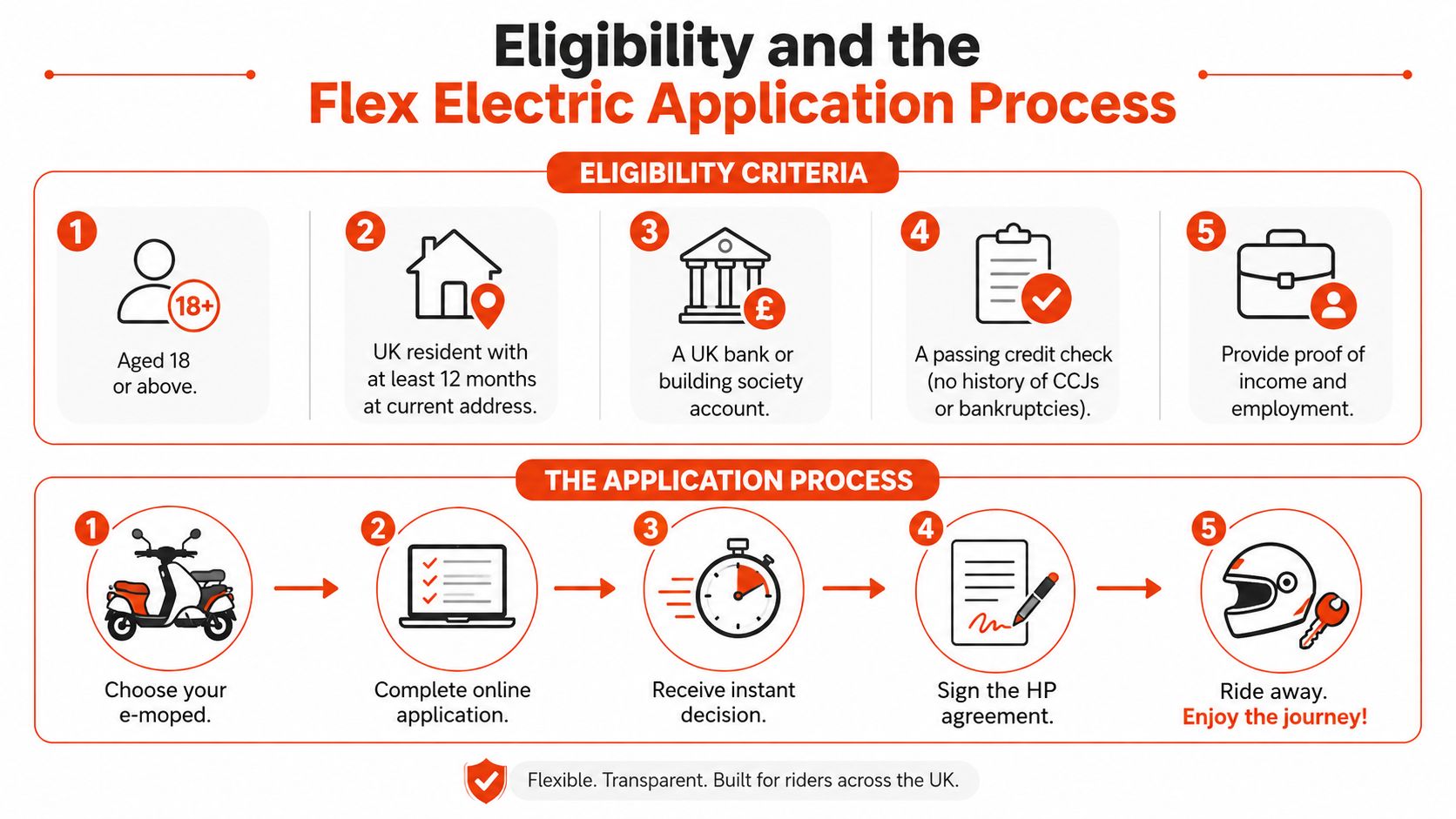
Lenders assess both identity and affordability. Typical requirements for a UK HP application include being 18 or over, living in the UK with at least 12 months at the current address, holding a UK bank or building society account, and passing the lender's affordability and credit assessment. Electoral-roll verification may form part of that assessment.
Prepare documents before you start:
- Photo identification: A passport or other accepted ID may be requested.
- Address evidence: A recent document can confirm where you live.
- Income evidence: Bank statements or payslips may help the lender assess affordability.
- Self-employed records: Applicants may be asked for two years of accounts or SA302s.
The application sequence
The online journey normally begins when you choose an electric moped and select the HP option at checkout. You complete an eligibility form, which can use a soft search at the initial stage, then receive an indication of the available finance route.
If you proceed with a formal application, the lender carries out the required hard credit search. After a decision, you review and electronically sign the agreement, choose whether to pay a deposit or use a no-minimum-deposit structure, and arrange collection or delivery. Approval isn't guaranteed, and the final terms depend on the lender's checks.
Flex Electric offers HP and PCP routes without requiring a minimum deposit, so a buyer who can't pay upfront can ask what terms are available. That doesn't make the finance free. It can increase the amount financed and may affect the monthly payment or total cost.
Read the agreement before signing, especially the APR, total charge for credit, deposit, payment dates, final fee and consequences of missed payments.
Common Misconceptions and Your Rights as a Buyer
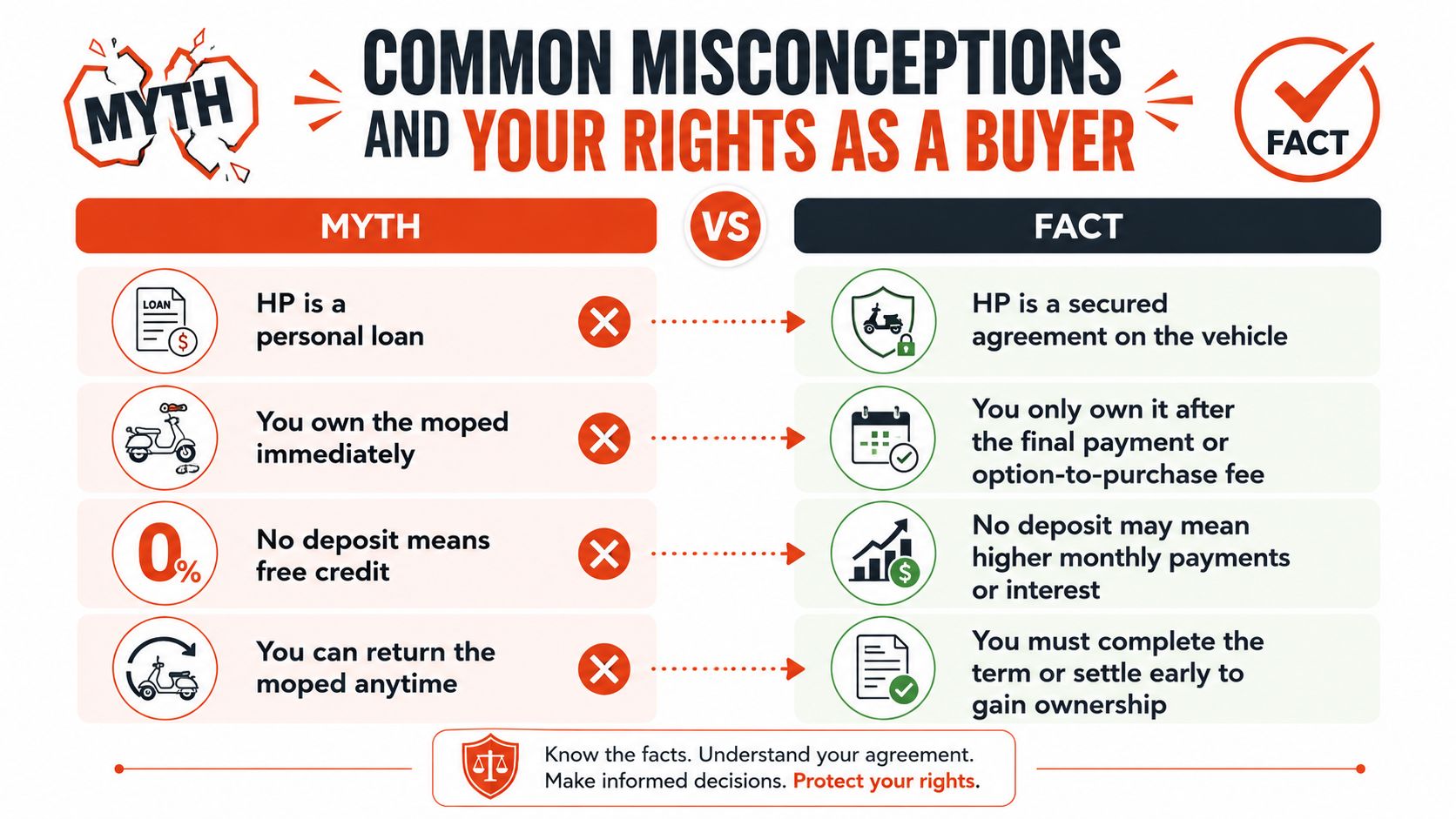
Myth: HP is just a personal loan.
A personal loan gives you borrowed money to spend, while HP is tied to a specified asset. In HP, the lender retains legal title until the contract's ownership condition is met.
Myth: The moped is yours as soon as you collect it.
You can use it, but ownership is deferred. The final instalment and any option-to-purchase fee form part of the route to legal ownership.
Myth: No deposit means free finance.
It doesn't. The price still has to be financed, and the agreement may produce a higher monthly payment or greater total finance cost than a similar deal with an upfront contribution.
Myth: You can return it whenever you want.
Ending an agreement early has rules. Missed payments can lead to enforcement action and possible repossession, so contact the finance company quickly if affordability changes.
Rights and complaint checks
The Consumer Credit Act gives consumers a 14-day right to withdraw from a regulated HP agreement after credit is provided, subject to paying the withdrawal sum under the statutory rules. Section 66A of the Act sets out that process.
Voluntary termination is another protection often associated with regulated vehicle finance, but its conditions depend on the agreement and the amount already paid. Early settlement can reduce future interest, although you need a settlement figure from the lender to know the exact amount.
Motor-finance complaints also deserve attention. The Financial Ombudsman Service recorded 37,673 complaints about motor hire purchase in 2025/26 in the verified data supplied for this article, and the FCA says vehicle finance used between 6 April 2007 and 1 November 2024 may fall within its complaint and redress framework. The FCA's consumer information explains which vehicle-finance arrangements may be in scope.
Keep the agreement, payment history, dealer messages, advertisements and any information about commission or lender disclosure. Check that the broker or lender is authorised, and use the firm's complaints process before approaching the Financial Ombudsman Service.
Is Hire Purchase Right for You and What to Do Next
HP suits a commuter who wants stable monthly budgeting and intends to keep the electric moped after completing the agreement. It can also suit a delivery rider who expects high mileage and wants to avoid PCP return conditions, or a buyer who needs to preserve savings by choosing a no-minimum-deposit route.
Before applying, gather proof of income, address history, bank statements and a realistic monthly budget. Leave room for insurance, charging, protective equipment, servicing, tyres and unexpected costs. A payment that fits only before essentials isn't affordable finance.
Use the application to compare the deposit, term, APR and total amount payable. Ask for a personalised quote so you can see how the agreement changes before signing, rather than treating a headline monthly figure as the final answer.
Flex Electric offers electric mopeds, scooters and motorbikes with HP and PCP options that don't require a minimum deposit, subject to lender approval and the agreed terms. Visit Flex Electric to browse suitable models and request a personalised finance quote for your commuting or delivery needs.
Find us
You will find us at 74 Dalry Road, Edinburgh, EH11 2AY
Showroom Opening Times:
Monday: By Appointment
Tuesday to Friday: 11am - 5:00pm
Saturday: 10am - 5pm
Sunday: By Appointment
