
Electric Motorbike Finance in 2026: Your UK Guide
Flex Electric
The UK's #1 Electric Moped and Electric Motorbike dealer.

You're probably in one of two spots right now.
You commute into town and want to stop burning money on daily travel, but the upfront cost of an electric bike still feels awkward. Or you ride for Deliveroo, Uber Eats or Stuart, and you know a quieter, simpler machine makes sense, but you can't afford to get the buying decision wrong.
That pressure got sharper after the grant support disappeared. A lot of riders who could just about justify a new electric moped or motorbike with government help now have to make the numbers work through finance instead. That changes the whole decision. You're no longer just picking a bike. You're picking a payment structure, a risk level, and an ownership outcome.
The mistake I see most often is simple. Riders focus on the monthly figure and ignore the contract behind it. That's how people end up stuck with the wrong term, the wrong deposit, or a bike that doesn't fit how they ride.
Introduction to Electric Motorbike Finance
A commuter in Manchester wants a clean, predictable way to get to work. A delivery rider in Birmingham needs a bike on the road fast, with as little cash tied up at the start as possible. Both now face the same problem. The Plug-in Motorcycle Grant ended on April 5, 2026, and it had previously offered a 35% discount up to £500 according to Bennetts' update on the UK motorcycling grant changes.
That matters because the grant used to soften the first financial hit. Without it, the entry cost lands directly on the rider. Finance is no longer a convenience. For many buyers, it's the only practical route.
Electric motorbike finance works when it solves a real cash-flow problem. If you need to preserve savings, spread the purchase cost, or keep options open for a future upgrade, the right agreement helps. The wrong one becomes expensive friction.
I'd treat finance the same way you'd treat the bike itself. Look at durability, flexibility and total cost, not just the glossy headline. If you want a broader sense of how structured borrowing can support vehicle purchases, these motorbike finance solutions offer useful context on how riders think through affordability and repayments.
Practical rule: If the grant's gone, your deposit strategy and end-of-term plan matter more than the brand badge on the tank.
Buyers in the post-grant market need sharper judgement. That's especially true if you're comparing new against pre-owned, or if you're earning from the bike rather than commuting on it.
Understanding Key Finance Options
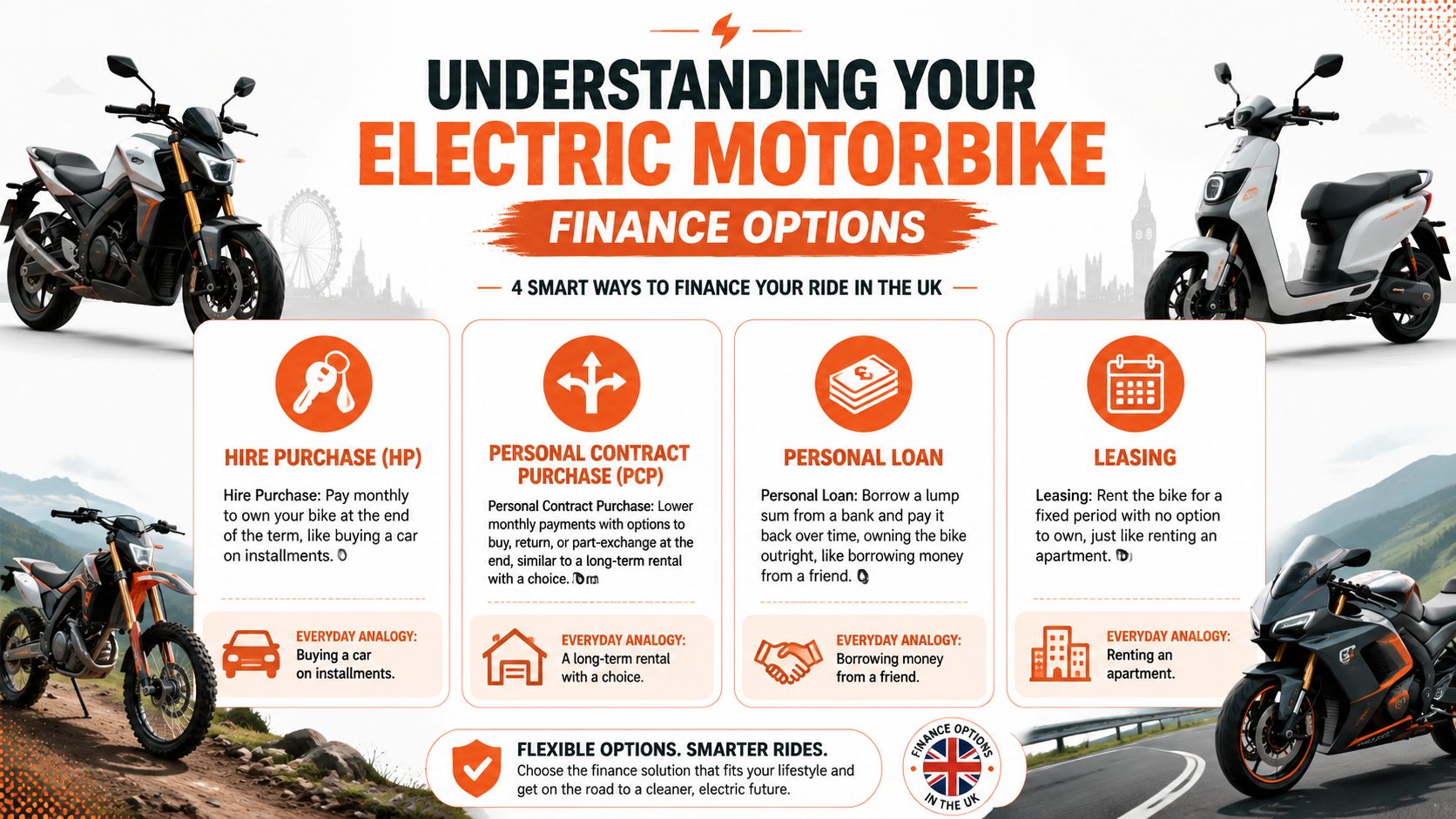
The core choice is straightforward. You've got Hire Purchase, Personal Contract Purchase, personal loans, and leasing. They all put you on a bike. They don't all get you to the same financial outcome.
The market is moving quickly enough that lenders have paid attention. The UK electric motorcycle market reached USD 1.41 billion in 2024 and is projected to reach USD 6.59 billion by 2033 according to IMARC's UK electric motorcycles market outlook. More lender interest usually means more product choice, but that doesn't mean every product suits every rider.
Hire Purchase
Think of HP like buying a home with instalments rather than paying the full amount in one go. You usually put down a deposit, pay fixed monthly amounts, and own the bike once the agreement ends and the final payment is made.
This suits riders who want a clear path to ownership. If you plan to keep the bike for years, HP is often easier to justify than a product built around frequent upgrades.
Personal Contract Purchase
PCP is closer to renting with options. You pay for part of the bike's value across the term, not all of it, so monthly payments are often lower than HP. At the end, you usually choose whether to return the bike, part-exchange it, or make the final payment to own it.
That flexibility is useful if you expect battery tech, range or model choice to improve and want room to switch later.
Lower monthly payments can be a smart move. They're only smart if you already know how you'll handle the end of the contract.
Personal loans
A personal loan is separate from dealer-linked bike finance. The lender gives you a lump sum, you buy the bike outright, and then you repay the loan over time. Ownership starts immediately because you've purchased the bike from day one.
This can work well if you want full control and don't want mileage rules or end-of-term conditions. It can also simplify resale because the bike is yours, not tied to a finance product.
Leasing
Leasing is the pure use-it option. You pay to use the bike for an agreed period and then hand it back. There's no ownership route built in.
For a business, that can be tidy. For a private rider who wants long-term value, it's usually harder to defend.
Insurance costs matter alongside finance, especially for younger riders. If that's your situation, reading up on understanding young adult insurance options can help you budget the whole package rather than just the repayment.
Comparing Finance Types Side by Side
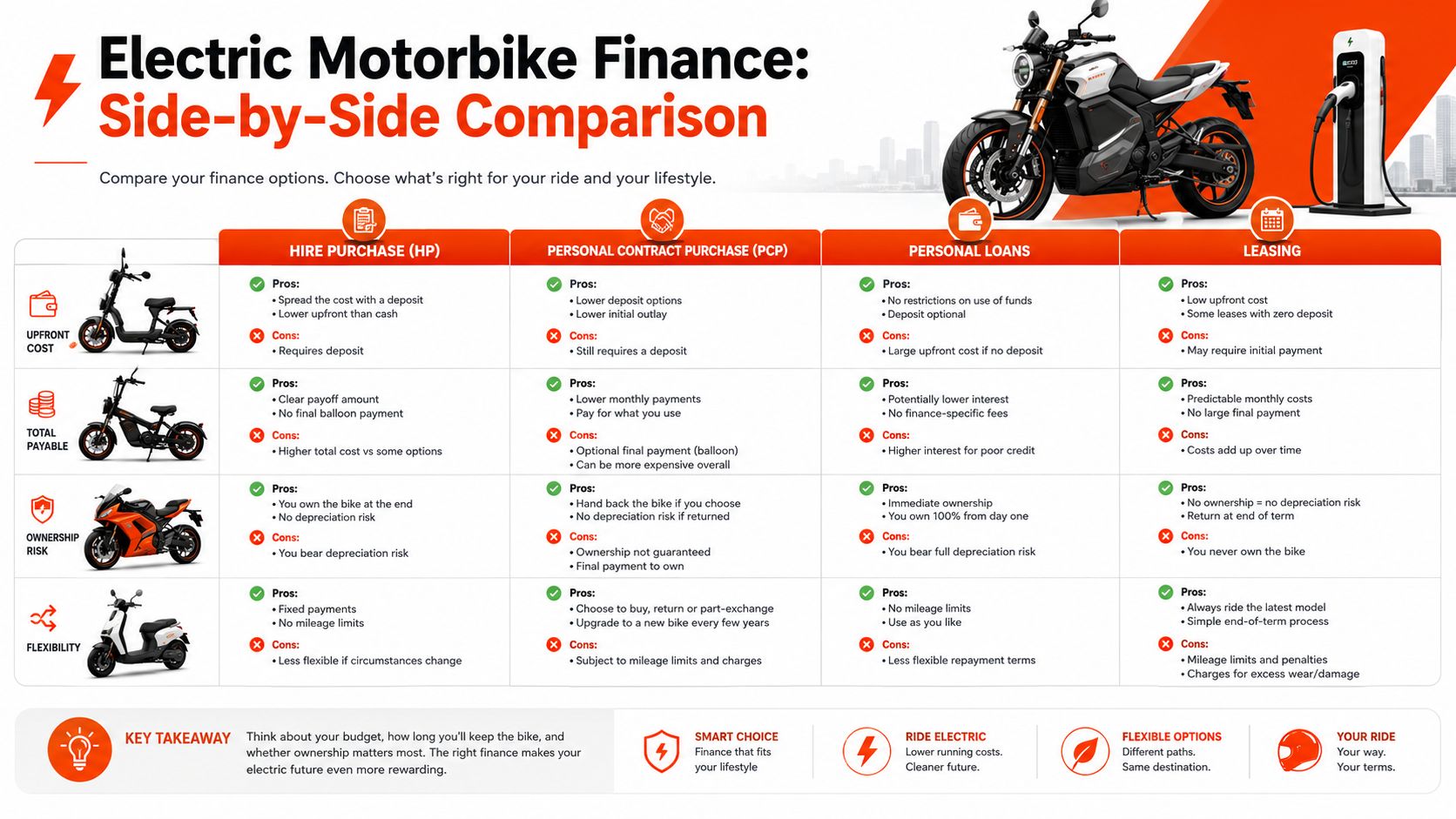
Here's the blunt version. If you care about ownership, HP and personal loans sit at the front of the queue. If you care about lower monthly pressure, PCP is often more attractive. If you want operational simplicity for temporary use, leasing earns a look.
Specialist dealers have also widened access. HP or PCP in the UK typically involves a deposit, a fixed term and a credit assessment, and specialist dealers such as Flex Electric don't mandate a minimum deposit as noted in this electric motorbike finance overview from Flex Electric. That matters if cash is tight at the start.
Quick comparison table
Finance typeProsConsHire PurchaseFixed payments, no mileage limits, ownership at the endMonthly cost is often higher than PCP, you carry depreciation riskPCPLower monthly payments, end-of-term flexibility, easier route into newer modelsOwnership isn't automatic, mileage conditions may apply, final payment can be significantPersonal loanYou own the bike immediately, no usage restrictions, easier to sell laterApproval depends on your wider credit profile, repayments may be less tailored to the bikeLeasingPredictable use-based costs, simple for short-cycle use, no resale headacheNo ownership, possible return conditions, not ideal if you want long-term value
How I'd choose
If you'll ride the bike hard, keep it for years, and don't want contract restrictions, go with HP or a personal loan.
If you like the option to hand it back and move into a newer machine later, PCP makes more sense.
If you're a business testing electric bikes before committing long term, leasing can reduce commitment while you learn what your riders need.
The cheapest monthly payment and the cheapest overall decision are rarely the same thing.
Real-World Repayment Examples
On this specific topic, many articles get sloppy, so let's keep it honest. I'm not going to invent repayment figures, because your actual quote depends on the bike price, deposit, term, credit profile, and the lender's rate. Without those exact inputs, any hard monthly number would be fiction.
What I can do is show you how to evaluate four common structures using a clean comparison framework. That's enough to stop you making a bad decision based on a headline payment.
Use the same bike as the reference point
Take a mid-range 125cc-equivalent electric bike. For example, Yadea Keeness is a 125cc equivalent electric motorbike with a top speed of 65mph and an 11kw peak power motor. That gives you a realistic reference category for commuting, suburban riding and some delivery work.
Now compare finance structures against that same type of bike, not against different machines with different capabilities. Otherwise the exercise is pointless.
What changes the monthly payment
Focus on five inputs:
- Bike price. This is the base amount being financed.
- Deposit. A higher deposit usually lowers the monthly cost.
- Term length. A longer term usually reduces the monthly figure but can increase the total paid.
- Interest structure. This decides how expensive the borrowing is over time.
- End-of-term amount. PCP may include a final payment if you want ownership.
Sample repayment calculations
Finance TypeDepositMonthly PaymentTotal CostOwnership OutcomeHire PurchaseUsually upfront unless a no-minimum-deposit arrangement is availableHigher than PCP in many cases because you're paying toward full ownership during the termOften easier to predict because the route to ownership is directYou own the bike after the agreement ends and final payment is madePCPUsually upfront unless the lender allows otherwiseOften lower than HP because you're not repaying the full value during the termCan rise sharply if you decide to make the final payment and keep the bikeYou choose to buy, return, or part-exchange at the endPersonal loanDepends on how you choose to structure the purchase, not on the bike finance product itselfBased on the loan amount and your credit offer from the lenderTotal cost depends on the loan terms rather than dealer finance rulesYou own the bike from the startLeasingVaries by provider and contractStructured around use rather than ownershipEasier to budget for access, but no ownership value at the endYou return the bike
How to read these examples properly
HP is the cleanest option if ownership is your target. You know what you're doing. You're paying down the machine so it becomes yours.
PCP works if you value optionality more than ownership. That's useful when technology is moving and you don't want to commit to keeping the same bike long term. It's less useful if you already know you'll want to keep the bike at the end, because the lower monthly figure can hide the true ownership cost.
Personal loans can be excellent for riders with strong credit who want freedom over mileage, servicing, accessories, and resale. The catch is that the lender isn't evaluating just the bike. They're evaluating your broader borrowing profile.
Leasing is often misunderstood by private buyers. It gives you access, not equity. That can be sensible for businesses or riders who want short-cycle convenience. It's poor value if your real intention is to own something durable and keep it.
The hidden cost checklist
Before you sign anything, ask these questions in writing:
- What happens at the end of the agreement?
- Is there any mileage condition?
- Who carries depreciation risk?
- Can I settle early, and what does that cost?
- What fees apply if I miss a payment or return the bike with wear?
If a salesperson can't answer those cleanly, walk away. Confusion in the quote stage usually turns into pain later.
Eligibility Requirements and Credit Tips
Lenders don't approve applications because the bike is sensible. They approve them because the borrower looks reliable.
For UK electric motorbike finance, a standard 10% deposit is often required, terms commonly run from 12 to 48 months, and some offers allow no interest if the balance is repaid within the first 12 months according to Cornwall Electric Bikes' finance information. That gives you a useful benchmark, even if individual lenders vary.
What lenders usually want to see
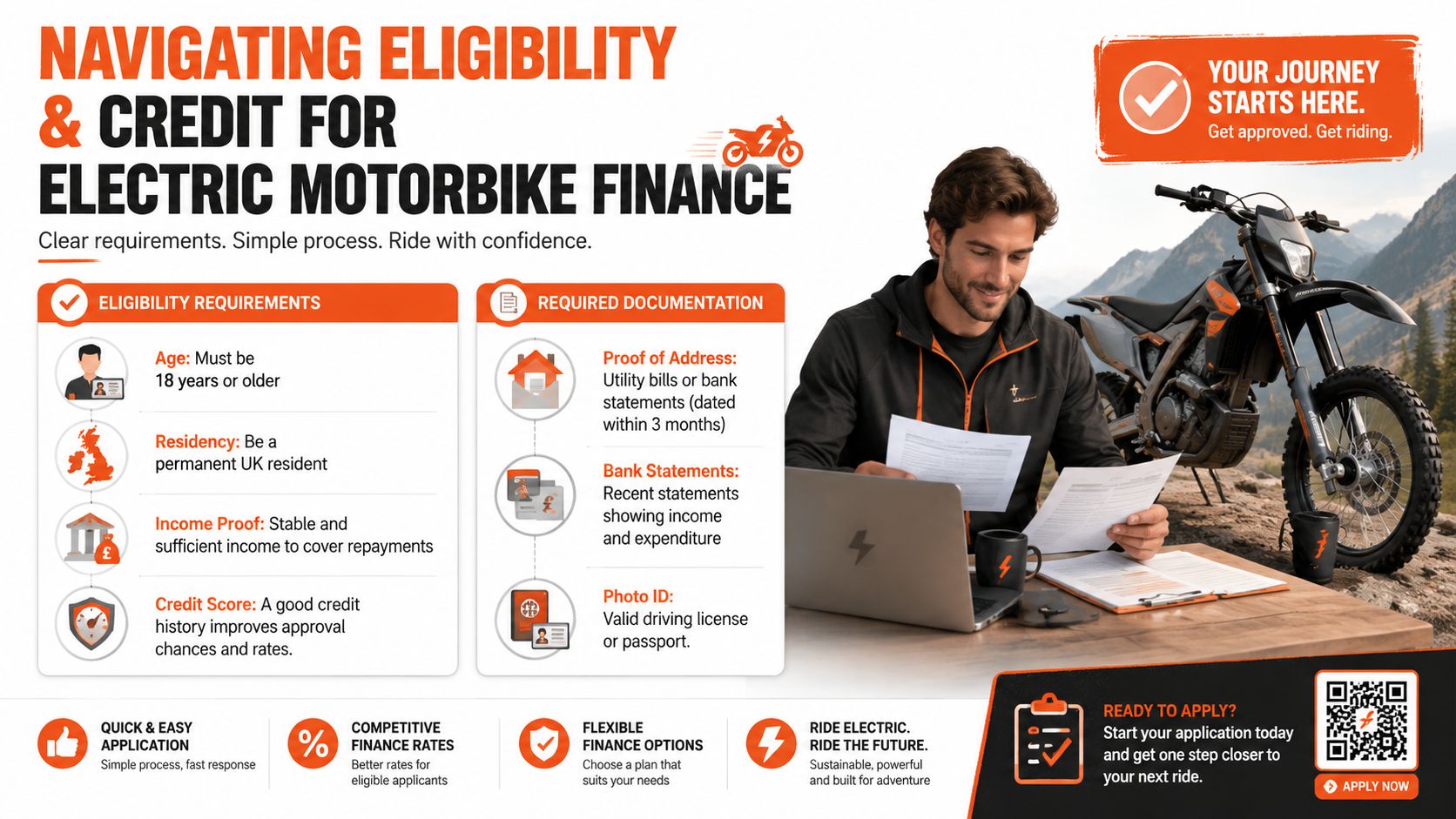
Most applications come down to a few basics:
- Age and residency. You'll usually need to be an adult and a permanent UK resident.
- Income evidence. Lenders want to see that repayments fit your real monthly finances.
- Credit behaviour. Missed payments elsewhere make approval harder.
- Stable details. Consistent address and banking information help.
Documents to gather first
Get these ready before you apply:
- Proof of address such as recent utility bills or bank statements
- Photo ID such as a driving licence or passport
- Bank statements showing income and regular outgoings
- Employment or income details if the lender asks for them
That sounds basic because it is. Most rejected or delayed applications don't fail on complexity. They fail on messy paperwork, inconsistent details, or avoidable credit issues.
Clean applications get faster decisions. Missing documents and mismatched information slow everything down.
Credit tips that actually help
- Reduce other short-term debt before applying if you can.
- Avoid multiple finance applications at once. That can make you look desperate.
- Check your bank account conduct. Lenders notice bounced payments and overdraft strain.
- Set up a realistic deposit. Even where no minimum deposit is available, some deposit can improve the shape of the deal.
- Be honest about income. Inflating numbers is a fast route to rejection.
If your credit file is mixed, don't panic. You may still have options. But you need to apply strategically, not emotionally.
Tailored Advice for Commuters Delivery Riders and Fleets
Different riders need different finance structures. That shouldn't be controversial, but a lot of finance content still treats every buyer the same. That's lazy advice.
Urban commuters
If you ride to work, park at home, and want your transport sorted for the long run, I'd lean toward HP first. You get a direct route to ownership, fixed repayments, and fewer complications around how you use the bike.
A commuter usually benefits from stability more than flexibility. You're not trying to refresh your machine every few years. You're trying to remove transport friction from your week.
Delivery riders
Delivery work changes the calculation. Income depends on uptime, and your needs can shift fast if your hours rise, your area changes, or a better bike becomes available. That makes PCP worth considering because it can lower monthly pressure and preserve the option to switch later.
For riders building a delivery setup from scratch, this modern delivery operation blueprint is useful because it frames the vehicle as part of a wider earning system, not a standalone purchase.
A practical example is the Vmoto TC Wanderer Pro. It launched in summer 2024 and has up to 60 miles of range, a 5.2 kW Soco motor, and a top speed of 58 mph, with a wide-handlebar layout and street-fighter style seating position that suits a broad range of riders. For city and suburban use, that sort of spec profile matters because comfort and practicality affect how long you can stay productive on the road.
Small businesses and fleets
For restaurants, takeaways, florists and venues, the question isn't just affordability. It's operational control. If you're putting several riders on bikes, leasing can make sense for trial periods or structured fleet use because it simplifies replacement cycles and avoids long ownership commitment on every unit.
But if you already know electric bikes fit your delivery pattern, HP can be stronger over time because it turns each bike into an owned asset rather than a permanent monthly outgoing.
My blunt recommendations
- Choose HP if you want ownership and expect to keep the bike.
- Choose PCP if flexibility matters more than ownership.
- Choose leasing if you're a business testing fleet viability.
- Choose a personal loan if you want full control and can secure sensible borrowing elsewhere.
The wrong finance product creates stress every month. The right one disappears into the background and lets you ride.
Flex Electric HP and PCP Solutions
If you want one place to compare specialist dealer-backed options, Flex Electric offers HP and PCP with no minimum deposit required, alongside a straightforward application process and model support. That matters most for riders who need access without tying up cash on day one.
The wider market structure supports this kind of arrangement. Retailers acting as brokers can offer finance for purchases from £250 up to £15,000 according to BikeRadar's bike finance overview. That range is broad enough to cover entry-level use cases and more serious electric motorbike purchases.
What to look for in a specialist dealer option
A specialist setup is useful when you need more than a lender portal. You may need help matching the finance type to the bike, understanding whether a commuter model or a 125cc-equivalent machine suits your use, and sorting the paperwork without delays.
The practical details matter too:
- Model selection support if you're deciding between commuting and higher-performance options
- Straightforward paperwork handling so approval doesn't drag
- Nationwide delivery if you're not near the showroom
- Warranty cover that protects the purchase after the deal is signed
Flex Electric states that its bikes come with a 2-year parts warranty and 3-year battery warranty, plus after-sales support. If you're financing, that kind of clarity matters because repayment obligations continue whether your support arrangement is strong or weak.
If you're comparing dealer finance, don't ask who shouts loudest. Ask who makes the contract easiest to understand.
Frequently Asked Questions
Can I finance a pre-owned electric motorbike?
Yes, but the market still feels underdeveloped in this regard. There's plenty of attention on new-bike HP and PCP. There's far less clear guidance for pre-owned electric motorbikes, even though many first-time riders and budget-conscious buyers would prefer that route.
One overlooked option is that the Energy Saving Trust offers zero-interest loans capped at £5,000 for second-hand pure electric motorcycles and mopeds, as noted in Kandoo's summary of e-bike and electric two-wheeler finance options. If you're buying used, start there before assuming dealer finance is your only route.
How soon can I ride after approval?
That depends on stock, paperwork completion and delivery timing. Approval doesn't automatically mean same-day riding. Ask when the agreement becomes active, when the bike can be released, and whether any ID or signature checks still need clearing.
What happens if I miss a payment?
Speak to the lender immediately. Don't wait. Missed payments can trigger fees, damage your credit profile, and in some agreements put the bike at risk. The earlier you deal with it, the more options you usually have.
How does upgrading under PCP work?
You usually reach the end of the term and then decide whether to return the bike, part-exchange it, or make the final payment and keep it. If you already know you'll want to upgrade, make sure the end-of-term process is clear before signing.
Is no-deposit finance always the right move?
No. It improves access, but it can also raise monthly pressure or total borrowing cost. If paying some deposit leaves you with a healthier agreement, do that instead of chasing zero upfront cost just because it sounds easier.
If you want a practical next step, visit Flex Electric to compare electric mopeds and motorbikes, check current HP and PCP options, and speak to someone who can match the finance structure to how you ride.
Find us
You will find us at 74 Dalry Road, Edinburgh, EH11 2AY
Showroom Opening Times:
Monday: By Appointment
Tuesday to Friday: 11am - 5:00pm
Saturday: 10am - 5pm
Sunday: By Appointment
